

The O’Jays were an American soul group that made 21 albums between 1965 and 1989, including the Seventies classics Back Stabbers, Ship Ahoy, and Family Reunion.
Formed in 1958 in Canton, Ohio, began their career recording singles and one album for Imperial between 1963 and 1966. Throughout the late 1960s, they released albums on Minit, Bell, Neptune, and Little Star, steadily refining their harmonies and developing a sound that blended gospel-infused vocals with emerging soul and funk rhythms.
Their career reached its peak after signing with Philadelphia International Records in 1972, where they became central figures in the Philadelphia soul movement. Over 15 years, they released 14 albums for the label, producing hits such as “Back Stabbers,” “Love Train,” “Use Ta Be My Girl,” and “Forever Mine,” and cementing their reputation for tight vocal arrangements, lush orchestration, and emotionally charged ballads.
Members: Eddie Levert (vocals), Walter Williams (vocals), Bill Isles (vocals, 1958-65), Bobby Massey (vocals, 1958-71), William Powell (vocals, 1958-76), Sam Strain (vocals, 1977-93)
Background
The O’Jays formed in 1958 by classmates at Canton McKinley High School. They initially called themselves The Mascots and issued their first single, “Miracles” (b/w “Can’t Take It”), on Apollo Records in 1961.
In 1963, they renamed themselves The O’Jays after Cleveland disc jockey Eddie O’Jay. That same year, they scored their first national hit, “Lonely Drifter,” on Imperial Records. Over the next three years, they issued 11 further singles and the album Comin’ Through on Imperial.
In 1967, The O’Jays released their second album, Soul Sounds, on Minit. Five singles apiece followed on Bell and Neptune over the next three years, including their 1968 R&B hit “I’ll Be Sweeter Tomorrow” and 1969’s seminal “One Night Affair” from their third album, Back on Top.
Super Bad
 The O’Jays released their fourth studio album, Super Bad, in 1971 on Little Star Records.
The album blends early-1970s soul with emerging funk elements, featuring the group’s signature vocal interplay. Eddie Levert and Walter Williams lead the harmonies, supported by Bobby Massey’s production and H. B. Barnum’s supervision, giving the set a polished yet rhythmically assertive texture.
Bobby Massey served as primary songwriter on multiple tracks, contributing to compositions alongside group members Levert and Williams, with Barnum co-writing and producing select songs. Covers include “Never Can Say Goodbye,” originally popularized by The Jackson 5.
The album mixes reflective ballads, mid-tempo soul, and funk-infused numbers. “Now He’s Home” and “Shattered Man” underscore personal and relational themes, while tracks such as “Gotta Get My Broom Out” and “La-De-Da” emphasize rhythmic push and vocal interplay.
A1. “Now He’s Home” (3:42) — written by B. Massey, Lester McKenzie, R. Dukes
A2. “Little Brother” (2:55) — written by R. Shonn, W. Williams
A3. “Crossroads of Life” (2:40) — written by E. Levert, F. Butler, W. Powell
A4. “La-De-Da” (2:38) — written by The O’Jays
A5. “Peace” (5:22) — written by Bradford Craig, H. B. Barnum
B1. “Shattered Man” (3:18) — written by Fred Butler, John Owens
B2. “Your Turn This Time” (3:44) — written by The O’Jays
B3. “Just to Be With You” (2:39) — written by B. Massey, B. Dukes
B4. “Gotta Get My Broom Out” (2:21) — written by The O’Jays
B5. “Never Can Say Goodbye” (3:50) — written by B. Massey, B. Dukes — originated as a 1971 single by The Jackson 5 and covered here by the O’Jays
Sessions occurred at Music Recorders, Inc., and Motion Picture Sound Co., with Bobby Massey producing and H. B. Barnum supervising.
Album art and photography were handled by Macy K. Vogel (layout) and Dick O’Shea, with liner notes by Tom Cross.
Little Star released singles including “Shattered Man” (b/w “La-De-Da (Means I’m Out to Get You)”) in March 1971.
In 1971, co-founder Bobby Massey departed, trimming the group down to the trio of Eddie Levert, Walter Williams, and William Powell. Neptune founders Kenneth Gamble and Leon Huff signed the act to their new label, Philadelphia International Records (PIR).
Back Stabbers
 The O’Jays released their fifth studio album, Back Stabbers, in August 1972 on Philadelphia International.
The album combines socially themed material with romantic ballads and exuberant dance numbers, marking the group’s full emergence as a trio of Eddie Levert, Walter Williams, and William Powell.
Kenneth Gamble and Leon Huff wrote six of the album’s ten songs and produced the sessions with Bunny Sigler, who co-wrote three numbers with Phil Hurtt. Leon Huff’s regular rhythm partners — guitarist Norman Harris, bassist Ronnie Baker, and drummer Earl Young — anchor the arrangements, which feature orchestral charts by Thom Bell and horn and string parts conducted by Don Renaldo.
The opening track, “When the World’s at Peace,” sets a reflective tone with full brass and choral interplay. The title track, “Back Stabbers,” warns of false friends behind a sleek, suspenseful rhythm pattern and is followed by the introspective “Who Am I” and the buoyant “(They Call Me) Mr. Lucky.” Side two centers on “992 Arguments,” a tension-filled piece that segues into the optimistic closing anthem “Love Train,” a worldwide call for unity that became the group’s signature hit.
Sessions occurred at Sigma Sound Studios in Philadelphia with producers Kenneth Gamble, Leon Huff, and Bunny Sigler, engineer Joe Tarsia, and arrangers Bobby Martin and Thom Bell.
Philadelphia International promoted Back Stabbers with four singles. “Back Stabbers” (b/w “Sunshine”) appeared in May 1972 and reached No. 1 on the Billboard R&B chart and No. 3 on the Hot 100. “992 Arguments” (b/w “Who Am I”) followed in October and reached No. 13 R&B. “Love Train” (b/w “Who Am I”) was issued in December and topped both the R&B and Hot 100 charts in early 1973. “Time to Get Down” (b/w “Listen to the Clock on the Wall”) appeared that April and peaked at No. 2 R&B and No. 33 pop.
Back Stabbers reached No. 3 on the Billboard R&B Albums chart and No. 10 on the Pop Albums chart, earning gold certification from the RIAA in 1973.
Ship Ahoy
 The O’Jays released their sixth studio album, Ship Ahoy, in October 1973 on Philadelphia International.
The album expands on the social themes of Back Stabbers with a mix of protest material and romantic soul, blending message tracks about greed, racism, and environmental decay with smoother love songs. Recorded with MFSB at Sigma Sound Studios, Ship Ahoy became one of Philadelphia International’s defining statements of early 1970s soul.
Primary writers Kenneth Gamble and Leon Huff wrote six of the album’s eight tracks, including the title epic and both singles. Bassist Anthony Jackson co-wrote “For the Love of Money,” and Bunny Sigler contributed to two numbers. The O’Jays’ vocal trio—Eddie Levert, Walter Williams, and William Powell—fronted arrangements by Bobby Martin, Norman Harris, and Lenny Pakula with instrumental backing by MFSB.
The album opens with “Put Your Hands Together,” an anthemic call for faith and unity that builds on gospel phrasing and choral drive. The nine-minute title track narrates the Middle Passage through percussive strokes, wave sounds, and dark harmonies. “For the Love of Money” follows as a hard-edged funk piece built around Jackson’s phased bassline, warning against material corruption. Other message songs include “This Air I Breathe,” which decries pollution, and “Don’t Call Me Brother,” a lengthy indictment of hypocrisy and betrayal. Romantic relief comes through “You Got Your Hooks in Me,” a slow soul ballad of entrapment, and “Now That We Found Love,” a lighter midtempo celebration later covered by Third World.
A1. “Put Your Hands Together” (4:07) – Call for unity through faith and action, the song frames optimism as collective resolve rather than naïve hope. Its rhythm moves with disciplined insistence, echoing the lyric’s appeal for perseverance in hardship.
A2. “Ship Ahoy” (9:41) – The centerpiece track reimagines the Middle Passage with cinematic detail: waves crash, whips crack, and chants rise from the hold. The repetition in rhythm mirrors the relentless journey, while the vocals move between lament and witness, refusing comfort or redemption.
A3. “This Air I Breathe” (3:53) – Written with Bunny Sigler; addresses environmental decay, the lyrics tie polluted air to moral neglect. The phrasing shifts between measured and clipped, underscoring urgency beneath the smooth orchestration.
A4. “You Got Your Hooks in Me” (5:34) – Sigler; study in emotional captivity, where devotion shades into dependency. The arrangement’s slow, deliberate pace heightens the sense of inevitability in the narrator’s surrender.
B1. “For the Love of Money” (7:19) – Warning drawn from scripture, exposing greed as a force that corrupts affection and loyalty. Built around Anthony Jackson’s hypnotic bass line, the song’s circular structure enacts the endless pull of desire it condemns.
B2. “Now That We Found Love” (4:41) – Reflection on commitment rather than infatuation, posing the question of what follows once love is secured. The rhythm remains fluid yet restrained, keeping the focus on the contemplative tone of the lyric. Later reinterpreted as a 1978 reggae-disco hit by Third World.
B3. “Don’t Call Me Brother” (8:58) – Rebuke of false solidarity and moral posturing, the song moves through dialogue and accusation with theatrical pacing. The extended runtime allows tension to build gradually, giving the final refrain a sharpened sting.
B4. “People Keep Tellin’ Me” (4:00) – Written by John Whitehead, Gene McFadden, and Victor Carstarphen; narrative of mistrust, where rumors test faith in love. The brisk rhythm underlines the protagonist’s quiet defiance, turning suspicion into a steady assertion of belief.
Sessions occurred at Sigma Sound Studios in Philadelphia with producers Gamble and Huff and engineer Joe Tarsia.
Ship Ahoy features cover artwork by illustrator James Barkley, whose painting depicts captives in a slave hold. The image reinforced the album’s concept of historical and social awakening.
Philadelphia International promoted the album with “Put Your Hands Together” (b/w “You Got Your Hooks in Me”), which reached No. 2 on Billboard’s R&B chart and No. 10 on the Hot 100. “For the Love of Money” followed in spring 1974 (b/w “People Keep Tellin’ Me”), peaking at No. 3 R&B and No. 9 pop.
Ship Ahoy topped Billboard’s R&B albums chart, reached No. 11 on the pop chart, and later earned RIAA platinum certification.
Survival
 The O’Jays released their seventh studio album, Survival, in April 1975 on Philadelphia International.
The album continues the group’s socially engaged Philadelphia soul style under the production of Kenny Gamble and Leon Huff. It balances message-driven songs with romantic ballads and maintained the polished Sigma Sound aesthetic that characterized the O’Jays’ early-70s output.
Gamble and Huff wrote most of the album’s material, including both singles. Bunny Sigler and Allan Felder contributed “Let Me Make Love to You,” while Sigler and Ron Tyson wrote “What Am I Waiting For.” Keyboardist and co-producer Leon Huff composed “Never Break Us Up.”
Thematically, Survival alternates between social realism and personal reflection. “Give the People What They Want” opens with assertive brass and rhythmic urgency, framing a call for equality through direct phrasing and march-like pacing. “Rich Get Richer” delivers sharp political commentary set to minor-key chords and choral overlays, while “Let Me Make Love to You” and “How Time Flies” slow the tempo with introspective romanticism. The title track and “Where Did We Go Wrong” blend regret and perseverance in the group’s classic three-part vocal format.
A1. “Give the People What They Want” (4:14) – Manifesto for fairness and social demand, its refrain insists on accountability from those in power. The rhythm’s steady propulsion mirrors the crowd’s persistence, channeling protest into structured resolve.
A2. “Let Me Make Love to You” (4:21) – Quiet shift into intimacy, co-written by Bunny Sigler and Allan Felder, the song treats affection as renewal rather than escape. The arrangement moves in slow, deliberate turns, giving space to the tenderness in each vocal phrase.
A3. “Survival” (3:44) – The title track frames endurance as both struggle and duty. Its clipped rhythm underlines the tension between perseverance and fatigue, while the lyrics reduce survival to an act of faith against adversity.
A4. “Where Did We Go Wrong” (3:40) – Reflection on love’s dissolution, told without blame yet heavy with awareness. The vocal phrasing moves between pleading and restraint, as if retracing the quiet moments where connection slipped away.
B1. “Rich Get Richer” (4:24) – Adapted from Ferdinand Lundberg’s social critique, the song turns economic injustice into rhythmic momentum. The repetition in the chorus mimics systemic imbalance—each cycle returning to the same inequity it condemns.
B2. “How Time Flies” (5:15) – Meditation on the passage of time and fading connection. The arrangement stretches with unhurried pacing, giving the lyric’s nostalgia a temporal weight that feels suspended between memory and loss.
B3. “What Am I Waiting For” (3:56) – Contemplation of hesitation and missed opportunity, its rhythm circles a restrained emotional core. The vocal delivery leans toward self-questioning, catching the moment before decision turns into regret.
B4. “Never Break Us Up” (3:18) – Declaration of resilience in love, written by Leon Huff. The rhythm maintains firm pacing as the singers affirm devotion through repetition, turning constancy into its own quiet form of defiance.
Sessions took place at Sigma Sound Studios in Philadelphia with producers Gamble and Huff and members of MFSB as the backing band, including guitarist Norman Harris, bassist Ronnie Baker, and drummer Earl Young.
Philadelphia International promoted Survival with the single “Give the People What They Want” (b/w “What Am I Waiting For”), which reached No. 1 on the Billboard R&B chart and No. 45 on the Hot 100. “Let Me Make Love to You” followed in August 1975 (b/w “Survival”) and peaked at No. 10 R&B and No. 75 pop.
Survival topped the Billboard R&B Albums chart and reached No. 11 on the Pop Albums chart, equaling the chart placement of Ship Ahoy. The politically charged “Rich Get Richer” later drew recognition among progressive soul historians for its pointed commentary on class disparity.
Family Reunion
 The O’Jays released their eighth studio album, Family Reunion, in November 1975 on Philadelphia International.
The album expands their Philadelphia soul sound into lush, extended arrangements that merge message-oriented material with romantic balladry and early disco textures. It stands as one of their most optimistic works, combining social reflection and celebration under Kenny Gamble and Leon Huff’s production at Sigma Sound Studios.
Gamble and Huff wrote the majority of the material, including both hit singles and the reflective title track. Songwriter–producer Bunny Sigler collaborated with Louise Bishop on “You and Me” and with Ron Tyson on “What Am I Waiting For,” while the McFadden & Whitehead team (with Victor Carstarphen) contributed “She’s Only a Woman.”
Family Reunion opens with “Unity,” a rhythmic anthem of social harmony framed by bright horns and layered strings. The six-minute title track mixes mid-tempo pacing with a closing spoken passage on family values. “Stairway to Heaven” — unrelated to the Led Zeppelin song — unfolds as a slow, ascending ballad that became a quiet storm staple. “Livin’ for the Weekend” moves from relaxed anticipation to party release across shifting rhythmic sections, while “I Love Music” closes the set with an extended, orchestral disco arrangement that celebrates joy through rhythm.
A1. “Unity” (4:59) – The album opens with a call for collective understanding that situates peace as a shared duty. The rhythm moves in steady alignment with the lyric’s communal tone, binding spiritual and social resolve into one movement.
A2. “Family Reunion” (6:55) – Reflection on kinship and continuity, its verses honor generational connection while the closing monologue reaffirms the family as moral center. The arrangement stretches with calm pacing, giving the song the cadence of memory and reflection.
A3. “You and Me” (5:59) – Written by Bunny Sigler and Louise Bishop, this slow confession of devotion frames love as partnership rooted in endurance. The contoured phrasing moves between declaration and intimacy, giving shape to trust as daily practice.
A4. “She’s Only a Woman” (5:44) – Composed by McFadden, Whitehead, and Carstarphen, the lyric defends emotional strength against casual judgment. The pacing remains deliberate, supporting the song’s quiet insistence that compassion defines power.
B1. “Livin’ for the Weekend” (6:29) – Working man’s anthem that traces the week’s fatigue to its release at night’s edge. The rhythm divides the song into sections of tension and freedom, mirroring the transformation from routine to brief liberation.
B2. “Stairway to Heaven” (6:15) – Slow-building ballad of devotion that treats love as transcendence. The layered harmonies rise in incremental turns, creating ascent through repetition rather than force.
B3. “I Love Music” (6:51) – Self-contained celebration of rhythm and sound as universal language. The lyric moves from individual joy to shared affirmation, as shifting percussion and brass create a sense of perpetual motion—music as both act and belief.
Sessions occurred at Sigma Sound Studios in Philadelphia with producers Gamble and Huff. MFSB provided instrumentation, featuring guitarist Norman Harris, bassist Ronnie Baker, and drummer Earl Young.
Philadelphia International promoted Family Reunion with “I Love Music (Part 1)” (b/w “I Love Music (Part II)”), which reached No. 1 on the Billboard R&B and Disco charts and No. 5 on the Hot 100. “Livin’ for the Weekend” followed in early 1976 (b/w “Stairway to Heaven”) and also topped the R&B chart, peaking at No. 20 pop.
Family Reunion became the O’Jays’ third consecutive No. 1 R&B album and their highest-charting pop release to date, reaching No. 7 on the Billboard 200. Its balance of dance-floor exuberance and moral reflection marked the culmination of the group’s classic mid-’70s run under Gamble and Huff.
Message in the Music
 The O’jays released their ninth studio album, Message in the Music, on September 3, 1976, on Philadelphia International.
The album blends socially conscious themes with romance-driven material, maintaining the lavish Philadelphia soul sound that defined the group’s 1970s output. It was the last O’Jays album to feature founding tenor William Powell, whose harmonies alongside Eddie Levert and Walter Williams gave the trio its classic vocal balance.
Kenny Gamble and Leon Huff wrote and produced most of the material, including the two R&B chart-topping singles. Songwriter–producer Bunny Sigler contributed “I Swear, I Love No One but You,” while John Whitehead, Gene McFadden, and Victor Carstarphen co-wrote “Let Life Flow.”
The album opens with “Message in Our Music,” a rhythmic declaration of unity and positive expression through song. “A Prayer” and “Make a Joyful Noise” channel gospel spirit into secular form, the former set to stately pacing, the latter marked by Eddie Levert’s pulpit-style delivery. “Paradise” and “Desire Me” showcase the trio’s layered harmonies across shifting tempos, while “Darlin’ Darlin’ Baby (Sweet, Tender, Love)” stands as the album’s standout romantic mid-tempo number. The closer, “Let Life Flow,” offers a sleek, reflective conclusion.
A1. “Message in Our Music” (6:24) – Statement of purpose that links rhythm to truth-telling, urging awareness through collective sound. The lyric presents music as both testimony and teaching, while the arrangement unfolds in layered movement that mirrors the message’s expansion from personal to universal.
A2. “A Prayer” (6:30) – Solemn meditation that turns devotion into dialogue. The phrasing rises and recedes like breath, balancing faith’s quiet plea with endurance drawn from shared belief.
A3. “Paradise” (5:02) – Fast-paced reflection on longing and imagined peace. The vocal interplay carries urgency beneath its smooth surface, tracing the distance between what is desired and what endures.
A4. “Make a Joyful Noise” (4:02) – Gospel-rooted affirmation that calls for uplift through sound. The lead vocal delivers fervor with preacher-like command, while the rhythm drives forward as if propelled by testimony itself.
B1. “Desire Me” (6:21) – Plea for recognition and emotional reciprocity, rendered with a deliberate, patient pace. The lyric turns longing into an act of vulnerability, where repetition underscores need as persistence.
B2. “Darlin’ Darlin’ Baby (Sweet, Tender, Love)” (4:14) – Mid-tempo declaration of affection that ties tenderness to stability. The pacing remains fluid as alternating voices give the song its layered texture—intimacy presented as dialogue rather than monologue.
B3. “I Swear, I Love No One But You” (5:13) – Written by Bunny Sigler, the song treats devotion as solemn vow. The harmonies unfold with controlled intensity, each line reinforcing fidelity through composure rather than ornament.
B4. “Let Life Flow” (4:37) – Penned by McFadden, Whitehead, and Carstarphen, the closing track advocates acceptance and renewal. Its pace moves gently forward, the refrain suggesting release as both freedom and faith in continuation.
Sessions occurred at Sigma Sound Studios in Philadelphia with producers Kenny Gamble and Leon Huff and engineer Joe Tarsia. MFSB supplied instrumentation, including guitarist Norman Harris, bassist Ronnie Baker, and drummer Earl Young.
Philadelphia International promoted Message in the Music with “Message in Our Music” (b/w “She’s Only a Woman”), which reached No. 1 on the Billboard R&B chart and No. 49 on the Hot 100 in October 1976. “Darlin’ Darlin’ Baby (Sweet, Tender, Love)” followed in November (b/w “A Prayer”) and also topped the R&B chart, reaching No. 72 pop and No. 24 in the UK.
Message in the Music reached No. 3 on the Billboard R&B Albums chart and No. 20 on the Billboard 200.
Travelin’ at the Speed of Thought
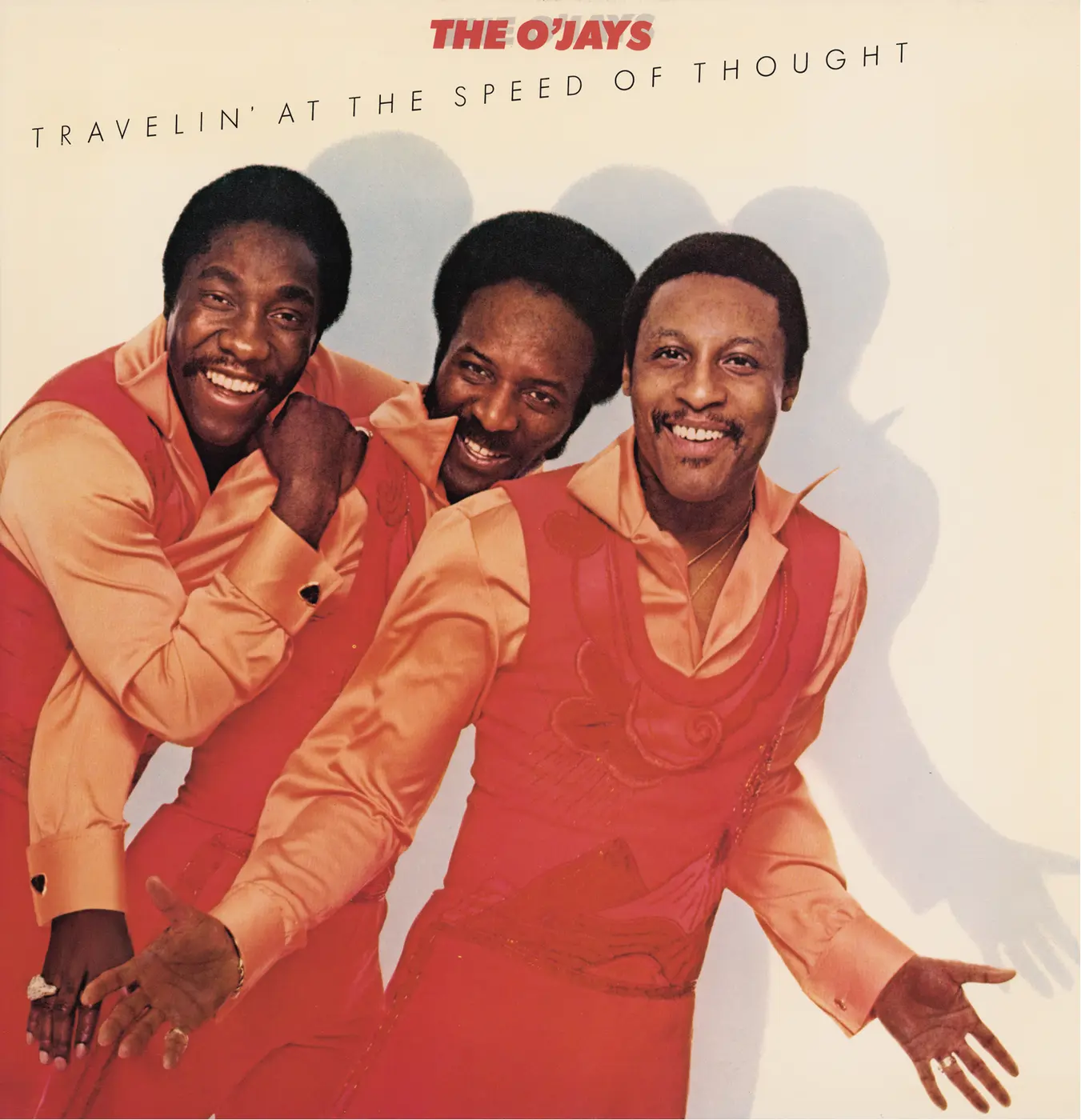 The O’Jays released their tenth studio album, Travelin’ at the Speed of Thought, in May 1977 on Philadelphia International.
The album continues the group’s partnership with producers Kenny Gamble and Leon Huff, combining socially minded lyrics with gospel-tinged harmonies and polished R&B arrangements. It marked the first O’Jays release to feature new member Sammy Strain, who replaced founding tenor William Powell shortly before Powell’s death that May.
Gamble and Huff wrote and produced six of the album’s eight tracks. John Whitehead, Gene McFadden, and Victor Carstarphen contributed “Those Lies (Done Caught Up with You This Time),” while the group covers Brazilian singer Morris Albert’s 1974 hit “Feelings.”
The title track opens with a measured funk rhythm and exhortative group vocals that frame the album’s central message of unity and perseverance. “We’re All in This Thing Together” sustains that tone with a steady, syncopated pace and tight vocal exchanges between Eddie Levert and Walter Williams. “So Glad I Got You, Girl” and “Stand Up” carry dance-floor energy, the latter arranged to simulate a live performance. Side two contrasts the tender remake “Feelings” with the sermon-like “Work on Me,” whose fervent call for renewal made it the album’s most successful single. The closing “Let’s Spend Some Time Together” evokes 1950s vocal R&B with Williams’ smooth falsetto phrasing.
A1. “Travelin’ at the Speed of Thought” (4:59) – The title track envisions unity and spiritual awakening through movement and connection. Its pacing shifts with urgency, echoing the lyric’s call to transcend division through awareness and shared rhythm.
A2. “We’re All in This Thing Together” (4:52) – A collective affirmation that ties endurance to mutual responsibility. The verses draw on the language of solidarity, binding moral persistence to the pulse of communal progress.
A3. “So Glad I Got You, Girl” (3:32) – A personal vow of gratitude shaped by restraint and quiet devotion. The phrasing turns gently inward, portraying love as stability earned through presence rather than passion.
A4. “Stand Up” (4:46) – A live-sounding exhortation urging resolve against complacency. The layered vocals and responsive rhythm give the track its sense of motion, turning performance into a shared call to act.
B1. “Those Lies (Done Caught Up with You This Time)” (3:45) – Written by McFadden, Whitehead, and Carstarphen, the song exposes deceit through measured rhythm and unflinching delivery. The lyric’s directness carries moral weight, treating truth as inevitable consequence.
B2. “Feelings” (7:11) – Originally by Morris Albert, the ballad is reframed with restrained vocal interplay. The O’Jays’ rendition builds gradually from stillness to release, tracing love’s endurance through memory and loss. Also covered in 1977 by Walter Jackson and Hi-Fi Set.
B3. “Work on Me” (4:26) – A plea for emotional reciprocity that frames self-improvement as relational effort. The rhythm sustains steady tension, while alternating leads emphasize the struggle between desire and understanding.
B4. “Let’s Spend Some Time Together” (4:33) – A closing reflection that blends doo-wop inflection with contemplative tone. The lyric offers companionship as remedy to isolation, ending the album on a note of quiet restoration.
Sessions occurred at Sigma Sound Studios in Philadelphia with producers Kenny Gamble and Leon Huff and engineer Joe Tarsia. MFSB provided the instrumental backing, featuring guitarists Roland Chambers, Dennis Harris, and T.J. Tindall; drummer Charles Collins; bassist Michael “Sugar Bear” Foreman; percussionist Larry Washington; pianist Dennis Williams; and organist Carlton Kent.
Philadelphia International promoted Travelin’ at the Speed of Thought with “Work on Me” (b/w “Feelings”), which reached No. 7 on the Billboard R&B chart, holding for 17 weeks.
The album peaked at No. 6 on the Billboard R&B Albums chart and No. 27 on the Billboard 200, achieving gold certification in the United States.
So Full of Love
 The O’Jays released their eleventh studio album, So Full of Love, in April 1978 on Philadelphia International.
The album finds the trio working within the lush, rhythm-centered framework of late-1970s Philadelphia soul, balancing mid-tempo numbers and smooth ballads with leaner funk textures. It was the group’s first album recorded entirely as a trio following the death of founding member William Powell, with Eddie Levert, Walter Williams, and Sammy Strain continuing the O’Jays’ trademark interplay of baritone, tenor, and falsetto harmonies.
Kenny Gamble and Leon Huff produced and wrote three of the album’s songs, while additional material came from Thom Bell, Bunny Sigler, and the duo Casey James and LeRoy Bell. The group also recorded two outside contributions: “Brandy” by Joseph Jefferson and Charles Simmons, and “Take Me to the Stars” by Larry Hancock and Al Boyd.
The album opens with “Sing My Heart Out,” a bright declaration of romantic energy that leads into the driving “Use ta Be My Girl,” one of the trio’s signature late-period singles. “Cry Together” follows with slow, overlapping vocal lines that trace emotional breakdown and reconciliation. Side two begins with “Brandy,” a reflective ballad that producers Gamble and Huff later revealed to be written about a dog, not a woman. “This Time Baby” carries an assertive rhythm and full string charts—one of two tracks Thom Bell produced at Kaye-Smith Studios in Seattle—later revived by Jackie Moore for her 1979 disco hit. “Help (Somebody Please)” blends devotional pleas with carnal imagery, while “Strokety Stroke” closes the set with humorous funk phrasing over clipped rhythm guitar.
Sessions occurred at Sigma Sound Studios in Philadelphia with producers Kenny Gamble, Leon Huff, and Bunny Sigler, assisted by engineer Joe Tarsia. Thom Bell produced and arranged two tracks at Kaye-Smith Studios in Seattle. Instrumentation was handled by members of MFSB, including guitarists Bobby Eli, Dennis Harris, Roland Chambers, and Bunny Sigler; bassist Ron Baker; drummer Earl Young; keyboardists Leon Huff, Lenny Pakula, and Thom Bell; percussionist Larry Washington; and vibraphonist Vincent Montana Jr. Don Renaldo arranged and conducted the string and horn sections.
Philadelphia International promoted So Full of Love with “Use ta Be My Girl” (b/w “This Time Baby”), which spent five weeks at No. 1 on the Billboard R&B chart and reached No. 4 on the Hot 100 in spring 1978. “Brandy (I Really Miss You)” followed as the second single (b/w “Cry Together”) and reached No. 21 R&B and No. 79 pop.
So Full of Love topped the Billboard R&B Albums chart and peaked at No. 6 on the Billboard 200, earning platinum certification.
Identify Yourself
 The O’Jays released their twelfth studio album, Identify Yourself, in August 1979 on Philadelphia International.
The album moves through the smooth contours and rhythmic shifts of late-1970s Philadelphia soul while incorporating funk-leaning textures. Eddie Levert, Walter Williams, and Sammy Strain maintain the trio’s layered vocal interplay, with Levert’s baritone and falsetto accents driving the emotional focus across the set.
Kenny Gamble and Leon Huff wrote and produced four tracks, while Eddie Levert and Walter Williams contributed three songs, and Thom Bell produced one.
Tracks divide between lively, celebratory numbers and introspective ballads. “Sing a Happy Song” opens with exuberant phrasing and layered harmonies, while “Get On Out and Party” emphasizes rhythmic drive with funk-inflected guitar and percussion. “Identify” follows with a mid-tempo, contoured arrangement, and “So Nice I Tried It Twice” explores repeating motifs over steady organ and keyboard figures. Side two features Levert- and Williams-penned “Hurry Up and Come Back,” a layered plea with expressive vocal turns, and “Forever Mine,” a heartfelt ballad showcasing broad vocal arcs. “I Want You Here with Me” provides a restrained, contemplative moment, while Thom Bell’s “One in a Million (Girl)” closes with string and horn flourishes.
A1. “Sing a Happy Song” (5:03)
A2. “Get On Out and Party” (5:04) — written by Walter Williams, Terry Stubbs, Leroy Simmons, Mike Jackson
A3. “Identify” (4:56)
A4. “So Nice I Tried It Twice” (5:50) — written by Williams, Jackson, Willie Ross
B1. “Hurry Up and Come Back” (5:09) — written by Eddie Levert, Mike Jackson, Walter Williams
B2. “Forever Mine” (6:10)
B3. “I Want You Here with Me” (5:28)
B4. “One in a Million (Girl)” (3:55) — written by Thom Bell, Joseph Ericksen
Sessions occurred at Sigma Sound Studios in Philadelphia with producers Kenny Gamble, Leon Huff, Eddie Levert, Walter Williams, and Thom Bell, with engineering by Joe Tarsia. Instrumentation included five guitarists (Roland Chambers, Dennis Harris, Anthony Bell, Bobby Eli, session players), three drummers (Quinton Joseph, Leon “Ndugu” Chancler, Charles Collins), three bassists (James Williams, Willie Ross, Bob Babbitt), multiple keyboardists (Leon Huff, Mike Jackson, Thom Bell), organists Lenny Pakula and Dunn Pearson, percussionists James Mtume and David Cruse, and Don Renaldo arranging horns and strings.
Philadelphia International promoted the album with “Sing a Happy Song” (b/w “So Nice I Tried It Twice”), which reached No. 7 on the US R&B chart and No. 39 in the UK. “Forever Mine” followed as a single (b/w “Hurry Up and Come Back”), reaching No. 4 R&B and No. 28 on the Billboard Hot 100. “I Want You Here with Me” later appeared on the R&B chart at No. 49.
Identify Yourself peaked at No. 3 on the US R&B Albums chart and No. 16 on the Billboard 200, earning platinum certification, marking the group’s last Philadelphia International set to achieve a top 20 pop chart position.
The Year 2000
 The O’Jays released their thirteenth studio album, The Year 2000, on August 8, 1980, on TSOP.
The album leans on late-1970s Philadelphia soul textures but largely lacks the vibrancy of the group’s prior releases. Levert, Williams, and Strain deliver tight harmonies throughout, with occasional expressive flourishes, while production alternates between the familiar Philadelphia International team and contributions from Dunn Pearson and Bunny Sigler.
Kenny Gamble and Leon Huff wrote and produced four tracks, Gene McFadden, John Whitehead, and Victor Carstarphen contributed one, Dunn Pearson with Levert and Williams produced two, and Bunny Sigler produced the closing track.
The set largely alternates between restrained mid-tempo numbers and soft ballads. “Once Is Not Enough,” Sigler’s composition, stands out with a sensuous, grinding rhythm and layered vocals. Tracks like “You Won’t Fail” and “You’re the Girls of My Dreams (Sho Nuff Real)” maintain steady, undulating pace but remain less distinctive compared with the group’s past R&B statements.
A1. “The Year 2000” — produced by Kenny Gamble, Leon Huff
A2. “To Prove I Love You” — produced by Kenny Gamble, Leon Huff
A3. “You’ll Never Know (All There Is to Know ’Bout My Love)” — produced by Gene McFadden, John Whitehead, Victor Carstarphen
A4. “You’re the Girls of My Dreams (Sho Nuff Real)” — produced by Dunn Pearson, Eddie Levert, Walter Williams
B1. “You Won’t Fail” — produced by Dunn Pearson, Eddie Levert, Walter Williams
B2. “Girl, Don’t Let It Get You Down” — produced by Kenny Gamble, Leon Huff
B3. “The Answer Is in You” — produced by Kenny Gamble, Leon Huff
B4. “Once Is Not Enough” — produced by Bunny Sigler
Sessions occurred at Sigma Sound Studios in Philadelphia with producers Kenneth Gamble, Leon Huff, Dunn Pearson, Eddie Levert, Walter Williams, and Bunny Sigler.
TSOP released singles in 1980: “Girl, Don’t Let It Get You Down” (b/w “You’re the Girls of My Dreams (Sho Nuff Real)”), “You Won’t Fail” (b/w “You’ll Never Know (All There Is to Know ’Bout My Love)”), and “Once Is Not Enough” (b/w “To Prove I Love You”). None of the singles registered significant chart presence.
Discography:
- Comin’ Through (1965)
- Soul Sounds (1967)
- Back on Top (1968)
- The O’Jays in Philadelphia (1970)
- Super Bad (1971)
- Back Stabbers (1972)
- Ship Ahoy (1973)
- O’Jays Meet The Moments (1974 • The O’Jays Meet The Moments)
- Survival (1975)
- Family Reunion (1975)
- Message in the Music (1976)
- Travelin’ at the Speed of Thought (1977)
- So Full of Love (1978)
- Identify Yourself (1979)
- The Year 2000 (1980)
- My Favorite Person (1982)
- When Will I See You Again (1983)
- Love and More (1984)
- Love Fever (1985)
- Let Me Touch You (1987)
- Serious (1989)
Sources:
- Discogs: The O’Jays
- 45worlds: The O’Jays
- 45cat: The O’Jays
- MusicBrainz: The O’Jays
- Zaragon: American Soul Albums Directory
Artist/Album Pages:
The Box Tops were an American pop-rock band that released four 1967–69 albums on Bell Records. They ...
Midnight was an American hard-rock band from Chicago that self-released the 1977 album Into the N...
Styx are an American symphonic/hard-rock band from Chicago, rooted in the early Dennis DeYoung–Pan...
Rayuela was an Argentine jazz-rock/folk band that released a 1977 self-titled album on Orfeo. Memb...
Washington Jamb Band was an American soul-funk band that issued two 1976 singles and the 1977 albu...
Ace was an English soul-rock band from Sheffield that released three albums on Anchor between 1974...
Montage was an American chamber-pop/psych band from New York that released a self-titled album on...
The Velvet Underground was an American rock band from NYC, founded in 1965 by guitarist–singer Lo...
Full Circle were an American jazz-rock band from Las Vegas that released an eponymous album in 197...
Thirsty Moon was a German jazz-rock band that released four albums on Brain between 1972 and 1976,...
Bill Withers (1938–2020) was an American soul singer/songwriter, best known for the 1971/72 AM eve...
Gary Wright (April 26, 1943 – September 4, 2023) was an American singer, musician, and songwriter ...