

The Motor Totemist Guild was an American avant-rock ensemble formed by composer and multi-instrumentalist James Grigsby and poet-vocalist Christine Clements. They issued the 1984–86 albums Infra Dig and Contact With Veils, plus the live Klang cassette, on the self-operated Rotary Totem label. Their 1988 collaboration with the 5uu’s produced Elements and spawned the merged group U Totem. Subsequent MTG titles appeared on the RēR affiliates No Man’s Land, Auf Dem Nil, and Cuneiform, culminating with the 1999 concept disc City of Mirrors.
Members: James Grigsby (composition, keyboards, bass, guitar, trumpet, electronics), Christine Clements (voice, clarinet, saxophone), Lynn Johnston (clarinets, saxophones), Becky Heninger (cello), Eric Strauss (voice, violin, keyboards, percussion), Emily Hay (voice, flutes), David Kerman (drums, percussion), Bridget Convey (keyboards), Hannes Giger (contrabass), Rod Poole (guitar), Vinny Golia (clarinets, saxophones), Eric Johnson-Tamai (bassoon), Brad Dutz (marimba, vibraphone), Jerry Wheeler (trombone), Motoko Honda (keyboards), Rich West (drums)
Background
Motor Totemist Guild formed in 1980 in Orange County, Calif., when composer and multi-instrumentalist James Grigsby teamed with poet-singer Christine Clements. Grigsby studied and performed electronic music and Renaissance polyphony through the 1970s. He also studied post-Webern serialism and Balinese gamelan, then played progressive rock with Mutapro and punk-jazz with See Spot. Clements was active in San Francisco poetry circles.
The pair made their first recordings on four-track tape at Grigsby’s home studio. Grigsby brought musicians from Mutapro and See Spot into the sessions, and multi-instrumentalist Eric Strauss joined partway through the Infra Dig project.
Grigsby established Rotary Totem in 1984 to issue the completed home tapes as the first Motor Totemist Guild LP.
Infra Dig
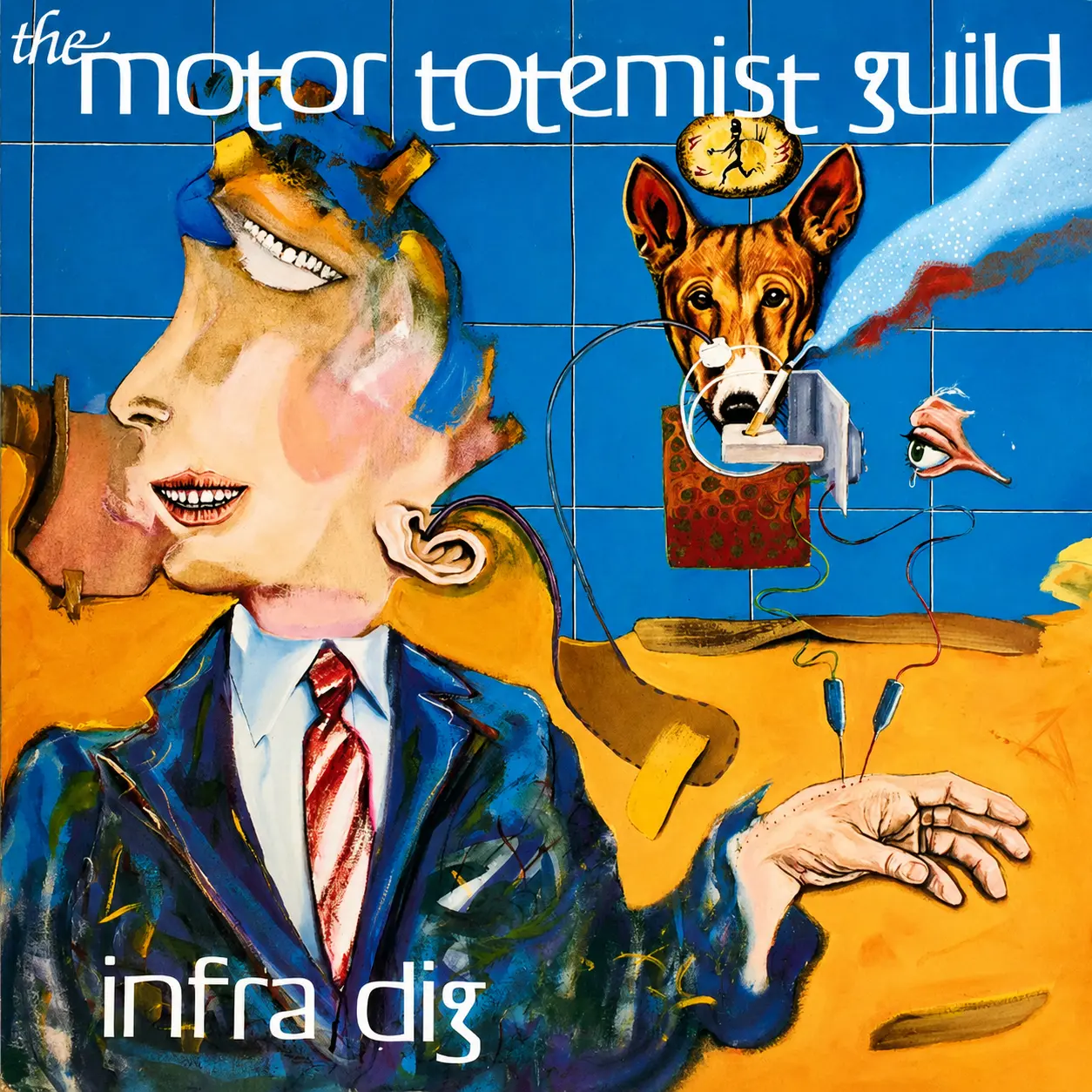 Motor Totemist Guild released the debut album, Infra Dig, in 1984 on Rotary Totem.
Infra Dig contains twelve pieces assembled on home four-track equipment. Clements appears on six titles, and Eric Strauss enters the sessions as a multi-instrumentalist. Selected cuts add guitarist Stuart Hathaway and drummer Nigel Bladen. The album includes their dicomolulated take on the 1962 Joanie Sommers hit “Johnny Get Angry.” Clements supplied the texts to “The Totem Motorist” and “Stares in Steps.”
“Edison Games” clusters brass figures before pivoting into jazz-inflected motifs. “The Totem Motorist” fractures across a patchwork of mismatched sections, piling abrupt turns into an intentionally unstable sequence. “Stares in Steps” veers from wave noise and angular sung lines through laughter-like interjections, then settles into clear piano improvisation and solemn ensemble passages.
A1. “Edison Games” (3:55)
A2. “Aunt Iodine” (3:55)
A3. “Frivilous Deities” (3:01)
A4. “Johnny Get Angry” (2:42)
A5. “Mute Tape Process” (1:53)
A6. “The Totem Motorist” (7:03)
B1. “Nigh” (1:55)
B2. “Humus Maskaself” (1:21)
B3. “Stares in Steps” (8:51)
B4. “Insular Phantastikos” (2:47)
B5. “Lap Over Chop Over Ring” (5:55)
B6. “In Sackcloth and Ashes” (1:49)
Sessions spanned 1981–83 at the Orange County home studio of composer-producer James Grigsby, who built Infra Dig on four-track tape. The sessions established Rotary Totem as the production outlet for subsequent Motor Totemist Guild recordings.
Illustrator Roger Whitridge, a Orange Coast College art professor, painted the Infra Dig cover as a fractured figurative tableau against a turquoise grid. A suited figure at left carries displaced facial features, while an animal-headed form at right sits among tubing and disconnected objects above an ochre floor.
Six years later, “Johnny Get Angry” reached new audiences through an ironic, dramatized SNL rendition by Canadian country-pop singer KD Lang.
Four decades later, Rotary Totem issued a digital remaster on August 30, 2024 with a PDF of the original album materials.
“Sub-Mission” / “Ballad of the Thin Man”
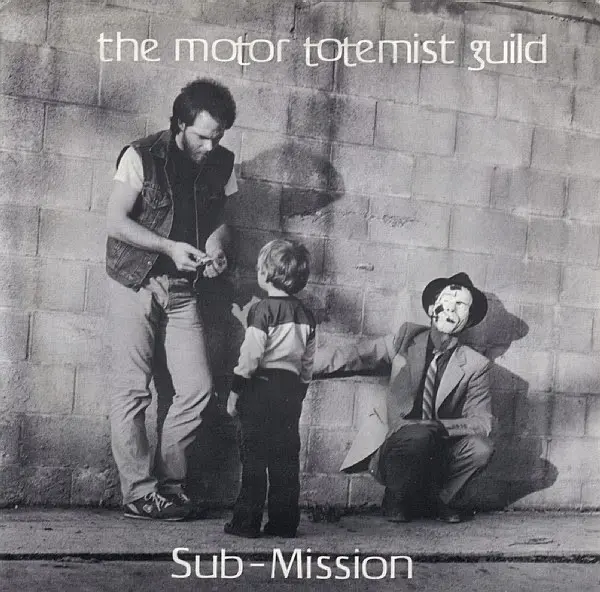 Also in 1984, the Motor Totemist Guild released a non-album seven-inch that pairs “Sub-Mission,” a wayward Sex Pistols cover backed with a rearranged “Ballad of the Thin Man,” the Bob Dylan chestnut. Guitarist Dave Paul Brown and percussionist Nigel Bladen join the Dylan side. Elizabeth Carlassare provides an additional voice part.
“Sub-Mission” was the first Pistols original, conceived in a pub between John Lydon and Glen Matlock, who thought up the line “I’m on a submarine mission for you baby” as a riff on their manager Malcolm McLaren, who sold S&M gear at his King’s Road shop SEX and wanted a song about the topic in their setlist. In the liner notes to the single, MTG describe their version as “The spirit of Elvis inhabits the body of Johnny Rotten at a scuba diving competition held in Ghana.”
Grigsby produced and arranged the Rotary Totem single, with the two tracks completed within the same early home-recording period as Infra Dig.
The Whitridge-illustrated picture sleeve uses a stark monochrome street photograph against a cinder-block wall. A bearded man stands at left and a child occupies the middle ground; a cartoonlike animal mask covers the face of a suited figure seated at right.
Klang
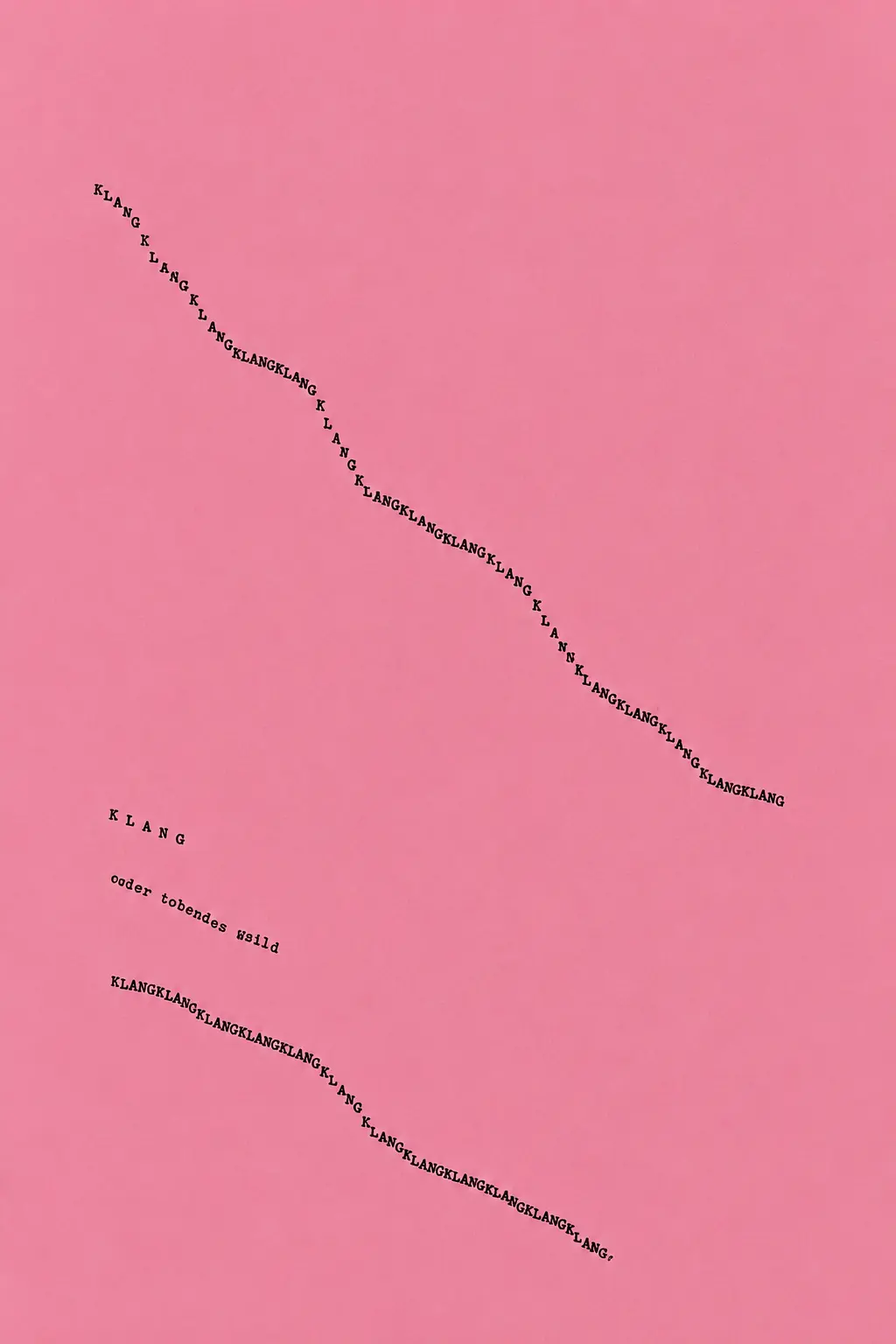 Motor Totemist Guild issued Klang in 1985 as a cassette-only release on Rotary Totem.
Klang combines home four-track pieces with concert tapes captured across an eighteen-month span. Johnston and Heninger establish a new trio configuration, while Strauss appears across selected pieces. Grigsby and Strauss co-composed the four-part “Barbie Variations,” which occupies most of side two.
“Crayons” threads tense chamber interplay through an uneasy opening piece. “Anti-Club” veers into severe dissonance with broader, almost balletic sectional turns. “Farmer Without Strings” skips through playful, jazz-dislocated passages with an imaginary-soundtrack cast. “Iroquois” pivots through spiky, unstable figures with little sense of fixed direction.
“The Barbie Variations” opens in concrete dissonance, then detours into an elliptical ceremonial passage. “Marriage and Divorce” settles into a comparatively restrained section. Part three ricochets through distorted soundtrack fragments, samples, and jazz quotations, briefly resolving into an elegant symphonic theme before returning to collage. “Barbie in Hell” tightens around elliptical motifs and a menacing final atmosphere.
A1. “Crayons” (2:36)
A2. “Anti-Club” (5:42)
A3. “Farmer Without Strings” (3:49) – recalls the French-Canadian band Et Cetera with soprano female vocals set to a pointillist, mallet-laden arrangement reminiscent of Interview-era Gentle Giant (“Give It Back,” “Design”); hallmarks of a style later dubbed zolo.
A4a. “Lhasa”
A4b. “Stares in Steps” (5:49)
A5. “Iroquois” (7:30)
B1a. “Barbie Variations I: Overtures to Barbie” (4:02)
B1b. “Barbie Variations II: Marriage and Divorce” (2:45)
B1c. “Barbie Variations III: Ken and G.I. Joe / The Singles Bar / Skipper’s Fling” (4:45)
B1d. “Barbie Variations IV: Barbie in Hell” (2:24)
B2. “A Mixture of Guise (Part One.Three)” (0:49) B3. “In Sackcloth and Ashes” (1:44)
B4. “I Will Follow” (3:03)
Grigsby produced Klang from home four-track material and concert tapes captured from January 1984 through July 1985 at the Anti-Club, Lhasa, Santa Monica Unitarian Church, and the Grigsby home. Motor Totemist Guild multi-instrumentalist Eric Strauss co-engineered the recordings with Grigsby.
Grigsby designed Klang as a handmade cassette package built around an eight-page booklet with Trelaine Lewis photographs. Rotary Totem paired the booklet with a small-run cassette label and catalog insert for an edition limited to 50 copies.
“Farmer Without Strings” also appears on A Beginner’s Guide to COMA, a 1985 Rotary Totem comp of musicians tied to the California Outside Music Association, including Cartoon, New Cross, Rhythm Plague, Tao Mao, Dogma Probe, Mark Soden, and Elma Mayer.
Contact With Veils
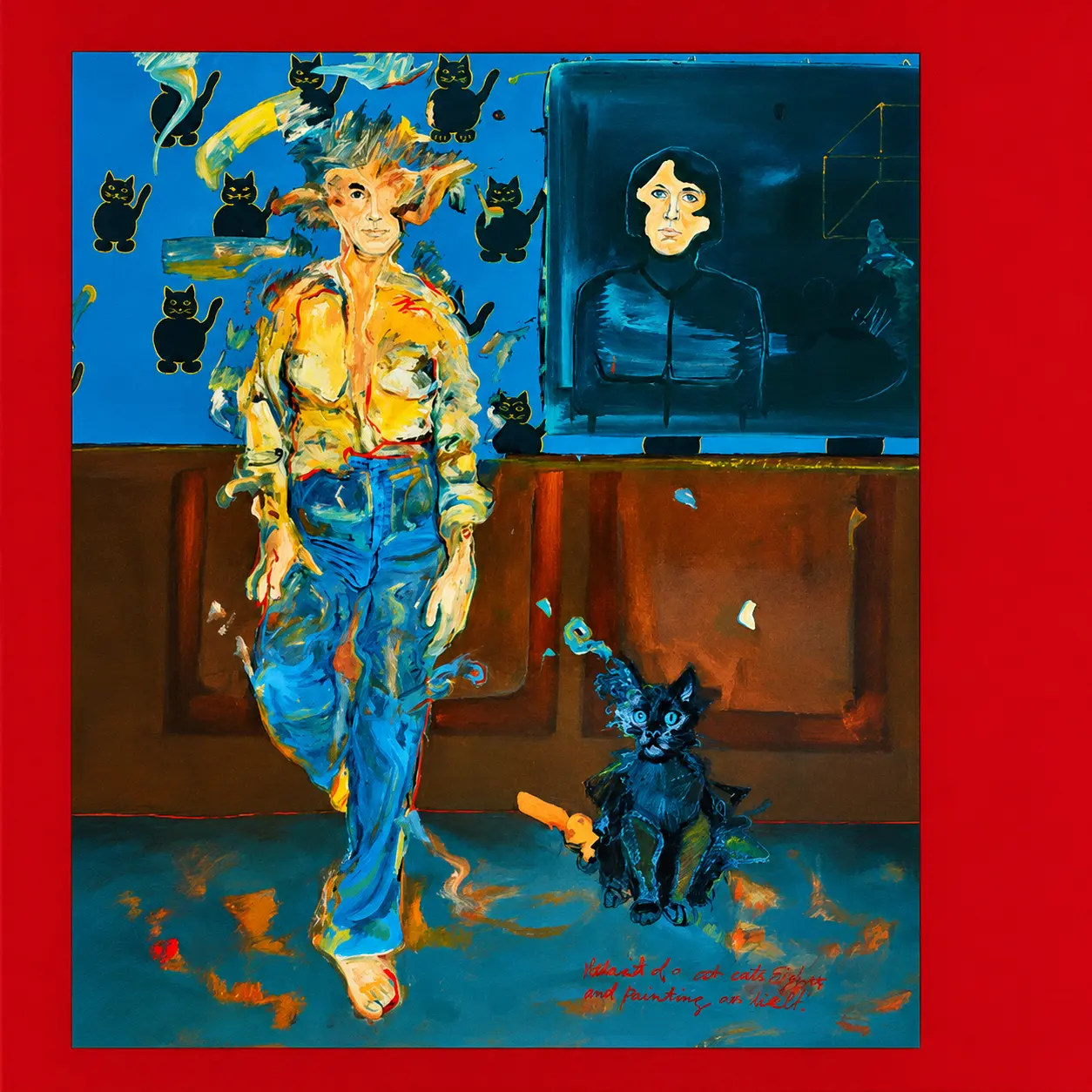 Motor Totemist Guild released the second studio album, Contact With Veils, in 1986 on Rotary Totem.
The five-track program includes “A Mixture of Guise” and the twelve-minute “Cuneiform” as two extended works. Johnston and Heninger return with 5uu’s drummer David Kerman, who makes his first recorded appearance with Grigsby. Percussionist Kraig Grady and bassoonist Eric Johnson-Tamai expand the chamber personnel; Maw Shein Win contributes voice.
“A Mixture of Guise” veers through warped chamber passages as orchestral breadth meets abrasive, abstract turns. “Cuneiform,” Grigsby’s first extended composition, makes titular reference to the RIO label founded in 1984 by Cow/Hatfield enthusiast Steve Feigenbaum, who chose the name — the Mesopotamina writing system — as an ode to ancient Middle Eastern art.
A1. “Unterm Rad [Under the Wheel]” (2:34)
A2. “Nigh” (4:05)
A3. “A Mixture of Guise” (9:59)
B1. “Felis Felicific” (4:45)
B2. “Cuneiform” (12:34)
Sessions occurred in spring 1986 at Trax in Los Angeles, where Motor Totemist Guild produced Contact With Veils with Trax engineer Russ Iadevaia. The album marked the first studio collaboration between Grigsby and 5uu’s drummer David Kerman, an association that soon developed through Elements and U Totem.
Whitridge returned with a painted scene framed by a broad red border. A pale blond figure advances through the left foreground beneath scattered black cats, while a dark cat occupies the blue-green floor. At right, a deep teal panel encloses a black-haired female figure above brown architectural forms, giving the central painting a compartmentalized interior arrangement.
Curt Wilson completed a new mix in 1991 for the later archive program. No Man’s Land paired that version with selected Infra Dig tracks on Archive One in 1996 on compact disc.
5uu’s with Motor Totemist Guild: Elements
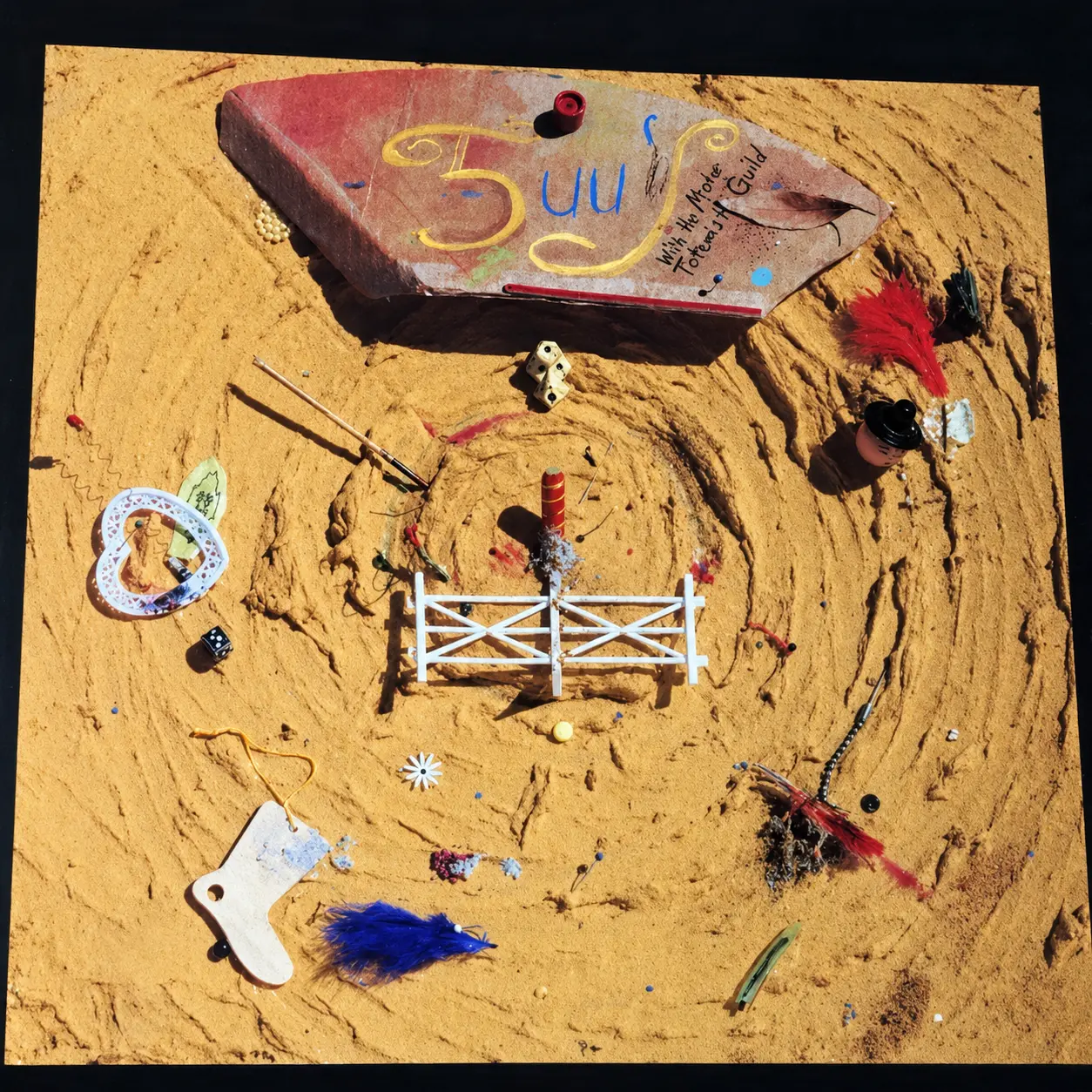 5uu’s and Motor Totemist Guild released the collaborative album Elements in 1988 through Recommended Records and Rotary Totem.
Elements joins the five-piece 5uu’s lineup with Johnston, Heninger, Grigsby, and new flutist Emily Hay. Kerman composed most of the nine titles; Grigsby and Kumar share selected credits with Kerman. The combined personnel supplied the lineup basis for U Totem.
“Acknowledgments” settles into a sentimental chamber-song manner. “Ignominies” marches through a severe, oppressive figure. “Imperfections” halts between isolated sung lines, with reversed effects marking each re-entry across long silences. “Cause of Merit” threads sung phrases against bassoon replies. “Elements” lopes through a relaxed, jazz-inflected tune. “Resentments” careens through brisk piano figures until horn entries replace sung lines. “The Artist” bounds through energetic accompaniment marked by vibraphone figures.
A1. “Ignominies” (5:12)
A2. “Imperfections” (4:23)
A3. “Resentments” (3:59)
A4. “Acknowledgements” (1:43)
A5. “Elements” (2:35)
B1. “In Life’s Hands” (4:55)
B2. “The Artist” (3:36)
B3. “Causes of Merit” (2:42)
B4. “The Futility of Oneness” (6:41)
Sessions occurred in 1986 at Telstar and Backlot Studios in Burbank with 5uu’s leader David Kerman as producer. 5uu’s singer and studio operator Curt Wilson recorded the album, which joined Kerman personnel with the Grigsby ensemble.
5uu’s visual collaborator Patrick Tierney constructed the Elements cover as an assemblage across a rough ochre field. A slab near the upper edge carries hand-painted 5uu’s and Motor Totemist Guild lettering; miniature fencing, a die, feathers, rods, and scattered objects occupy circular markings across the surface. A heavy black frame contains the composition. Tierney also supplied artwork for the 1986 5uu’s album Bel Marduk & Tiamat.
Cuneiform paired Elements with the first 5uu’s album and early single material on Point of Views in 1996 on compact disc.
Shapuno Zoo
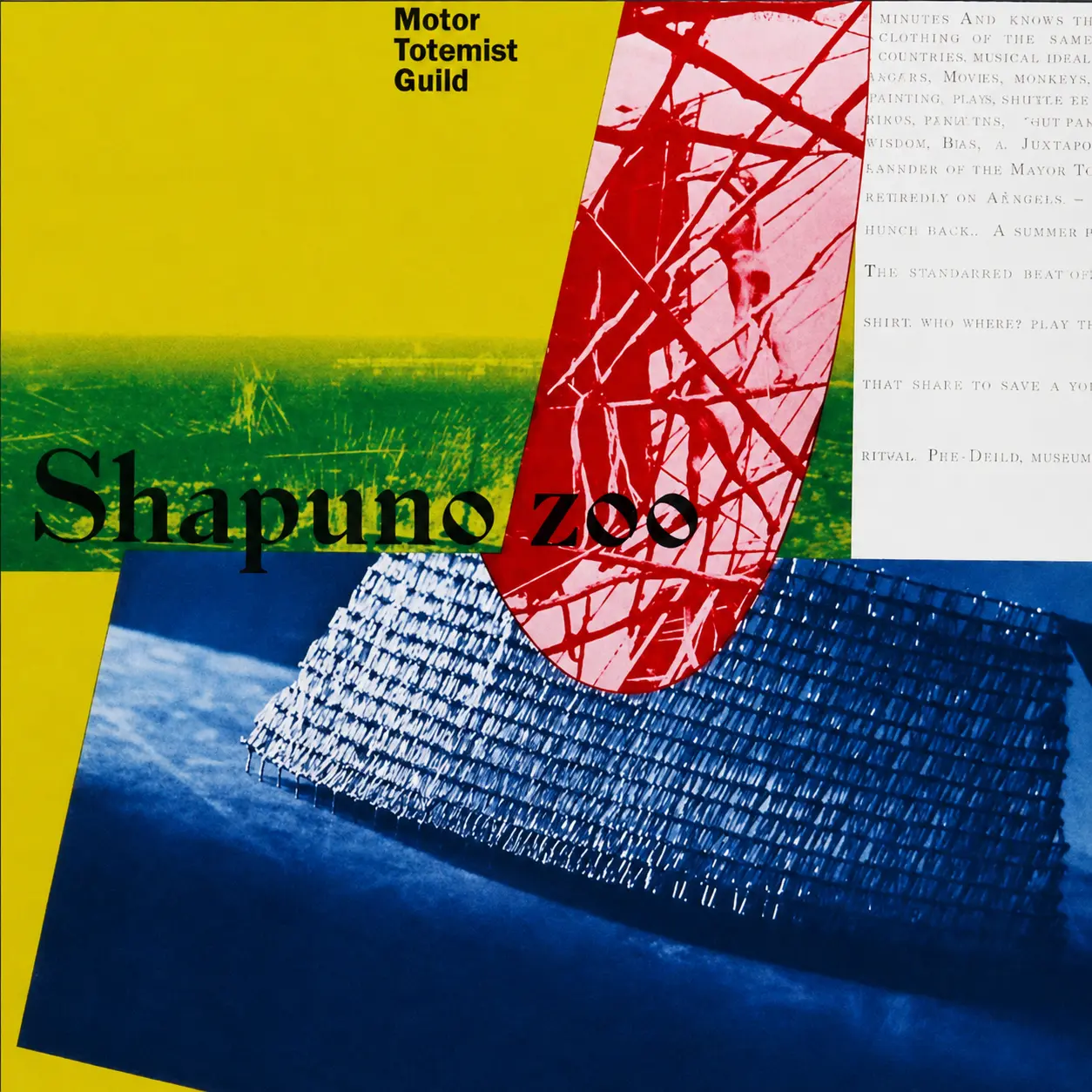 Motor Totemist Guild released the third studio album, Shapuno Zoo, in spring 1988 on No Man’s Land.
Shapuno Zoo features Strauss, Kerman, and Hay in full ensemble roles alongside Johnston and Heninger. Selected titles add percussionist Brad Laner and tuba player William Roper. Kerman and Strauss supplied texts alongside Maw Shein Win.
“Set of Crayons” threads cello against sung lines, then turns processional near its close. “Do the Crawl” emerges from an extended hush into cello-and-flute interplay with later sung lines. “Familiar Philippic” coils through dense chamber counterpoint between quotations from “A Man and a Woman” at either end.
“Indian Bingo” loops a repeated riff beneath acted dialogue as complex meters alter successive ensemble entries. “Imperfections” pivots from restless piano figures into a calmer sung passage. “Prisms of Ribbon” develops two tightly composed movements, then splinters into solo improvisations whose fragments return to opening material before vague closing notes.
A1. “Set of Crayons” (4:11)
A2. “Do the Crawl” (5:01)
A3. “Familiar Philippic” (6:20)
B1. “Indian Bingo” (4:54)
B2. “Imperfections” (4:29)
B3. “Prisms of Ribbon” (11:47)
Sessions spanned autumn 1987 through winter 1987/88 at Telstar Studio in Burbank, where Grigsby produced Shapuno Zoo with 5uu’s singer-engineer Curt Wilson. The pairing followed work on Elements and continued on A Luigi Futi.
No Man’s Land housed Shapuno Zoo in a die-cut foldover sleeve built from screened photography and collage across an olive field. A red vertical oval at upper right encloses a black lattice structure with a small human figure, while a black-and-white textured form cuts across a gray photographic band below. Oversized serif title lettering dominates the middle of the sleeve beside a narrow white text strip at right.
The 1996 compilation Archive Two retained the six LP tracks and added related material on compact disc. Rotary Totem issued a 35th-anniversary digital remaster on February 24, 2023 with a PDF containing album art and credits, plus lyrics and photographs.
A Luigi Futi
 Motor Totemist Guild released the fourth studio album, A Luigi Futi, in 1989 on Auf Dem Nil. The LP also carries the expanded title Omaggio a Luigi Futi.
A Luigi Futi devotes side one to the twenty-minute “Omaggio a Futi,” a tape construction assembled from live Guild material with the USC Contemporary Chamber Ensemble and musicians from Cambodia and Laos. Side two contains “Lightly Into Nappy” and “Farmer Without Strings” alongside revised sections of the Grigsby–Strauss “Barbie Variations.” Guitarist Ken Ando joins the established six-member lineup.
“Omaggio a Futi” opens on a defined bass figure, then splinters into letter-spelling calls altered by tape effects and abstract episodes. A jazz-inflected middle passage interrupts this sequence before earlier abstraction returns. “Follow the Drinking Gourd” enters near the close and collides with Cambodian-Laotian material and further tape interruptions.
A1. “Omaggio a Futi [Homage to Futi]” (20:00)
B1. “Lightly Into Nappy” (4:32)
B2. “Farmer Without Strings” (4:14)
B3. “Birth by Injection Mold” (4:06)
B4. “Marriage and Divorce” (2:48)
B5. “Ken vs. Joe / Skipper’s Fling” (4:49)
B6. “Barbie in Hell” (2:41)
Grigsby produced A Luigi Futi from California recordings made circa 1982–88, with source tapes from Telstar Studio in Burbank and Japan America Theater in Los Angeles. Curt Wilson handled engineering, overdubs, effects, and tape assembly after the Wilson-Grigsby work on Shapuno Zoo and Elements.
Los Angeles architect and artist Eric A. Kahn supplied the cover drawing for A Luigi Futi. A broad pale-gray field surrounds a compact blue-black line construction near the lower portion of the jacket, where angular mechanical and architectural forms intersect in a dense cluster. Mustard “Futi” lettering runs vertically along the left edge, leaving most of the sleeve as open space around the drawing. Kahn worked across architecture, graphic design, installations, and visual art within the Southern California design community.
No Man’s Land retained the title work and four “Barbie Variations” pieces on Archive Two in 1996 on compact disc.
U Totem and Reformation
The Elements personnel merged as U Totem and appeared at the Frankfurt Art Rock Festival. Cuneiform issued U Totem in 1990 and Strange Attractors in 1994 under the new group name. Grigsby and Hay revived Motor Totemist Guild in 1997 with a fourteen-piece lineup built around returning members and West Coast improvisers.
City of Mirrors
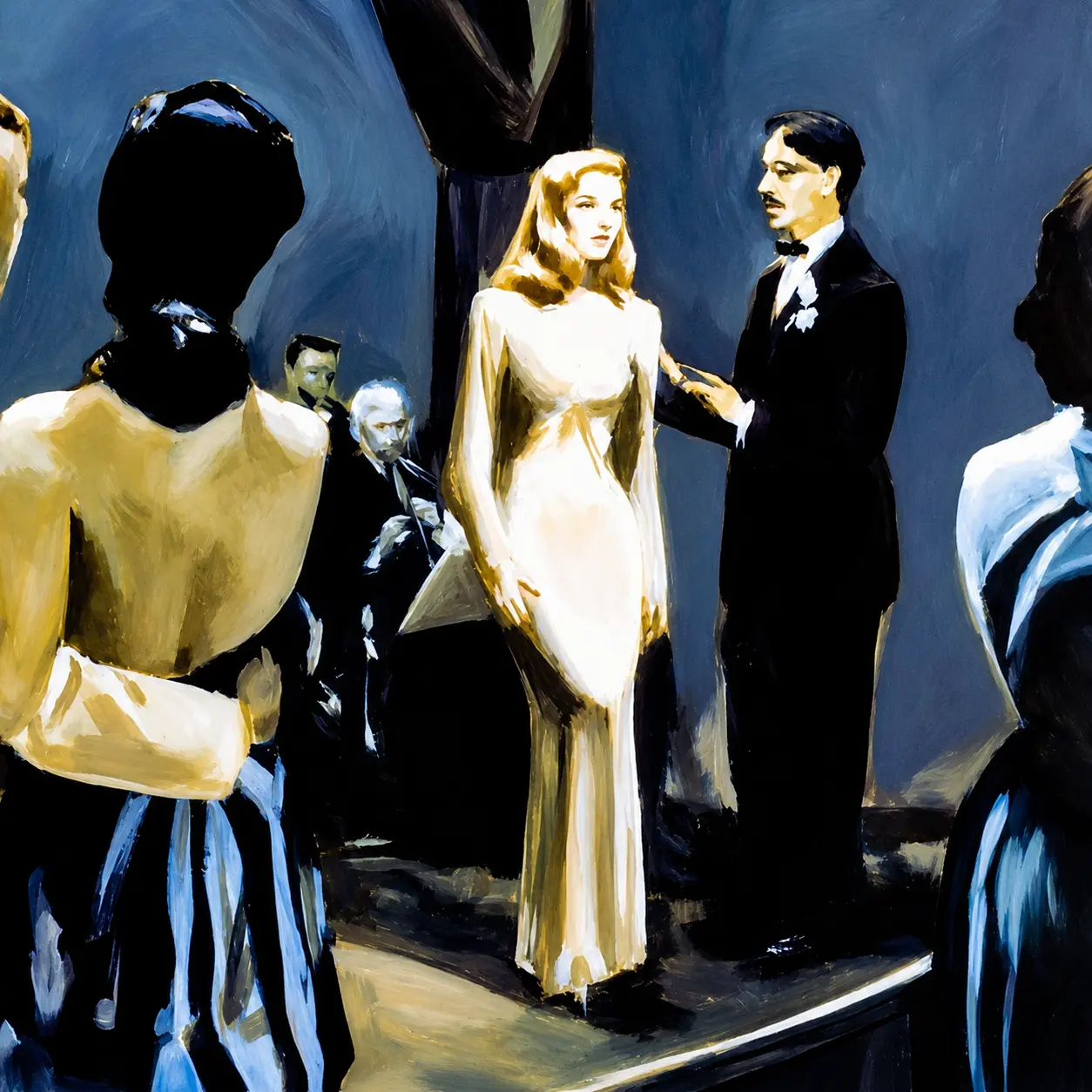 Motor Totemist Guild released the fifth studio album, City of Mirrors, on January 27, 1999 through Cuneiform Records.
City of Mirrors uses a fourteen-piece lineup that retains Hay and Johnston, with reedist Vinny Golia and mallet percussionist Brad Dutz among the new personnel. Kerman shares drum duties with Joseph Berardi. Five titles come from studio sessions, while the twenty-eight-minute “Bixby Slough” preserves a Los Angeles Harbor College performance. Grigsby used graphic notation within the extended material and incorporated improvisation with studio edits.
Grigsby conceived City of Mirrors as a late-century reflection on experiments by American pianist and bandleader Stan Kenton and arranger-composer Bob Graettinger. Kenton mounted the Innovations in Modern Music concert projects with an expanded orchestra built for contemporary concert works, while Graettinger supplied the four-movement City of Glass, a dissonant, through-composed suite that blurred big-band jazz and modern orchestral composition. Motor Totemist Guild recasts that precedent with a 14-piece “little big band,” combining swing-era ensemble language with chamber modernism, free improvisation, and electronic processing.
“Tower of London” threads Curt Wilson’s contoured sung part through intricate, regal ensemble lines. “Scarfnet” veers from dramatic sung passages into elaborate ensemble development, detouring through Afro-Cuban and calypso rhythms before successive wind solos.
“Narcotic Lollipop” pivots a recurring motif among changing instrumental entries and tempos, with trumpet calls punctuating dense contemporary-classical passages before jazz sections open for trombone and saxophone solos. “Prudes vs. Libertines” glides through isolated electronic tones, uneasy chords, and repeated glissandi before a defined rhythmic figure emerges.
“Bixby Slough” erupts from eerie atmosphere into collective free improvisation, passing through dissonant episodes, shouted interjections, recurring jazz motifs, and fragments recalled from earlier pieces. Near its close, Grigsby introduces each player as successive solos ride a simple bass figure through deliberately antiquated jazz sonics.
1. “Tower of London” (2:59)
2. “Scarfnet” (14:56)
3. “Narcotic Lollipop” (13:32)
4. “Prudes vs. Libertines” (4:42)
5. “Bixby Slough” (28:11)
6. “Blood in the Tower” (3:07)
Grigsby produced City of Mirrors from 1998 sessions at Headway Group, with “Bixby Slough” recorded on January 17 at Los Angeles Harbor College. Curt Wilson engineered the five Headway tracks; guitarist and recording engineer Rod Poole handled “Bixby Slough” amid late-Nineties production work on solo and experimental recordings.
David Grigsby supplied drawings and paintings for the City of Mirrors package. The cover centers a formally dressed couple within a muted blue-gray 1940s ballroom scene: a woman in a pale evening gown stands beside a man in a black tuxedo, while cropped figures occupy the foreground and additional guests recede across the room. Dark architectural planes enclose the upper and right portions of the image around the central pair.
All America City
 Motor Totemist Guild released the sixth studio album, All America City, in June 2000 on Rotary Totem.
Grigsby composed All America City as the score to the motion picture Yu Gakusei. Short cues rely heavily on keyboards and samplers, while the original program includes the twenty-seven-minute “Yamatonadeshiko” as an extended ensemble piece. Convey, Giger, and Kerman return beside new guitarist Rod Poole in the five-member core.
“Amaterasu” expands a contoured electronic figure through gradual development and changing sonorities. “Yamatonadeshiko” suspends graphic-score passages across acoustic group improvisation as electronic layers enter its open construction. “On Raiko’s P.O.V.” dissolves into water sounds and a remote human utterance.
 1. “The Blue Lantern” (0:18)
2. “Close Shot of Attache Case” (0:52)
3. “Stardust Mobile Estates” (2:32)
4. “Parachute Kids” (1:20)
5. “Friendly Liquors” (1:29)
6. “Hostess with Whipped Cream Cannister” (2:15)
7. “Shocks Hardware” (2:08)
8. “Exterior Dilapidated Shack” (2:14)
9. “Ron’s Barbary Coast” (2:00)
10. “Strip Mall with Gas Station and Izakaya [Japanese Pub]” (2:27)
11. “Nader’s Furniture” (0:50)
12. “Ron’s Barbary Coast Nude” (1:54)
13. “Edge of the Cliff” (1:34)
14. “Hinoki [Japanese Cypress]” (1:08)
15. “Donut King” (1:03) 16. “Obese Mice” (1:58)
17. “Town Motel” (1:01)
18. “D.J. Tiki Torch” (2:45)
19. “Sandy Vitale Dance Studio” (3:12)
20. “Chapatsu Girls [Brown-Haired Girls]” (3:38)
21. “Amaterasu [Shining in Heaven]” (6:01)
22. “Yamatonadeshiko [Ideal Japanese Woman]” (27:19)
23. “From Reiko’s P.O.V.” (3:24)
Grigsby produced All America City as the score to Yu Gakusei, with longtime associate Curt Wilson sharing recording duties. Wilson resumed an engineering partnership established through Elements, Shapuno Zoo, and A Luigi Futi.
The All America City package uses roadside Americana as the principal visual scheme. The front cover photographs a weathered arrow-shaped sign against blue sky, with stacked black ALL AMERICA CITY capitals on a white panel beneath a smaller red Motor Totemist banner and exposed metal supports. The back shifts to a rust-and-blue motel scene dominated by a large TOWN MOTEL sign beside a pale tracklist panel. James Grigsby and J.M. Herrin supplied the photography, with illustrations by David Grigsby elsewhere in the package.
Rotary Totem remastered the album for a 25th-anniversary digital edition on March 7, 2025 through Bandcamp. The package adds a PDF with cover art and credits, plus photographs and screenplay excerpts.
Later Activity
Grigsby shifted to NIMBY for Songs for Adults in 2006, then paused recording activity. He returned with the 2022–24 solo albums Illusions and Solar Maxima. In 2023, Rotary Totem remastered Shapuno Zoo and Infra Dig for digital release. The 25th-anniversary edition of All America City followed in 2025 with expanded materials. In June 2026, the label issued Set, an archival U Totem concert album compiled from 1989/90 performances.
Discography:
- Infra Dig (1984)
- “Sub-Mission” / “Ballad of the Thin Man” (1984)
- Klang (live, 1985)
- Contact With Veils (1986)
- Elements (1988 • 5uu’s With The Motor Totemist Guild)
- Shapuno Zoo (1988)
- A Luigi Futi (1989)
- City of Mirrors (1999)
- All America City (2000)
Sources:
Artist/Album Pages:
Julian Cope (Oct. 21, 1957) is a Welsh singer, multi-instrumentalist, and songwriter who first eme...
Kyriakos Sfetsas (September 29, 1945 – April 20, 2026) was a Greek composer and arranger behind nu...
Lloyd Cole & The Commotions were a Scottish pop-rock band that released ten singles and the 19...
Iron Maiden are an English heavy metal band that has been active since the late 1970s. In the early ...
Cocteau Twins were a Scottish goth/dream-pop trio that was active for 16 years, starting in 1981. ...
Exodus are an American metal band that emerged with the 1985 album Bonded by Blood on Torrid/Musi...
The Style Council was an English sophisti-pop band fronted by ex-Jam leader Paul Weller. Starting ...
Kahondo Style was a London-based, multinational chamber-jazz/rock ensemble that released the 1985–...
Pyrolator is the moniker of German electronic musician Kurt Dahlke, first active with the 1979–81 ND...
Allies were an American CCM melodic-rock band behind the 1985/86 albums Allies and Virtues on Ligh...
The Icicle Works are an English rock band led by guitarist–songwriter Ian McNabb. They emerged in Li...
Chicago are an American band formed in 1967; noted as one of the first rock acts with an integrated ...