

The Bonzo Dog Band was an English comedy rock act that released four albums on Liberty between 1967 and 1969. Formed in the early 1960s by Vivian Stanshall and Rodney Slater, the group evolved from a trad jazz and Dadaist revue into a surrealist pop ensemble that blended satire, pastiche, and theatrical absurdity. They became household names through appearances on Do Not Adjust Your Set and scored a UK Top 5 hit with “I’m the Urban Spaceman,” produced by Paul McCartney. Known for their genre-bending approach, they incorporated music hall, psychedelia, sound collage, and rock parody across a string of increasingly elaborate studio albums. After disbanding in 1970, they reunited for a final contractual album in 1972.
Members: Roger Ruskin Spear (tenor saxophone, trumpet, vocals), Rodney Slater (alto saxophone, baritone saxophone, bass saxophone, clarinet, bass, clarinet, trombone, 1966-70), Vivian Stanshall (trumpet, wind instruments, violin, vocals), Neil Innes (vocals, piano, guitar), Vernon Dudley Bohay-Nowell (electric bass, banjo, saxophone, 1966-67), ‘Legs’ Larry Smith (tuba, drums, vocals), Sam Spoons [Martin Ash] (drums, string bass, percussion, 1966-67), Rob Kerr (harmonica, vocals), Joel Druckman (bass, vocals, 1967-68), Dave Clague (electric bass, 1967-68), Dennis Cowan (electric bass, guitar, vocals, 1968-72)
Background
The Bonzos formed in late 1962 when Central School of Art and Design student Vivian Stanshall and saxophone–clarinet player Rodney Slater bonded over the September 25 boxing match between heavyweight champion Floyd Patterson and challenger Sonny Liston, who beat his opponent in the first round, broadcast internationally from Chicago’s Comiskey Park. They met through a mutual friend, sousaphonist Tom Parkinson, who played trad jazz with Slater in a ramshackle group with trombonist Chris Jennings and two Royal College of Art attendees: trumpeter Roger (‘Happy’ Wally) Wilkes and banjo-player Trevor Brown.
Stanshall joined on vocals and euphonium. He renamed their act the Bonzo Dog Dada Band: inspired by two phenomenons of the 1920s — Bonzo the Dog (a cartoon character by English comic strip artist George Studdy) and Dada (the European art movement). They rehearsed as an octet until the autumn term expulsion of Slater and Parkinson for overspent grants and unpaid rent.
In 1963, Slater and Stanshall reunited with Wilkes and two new members: banjoist–contrabassist Vernon Dudley Bowhay-Nowell (a Goldsmiths College lecturer) and pianist–songwriter Neil Innes (a Goldsmiths fine art student). Innes brought cohesion to the group, whose mix of vaudeville and music hall mirrored The Alberts and The Temperance Seven, both purveyors of retro-’20s comedy jazz. Stanshall cultivated a period look with pince-nez glasses and Victorian frock coats.
Slater on-boarded drummer Martin Ash (aka Sam Spoons), who secured a Bonzos residency at The Kensignton, a Notting Hill pub where attendee “Big” Sid Nicholls entered the fold as a second banjoist. Big introduced them to Roger Ruskin Spear, an electronics whizz who joined on saxophone and trumpet. Spear summoned trumpeter and former Jungle Orchestra bandmate Leon “Lenny” Williams, who replaced Wilkes.
Through 1964, the Bonzos performed as a ten-piece composed of Innes, Slater, Stanshall, Bowhay-Nowell, Ash, Nicholls, Spear, Williams, tuba player Raymond Lewitt, and trombonist John “Pazz” Parry, who soon resigned to an auxiliary role (he later co-founded the Pasadena Roof Orchestra, a perennial retro-1930s swing big band). Lewitt cleared for tubaist “Legs” Larry Smith, a friend of Stanshall from Central College of Art. Smith took his nickname from the 1960 historical crime film The Rise and Fall of Legs Diamond, which stars Ray Danton as Jack Diamond, a Prohibition-era NY gangster whose “Legs” nickname derived from his ability to escape authorities.
The Bonzos gigged around London and gained club residencies in Homerton (The Deuragon Arms) and Catford (The Tiger’s Head). They impressed Reg Tracey, a showbiz manager who found them steady work on the Northern Working Men’s club circuit.
In February 1966, the Bonzos performed a cover of Bobby Darin’s “Won’t You Come Home Bill Bailey” on Blue Peter, a BBC children’s show hosted by John Noakes. Soon after, Sid Nicholls left the band and Leon Williams cleared for harpist Rob Kerr.
Tracey linked the Bonzos with Parlophone, which issued the band’s April 1966 debut single “My Brother Makes the Noises for the Talkies,” a 1920s cover backed with “I’m Going to Bring a Watermelon to My Girl Tonight.” In Octobet, the Bonzos released their second single: “Alley Oop” backed with “Button Up Your Overcoat.”
The Bonzos impressed music mogul Gerry Bron, who wrested the band from Tracey and secured them a deal with Liberty Records as the Bonzo Dog Doo-Dah Band. Legs proposed an update to their sound.
Meanwhile, Kerr’s friend, producer–songwriter Geoff Stephens, scored an unexpected hit with “Winchester Cathedral,” a retro-’20s music-hall ditty credited to The New Vaudeville Band! With public demand for the fictional group, Stephens asked the Bonzos to assume the identity of the New Vaudeville Band for TV and live appearances. Kerr obliged but the others rebuffed Stephens’ proposal, only to find their retro-aesthetic thunder stolen by the ramshackle New Vaudeville Band, which had a Stanshall-clone singer (Alan Klein, aka ‘Tristam, Seventh Earl of Cricklewood’) and stole the Bonzos’ cutout speech balloons.
In light of this slight, the Bonzos heeded Legs’ suggestion and fused their music-hall leanings with the burgeoning psychedelic sound. Paul McCartney, who imparted a similar balance of styles on the Beatles‘ recent output, cast the Bonzos in Magical Mystery Tour, a late-1967 television film with surreal vignettes tied to Beatles songs. The Bonzos perform the Innes–Stanshall original “Death Cab For Cutie” in the film’s penultimate part, in which a go-go dancer boa-slithers around Vivian as he croons the hookline “Someone’s gonna make you pay your fare.”
The Bonzos served as the resident band on Do Not Adjust Your Set, a children’s comedy show that ran for 29 episodes between December 1967 and May 1969 on the ITV network. The show’s cast included three comedians (Eric Idle, Terry Jones, and Michael Palin) who subsequently formed the Monty Python comedy troupe with Graham Chapman, John Cleese, and Terry Gilliam.
Gorilla
 The Bonzo Dog Doo-Dah Band released their debut album, Gorilla, in October 1967 on Liberty.
Gorilla introduces the Bonzos’ comedic fusion of satirical pop, trad jazz parody, and surreal pastiche across 35 minutes of tightly sequenced tracks. The band juxtaposes polished pop sendups with vintage novelty song revivals, interspersing pastiches of contemporary styles with absurdist humor and vaudevillian flair.
Neil Innes contributes a series of stylistically precise originals including “The Equestrian Statue,” “Music for the Head Ballet,” and “Piggy Bank Love,” while Vivian Stanshall anchors the album’s conceptual voice with pieces like “Look Out, There’s a Monster Coming,” “Big Shot,” “I’m Bored,” and the elaborate spoken-word gag “The Intro and the Outro.” Together they co-wrote the opening fanfare “Cool Britannia.” The album also includes the band-written trad-jazz deconstruction “Jazz, Delicious Hot, Disgusting Cold,” and their best-known parody “Death Cab for Cutie,” a send-up of Elvis Presley’s teen-tragedy era. Side A briefly quotes Tony Bennett’s “I Left My Heart in San Francisco,” and Side B includes renditions of standards by Leslie Sarony, Ethelbert Nevin, Eddie Lisbonna & Tommy Connor, and Rodgers & Hammerstein.
Vivian Stanshall sings lead on multiple tracks and plays trumpet, euphonium, tuba, and ukulele. Neil Innes serves as musical director and performs piano, harpsichord, guitar, and backing vocals. Vernon Dudley Bohay-Nowell plays bass guitar, banjo, baritone and bass saxophones. Rodney Slater handles alto, baritone, and bass saxophones, clarinet, and trombone. Sam Spoons plays double bass and percussion. Roger Ruskin Spear adds tenor saxophone, trumpet, xylophone, and bells. “Legs” Larry Smith plays drums, tuba, and performs tap dance. Dave Clague contributes additional bass guitar on unspecified tracks.
A1. “Cool Britannia” (1:00)
A2. “The Equestrian Statue” (2:49)
A3. “Jollity Farm” (Leslie Sarony) – 2:29
A4. “I Left My Heart in San Francisco” (George Cory, Douglass Cross) – 1:04
A5. “Look Out, There’s a Monster Coming” (2:55)
A6. “Jazz, Delicious Hot, Disgusting Cold” (3:11) lampoons their earlier ramshackle trad-jazz configuration with intentional ineptitude.
A7. “Death Cab for Cutie” (2:56) is a musical pastiche of “(Let Me Be Your) Teddy Bear” by Elvis Presley.
A8. “Narcissus” (Ethelbert Nevin) – 0:27
B1. “The Intro and the Outro” (3:04) is a member-by-member showcase (based on Duke Ellington’s “C Jam Blues”) that name-checks each player (with corresponding solos) and a host of imaginary guests, including ‘John Wayne’ (xylophone), ‘Harold Wilson’ (violin), and ‘Adolph Hitler’ (vibraphone).
B2. “Mickey’s Son and Daughter” (Eddie Lisbonna, Tommy Connor) – 2:43
B3. “Big Shot” (3:31)
B4. “Music for the Head Ballet” (1:45)
B5. “Piggy Bank Love” (3:04)
B6. “I’m Bored” (3:06)
B7. “The Sound of Music” (Oscar Hammerstein II, Richard Rodgers) – 1:21
The band recorded Gorilla on four-track tape, typical of 1967 UK studio practice. Time constraints limited most tracks to two hours of studio time. “Jazz, Delicious Hot, Disgusting Cold” was recorded in one take to make room for the overdub-intensive “The Intro and the Outro,” which layers spoken narration over a vamp, with “guest appearances” created via fade-ins and edits. Stanshall revised one politically sensitive line (“Quintin Hogg on pig grunt”) before release under pressure. Stanshall also wrote the sleeve notes and designed the album cover, dedicating it to “Kong who must have been a great bloke.”
“Death Cab for Cutie” gained wider exposure when the Bonzos performed it during a nightclub sequence in Magical Mystery Tour, the Beatles’ December 1967 BBC television special. Jan Carson of the Raymond Revuebar performed a striptease to the band’s stage version while Paul McCartney encouraged Stanshall to wear a pink chiffon scarf. The band also performed “Death Cab” and other album tracks on Do Not Adjust Your Set, a television series featuring future members of Monty Python.
Liberty issued Gorilla in the US on Imperial (mono LP-9370, stereo LP-12370), omitting “Big Shot.” EMI reissued the album on CD in 2007 with seven bonus tracks, including the early novelty “My Brother Makes the Noises for the Talkies,” 1920s covers like “Ali Baba’s Camel” and “Button Up Your Overcoat,” and the medley “The Craig Torso Show.”
The Doughnut in Granny’s Greenhouse
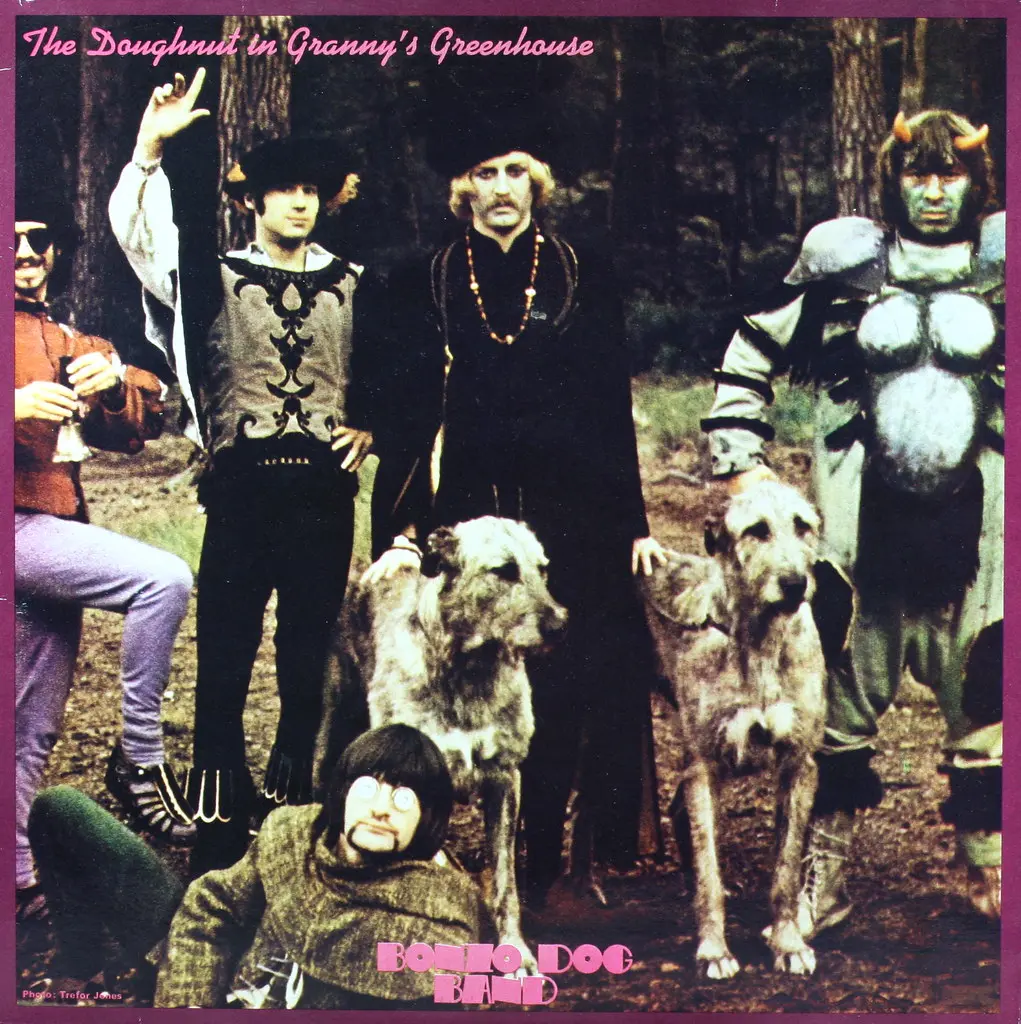 The Bonzo Dog Band released their second album, The Doughnut in Granny’s Greenhouse, in November 1968 on Liberty (UK) and Imperial (US).
Doughnut presents a stylistic shift from the group’s earlier music hall and jazz pastiche toward amplified satire rooted in contemporary psychedelia, electric blues, and avant-garde experimentation. The album emphasizes electric instrumentation and surrealist humor, pairing Innes’s structured songcraft with Stanshall’s theatrical monologues and character pieces. It marks the Bonzos’ first use of modern studio technology, reflecting a move toward layered production and tighter musical interplay.
Tracks such as “We Are Normal,” “Rhinocratic Oaths,” and “Can Blue Men Sing the Whites” deploy absurdism and sonic collage, while “My Pink Half of the Drainpipe” and “Trouser Press” show the band engaging with British domestic imagery and pop-cultural critique. Innes composed or co-composed the majority of the material, with Stanshall contributing original concepts and darkly comedic lyrics.
Guitar parts are handled by Neil Innes and Roger Ruskin Spear. Bass parts are played by Joel Druckman and possibly Dave Clague on select tracks. Larry Smith plays drums, congas, and contributes vocals and tap-dance elements. Neil Innes performs all keyboard parts, including piano, organ, harpsichord, Mellotron, and accordion. Stanshall contributes trumpet, tuba, euphonium, congas, bagpipes, and phonofiddle in addition to spoken-word vocals. Rodney Slater adds saxophones, trumpet, oboe, and trombone. Spear also plays clarinet, xylophone, glockenspiel, cornet, and accordion, and sings lead on “Trouser Press.”
A1. “We Are Normal” (4:49)
A2. “Postcard” (4:23)
A3. “Beautiful Zelda” (2:25)
A4. “Can Blue Men Sing the Whites” (2:49)
A5. “Hello Mabel” (2:46)
A6. “Kama Sutra” (0:40)
B1. “Humanoid Boogie” (3:03)
B2. “Trouser Press” (2:18)
B3. “My Pink Half of the Drainpipe” (3:34)
B4. “Rockaliser Baby” (3:32)
B5. “Rhinocratic Oaths” (3:22)
B6. “11 Moustachioed Daughters” (4:49)
Sessions took place at Morgan Studios in London with Gerry Bron and Gus Dudgeon producing. Engineers Andy Johns and Terry Brown supervised the recording, which utilized multitrack equipment to build layered arrangements and collage-like transitions. Vivian Stanshall provided the album’s cover artwork and sleeve notes. The original gatefold release included the message: “The noises of your bodies are a part of this record.”
In September 1968, Liberty issued “I’m the Urban Spaceman” backed with “Canyons of Your Mind” as a standalone single (LBF 15144). It reached No. 5 on the UK Singles Chart, becoming the band’s highest-charting release. Although not included on the original LP, the US version of the album—retitled Urban Spaceman—added the title track to capitalize on the single’s popularity.
The album charted modestly and has since gained retrospective attention for its inventive arrangements and satirical reach. EMI reissued the UK edition in 2007 with five bonus tracks: two previously unreleased covers (“Blue Suede Shoes,” “Bang Bang”), alternate versions of “Alley Oop” and “Mr. Apollo,” and the original single version of “Canyons of Your Mind.”
Tadpoles
 The Bonzo Dog Band released their third album, Tadpoles, in June 1969 on Imperial (US) and in August on Liberty (UK).
Tadpoles compiles material performed during the band’s tenure as house group on the ITV comedy series Do Not Adjust Your Set, with each track specially re-recorded in the studio for the LP. The album balances older novelty tunes and theatrical pastiche with original compositions rooted in psychedelic pop, jazz, and absurdist satire.
Stanshall and Innes share authorship on several tracks, including “Mr. Apollo” and “Canyons of Your Mind,” while Spear contributes two instrumentals. The band also revisits earlier jazz and novelty standards such as “Dr. Jazz,” “Ali-Baba’s Camel,” and “Monster Mash,” filtered through their distinct mix of musicality and humor. The tracklist differs between UK and US editions: the US version omits “I’m the Urban Spaceman” and includes the 1969 b-side “Readymades.” The UK version was later reissued under the title I’m the Urban Spaceman on Liberty’s budget imprint Sunset.
Guitar parts are performed by Neil Innes, who also plays piano and sings lead on several tracks. Dennis Cowan handles bass guitar throughout. Larry Smith plays drums and contributes rhythmic support. Keyboard parts are played by Innes. Roger Ruskin Spear and Rodney Slater alternate on saxophones, with Spear also contributing original compositions and effects. Vivian Stanshall sings lead vocals and performs on tuba and recorder.
A1. “Hunting Tigers Out in ‘Indiah'” (3:06)
A2. “Shirt” (4:27)
A3. “Tubas in the Moonlight” (2:23)
A4. “Dr. Jazz” (2:40)
A5. “Monster Mash” (2:59)
A6. “I’m the Urban Spaceman” (2:24)
B1. “Ali-Baba’s Camel” (3:31)
B2. “Laughing Blues” (3:44)
B3. “By a Waterfall” (3:09)
B4. “Mr. Apollo” (4:20)
B5. “Canyons of Your Mind” (3:04)
Sessions took place at Trident Studios in London with Gus Dudgeon producing. The band tracked new versions of songs previously performed for television, adjusting arrangements to studio conditions. The LP sleeve featured interactive artwork with seven die-cut holes and a movable image insert designed to show imagined thoughts of each band member.
On October 11, 1968, Liberty issued “I’m the Urban Spaceman” backed with “Canyons of Your Mind.” Written by Innes and produced by Paul McCartney under the pseudonym Apollo C. Vermouth, the single peaked at No. 5 on the UK chart and earned Innes an Ivor Novello Award. Liberty followed with “Mr. Apollo” and its b-side “Readymades” in mid-1969. EMI reissued Tadpoles in 2007 on CD with five bonus tracks, including “Boo!”—the only unused piece from the Do Not Adjust Your Set era—and outtakes like “Look At Me I’m Wonderful” and “The Craig Torso Christmas Show.”
Keynsham
 The Bonzo Dog Band released their fourth album, Keynsham, in November 1969 on Liberty.
Keynsham continues the band’s format of original parodies, musical satire, and sound collage, combining short thematic songs with spoken-word segments and surreal interludes. Neil Innes and Vivian Stanshall serve as joint producers, splitting composition duties across material that spans psychedelic pop, mock-orchestral balladry, and music hall burlesque. Roger Ruskin Spear contributes theremin effects and tape treatments, while Rodney Slater introduces cue-card absurdity and miniature arrangements.
Tracks such as “Mr. Slater’s Parrot” and “Noises for the Leg” extend the band’s theatrical and sound-effect driven sketches. The album opens with a reference to Horace Batchelor’s postal betting advertisements and ends with the seven-minute multipart suite “Busted.” Additional contributors include Gerry Salisbury on cornet for one track and various members assuming comic personas or instrumental oddities across the album.
Neil Innes plays guitar, piano, and sings on multiple tracks. Dennis Cowan handles bass guitar and serves as narrator alongside Stanshall. Larry Smith plays drums and appears as “Topo D. Bil” on later solo material. Roger Ruskin Spear provides saxophones, theremin, and percussion effects. Rodney Slater arranges specific sequences and contributes woodwinds. Stanshall sings lead on numerous tracks and appears as narrator, percussionist, and sonic instigator.
A1. “You Done My Brain In” (1:41)
A2. “Keynsham” (2:22)
A3. “Quiet Talks & Summer Walks” (3:38)
A4. “Tent” (3:06)
A5. “We Were Wrong” (2:33)
A6. “Joke Shop Man” (1:23)
A7. “The Bride Stripped Bare (By The Bachelors)” (2:40)
B1. “Look at Me, I’m Wonderful” (1:47)
B2. “What Do You Do?” (3:12)
B3. “Mr. Slater’s Parrot” (2:27)
B4. “Sport (The Odd Boy)” (3:31)
B5. “I Want to Be with You” (2:17)
B6. “Noises for the Leg” (1:54)
B7. “Busted” (5:48)
Sessions took place at Trident Studios with Barry Sheffield engineering. Innes and Stanshall produced the album, which included multiple spoken inserts and off-kilter arrangements performed live in-studio with limited overdubs. The packaging, designed by Stanshall, featured the warning “This record is inedible,” and presented track credits with mock scientific or anatomical attributions. Roger Ruskin Spear arranged the spoken interlude “Functions of the Body,” and Gerry Salisbury plays cornet on the closing track “Busted.”
Liberty issued three singles from the album sessions. “Mr. Apollo” backed with “Ready-Mades” appeared in early 1969 on LBF 15201. In August, Liberty followed with “I Want to Be with You” backed with “We Were Wrong” on LBF 15273. In early 1970, Liberty issued “You Done My Brain In” backed with “Mr. Slater’s Parrot” as LBF 15314. None of the singles charted in the UK.
EMI reissued Keynsham on CD in 2007 with five bonus tracks, all drawn from solo singles released after the album’s original issue. These include material credited to Vivian Stanshall & Kilgaron, Neil Innes, Roger Ruskin Spear, and Topo D. Bil, representing the group’s post-album solo activity rather than outtakes from the album’s sessions.
Let’s Make Up and Be Friendly
 The Bonzo Dog Band regrouped for a fifth album, Let’s Make Up and Be Friendly, released as a contractual obligation in March 1972 on United Artists.
Let’s Make Up and Be Friendly combines surrealist satire, sound collage, and studio experimentation in a loosely structured farewell project conceived after the band’s official breakup. Innes and Stanshall split production duties and reassembled the full lineup with support from auxiliary musicians.
The album includes compositions by all core members, along with co-writes and outside contributions, most notably the extended narrative “Rawlinson End,” which introduces Stanshall’s later solo alter ego Sir Henry Rawlinson. Several tracks feature orchestration, monologue-driven narratives, studio effects, and instrument-switching among players. Roger Ruskin Spear and Larry Smith each take lead vocals, while Tony Kaye co-produces and performs on the track “Rusty (Champion Thrust),” a stylized interlude distinct from the rest of the album.
Neil Innes plays piano, organ, guitar, and sings lead on multiple tracks. Dennis Cowan plays bass and contributes slide guitar and background voices. Dave Richards handles additional bass parts and contributes vocal interjections. Hughie Flint plays drums and percussion throughout most of the album. “Legs” Larry Smith drums and sings on “Rusty (Champion Thrust)” and “Waiting for the Wardrobe.” Roger Ruskin Spear contributes saxophones, xylophone, and sings lead on “Waiting for the Wardrobe.” Vivian Stanshall sings lead vocals and plays ukulele. Anthony “Bubs” White plays electric and Spanish guitar. Andy Roberts adds rhythm and acoustic guitar, mandolin, and effects. Tony Kaye plays piano and organ on “Rusty (Champion Thrust).” Dick Parry adds saxophones and flutes.
A1. “The Strain” (3:20)
A2. “Turkeys” (2:11)
A3. “King of Scurf” (4:56)
A4. “Waiting for the Wardrobe” (2:50)
A5. “Straight from My Heart” (3:05)
A6. “Rusty (Champion Thrust)” (8:07)
B1. “Rawlinson End” (9:31)
B2. “Don’t Get Me Wrong” (4:51)
B3. “Fresh Wound” (4:25)
B4. “Bad Blood” (5:10)
B5. “Slush” (2:20)
Recording took place in November 1971 at The Manor in Oxfordshire, shortly before the facility completed its full studio conversion. Neil Innes and Vivian Stanshall produced the sessions, with Tom Newman and Phil Newell engineering. “Rusty (Champion Thrust)” was recorded separately under the supervision of Smith and Kaye. Several band members rotated instruments or contributed sound effects and vocal inserts, while liner credits list unconventional roles such as “heavenly sqwarking” and “empyreal screaming.” Stanshall designed the packaging and wrote the sleeve notes.
United Artists issued “Slush” as a promotional single in the US with “King of Scurf” on the B-side. A withdrawn UK single (UP 35358) paired “Slush” with “Music from Rawlinson End” under Neil Innes’ name. The album charted briefly, peaking at No. 199 on the Billboard Top LPs & Tape chart in the US.
EMI reissued Let’s Make Up and Be Friendly in 2007 with six bonus tracks, including solo items by Topo D. Bil (Larry Smith), Roger Ruskin Spear, Neil Innes, and Vivian Stanshall, as well as early or alternate versions of Bonzo-era material. These additions reflect the post-band activities of individual members rather than archival outtakes from the original sessions.
Discography:
- Gorilla (1967 • Bonzo Dog Doo-Dah Band)
- The Doughnut in Granny’s Greenhouse (1968)
- Tadpoles (1969)
- Keynsham (1969)
- Let’s Make Up and Be Friendly (1972)
- Unpeeled (archival, 1995)
Sources:
Artist/Album Pages:
Mick Greenwood (born Feb. 13, 1951) is an English singer/songwriter from Potters Bar, Hertfordshir...
Birtha was an American soul-rock band from Los Angeles that released the 1972–73 albums Birtha and...
Francesco De Gregori (born April 4, 1951) is an Italian singer/songwriter who emerged in 1972 as o...
Eugene McDaniels (Feb. 12, 1935 – July 29, 2011) was an American soul singer from Kansas City, Ka...
Shelagh McDonald is a Scottish singer/songwriter who released two albums in 1970 and 1971 on B &am...
Gillian McPherson is an Irish singer/songwriter from Belfast who released the 1971 album Poets and...
Simon Dupree & The Big Sound were an English R&B–beat group from Portsmouth that released ...
May Blitz was an English–Canadian hard-rock trio that released two albums on Vertigo during 1970 a...
Archie Bell & The Drells were an American soul group from Houston that released three albums o...
Fever Tree was an American psych-rock band from Houston that released three albums on Uni in 1968...
The Mission are an English goth-rock band formed in Leeds in late 1985 by singer-guitarist Wayne H...
Egberto Gismonti (born Dec. 5, 1947) is a Brazilian pianist, guitarist, and composer from Carmo, R...