

Schicke Führs Fröhling (SFF) were a German symphonic-rock band that released three albums on Brain between 1976 and 1979. After the departure of drummer/percussionist Eduard Schicke, the remaining two continued as Führs & Fröhling.
Members: Eduard Schicke (drums, percussion, Moog, metallophone, xylophone), Gerd Führs (grand piano, electric piano, Moog, clavinet, Mellotron, ARP Solina string ensemble, basset horn), Heinz Fröhling (bass, acoustic guitar, electric guitar, Mellotron, clavinet, ARP Solina string ensemble)
Background
In 1974, drummer Eduard Schicke (b. 1947) and guitarist Heinz Fröhling (b. 1951) played in the symphonic-rock quartet Spektakel. Though they didn’t make a proper album, they were a popular draw in northern Germany. That September, they recorded three lengthy studio tracks at Spektakel Studio, Steenfelde (later paired with a 20-minute live number on an archival CD by Laser’s Edge). They also served as the backing band on the album Wie Jedermann Geboren Und Gestorben by singer/songwriter Ulrich Cop.
Keyboardist Gerd Führs (1955–1992), then in a jazz-rock band called Sampsel, caught Spektakel live and approached Schicke and Fröhling after the show. After witnessing Führs’ abilities, they decided to form a trio. They rehearsed for six months in a studio farm where they lived communally and honed their sound and repertoire. In 1975, they made their live premiere before 5,000 attendees of the German Rock Festival, Circus Krone, Munich. Metronome Records signed the trio and tapped Frank Zappa as their producer. Due to scheduling conflicts, they ultimately linked with producer Dieter Dierks (Wallenstein, Tea, Atlantis, Scorpions).
Symphonic Pictures
 Schicke Führs Fröhling released their debut album, Symphonic Pictures, in October 1976 on Brain.
The album presents an expansive interplay between guitarist Heinz Fröhling and keyboardist Gerhard Führs, with textured exchanges that contrast Mellotron lines against clipped Clavinet figures and arcing Moog flourishes. Percussionist Eduard Schicke anchors the shifting dynamics with accents on vibraphone, xylophone, and phased Moog overlays that echo, mirror, or rupture the linear flow of the arrangements.
On Symphonic Pictures, Schicke Führs Fröhling build long-form instrumentals around dense Mellotron architecture, with recurring themes that lock into place through abrupt pivots and carefully staged dynamic lifts. “Tao” opens with an extended Mellotron-only prelude, then shifts into a brisker sequence of interlinked motifs where guitar phrases and keyboard choirs trade prominence until a more forceful central section tightens the pulse and raises the intensity. “Solution” and “Sundrops” function as shorter breathers, leaning on softer pacing and lighter textures—acoustic guitar, xylophone/vibraphone colors, and slow-moving keyboard layers—before “Dialog” widens the language again with intricate drumming, darting timbral changes, and a mid-track arrival point where the material snaps into a darker, more angular contour driven by repeated keyboard figures and intensified guitar response.
Across Side B, “Pictures” stretches the band’s vocabulary into its largest arc: ominous Mellotron choirs and haunted atmospheres give way to marching, pulse-driven passages with rising keyboard waves, then a pronounced drop into quieter terrain where piano lines surface and the arrangement rebuilds in layered steps toward a full, heavy crest near the end. The trio group-wrote all five tracks.
A1. “Tao” (8:36)
A2. “Solution” (2:51)
A3. “Dialog” (5:30)
A4. “Sundrops” (2:23)
B1. “Pictures” (16:23)
Dieter Dierks produced the album at his Stommeln studio with arrangement input from the band. Jan Vermeulen supplied the cover photography. Metronome Records GmbH managed distribution and manufacturing.
Sunburst
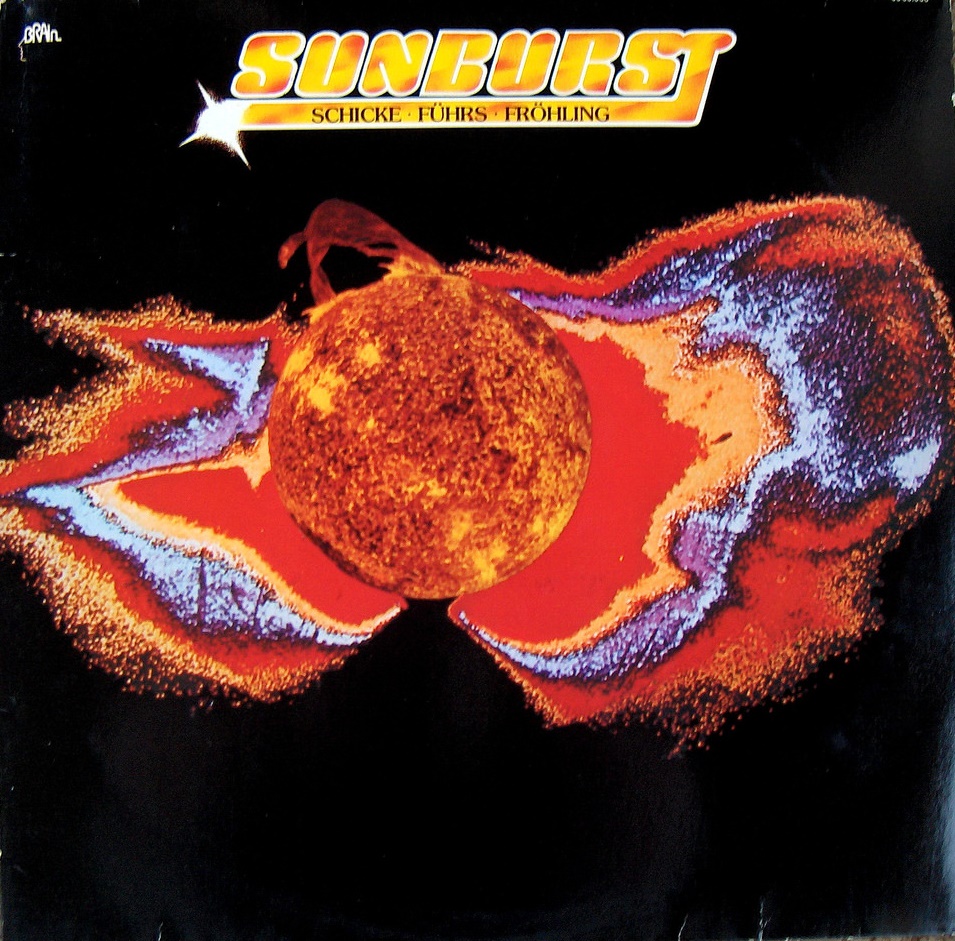 Schicke Führs Fröhling released their second album, Sunburst, in September 1977 on Brain.
Framed by tighter arrangements and more compact structures than its predecessor, the album retains the fluid dialogue between electric guitar and layered keyboard textures. Guitarist Heinz Fröhling alternates between acoustic, electric, and clavinet timbres, weaving through synthesizer sequences and Mellotron voicings by Gerhard Führs, whose interplay pivots between sharp electric piano runs and sustained stringensemble pads.
On Sunburst, Schicke Führs Fröhling pivot toward looser, more improvisation-forward structures, shifting quickly between brisk fusion-like motion and slower, atmospheric stretches where keyboards hang in long layers over soft percussion detail. “Wizzard” sets that agenda with uptempo momentum, quick tempo turns, and sharp interlocks between electric guitar and Mellotron, while “Autumn Sun in Cold Water” pulls the energy down into a spacious, keyboard-led drift with prominent drum detail and a lighter surface. “Artificial Energy” moves at a measured pace, built on watery arpeggios and sustained textures, with somber, Fripp-like guitar lines cutting through the haze.
“Driftin’” keeps the mood-change principle in constant motion, flipping meters and feel while clavinet stabs and synth pads trade foreground space, and “Troja” expands into the album’s most dramatic arc—motifs cycle and mutate, Mellotron arrives partway in, then the arrangement drives toward a heavier, more forceful closing run. “1580” opens with piano and gradually thickens as Moog phrases and drum accents rise and fall in waves, and “Explorer” starts in electronic shadow before the track locks into a firmer pulse, with Mellotron-led surges pushing the final minutes into a denser, higher-intensity finish.
A1. “Wizzard” (4:25) – Führs, Fröhling
A2. “Autumn Sun In Cold Water” (4:46) – Fröhling
A3. “Artificial Energy” (5:30) – Schicke, Führs, Fröhling
A4. “Driftin’” (3:15) – Führs, Fröhling
B1. “Troja” (7:20) – Fröhling
B2. “1580” (5:15) – Fröhling
B3. “Explorer” (4:55) – Führs, Fröhling
SFF recorded the album in August 1977 at Dierks Studios under the production and mixing supervision of Dieter Dierks. Engineering duties were shared by Gerd Rautenbach and Heinz Friesz. Breeze Music handled publishing, and Metronome Musik GmbH managed manufacturing and marketing. Label text on Sunburst differs from its predecessor, listing “metronom musik gmbh” rather than “metronome records gmbh.” A-side label credits track A3 as “Artifical Energy.”
Ticket to Everywhere
 SFF released their third album, Ticket to Everywhere, in February 1979 on Brain.
The album tightens their melodic focus around compact structures while preserving the intricate exchanges between guitarist Heinz Fröhling and keyboardist Gerhard Führs, who trade lines across electric piano, string ensemble synths, and Mellotron layers. Fröhling threads acoustic and electric figures through shifting harmonic textures, met with sweeping counterlines and pulse variations shaped by Führs’ modular overlays and Moog phrasing. Fröhling composed everything apart from “Here and Now,” a Führs co-write.
On Ticket to Everywhere, Schicke Führs Fröhling embrace shorter structures and cleaner textures, shifting toward a lighter, synthesized atmosphere punctuated by sudden tempo shifts and animated keyboard leads. “Open Doors” sets the tone with phased electric piano, layered synths, and a contoured flow built around syncopated transitions. “Song From India” adds a rare vocal passage—delivered with soft projection—and places its rhythm section in a bright, pulsing frame, colored by looped keyboard lines and midrange guitar. The title track moves through multiple sections, with abrupt breaks and clustered synth accents that steer the piece into asymmetrical territory before recentering on a clipped rhythmic cadence.
“Spain Span Spanish” places its detail in dry textures and mechanical precision, with Moog squelches and active drumming underscoring clipped melodic cells. “Slow Motion” stretches over eight minutes of fluid pacing, cycling between slow rises and quiet plateaus, its moody synth phrasing and low-end presence giving the piece a drifting quality. “Folk ’n Roll” closes with brisk motion and light surface interplay, its layered sequencing and looped phrasing kept taut by fast cymbal work and sudden instrumental shifts.
A1. “Open Doors” (5:30)
A2. “Song From India” (4:21)
A3. “Ticket to Everywhere” (3:47)
A4. “Spain Span Spanish” (4:02)
B1. “Here and Now” (5:49) – Führs, Fröhling
B2. “Slow Motion” (8:06)
B3. “Folk ‘n Roll” (4:20)
Bonus tracks:
8. “Every Land Tells A Story” (Live) (4:03)
9. “Explorer / Wizzard” (Live) (10:24)
10. “Ticket To Everywhere” (Live) (2:47)
Tracks 1–7 were recorded at Dierks Studio, Stommeln, with Dieter Dierks producing and Heinz Friesz engineering. Breeze Music published the material. Tracks 8 and 9 were recorded live at the Brain Festival, Grugahalle Essen, on February 24–25, 1978, using the Dieter Dierks Mobile Recording Unit. Track 10 stems from a November 1978 performance at Gewächshaus, Westerstede. Cherry Red reissued the album in 2010 on Esoteric Recordings, remastered by Paschal Byrne from 24-bit digital transfers at The Audio Archiving Company, London.
Live 1975
In 2002, Nordsee Records issued Live 1975, a document of the pre-record Schicke Führs Fröhling.
The set captures extended interplay between guitarist Heinz Fröhling and keyboardist Gerhard Führs, who engage in shifting textures across Mellotron, Rhodes, Moog, and basset keyboard voicings. Fröhling’s electric lines thread in and out of Führs’ sustained pads and counter-harmonics, while the improvisational framework expands during modal passages anchored by the duo’s dynamic phrasing and timbral contrast.
1. “Tao” (9:25) – Schicke, Führs, Fröhling
2. “Dialog” (7:20) – Schicke, Führs, Fröhling
3. “Gedankenspiel” (8:52) – Schicke, Führs, Fröhling
4. “Modimidofre” (27:44) – Schicke, Führs, Fröhling
5. “Prickel Pit” (6:02) – Schicke, Führs, Fröhling
6. “Ammernoon” (5:14) – Fröhling
7. “Dadadam” (4:51) – Fröhling
Bonus
8. “Ticket To Everywhere” (3:32) – Fröhling
Tracks 1–7 were recorded live in Papenburg during autumn 1975. Track 8 was recorded in November 1978 at Gewächshaus, Westerstede. Nordsee Records produced and released the album, with publishing split between Breeze Music Switzerland and Little Felix Musikverlag. Kai Liedtke designed the cover and graphics.
Discography:
- Symphonic Pictures (1976)
- Sunburst (1977)
- Ticket to Everywhere (1979)
- Live 1975 (2002)
Sources:
- Discogs: Schicke Führs Fröhling
- RYM: Schicke Führs Fröhling
- ProgArchives: Schicke Führs Fröhling
- MusicBrainz: Schicke Führs Fröhling
Artist/Album Pages:
Itoiz was a Spanish symphonic-folk band from the Basque coastal towns of Mutriku and Ondarroa that...
Gordon Lightfoot (November 17, 1938 – May 1, 2023) was a Canadian singer/songwriter, best known fo...
Lea Roberts is an American soul singer who cut five singles between 1969 and 1972, followed by th...
Giant Step was an Indonesian symphonic/hard-rock band that released seven cassette albums between ...
P.P. Zahl was a German symphonic-rock project named after an imprisoned author, whose poetry becam...
Sylvia Robinson (May 29, 1935 — September 29, 2011) was an American singer, songwriter, producer, ...
Cybotron was an Australian electronic combo from Melbourne that released a 1976 self-titled album ...
Alkana was an American symphonic/hard-rock band from San Bernardino that self-released the 1978 al...
Aera was a German jazz-rock band that cut the 1975–79 Erlkönig titles Humanum est, Hand und Fuß, a...
First Light was an Australian jazz-rock band that self-released a 1978 eponymous album on M.F.S. ...
Jack McDuff (September 17, 1926 — January 23, 2001) was an American soul-jazz/funk organist. He r...
Georges Rodi is a French studio musician who released numerous library albums between 1975 and 198...