

Ronnie Dyson (1950–1990) was an American soul singer and actor who released five albums between 1970 and 1979 on Columbia and two further albums in 1982–83 on Cotillion. He scored three Billboard R&B Top 10 hits: “I Don’t Wanna Cry,” “(If You Let Me Make Love to You Then) Why Can’t I Touch You?” (both 1970) and “The More You Do It (The More I Like It Done to Me)” (1973).
Background
Ronald Dyson was born on June 5, 1950, in Washington, D.C., and grew up in Brooklyn, where he sang in church choirs. At eighteen, he joined the original Broadway cast of Hair and led “Aquarius” when the production opened in April 1968 at the Biltmore Theatre.
Dyson appeared in Robert Downey Sr.’s 1969 film Putney Swope and returned to the stage in Salvation. RCA issued “Aquarius” under the billing Ronald Dyson and Company. Columbia followed in October 1969 with “God Bless the Children,” credited to Ron Dyson.
The label retained Dyson and assigned producer Billy Jackson, whose prior work included the Tymes. Jackson supervised “(If You Let Me Make Love to You Then) Why Can’t I Touch You?,” adapted from the Salvation score, and Columbia issued the recording in February 1970 as Dyson’s first single under his established stage name.
(If You Let Me Make Love to You Then) Why Can’t I Touch You?
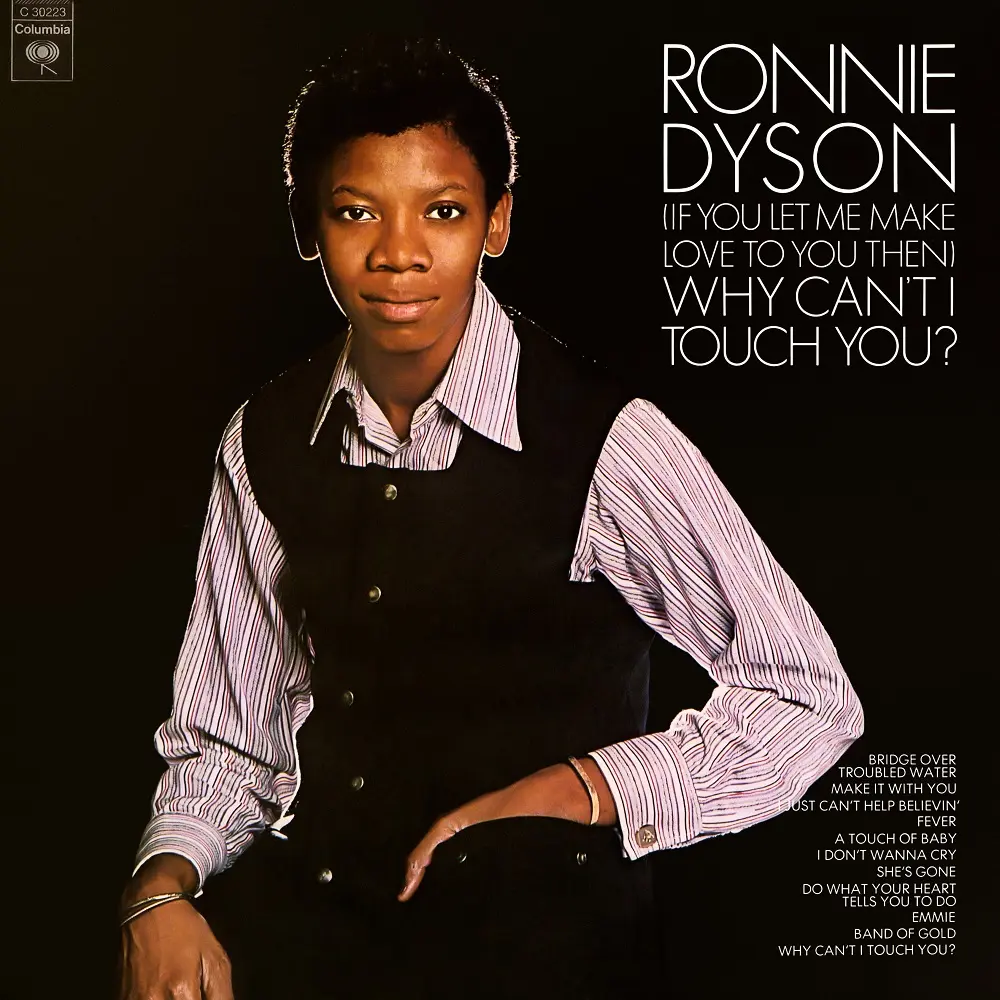 Ronnie Dyson released his debut album, (If You Let Me Make Love to You Then) Why Can’t I Touch You?, in August 1970 on Columbia.
Billy Jackson paired selections from Salvation with contemporary pop and soul material. Dyson revisits songs recorded by Chuck Jackson (“I Don’t Wanna Cry”), the Tymes (“A Touch of Baby”), Laura Nyro (“Emmie”), and B.J. Thomas (“I Just Can’t Help Believin’”). The program also draws from Freda Payne (“Band of Gold”), Bread (“Make It with You”), Peggy Lee (“Fever”), and Simon & Garfunkel (“Bridge over Troubled Water”). Jimmy Wisner arranged most of the program; Thom Bell scored “Make It with You,” and Ellen Starr arranged the title track.
“(If You Let Me Make Love to You Then) Why Can’t I Touch You?” rises from controlled pleading into theatrical fervor as Dyson shapes each appeal with smooth, impassioned control. “Band of Gold” quickens through a brisker reading as Dyson holds each phrase in smooth, firm control. “Fever” races through a restless arrangement as Dyson sustains each phrase with fervor.
A1. “I Don’t Wanna Cry” (3:00) – Chuck Jackson, Luther Dixon
A2. “Emmie” (3:14) – Laura Nyro
A3. “A Touch of Baby” (2:15) – Bobby Bloom, Jon Linde, Paul Antell
A4. “I Just Can’t Help Believin’” (2:46) – Barry Mann, Cynthia Weil
A5. “She’s Gone” (3:26) – Billy Jackson, Richie Rome
A6. “Band of Gold” (2:47) – Ronald Dunbar, Edythe Wayne
B1. “(If You Let Me Make Love to You Then) Why Can’t I Touch You?” (3:25) – C.C. Courtney, Peter Link
B2. “Make It with You” (3:24) – David Gates
B3. “Fever” (2:36) – Eddie Cooley, John Davenport
B4. “Do What Your Heart Tells You to Do” (2:05) – Billy Jackson, Jimmy Wisner
B5. “Bridge over Troubled Water” (5:25) – Paul Simon
Jackson produced the album with sound supervision by Warren Vincent. Engineers Stan Tonkel and Stan Weiss recorded the sessions; their Columbia work from the same period also included Miles Davis projects. The label’s photo studio supplied the cover image, which presents a close monochrome portrait of Dyson with his chin resting on one hand.
Columbia issued the title track in February 1970 (b/w “Girl Don’t Come”); the single reached No. 8 on the Billboard Hot 100 and No. 9 on the R&B chart. “I Don’t Wanna Cry” followed in October (b/w “She’s Gone”) and reached No. 50 on the Hot 100 and No. 9 on the R&B chart.
The album reached No. 55 on the Billboard 200 and No. 12 on the R&B albums chart. SoulMusic Records expanded the album into Lady in Red: The Columbia Sides Plus on a 2014 CD with twelve single sides and previously uncollected recordings.
One Man Band
 Ronnie Dyson released his second album, One Man Band, in March 1973 on Columbia.
Thom Bell produced four new selections with lyricist Linda Creed, while the balance combines earlier Billy Jackson and Stan Vincent sessions. Dyson interprets material known through the Delfonics (“When You Get Right Down to It”), the Guess Who (“A Wednesday in Your Garden”), the Beatles (“Something”), Sandie Shaw (“Girl Don’t Come”), and Samantha Sang (“The Love of a Woman”). Creed remixed the older masters to connect both recording periods.
“One Man Band (Plays All Alone)” soars across plush orchestration and regal harmonies as Dyson turns self-reliant bravado toward isolation. “Just Don’t Want to Be Lonely” laments amid stately phrasing as strings and horn accents deepen a breakup plea. “I Think I’ll Tell Her” shuffles through wistful introspection as a light rhythmic sway carries quiet confession. “Give In to Love” blooms from subtle orchestration into a broad refrain, where Dyson’s rich lead meets choir-like harmonies.
“When You Get Right Down to It” swells through melodramatic rises as Dyson projects each appeal with full-throated authority. “Point of No Return” drives through punchy turns and a brisk rhythmic line. “A Wednesday in Your Garden” surges into an emphatic refrain as Dyson lifts each return with theatrical projection.
A1. “One Man Band (Plays All Alone)” (3:38) – Thom Bell, Linda Creed
A2. “I Think I’ll Tell Her” (4:04) – Bell, Creed
A3. “Just Don’t Want to Be Lonely” (3:11) – Vinnie Barrett, Bobby Eli, John Freeman
A4. “Give In to Love” (4:51) – Bell, Creed
A5. “When You Get Right Down to It” (2:47) – Barry Mann
B1. “A Wednesday in Your Garden” (3:17) – Randy Bachman
B2. “Something” (2:49) – George Harrison
B3. “Girl Don’t Come” (2:45) – Chris Andrews
B4. “Point of No Return” (2:08) – Bell, Creed
B5. “The Love of a Woman” (2:41) – Neil Sedaka, Howard Greenfield
Bell produced and arranged A1–A4. Vincent produced A5, B1, and B4, while Jackson handled the remaining selections. The original sleeve supplies no recording-engineer credit for the Bell sessions. Bell entered the project amid contemporary productions for the Spinners and the Stylistics.
Roger Williams designed the blue-gray portrait sleeve, which places Dyson in a dark jacket beneath a compact white title block. Williams also supplied artwork for 1973 albums by Labelle and the Dramatics.
Columbia lifted “One Man Band (Plays All Alone)” in January 1973 (b/w “I Think I’ll Tell Her”); the single reached No. 28 on the Hot 100, No. 15 on the R&B chart, and No. 16 on the Easy Listening chart. “Just Don’t Want to Be Lonely” followed in May (b/w “Point of No Return”) and reached No. 60 on the Hot 100, No. 29 on the R&B chart, and No. 30 on the Easy Listening chart.
The album reached No. 142 on the Billboard 200 and No. 34 on the R&B albums chart. Purpose Music Vaults issued an expanded CD in 2012 with six additional single sides; Sean Brennan remastered the program from Columbia two-track masters at Battery Studios.
The More You Do It
 Ronnie Dyson released his third album, The More You Do It, in October 1976 on Columbia.
Chuck Jackson and Marvin Yancy moved Dyson into their Chicago production unit. The album takes in Leon Russell’s “A Song for You,” Major Harris’s “Love Won’t Let Me Wait,” and the Bee Gees’ “Jive Talkin’.” Gene Barge directed the rhythm arrangements, while Gene Page and Richard Evans divided the orchestral charts across original material and outside songs.
“The More You Do It (The More I Like It Done to Me)” steps along a gentle midtempo pattern and settles warm phrases into an intimate refrain. “You and Me” sways with unhurried motion as full-bodied backing supports personal phrasing. “Close to You” glides beneath lush orchestration and warm, personal phrasing.
“Love Won’t Let Me Wait” lingers over a gentle midtempo sway and sustains warm lines across a measured refrain. “Lovin’ Feelin’ Won’t You Come Stay with Me” settles into a soft rhythmic step and personal phrasing.
A1. “A Song for You” (4:53) – Leon Russell
A2. “Close to You” (2:55) – Chuck Jackson, Marvin Yancy
A3. “The More You Do It (The More I Like It Done to Me)” (3:10) – Jackson, Yancy
A4. “You Set My Spirits Free” (6:48) – Jackson, Yancy
B1. “You and Me” (3:12) – Jackson, Yancy
B2. “Love Won’t Let Me Wait” (3:37) – Vinnie Barrett, Bobby Eli
B3. “Lovin’ Feelin’” (3:23) – Billy Jackson
B4. “Won’t You Come Stay with Me” (3:27) – Jackson, Yancy
B5. “Jive Talkin’” (2:59) – Barry Gibb, Maurice Gibb, Robin Gibb
Jackson and Yancy produced sessions at P.S. Recording Studios and Curtom Studios in Chicago. Fred Breitberg and Paul Serrano engineered the recordings, and Steve Hodge remixed the album. Before the Dyson sessions, Jackson and Yancy produced Natalie Cole’s first albums and records by the Independents.
Ed Lee and CBS art director Paula Scher designed the sleeve; Frank Laffitte supplied the portrait photography. Scher’s 1976 CBS assignments also included Boston and Fifty Years of Jazz Guitar, while Laffitte photographed the same-year Wild Cherry cover.
Columbia issued “The More You Do It (The More I Like It Done to Me)” in June 1976 (b/w “You and Me”); the single reached No. 62 on the Hot 100 and No. 6 on the R&B chart. “(I Like Being) Close to You” followed in November (b/w “Lovin’ Feelin’”) and reached No. 75 on the R&B chart.
The album reached No. 30 on the R&B albums chart. Expansion paired the album with Love in All Flavors on a 2012 twofer for the Soul Together imprint.
Love in All Flavors
 Ronnie Dyson released his fourth album, Love in All Flavors, in October 1977 on Columbia.
Chuck Jackson and Marvin Yancy retained their Chicago production unit, while Gene Barge arranged the nine-track program. Dyson covers “I Want to Be Where You Are,” first recorded by Michael Jackson, and the Hall & Oates ballad “Sara Smile.”
“Don’t Be Afraid” bounces from firm piano figures into energetic rises as Dyson brightens each appeal with supple phrasing. “Ain’t Nothing Wrong” blooms from intimate balladry into church-rooted fervor as Dyson turns a plain declaration into a grand plea.
A1. “I Want to Be Where You Are” (3:28) – Leon Ware, Arthur Ross
A2. “Ain’t Nothing Wrong” (4:11) – Chuck Jackson, Marvin Yancy
A3. “Don’t Be Afraid” (3:36) – Jackson, Yancy
A4. “I Just Want to Be There” (3:22) – Jackson, Yancy
A5. “No Way” (4:21) – Jackson, Yancy
B1. “Sara Smile” (5:03) – Daryl Hall, John Oates
B2. “Just as You Are” (3:25) – Jackson, Yancy
B3. “I Can’t Believe That” (3:23) – Jackson, Yancy
B4. “You’re Number One” (3:38) – K. Echols, A. Sanderson
Jackson and Yancy produced the sessions at P.S. Recording Studios in Chicago. Bruce Swedien, Paul Serrano, and Scott Rowley recorded and engineered the album, while Barney Perkins completed the remixes. Swedien’s contemporary work included sessions with Quincy Jones and Chicago; Serrano returned from the prior Dyson album.
Paula Scher designed the sleeve with photography by Jerry Abramowitz. Scher remained one of CBS Records’ principal cover designers. Abramowitz came to the sleeve after photographing Billy Joel’s Turnstiles.
Columbia lifted “Don’t Be Afraid” in September 1977 (b/w “I Just Want to Be There”); the single reached No. 30 on the R&B chart. “Ain’t Nothing Wrong” followed in December (b/w “Just as You Are”) and reached No. 77 on the same chart, while “Sara Smile” appeared as a March 1978 single (b/w “No Way”).
The album reached No. 45 on the R&B albums chart. Expansion paired it with The More You Do It on a 2012 twofer for the Soul Together imprint.
If the Shoe Fits
 Ronnie Dyson released his fifth album, If the Shoe Fits, in July 1979 on Columbia.
Michael Zager produced five selections with a New York session cast that included guitarist Hiram Bullock, bassist Neil Jason, drummer Steve Jordan, and trumpeters Randy Brecker and Jon Faddis. Eugene McDaniels produced the remaining pair, “Everything You Need” and “Long Distance Lover.”
“If the Shoe Fits (Dance in It)” glides across buoyant floor motion as female replies brighten Dyson’s silky lead. “So in Love with You” twirls through a breezy dance step and sustained romantic phrasing. “Couples Only” bounces on a bright, rolling figure as Dyson carries invitation with an easy tenor.
“Hide Behind Music” shimmers through an urbane dance arrangement with a smooth, extended lead. “Everything You Need” saunters through an unhurried, mellow step as Dyson deepens each phrase with measured warmth.
A1. “If the Shoe Fits (Dance in It)” (4:41) – Alvin Fields, David Frank, Dennis James
A2. “So in Love with You” (5:32) – Alvin Fields, Michael Zager
A3. “Couples Only” (6:18) – Dennis James, Tony Christopher
B1. “Hide Behind Music” (5:54) – Alvin Fields, David Frank
B2. “Familiar Strangers” (3:58) – Dennis James, Tony Christopher
B3. “Everything You Need” (3:25) – Alan Silvestri, Eugene McDaniels
B4. “Long Distance Lover” (3:31) – Charles Nolen, Rachel Crossley
Zager produced A1 through B2, while McDaniels produced the final two selections. Bob Carbone, Doug Rider, Eric Breekha, and Jack Malken engineered the sessions. Zager issued Life’s a Party with the Michael Zager Band in the same year, and several members of that studio circle also appear on Dyson’s album.
Andrea Klein and Columbia art director John Berg designed the sleeve with photography by Duane Michals. Berg came to the project after Grammy-recognized Columbia packages for Chicago and Ramsey Lewis. Michals brought his established sequence and portrait practice to the Dyson photograph.
Columbia issued “Couples Only” in 1979 (b/w “Long Distance Lover”). The label followed in June with a promotional twelve-inch of “If the Shoe Fits (Dance in It),” using the full album version on both sides.
Phase 2
 Ronnie Dyson released his sixth album, Phase 2, in March 1982 on Cotillion.
Bobby Eli oversaw Dyson’s first album outside Columbia and divided the work between Philadelphia and New York. “Expressway to Your Heart” revisits the Soul Survivors hit. Eli arranged the rhythm, horn, and string parts, while Richie Rome supplied additional orchestral charts; Ray Chew, Cotton Kent, and Peter Cannerozzi covered the principal keyboard roles.
“Bring It on Home” charges through brassy accents and swinging strings as female replies circle Dyson’s assertive lead. “Heart to Heart” slinks through a sleek midtempo pattern as Dyson shapes each line with insinuating restraint. “One More Chance for the Fool” swings through supple verses before Dyson releases each return with theatrical fervor. “Say You Will” pleads across slow, full backing as Dyson stretches each appeal toward emotional strain.
“Even in the Darkest Night” smolders through an unhurried roll and intimate phrasing. “Foreplay” simmers through a heated dance step as Dyson leans into playful suggestion. “I Found Someone” settles into smooth romance with controlled tenor and softened replies.
A1. “Bring It On Home” (4:10) – Eltesa Weathersby, Frank Fuchs, Gavin Spencer
A2. “Heart to Heart” (4:13) – Eban Kelly, Charles Williams
A3. “One More Chance for the Fool” (4:10) – Bobby Eli, Arlene J. Matza
A4. “Say You Will” (5:08) – Sam Culley
B1. “Expressway to Your Heart” (4:22) – Kenny Gamble, Leon Huff
B2. “Now” (3:35) – Allee Willis, Patrick Henderson
B3. “Even in the Darkest Night” (4:05) – Eli, Matza
B4. “Foreplay” (5:01) – Eli, Jeff Prusan
B5. “I Found Someone” (3:46) – Timothy Wright
Producer Bobby Eli directed the sessions, with Bobby Warner engineering rhythm tracks and the final mix. Gene Leone recorded the horns and strings, Ken Bloom handled Dyson’s lead parts, and Jason Lyle and Bill Dooley assisted. Eli arrived after production and arrangement work for Atlantic Starr and Keith Barrow.
Lynn Dreese Breslin directed the sleeve with design by Roger Williams and photography by Gary Heery. The photographer opened a Soho studio in 1981 after photographing Rory Gallagher’s Photo-Finish. Repeated monochrome figures flank Dyson against a divided red-and-blue field.
Cotillion issued “Bring It On Home” in March 1982 (b/w “Heart to Heart”); the single reached No. 66 on the R&B chart. “Heart to Heart” also received a promotional single in May and reached No. 57 on the same chart.
Real Gone Music paired Phase 2 with Brand New Day on a two-album CD released in September 2014 through the SoulMusic series.
Brand New Day
 Ronnie Dyson released his seventh album, Brand New Day, in August 1983 on Cotillion.
Butch Ingram built the sessions around members of Ingram, with Barbara Ingram sharing the lead on “Let the Love Begin.” Dyson wrote “Tender Loving Care,” while Butch, John, Robert, Jimmy, and Barbara Ingram supplied six more selections.
“All Over Your Face” percolates beneath an insinuating accusation as synthesizers bubble and percussion locks a nonstop beat. “Don’t Need You Now” pulses through bright electronic figures and a steady floor pattern. “Waiting for You” hushes after a spoken entrance as spare backing clears room for intimate calls and female replies.
“Tender Lovin’ Care” settles into a tender promise as huskier phrasing softens each appeal. “I Need Just a Little More Lovin’” struts through bluesy, mechanical swing as Dyson roughens his tenor. “I Gave You All of Me” unfurls from bare piano into understated confession. “You Better Be Fierce” coils around dense repeating figures before a spoken exhortation breaks into a buoyant club chant.
A1. “All Over Your Face” (6:09) – Butch Ingram
A2. “Let the Love Begin” (3:53) – Joe Russo
A3. “Don’t Need You Now” (4:25) – Robert Ingram
A4. “Waiting for You” (5:05) – Butch Ingram
B1. “Tender Loving Care” (3:42) – Ronnie Dyson
B2. “I Need Just a Little More Lovin’” (4:22) – John Ingram
B3. “I Gave You All of Me” (2:53) – Jimmy Ingram
B4. “You Better Be Fierce” (5:13) – Barbara Ingram, Butch Ingram
Butch Ingram produced the album at Starr Recording Studio in Philadelphia, where Dirk Devlin engineered the sessions. Engineer Butch Jones handled “All Over Your Face,” and John Morales and Sergio Munzibai mixed the single. Ingram brought the family group’s studio personnel directly into Dyson’s Cotillion sessions.
Bob Defrin directed the sleeve with photography by David Michael Kennedy. Defrin’s Atlantic work from the surrounding period included Back in Black and We Are Family. Kennedy came to the sleeve after music-industry portraits of Muddy Waters and Loverboy.
Cotillion issued “All Over Your Face” in August 1983 (b/w “Don’t Need You Now”); the single reached No. 23 on the R&B chart and No. 16 on the Dance Club chart. “You Better Be Fierce” followed in October (b/w “I Need Just a Little More Lovin’”).
The album reached No. 53 on the R&B albums chart. Real Gone Music included the complete program on the 2014 Phase 2/Brand New Day twofer.
Later Activity
Dyson supplied the singing voice for “Nola” in Spike Lee’s She’s Gotta Have It. Ardent issued his final solo single, “See the Clown” b/w “Shine,” in July 1990 through the Memphis label.
Heart failure ended Dyson’s life on November 10, 1990, at age forty. Society Hill released “Are We So Far Apart (We Can’t Talk Anymore),” a duet with Vicki Austin, in 1991; the recording reached No. 79 on the R&B chart.
Discography:
- If You Let Me Make Love to You Then Why Can’t I Touch You? (1970)
- One Man Band (1973)
- The More You Do It (1976)
- Love in All Flavors (1977)
- If the Shoe Fits (1979)
- Phase 2 (1982)
- Brand New Day (1983)
Sources:
- Discogs: Ronnie Dyson
- 45worlds: Ronnie Dyson
- 45cat: Ronnie Dyson
Artist/Album Pages:
Darryl Way’s Wolf was an English jazz-rock band responsible for the 1973–74 Deram albums Canis Lup...
Juicy Lucy was an English blues-rock band that released the 1969–70 Vertigo albums Juicy Lucy and ...
This Heat was an English avant-garde rock trio that made the 1979–81 titles This Heat, Health and ...
Crane was an American hard-rock recording project built around singer and guitarist Chuck Kirkpat...
Living Life was an Italian symphonic/jazz-rock band that established Shirak Records for the 1975 a...
Emmanuel Booz (born 1943) is a French symphonic/folk singer and composer who released four albums ...
Sweet Charles — aka Charles Emanuel Sherrell (born March 8, 1943) — is an American soul singer fro...
Instant Funk was an American soul-funk band that released the 1976 TSOP album Get Down With the Ph...
Joe O'Donnell (born Sept. 4, 1948) is an Irish violinist who played with various folk and rock ban...
Fashion was an English new wave trio (later quartet) that released three albums and a clutch of sing...
Nite People was an English jazz-rock/psych band behind the 1969 album P.M. on Page One. Members...
Catharsis was a French jazz-rock/psych band that made two albums in 1971/72 on Saravah, followed ...