

Ramatam was an American hard-rock band that released two albums on Atlantic: Ramatam (1972) and In April Came the Dawning of the Red Suns (1973).
Members: April Lawton (lead guitar), Mitch Mitchell (drums), Mike Pinera (guitar), Russ Smith (bass, vocals), Tommy Sullivan (keyboards, reeds, vocals), Jimmy Walker (percussion, vocals)
Background
Ramatam formed in 1971 when guitarist Mike Pinera teamed with keyboardist Tommy Sullivan and English drummer Mitch Mitchell.
Pinera started in the Tampa, Fla., post-psych band Blues Image and played on their first two albums, the 1969/70 ATCO releases Blues Image and Open. The latter spawned the hit “Ride Captain Ride,” a Pinera co-write. He jumped ship to ATCO labelmates Iron Butterfly in time for their 1970 release Metamorphosis. Concurrently, he played on another ATCO title, Moments by folk singer Judy Mayhan.
Sullivan hailed from The Brooklyn Bridge, a Manhattan pop-vocal ensemble that scored a 1969 Billboard #1 with “The Worst That Could Happen.” He performs on their first three albums, released on Buddah between 1968 and 1970.
Mitchell, originally from Ealing, Middlesex, got his first gig in R&B/beatsters Georgie Fame & the Blue Flames. His big break came when American guitarist Jimi Hendrix chose Mitchell for the Experience. Mitchell played on the three Experience albums: Are You Experienced, Axis: Bold as Love, and Electric Ladyland. Mitchell then joined Jimi’s followup band Gypsy Sun and Rainbows, which lasted long enough to play Woodstock. He also played on the debut album by singer Martha Velez (Fiends & Angels) and co-wrote “Creation,” a track on the album Galactic Zoo Dossier by Arthur Brown and Kingdom Come.
The initial five-piece Ramatam completed itself with bassist Russ Smith and lead guitarist April Lawton (born Gregory R. Ferrara).
Ramatam
 Ramatam released their self-titled debut album in July 1972 on Atlantic.
Guitarist/singer Mike Pinera wrote two songs (“Ask Brother Ask,” “Strange Place”) and collaborated with lead guitarist April Lawton on “What I Dream I Am,” “Changing Days,” and “Can’t Sit Still.” Pinera co-wrote “Heart Song” with future Stray Dog drummer Les Sampson (then in Road with drummer Mitch Mitchell’s former Experience bandmate, Noel Redding). Bassist Russ submitted “Wild Like Wine.” The bookend tracks on Side A are credited to the full group, including keyboardist/reedsman Tommy Sullivan.
The album blends hard rock, fusion, and folk with frequent shifts in tone and style. Opener “Whiskey Place” presents a brassy, blues-rooted rocker with freewheeling interplay between horns and guitars. “Heart Song” veers into jazz-rock territory with crisp, undistorted leads and Traffic-style chords. “Ask Brother Ask” showcases Pinera’s heavier leanings, while “What I Dream I Am” shifts focus to acoustic guitar, flutes, and a mellow, dreamy atmosphere. The group reconvenes on “Wayso,” marked by Lawton’s sawed-edge riffing.
Side B opens with “Changing Days,” a folk–rock ballad with layered harmonies and dynamic tempo shifts. “Strange Place” explores funk-inflected hard rock with loose vocal arrangements. “Wild Like Wine” continues the stylistic cross-pollination, blending fusion, blues, and rhythm changes, while the finale “Can’t Sit Still” is a winding jam with energetic guitar interplay, tempo breaks, and rhythmic abandon.
A1. “Whiskey Place” (3:23)
A2. “Heart Song” (4:57)
A3. “Ask Brother Ask” (5:04)
A4. “What I Dream I Am” (4:00)
A5. “Wayso” (3:25)
B1. “Changing Days” (3:28)
B2. “Strange Place” (6:06)
B3. “Wild Like Wine” (3:48)
B4. “Can’t Sit Still” (6:02)
Sessions occurred at Criteria Studios in Miami, Florida, with veteran producer Tom Dowd, who oversaw 1972 recordings by the Allman Brothers, Aretha Franklin, Bette Midler, Jo Jo Gunne, Tami Lynn, and Tony Joe White. Ramatam credits six engineers, including brothers Ron and Howie Albert (aka Fat Albert Productions), a party to Dowd’s recent Criteria work and recent titles by Bang, Donny Hathaway, Maxayn, and Rasputin’s Stash.
Ramatam appeared in a black sleeve with a red/blue logo designed by Hiroshi Morishima (Elf, Compost) and backside monochrome profile pictures by photographer David Gahr (Attila, Chase, Chelsea Beige, Tin House).
Ramatam received modest promotion but developed a cult following for its genre-blending ambition and early ’70s exploratory vibe. Lawton’s guitar work drew praise for its clarity and dexterity across multiple modes: crisp fusion leads, hard rock riffs, and intricate acoustic figures.
On July 8, 1972, Ramatam performed as part of Concert 10, a weekend festival event at Pocono International Raceway in Long Pond, Pennsylvania, with sets by Bull Angus, Cactus, Claire Hamill, Emerson Lake & Palmer, Faces, Humble Pie, Groundhogs, and Mother Night.
In April Came the Dawning of the Red Suns
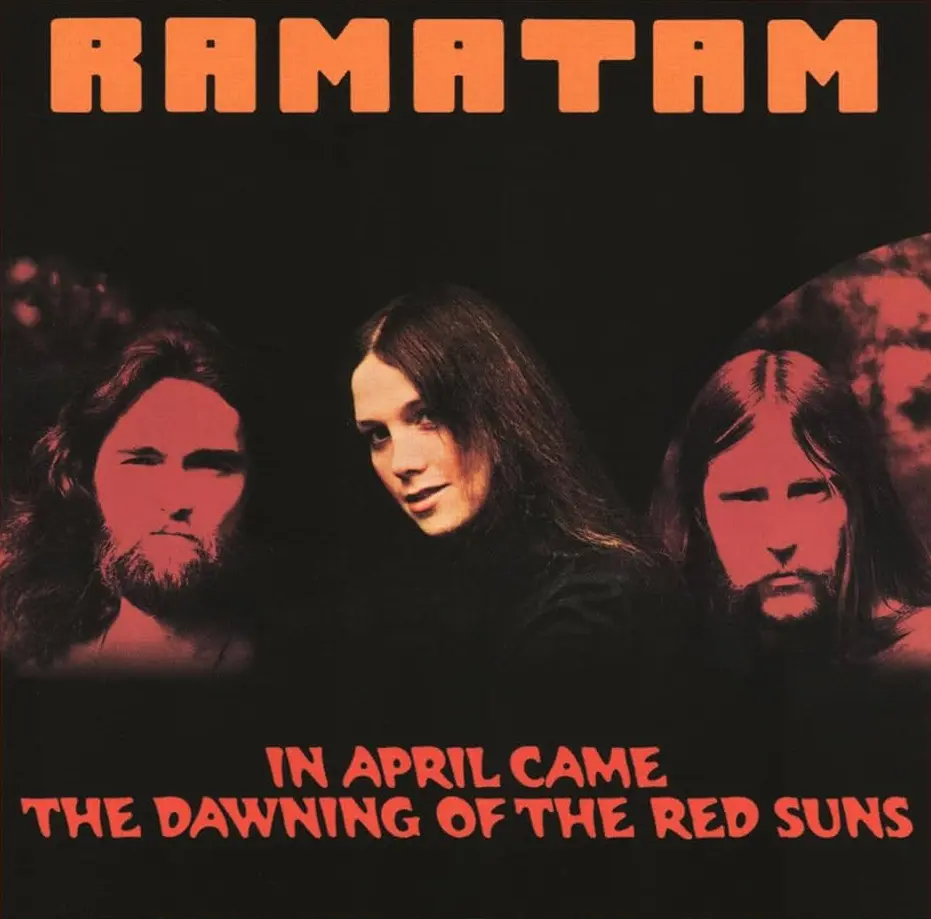 Ramatam released their second album, In April Came the Dawning of the Red Suns, in July 1973 on Atlantic.
Guitarist Mike Pinera, bassist Russ Smith, and drummer Mitch Mitchell all departed prior to recording. Guitarist April Lawton took the reins and co-wrote all the album’s material with keyboardist Tommy Sullivan, now joined by ex-Royale Monarchs/Standells drummer Jimmy Walker. Lawton also played bass and handled most guitar duties, while Sullivan assumed the bulk of vocal and keyboard roles.
The album spans multiple styles, combining hard rock, folk, baroque pop, orchestration, and experimental interludes. Side A opens with the two-part “The Land / Rainy Sunday Evening,” a string-laced ballad with acoustic strumming, gentle vocal harmonies, and lush brass flourishes. “Betty Lou” shifts gears to uptempo hard rock with sax accents and group vocals, followed by “I Can Only Love You,” a mid-tempo ballad with tender lead guitar and soft harmonies. Lawton steps out on “Excerpt From Guitar Concerto #1,” a brief classical-flavored solo piece. “Autumn Now” closes the side with layered harmonica, organ, and guitar textures over a breezy folk-pop progression.
Side B opens with a Moog- and guitar-led adaptation of John Philip Sousa’s “Stars and Stripes Forever,” followed by “Bounty on My Table,” a string-laden folk-rock ballad with a lead vocal by Lawton and violin solo by guest Bruce Morgenheim. “Downrange Party” returns to amplified riffing and upbeat rhythmic interplay, while “Free Fall” offers a 60-second ambient Moog interlude. “Push a Little” combines rhythmic insistence with dense harmonic layering, and “Rhinoceros” closes the album with a retro-tinged 1950s pastiche marked by vocal tradeoffs and whimsical mood shifts.
A1a. “The Land” (6:22)
A1b. “Rainy Sunday Evening”
A2. “Betty Lou” (4:03)
A3. “I Can Only Love You” (5:33)
A4. “Excerpt From Guitar Concerto #1” (0:44)
A5. “Autumn Now” (3:50)
B1. “Stars and Stripes Forever” (2:15)
B2. “Bounty on My Table” (3:57)
B3. “Downrange Party” (4:53)
B4. “Free Fall” (1:00)
B5. “Push a Little” (5:20)
B6. “Rhinoceros” (3:05)
Sessions occurred between February and May 1973 at Atlantic Studios and Advantage Sound in New York City with Loaded producer Geoffrey Haslam, whose recent credits include The Divine Miss M by Bette Midler and recent titles by Badger and Guns & Butter. Charles Gouse conducted brass and string sections on select tracks. Sullivan and Lawton arranged all music and co-designed the gatefold sleeve, which features cover photography by David Gahr and artwork by Lawton, including the guitar painting and back-cover poem.
In April Came the Dawning of the Red Suns departed from the supergroup dynamics of Ramatam’s debut. Instead, the album reflects Lawton’s increasing artistic control and eclectic vision, blending orchestral instrumentation, chamber-folk, and heavy rock motifs. The album has since drawn attention for its stylistic breadth and Lawton’s unorthodox guitar phrasing and compositional ambition.
Aftermath
April Lawton disbanded Ramatam following the release of In April Came the Dawning of the Red Suns. She briefly led a namesake unit, the April Lawton Band, which remained active through the late 1970s but released no recordings. During the early 1980s, she contributed as a co-writer to two AOR albums: Spy (1980, Kirshner), which includes the Lawton–David Nelson ballad “Ruby Twilight,” and First Stop (1983, Polydor) by Shelter, which features two Lawton co-writes with singer Joe Lamente (“So Glad I Found You,” “Who Do You Love”).
Lawton gradually withdrew from the music industry and refocused her creative efforts on painting and graphic design. In the 1990s, she recorded a series of demos for a potential solo release, though the material remains officially unreleased. Brief audio excerpts circulated on a tribute website dedicated to her legacy.
From 1978 to 2002, Lawton lived under the name April Trewhala. She died of heart failure at her home on November 23, 2006, at age 58. Her reclusive nature and minimal public interviews contributed to her enduring mystique, particularly among guitarists who admire her unorthodox technique and cross-genre versatility.
Discography:
- Ramatam (1972)
- In April Came the Dawning of the Red Suns (1973)
Sources:
Artist/Album Pages:
Lee Ritenour (born Jan. 11, 1952) is an American jazz/pop session guitarist and recording artist f...
Balkan were a Danish folk trio from Copenhagen that released the album Spiller on Sonet in 1973. ...
The Load was an American symphonic-rock trio that released the 1976 album Praise the Load on Colum...
Salamander was an English symphonic-rock band that released the album The Ten Commandments on Youn...
The Velvet Underground was an American rock band from NYC, founded in 1965 by guitarist–singer Lo...
Catalyst was an American jazz-funk band that released four albums between 1972 and 1975. Their fir...
Universal Jones was an American soul-funk band that released the 1972 album Vol. 1 on MGM, produc...
Ben and the Platano Group were a French Latin-funk ensemble that released the 1970 Barclay album P...
Charles Sullivan — aka Kamau Muata Adilifu (born Nov. 8, 1944) — is an American post-bop/jazz-funk...
Frank Zappa (December 21, 1940 — December 4, 1993) was an American musician, composer, producer, ...
Hamza El Din (July 10, 1929 — May 22, 2006) was an Egyptian oudist, singer, and composer who made...
The Who are an English rock band that released ten studio albums between 1965 and 1982, including th...
You forget about all the bands until you read articles such as this I almost became the Bass player for Ramatam actually spoke to April Lawton as they had come into TSS where I worked in their record department and asked how I could become better Bass player and she said to learn all the so gs that I liked to listen to.
Rmatam also came to see my bands play at the bar the “Trolly Stop” and asked guitarist and lead singer if I wanted to join Ramatam as their Bass player and without my knowledge, told.them no. Jerome Walsh