

Pilot was a Scottish pop-rock band, best known for the transatlantic hit “Magic” and the UK/Australian chart-topper “January.” They released four albums between 1974 and 1977, led by the singing/songwriting team of bassist David Paton and keyboardist William Lyall.
Alan Parsons produced their first two albums: From the Album of the Same Name and Second Flight. In 1976, they made the ambitious Morin Heights with producer Roy Thomas Baker. After Lyall went solo and drummer Stuart Tosh joined 10cc, Paton and guitarist Ian Bairnson concluded Pilot’s run with the 1977 album Two’s a Crowd.
Members: David Paton (vocals, bass, guitar), Stuart Tosh (drums, vocals, 1973-76), William Lyall (keyboards, vocals, 1973-76), Ian Bairnson (guitar, vocals, bass, 1974-78)
Background
Pilot launched from a partnership between bassist–singer David Paton and keyboardist Billy Lyall, who came from a pre-fame lineup (1969–71) of the Scottish pop sensation the Bay City Rollers. Between 1972 and 1974, they demoed material with drummer Stuart Tosh at Edinburgh’s Craighall Studios, where Lyall engineered albums by comedian Billy Connolly (ex-Humblebums) and numerous Celt and military brass bands (Tartan Lads; Midland Band of the Royal Air Force; Rhine Staff Band of the Royal Tank Regiment).
Pilot signed to EMI and recorded their first album with sessionist guitarist Ian Bairnson and producer Alan Parsons, a prior Beatles and Pink Floyd engineer who worked most recently with Cockney Rebel on their breakthrough single (“Judy Teen”) and second album (The Psychomodo).
On June 7, 1974, Pilot released their debut single: “Just a Smile” backed with “Don’t Speak Loudly,” both Parsons-produced Paton/Lyall originals. They masqueraded as Scotch Mist for the September single “Ra Ta Ta,” a German schlager cover backed with “Pamela,” a Paton/Lyall number.
B. “Pamela” (3:14)
From the Album of the Same Name [aka Pilot]
 Pilot released their debut album, From the Album of the Same Name, in October 1974 on EMI.
The album contains twelve songs co-written by singer–bassist David Paton and keyboardist Billy Lyall, including both sides of their debut summer single (“Just a Smile,” “Don’t Speak Loudly”) and the just-released a-side “Magic.”
Lyall plays piano, electric piano, and synthesizer on the album, which features Ian Bairnson on “Magic” and “High Into the Sky.”
A1. “Just a Smile” (3:17)
A2. “Magic” (3:06)
A3. “Lucky for Some” (3:15)
A4. “Girl Next Door” (4:03) features “Penny Lane” trumpeter David Mason.
A5. “Lovely Lady Smile” (3:40)
A6. “Sooner or Later” (4:15)
B1. “Don’t Speak Loudly” (4:44)
B2. “Over the Moon” (3:44)
B3. “Never Give Up” (3:56)
B4. “High Into the Sky” (3:18)
B5. “Auntie Iris” (1:49) features spoken voice by band manager Nick Heath.
B6. “Sky Blue” (5:25)
Sessions occurred in Northwest London at Abbey Road Studios, where Alan Parsons produced Same Name between the second and third Cockney Rebel albums. Same Name features orchestral arrangements by Richard Hewson, a prior arranger for Aubrey Small, Claire Hamill, Clifford T Ward, Jigsaw, and Renaissance.
“Magic”
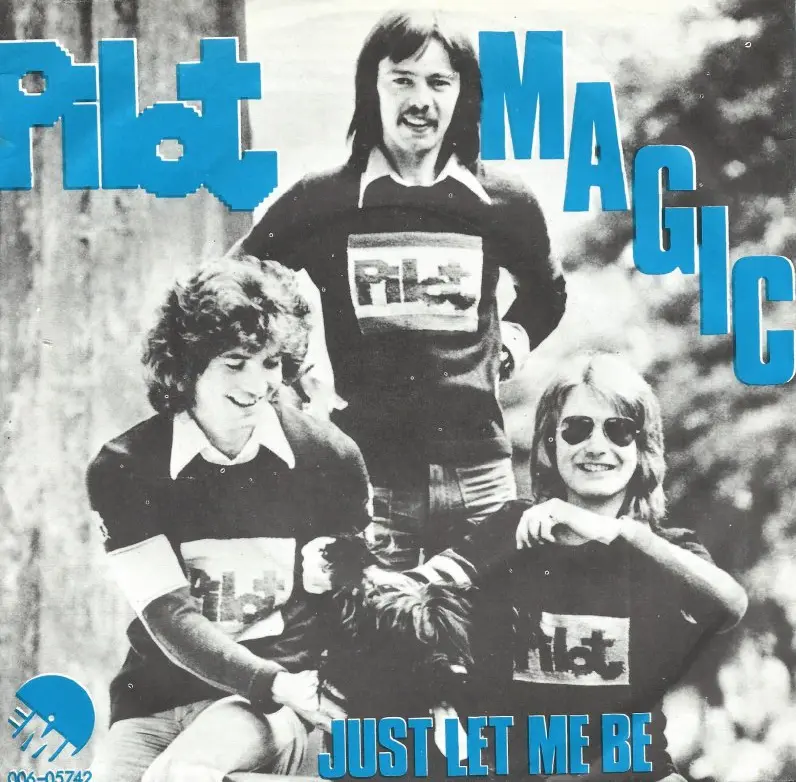 On September 20, 1974, “Magic” appeared as a second advance single, backed with “Just Let Me Be,” a Paton/Lyall exclusive.
B. “Just Let Me Be” (3:49)
Pilot mimed “Magic” for the October 4 broadcast of the BBC music program Top of the Pops, which thrice aired the song amid autumn ’75 in-studio numbers by Ace (“How Long”), Andy Fairweather Low (“Reggae Tune”), David Essex (“Gonna Make You a Star”), Roxy Music (“All I Want Is You”), Sparks (“Never Turn Your Back on Mother Earth”), and Splinter (“Costafine Town”).
“Magic” reached No. 11 on the UK Singles Chart. Abroad, it reached No. 6 in Ireland, No. 8 in the Netherlands, No. 11 in South Africa, and No. 12 in Australia.
“January”
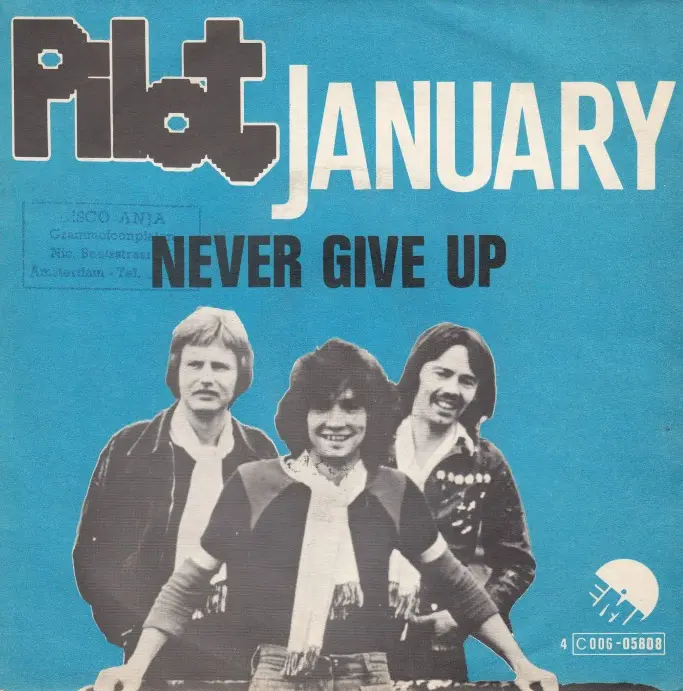 On January 3, 1975, Pilot released their third single: “January,” an exuberant piece of production pop backed with “Never Give Up” from the preceding album. With the song’s timely title and Pilot’s momentum from their prior single, “January” debuted in the UK Top 30.
Pilot mimed “January” for the January 2 broadcast of TotP, which aired the song fortnightly through Jan. 30 and weekly through February 13 (five airings) amid winter ’75 in-studio numbers by Betty Wright (“Shoorah! Shoorah!”), Fox (“Only You Can”), George McCrae (“You Can Have It All”), Queen (“Now I’m Here”), Ralph McTell (“Streets of London”), Slade (“How Does It Feel”), Status Quo (“Down Down”), Supertramp (“Dreamer”), Syreeta (“Your Kiss Is Sweet”), The Tymes (“Ms. Grace”), and Wizzard (“Are You Ready to Rock”).
“January” reached No. 1 in Ireland, No. 4 in Norway, and went Top 20 in Austria and West Germany. On the week of February 1, 1975, “January” reached No. 1 on the UK Singles Chart, where it ousted “Ms. Grace” and reigned for three weeks until Steve Harley & Cockney Rebel took the honors with “Make Me Smile (Come Up and See Me),” a trade-off that gave producer Alan Parsons back-to-back chart toppers.
In mid-March, EMI issued “January” in Australia, where it made its slow climb up the Kent Music Report. On the week of May 26, “January” reached No. 1 on the Australian Singles Chart, where it ousted “Summer Love” by Sherbet and reigned for eight weeks through July 14 when Tejano singer Freddy Fender claimed the spot with “Before the Next Teardrop Falls.” On Kent’s 1975 year-end report, “January” ranked as the No. 2 song behind “Fox on the Run” by Sweet.
Meanwhile, “Magic” gained traction in North America, where EMI issued From the Album of the Same Name as Pilot. “Magic” reached No. 1 in Canada and No. 5 on the US Billboard Hot 100, where it peaked on the week of July 12, 1975, under singles by Michael Murphy (“Wildfire”), Wings (“Listen to What the Man Said”), Van McCoy (“The Hustle’), and reigning chart-toppers Captain & Tennille (“Love Will Keep Us Together”). By now, Pilot were on to their second album and fourth UK single.
Second Flight
 Pilot released their second album, Second Flight, in June 1975 on EMI. This was their first album as a four-piece with guitarist Ian Bairnson as an official member.
The album contains their huge winter hit “January” and four additional David Paton numbers: “Love Is,” “To You Alone,” “Heard It All Before,” and “You’re My No. 1.”
Paton co-wrote “Call Me Round” and “Bad To Me” with Bairnson, who co-wrote the instrumental “55º North 3º West” with keyboardist Billy Lyall, who wrote “Do Me Good,” “You’re Devotion,” “Passion Piece,” and the epic “Dear Artist.”
A1. “You’re My No. 1” (3:24)
A2. “Love Is” (3:17)
A3. “Call Me Round” (3:06)
A4. “55º North 3º West” (4:25)
A5. “To You Alone” (3:14)
A6. “Do Me Good” (3:48)
B1. “Heard It All Before” (3:20)
B2. “Bad To Me” (3:16)
B3. “You’re Devotion” (3:47)
B4. “January” (3:36)
B5. “Passion Piece” (2:44)
B6. “Dear Artist” (4:39)
“January” aside, sessions occurred in March 1975 at AIR Studios in London, where Alan Parsons produced and engineered Second Flight in sequence with albums by Ambrosia (S/T), Al Stewart (Modern Times), and Cockney Rebel (The Best Years of Our Lives). The last two feature string arrangements by Andrew Powell, who did likewise on “January.” The mixing engineer on Second Flight, Ben Emrys-Roberts (Birth Control, Walker Brothers), played French horn on “Dear Artist.”
Second Flight shows an unattached aircraft propeller in free flight, designed by Dick Ward, who also designed 1974/75 covers for Claire Hamill, Gonzalez, Hudson–Ford, Smokey, and Supertramp (Crisis? What Crisis?).
“Call Me Round” first appeared on April 4 as the second advance UK single (b/w “Do Me Good”). It reached the UK Top 35 just as “January” broke in the Southern Hemisphere and “Magic” caught hold stateside. Second Flight peaked inside the UK Top 50.
 In the US, EMI released the album in February 1976 as January with new cover art by Michael Bryan, whose blue-scale illustration depicts Pilot as pilots of a WW2 bomber plane adorned with pinup art. The back cover shows leopards crouched on a field under a starry-night sky near a leopard-print aircraft. Bryan also illustrated the spherical flying objects cover to We Love You (Whoever You Are), the 1975 album by Love Craft (a revamped iteration of Sixties psychsters HP Lovecraft).
“January” reached the lower Hot 100 roughly one year after its international peak.
Meanwhile, EMI released “Just a Smile” as a September 1975 single backed with “Are You In Love,” a David Paton exclusive. This version (different from the 1974 single) reached No. 31 on the UK Singles Chart.
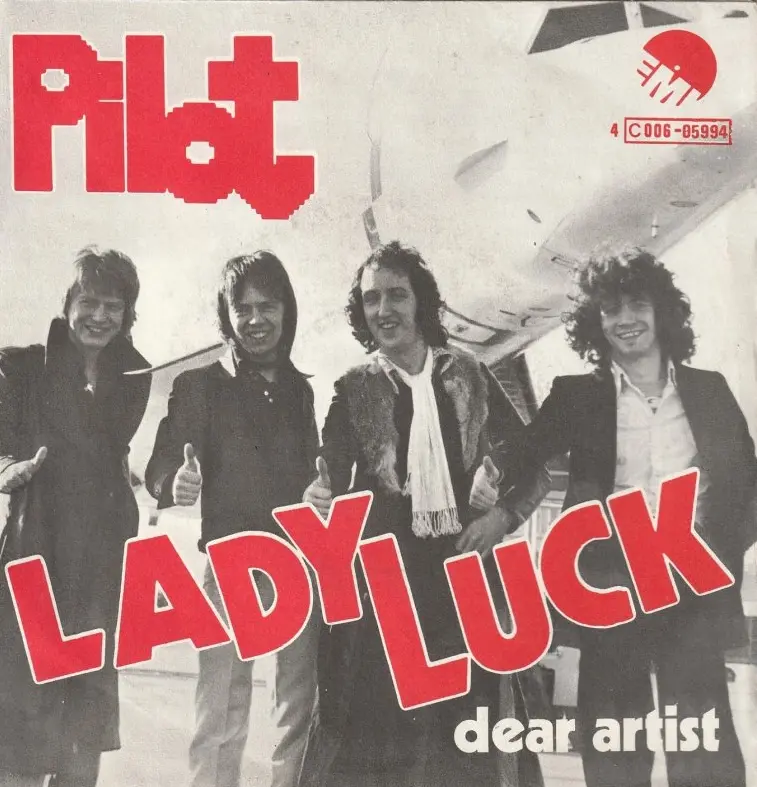 B. “Are You In Love”
In November, “Dear Artist” reappeared as the b-side of Paton’s “Lady Luck,” a standalone music-hall number.
A. “Lady Luck”
All four Pilot members partook in the late-1975 sessions for Tales of Mystery and Imagination, the 1976 debut album by the Alan Parsons Project.
Lineup Change
In early 1976, Billy Lyall left Pilot and cut his own album, Solo Casting, released that year on EMI under his proper name, William Lyall.
Solo Casting contains ten Lyall originals performed on multiple keyboards, including Fender Rhodes electric piano (“Us”), clavinet and harpsichord (“Supertrader). He’s backed on most tracks by bassist Phil Chen (of Rod Stewart‘s backing band) and Genesis/Brand X drummer Phil Collins. Paton and Barnson both play on the title track and make scattered appearances amid the album’s main guitarist, Robert Ahwai of Hummingbird. Paul Buckmaster (a longtime arranger for Elton John) conducted strings on “The Deeper You Get” and “Maniac.” The album concludes with “Sleep,” a Lyall-arranged orchestral number with sitar by Ray Russell.
Morin Heights
 Pilot released their third album, Morin Heights, in July 1976 on EMI. They titled the album after its creation site in Southern Quebec.
The album contains four songs by Ian Bairnson (“Hold On,” “Steps,” “The Mover,” “Running Water”) and lavish harmonized numbers by David Paton, including the melodramatic “Too Many Hopes” and the epic conjoined tracks “Trembling” and “Maniac (Come Back),” the last of those co-written by former member Billy Lyall.
Morin Heights features a three-piece lineup (Paton, Bairnson, Stuart Tosh) augmented by keyboardist Peter Oxendale, recently of the Sparks spinoff Jet.
A1. “Hold On” (2:43)
A2. “Canada” (2:35)
A3. “First After Me” (2:05)
A4. “Steps” (3:34)
A5. “The Mover” (3:12)
A6. “Penny In My Pocket” (4:10)
B1. “Lies and Lies” (3:05)
B2. “Running Water” (3:20)
B3. “Trembling” (3:14)
B4. “Maniac (Come Back)” (3:22)
B5. “Too Many Hopes” (4:11)
Sessions occurred at Le Studio in Morin-Heights with Queen producer Roy Thomas Baker, who produced Pilot between the second Be-Bop Deluxe album (Futurama) and the debut by Welsh rockers Lone Star. Morin Heights was engineered by Le Studio’s Nick Blagona (Aut’chose, Lewis Furey, Lougarou) and mixed in London at Sarm Studios by Gary Lyons, Mike Stone, a 1975/76 soundman for A Raincoat, Charlie, Easy Street, Peter Hammill, and Starry Eyed and Laughing.
Morin Heights appeared in a gatefold with simple photography of the town’s greeting sign and Pilot’s snowbound accommodations (inner-gate).
“Running Water” first appeared in late April as an advance single (b/w “First After Me”).
On July 2, “Canada” became the second single (b/w “The Mover”). Pilot mimed “Canada” for the 6/24 TotP broadcast, which also features in-studios by Lee Garrett (“You’re My Everything”), Osibisa (“Dance the Body Music”), The Real Thing (“You to Me Are Everything”), and the Sensational Alex Harvey Band (“Boston Tea Party”).
“Canada” reached No. 23 in Ireland. In late September, “Penny In My Pocket” became the third single (b/w “Steps”).
In early 1977, Paton, Bairnson, and Tosh partook in the sessions for I Robot, the second Parsons Project album. Tosh jumped ship to 10cc, where he replaced Kevin Godley in their reconfigured six-piece lineup on the live double-album Live and Let Live and 1978 studio album Bloody Tourists. His departure cut Pilot to a duo (much like Godley & Creme‘s departure cut 10cc to a duo for their December 1976 single “The Things We Do for Love” and May 1977 album Deceptive Bends).
Two’s a Crowd
 Pilot released their fourth album, Two’s a Crowd, in 1977 on Arista. Ian Bairnson wrote the interior of Side One (“Creeping Round Midnight,” “One Good Reason Why,” “There’s a Place”) and the bookends of Side Two (“Monday Tuesday,” “Big Screen Kill”). David Paton wrote the album’s six remaining songs, including the singles “Get Up and Go” and “Ten Feet Tall.”
Bairnson and Paton both play guitar (electric and acoustic), bass, tambourine, and sundry percussion. Session drummer Henry Spinetti appears on all but four tracks (“Get Up and Go,” “Library Door,” “One Good Reason Why,” “Mr. Do or Die”), which feature Trevor Spencer of the Tarney–Spencer Band (who titled their 1978 album Three’s a Crowd). Keyboardist Steve Swindells rounds out the sound on piano, synthesizer, clavinet, harmonium, and glockenspiel.
A1. “Get Up and Go” (3:34)
A2. “Library Door” (3:35)
A3. “Creeping Round Midnight” (2:52)
A4. “One Good Reason Why” (3:37)
A5. “There’s a Place” (3:39)
A6. “The Other Side” (3:55)
B1. “Monday Tuesday” (4:08)
B2. “Ten Feet Tall” (3:22)
B3. “Evil Eye” (3:49)
B4. “Mr. Do or Die” (3:32)
B5. “Big Screen Kill” (4:36)
Sessions took place during winter/spring 1977 at Abbey Road Studios, where Alan Parsons produced Two’s a Crowd ahead of his third album with Al Stewart (Time Passages) and the third Parsons Project album Pyramid, which features Paton and Bairnson amid multiple guests, including Cockney Rebel keyboardist Duncan MacKay, singer John Miles, and former Zombies frontman Colin Blunstone.
Abbey’s Pat Stapley engineered all three albums, which feature orchestration by Andrew Powell, who also arranged the first two Kate Bush albums, The Kick Inside and Lionheart (both 1978).
Two’s a Crowd shows the profiles of Paton and Bairnson rendered with Ben Day dots by Bob Searles, who also designed 1977 sleeves for Camel (Rain Dances), Caravan, Roogalator, and Widowmaker.
Between late July and Thanksgiving 1977, Arista lifted three Two’s a Crowd singles: “Get Up and Go” (b/w “Big Screen Kill”), “Monday Tuesday” (b/w “Evil Eye”), and “Ten Feet Tall” (b/w “One Good Reason Why”).
Discography:
- From the Album of the Same Name [aka Pilot] (1974)
- Second Flight (1975)
- Morin Heights (1976)
- Two’s a Crowd (1977)
Sources:
Artist/Album Pages:
Robin Runge (aka Robin Crow) is an American folk-psych guitarist and composer from Portland, Ore....
Charlie and the Pep Boys were an American R&B/rock band behind the 1976 A&M album Daddy's...
Joe Haider is a German jazz pianist and bandleader with 100-plus album credits since the late 1960...
Krystyna Prońko is a Polish jazz-pop/soul singer who released seven albums between 1975 and 1989 o...
Nyl was a French psych-rock and Zeuhl band that released a 1976 self-titled album on Urus. Membe...
Delegation was an English soul-funk band from Birmingham that made the 1977 album The Promise of L...
The Armoury Show was a British new wave rock band that released the 1985 Parlophone album Waiting fo...
The Incredible String Band was a Scottish folk-rock band from Edinburgh that released six studio a...
Shawn Phillips (born Feb. 3, 1943) is an American singer/songwriter who released the 1965/66 Columbi...
America is a rustic folk–pop combo, formed in 1968 in Watford, England, by American musicians Dewe...
Veludo was a Brazilian symphonic/space-rock band of the mid-Seventies. Their 1975 Festival Banana ...
Rajie is a Japanese pop vocalist who released five albums between 1977 and 1981 on CBS/Sony, followe...