
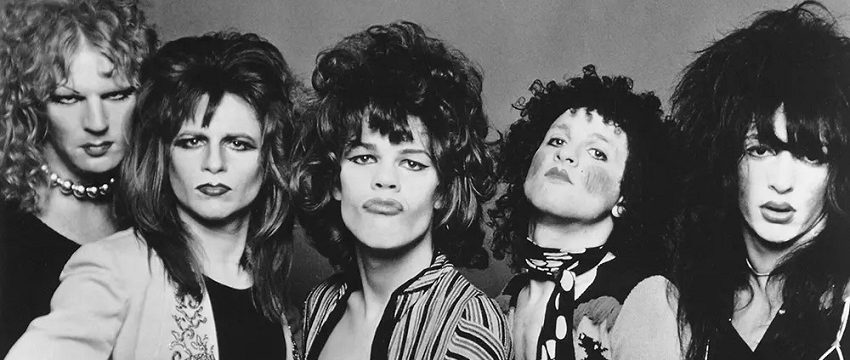
The New York Dolls were an American hard-rock/glam band that released a self-titled album (produced by Todd Rundgren) on Mercury in 1973, followed by Too Much Too Soon in 1974. Fan favorites include the band originals “Personality Crisis,” “Trash,” “Puss ‘N’ Boots,” and their cover of the Gamble/Huff song “(There’s Gonna Be a) Showdown,” originally performed by Philly soulsters Archie Bell & The Drells.
The Dolls were notorious for their mix of campy attire and cocky stage antics, later adapted by the LA pop-metal scene. Musically, they formed a missing link between the fractious primalism of The Stooges and the frenetic abandon of the later punk movement. The Lower East Side rock scene (Television, Blondie, The Shirts, Talking Heads, Richard Hell & the Voidoids) thrived in their wake.
Toward the end of their initial run, the Dolls were managed by English haberdasher Malcolm McLaren, who subsequently svengalied The Sex Pistols. Frontman David Johansen launched a solo career and later adopted the lounge-salsa alter-ego Buster Poindexter. Guitarist Johnny Thunders fronted The Heartbreakers (not to be confused with Tom Petty’s band), which toured the UK in 1976 with the Pistols, The Clash, and The Damned on the ill-fated Anarchy Tour.
In 2004, surviving members Johansen, Sylvain Sylvain, and Arthur Kane regrouped for live shows. After Kane’s passing, the resurrected Dolls released three new albums between 2006 and 2011.
Members: David Johansen (vocals, harmonica, gong), Johnny Thunders (guitar, vocals, 1971-75), Arthur Kane (bass, 1971-75, 2004), Billy Murcia (drums, 1971-72), Rick Rivets (guitar, 1971), Sylvain Sylvain (guitar, piano, vocals, 1971-2011), Jerry Nolan (drums, percussion, 1972-75), Peter Jordan (bass, 1975-76), Chris Robison (keyboards, 1975), Tony Machine (drums, 1975-76), Bobby Blaine (keyboards, 1976), Steve Conte (guitar, 2004-10)
The Pox and Early Dolls
The New York Dolls had their roots in The Pox, a school band formed in 1967 by Jackson Heights teens Sylvain Sylvain and Billy Murcia, then classmates at Quintano’s School for Young Professionals, an alternative school for aspiring actors, artists, and musicians located at 156 W. 56th St.
Syl was born Sylvain Mizrahi on February 14, 1951, in Cairo to a Jewish-Syrian family that fled Egypt’s antisemitic persecution during the 1956 Suez Crisis. They arrived in Buffalo, New York, and later settled in the Rego Park neighborhood in the borough of Queens. Sylvain attended Newtown High School with Murcia (b. October 9, 1951), a native of Bogotá, Colombia, raised from childhood in Jackson Heights.
After the Pox singer’s departure, Sylvain and Murcia launched Truth and Soul, an independent clothing venture. A self-described “walking, talking art show,” Syl designed spandex stretch pants and Fifties-style gold lamé capris for unisex patrons. He also worked at A Different Drummer, a haberdashery across from the New York Doll Hospital, a mannequin repair shop at 787 Lexington Ave. In 1970, Syl and Billy formed their second band, The Dolls, with Johnny Thunders, a fellow Quintano’s alumnus.
Thunders was born John Anthony Genzale on July 15, 1952, in Queens; the second of two children in an Italian-American family that resided in East Elmhurst and resettled in Jackson Heights. At fourteen, he joined his first band, The Reign. While enrolled at Quintano’s, he adopted the name Johnny Volume for his second band, Johnny & The Jaywalkers.
By age fifteen, Thunders frequented rock shows at the Fillmore East on Second Ave. near E. 6th St., where he sported rooster hairdos modeled on Keith Richards. In 1969, he landed sales work at D’Naz, a Bleecker St. leather shop. In late November, he attended the Rolling Stones two-nighter at Madison Square Garden, where cameras captured his towering presence some seven rows from the stage, as seen in the 1970 Stones docu-film Gimme Shelter.
Actress and the New York Dolls
Sylvain hired Thunders as a bassist but guided him along on guitar. When Syl departed for a season in London, Thunders joined Actress, a band formed by guitarists Killer Kane and Rick Rivets.
Killer was born Arthur Harold Kane Jr. on February 3, 1949, in the Bronx. An only child, he learned music from his aunt Millie, an Elvis Presley fan. He graduated from Martin Van Buren High School and enrolled at the Pratt Institute, where he majored in Food Science. In 1970, he used inheritance money to fund a year-long stay in Amsterdam, where he raided Waterlooplein flea markets for outlandish clothing and searched in vain for like-minded musicians.
Back in New York, Kane approached Thunders outside a West Village pizzeria, accompanied by Rivets, who knew of Johnny’s musical activities. With Billy Murcia in tow, they jammed at a Midtown rehearsal space near the garment district, where Thunders’ raw, unbridled guitar playing floored Kane, who swapped the instrument for a Fender bass. Demos from this lineup (Thunders, Kane, Rivets, Murcia) later surfaced on Dawn of the Dolls, a posthumous Thunders CD later reissued as Actress: Birth of the New York Dolls.
When Thunders decided he didn’t want to double as a frontman, Kane thought of David Johansen, a nearby singer.
David Roger Johansen was born on January 9, 1950, on Staten Island to an Irish-American librarian mother and a Norwegian-American insurance salesman father, a former opera singer. He led his first band, The Vagabond Missionaries, in the late Sixties with fellow Staten Isle youth. By mid-1971, he resided on E. 6th St., where Kane and Murcia knocked on his door and invited him to Thunder’s 10th St. apartment for an audition.
The original New York Dolls stabilized when Rivets cleared for Sylvian, who returned from his London sojourn. The lineup of Johansen, Thunders, Sylvian, Kane, and Murcia cut multiple demos, collected first on the 1981 cassette Lipstick Killers (later released under the borrowed title Dawn of the Dolls).
On Christmas Eve, 1971, the New York Dolls made their live debut at the Endicott Hotel, a Gilded Age luxury hotel turned welfare tenement.
London, Jerry Nolan, and Mercury
During 1972, they played multiple shows at the Mercer Arts Center, the converted kitchen of the former Grand Central Hotel at 673 Broadway. In October, they flew to London for the Wembley Festival of Music, a two-day event with sets by Blackfoot Sue, Slade, and Vigrass & Osborne. The Dolls played Sunday’s show (Oct. 29) along with Pink Fairies and headliners Rod Stewart and Faces.
On November 4, the Dolls and Capability Brown supported Status Quo at London’s Imperial College. The following night, Murcia attended a party where he fainted from an overdose. Attendees moved his body to a bathtub, where they attempted to revive him with force-fed coffee. On the morning of November 6, 1972, Billy Murcia was pronounced dead from asphyxiation. The drummer was 21 years old.
The Dolls returned to New York and auditioned multiple drummers, including Peter Criscuola of psych-rockers Chelsea and Marc Bell of the powertrio Dust. Their mutual friend, Jerry Nolan, won the gig with his no-frills straight timing. (Criscuola and Bell landed respective gigs in Kiss and Estus. Bell did subsequent stints in the Voidoids and The Ramones.)
Jerry was born Gerard Nolan on May 7, 1946, in Williamsburg, Brooklyn. His prior stints included the bands Queen Elizabeth (with Wayne County) and the unsigned Kicks (with Billy Squier, pre-Piper). At the time of his Dolls recruitment, he played with Shaker, a rising local powertrio.
The New York Dolls found management under Marty Thau, a onetime Tony Orlando collaborator and co-writer of “Soul Struttin’,” a bubblegum staple of the Ohio Express and the 1910 Fruitgum Co. They impressed Paul Nelson, a music critic and David Bowie publicist who brokered them a deal with Mercury Records.
New York Dolls
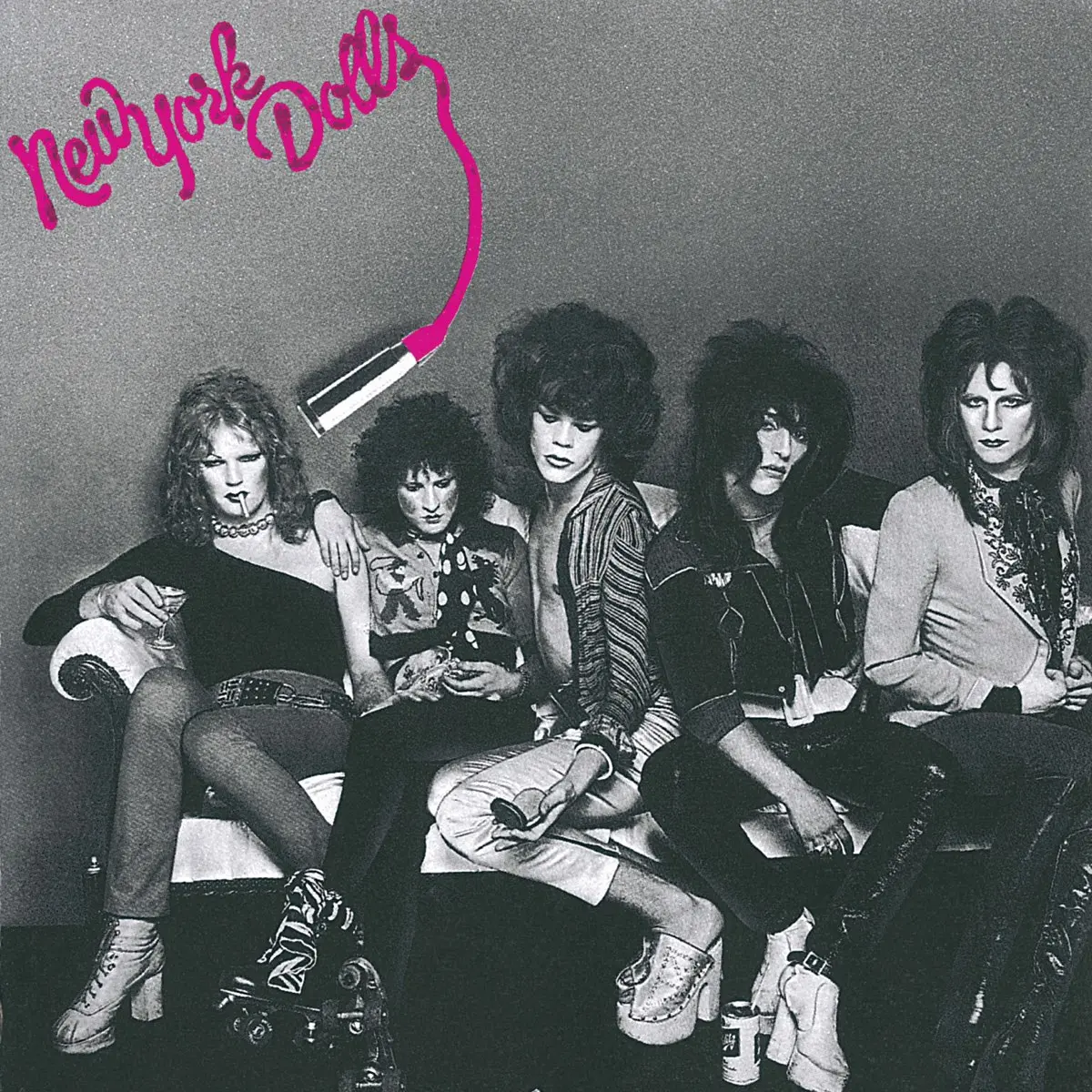 The New York Dolls released their self-titled debut album on July 27, 1973, on Mercury.
Short songs drive the record through dual-guitar clash, piano jabs, shouted refrains, and sudden holds. Guitarists Johnny Thunders and Sylvain Sylvain cut the sequence with bent-note leads, rough chord bursts, and fast resets, while bassist Arthur Kane and drummer Jerry Nolan hold a direct backbeat under David Johansen’s vocal attack. Johansen wrote six songs alone, wrote three with Thunders, wrote two with Sylvain, and the band cut one outside number, Bo Diddley’s “Pills.”
“Personality Crisis” opens with twin guitars, boogie-woogie piano, and a stop-start break that snaps the band back into place. “Looking for a Kiss” lifts a Shangri-Las line and turns it into a street romance crowded by pills and peer drift, while “Vietnamese Baby” pulls the war into daily life and adds gong strike and synthesizer glare. “Lonely Planet Boy” eases the pace and lets Buddy Bowser’s saxophone and distorted overdubbed voices widen the song’s lonely pull.
“Trash” starts at the chorus and pushes its low-life love plea through shifting refrains, brassy singing, and a double-beat close with high backing voices. “Subway Train” stretches the side and folds a line from “Someone’s in the Kitchen with Dinah” into its city tale, “Private World” turns Kane’s search for stability into a shut-door retreat, and “Jet Boy” closes the album on a swooping riff and a tale about the flyer who stole Johansen’s girl. “Pills” cuts through the middle with harmonica, a hard beat, and a stripped-down shove.
A1. “Personality Crisis” (3:41) — Johansen, Thunders
A2. “Looking for a Kiss” (3:19) — Johansen
A3. “Vietnamese Baby” (3:38) — Johansen
A4. “Lonely Planet Boy” (4:09) — Johansen
A5. “Frankenstein (Orig.)” (6:00) — Johansen, Sylvain
B1. “Trash” (3:08) — Johansen, Sylvain
B2. “Bad Girl” (3:04) — Johansen, Thunders
B3. “Subway Train” (4:21) — Johansen, Thunders
B4. “Pills” (2:48) — Bo Diddley
B5. “Private World” (3:39) — Johansen, Kane
B6. “Jet Boy” (4:41) — Johansen, Thunders
Sessions spanned mid-April through mid-June 1973 at Record Plant East in New York, where Todd Rundgren produced the album with engineers Jack Douglas and Ed Sprigg. Rundgren carried 1971–73 production credits on Badfinger (Straight Up), Sparks (Halfnelson), Fanny (Mothers Pride), and Grand Funk Railroad (We’re an American Band). Douglas held the chief-engineer credit on Yoko Ono (Approximately Infinite Universe); he and Sprigg also worked among the engineering team on Alice Cooper (Billion Dollar Babies).
The New York Dolls sessions lasted eight days on a $17,000 budget; the band chose the final sequence from songs that had already proven themselves in performance. Rundgren’s work with the band fell between his 1973 release A Wizard, a True Star and its two-record followup, Todd.
Album Graphics Inc. coordinated the sleeve around photography by Japanese New York fashion photographer Toshi Matsuo, then active on Vogue assignments. Sylvain Sylvain rejected an earlier Mercury antique-shop setup and recruited Matsuo through friends in the fashion trade.
Matsuo photographed the five members in makeup and high-heeled stagewear on a discarded couch covered with white satin, beneath a pink lipstick-script nameplate with the lipstick tube incorporated into the lettering. Shin styled the hair, while Dave O’Grady supplied makeup. The back cover uses another Matsuo portrait outside Gem Spa at St. Mark’s Place and Second Avenue.
Mercury promoted the album’s release with “Trash” (b/w “Personality Crisis”), followed in November by “Jet Boy” (b/w “Vietnamese Baby”), both issued as double a-sides.
The album reached No. 116 on the Billboard Top LPs chart and No. 81 in Canada.
Too Much Too Soon
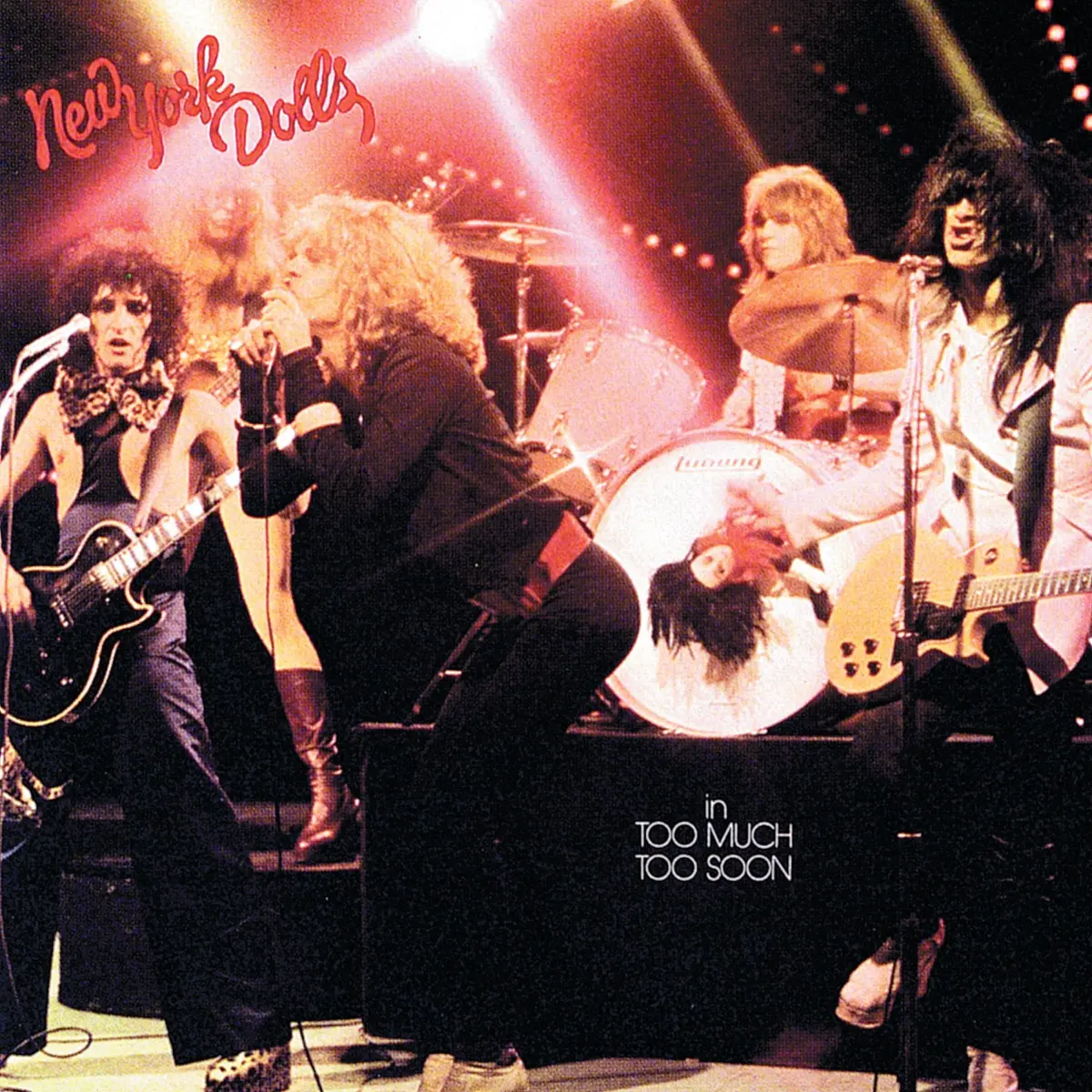 The New York Dolls released their second album, Too Much Too Soon, on May 10, 1974, on Mercury.
The record tightens the group’s attack into shorter bursts, harder starts, and a more deliberate studio shape. Guitarists Johnny Thunders and Sylvain Sylvain keep the front line in constant scrape and slash, while bassist Arthur Kane and drummer Jerry Nolan pin the songs to a blunt backbeat that lets David Johansen bark, sneer, and lunge across the top. The writing splits between Johansen-Thunders originals, one Johansen-Sylvain title, Thunders’ first lead-sung composition, and a run of outside songs drawn from doo-wop, soul, blues, and novelty R&B.
“Babylon” opens with a whistle and a shouted cue, then tears forward on train-like guitars and a vocal that sounds boxed in by the city’s daily pressure. “Stranded in the Jungle” turns the old doo-wop tale into a louder, faster scramble with sweet backing voices set against the band’s street-level shove, and “(There’s Gonna Be A) Showdown” recasts the Gamble-Huff song with sharper tension, harder drum punctuation, and a breakdown where Johansen prods Nolan toward a final pounding roll. “It’s Too Late” begins in a broken funk shape before the band settles into a dirtier boogie push.
Side two keeps the pressure high. “Puss ’n’ Boots” struts on taunting vocal attack and street-corner menace, “Chatterbox” throws Thunders into the lead with piercing guitar lines and a thin, needling voice that fits the crossed-wire complaint, and “Don’t Start Me Talkin’” drives the Sonny Boy Williamson number with a harder shove than the original cut. “Human Being” closes the album in a full rave-up of blaring guitar, honking saxophone, and barked demands for dignity, then clears space at the end for a saxophone coda.
A1. “Babylon” (3:31) — David Johansen, Johnny Thunders
A2. “Stranded in the Jungle” (3:46) — James Johnson, Ernestine Smith
A3. “Who Are the Mystery Girls?” (3:08) — David Johansen, Johnny Thunders
A4. “(There’s Gonna Be A) Showdown” (3:38) — originated as a title track to the 1969 album by Archie Bell & The Drells, written by Kenny Gamble and Leon Huff.
A5. “It’s Too Late” (4:40) — David Johansen, Johnny Thunders
B1. “Puss ’n’ Boots” (3:06) — David Johansen, Sylvain Sylvain
B2. “Chatterbox” (2:25) — Johnny Thunders
B3. “Bad Detective” (3:39) — Keni St. Lewis
B4. “Don’t Start Me Talkin’” (3:13) — Sonny Boy Williamson II
B5. “Human Being” (5:45) — David Johansen, Johnny Thunders
The New York Dolls recorded Too Much Too Soon at A&R Studios in New York during January and February 1974 with producer Shadow Morton and engineers Dennis Druzbik and Dixon Van Winkle. Morton added repeated vocal takes, female backing voices, and sound effects that included gongs, gunshots, and other studio touches.
The title came from the Diana Barrymore biography Too Much, Too Soon. The gatefold carries a dedication to Barrymore, and the sleeve drops the first album’s drag tableau for a staged concert image; during the photo shoot, Thunders held a doll as though he might smash it against his guitar. Bob Gruen, Hans G. Lehmann, and Pieter Mazel supplied the photography.
Mercury lifted “Stranded in the Jungle” in May 1974 as a double s-sided with “Who Are the Mystery Girls?” In September, “(There’s Gonna Be A) Showdown” became their fourth doubled a-sided single with “Puss ’n’ Boots.”
Too Much Too Soon reached No. 167 on Billboard’s Top LPs & Tape chart.
Malcolm McLaren and the end
By early 1975, the New York Dolls played smaller rooms as their Mercury relationship deteriorated and internal disputes intensified around drug and alcohol use. Sylvain approached Malcolm McLaren for help after manager Marty Thau cut ties with the group. The London haberdasher knew the Dolls through earlier contact around his King’s Road shop Too Fast to Live, Too Young to Die and their European appearances. McLaren came to New York to secure rehearsal space and bookings for another run of shows.
McLaren and Vivienne Westwood recast the group in red patent leather against hammer-and-sickle imagery. He booked a five-borough New York run with Television and Pure Hell on selected bills and promoted the Dolls through a self-described “Communist” image intended to replace their earlier drag presentation. The campaign failed to resolve the split within the lineup.
The group also developed material intended for a third album. A late-1974 attempt to record “Teenage News” collapsed when only Johansen and Sylvain arrived fit to work. The March 2, 1975, Little Hippodrome show, later issued as Red Patent Leather, included “Red Patent Leather,” “On Fire,” “Girls,” “Down, Down Downtown,” “Pirate Love,” and “Teenage News.” Johansen, Sylvain, and Thunders later recorded several of those songs in their respective post-Dolls careers.
McLaren next booked the group for club dates in Florida. Tensions between Johansen and the Thunders–Nolan faction culminated in a drunken dinner confrontation in March 1975, after which Johnny Thunders and Jerry Nolan quit the group and returned to New York. Arthur Kane left soon afterward.
Johansen and Sylvain continued the New York Dolls with bassist Peter Jordan, keyboardist Chris Robison, drummer Tony Machine, and guitarist Blackie Lawless, followed later by keyboardist Bobby Blaine. Mercury dropped the group that October. The revised lineup continued through 1976 and added newer Johansen songs including “Funky But Chic,” “Frenchette,” and “Wreckless Crazy” to the set. The New York Dolls played their final show on December 30, 1976, at Max’s Kansas City on a bill with Blondie.
Postlude
Upon their exit, Thunders and Nolan formed the Heartbreakers with Television co-founder Richard Hell, then added Walter Lure and carried their wrecked glamour into the first punk circuit on both sides of the Atlantic.
In 1978, Johansen launched a solo career, then widened parlayed into film work and his lounge-crooner alter ego, Buster Poindexter.
Kane went west and formed the Killer Kane Band with Blackie Lawless, then turned up in later projects that included the Idols (with Nolan), the Corpse Grinders, and intermittent Thunders work.
Sylvain cut a 1979 solo album, followed by the 1981 release Syl Sylvain and the Teardrops. He later fronted the Criminals, and kept close ties with Johansen across the post-Dolls years. Those separate lines finally crossed again in 2004, when Johansen, Sylvain, and Kane regrouped for the Morrissey-curated Meltdown shows. Kane died of leukemia weeks later, but the reunion reopened the band’s final chapter and led to three later Dolls albums from the Johansen-Sylvain edition.
Discography:
- New York Dolls (1973)
- Too Much Too Soon (1974)
- Red Patent Leather (1984)
- Lipstick Killers: The Mercer Street Sessions (1981)
- One Day It Will Please Us to Remember Even This (2006)
- Cause I Sez So (2009)
- Dancing Backward in High Heels (2011)
Sources:
Artist/Album Pages:
Giants was the retroactive name for Attitude, an American Latin-funk studio group assembled in 197...
Oregon are an American ethno-jazz band from Eugene, Ore., formed in 1970. The original lineup—guit...
Nuova Idea was an Italian symphonic-rock band that released the 1971–73 Ariston albums In the Begi...
Grail was an English hard-rock/folk band from London that released a 1970 self-titled album on Met...
Funk, Inc. was an American soul-funk band from Indianapolis that released five albums between 1971...
Perigeo was an Italian jazz-rock band that released five albums between 1972 and 1976 on RCA Itali...
Creative Source was an American soul group from Los Angeles that released four albums between 1973...
Martha and the Vandellas were an American soul-pop trio from Detroit, signed to the Gordy division o...
Paul Brett's Sage were an English folk-rock band that released a 1970 self-titled album on Pye, fo...
Haze was the Swiss Krautrock band behind the 1971 album Hazecolor Dia on Bacillus Records. Member...
Rare Bird was an English organ-rock quartet that released two albums on Charisma in 1969 and 1970, f...
Kiki Dee is an English pop-rock singer who cut nine singles (1963–67) on Fontana, which issued her...