

Modrý Efekt was a Czech rock band, formed in 1968 as Blue Effect. They charted early with “Slunečný Hrob,” followed by the 1970 album Meditace on Supraphon. After that year’s Coniunctio (a collaboration with Jazz Q) they reverted to the Czech spelling of their name for 1971’s Nová Syntéza. Between 1974 and 1981, they released six symphonic/hard-rock albums.
Members: Radim Hladík (guitar), Vladimír Mišík (vocals, flute, 1968-70), Miloš Svoboda (guitar, 1968-69), Jiří Kozel (bass, 1968-72), Vlado Čech (drums, 1968-81, 1984-85), Lešek Semelka (keyboards, vocals, 1970-75, 1977-81), Josef Kůstka (bass, electric violin, 1972-75), Fedor Frešo (bass, 1975-77), Oldřich Veselý (keyboards, vocals, 1975-79), Oldřich Kellner (guitar, vocals, 1981)
Background
Modrý Efekt started in 1968 when singer/guitarist Vladimír Mišík and guitarist Radim Hladík teamed with bassist Jiří Kozel, drummer Vlado Čech, and second guitarist Miloš Svoboda. Mišík and Hladík hailed from garage rockers The Matadors, which issued multiple 1966–68 singles and one album on Supraphon. Kozel played in The Colour Images, which issued two 1968 pop-psych singles behind singer Pavel Sedláček. Svoboda was in the beat group Donald.
At Mišík’s suggestion, they named their band The Special Blue Effect, a reference to the Modrá knížka (Blue book), a certificate obtained by most of the members for exemption from the Czech military draft. They soon shortened their name to The Blue Effect. In December 1968, they were named “Discovery of the Year” at the 2nd Czechoslovak Beat Festival at Palác Lucerna.
Early Singles
The Blue Effect scored a national hit in 1969 with their first single, “Slunečný Hrob” (b/w “I’ve Got My Mojo Working”), which sold 50k copies on Panton. Mišík wrote the a-side with non-performing lyricist Jiří Smetana, a frequent collaborator since the Matadors days. They mimed the song — a soulful ballad with bluesy guitar, shimmering mellotron, and a lucid soliloquy on the opening notes — on Czech television.
Later that year, The Blue Effect issued the four-song maxi-single Snakes, containing the group-written “I Like the World (Sun Is So Bright)” (with lyrics by Karel Kozel) and three Mišík/Smetana originals: “Sen Není Věčný,” “Blue Taxi,” and “Snakes.” On “Sen,” they throw some jazzy bridges and psych licks into their blues-based sound. Soon after this release, Svoboda jumped ship to the Orchestr Golden Kids, leaving The Blue Effect as a four-piece.
Meditace
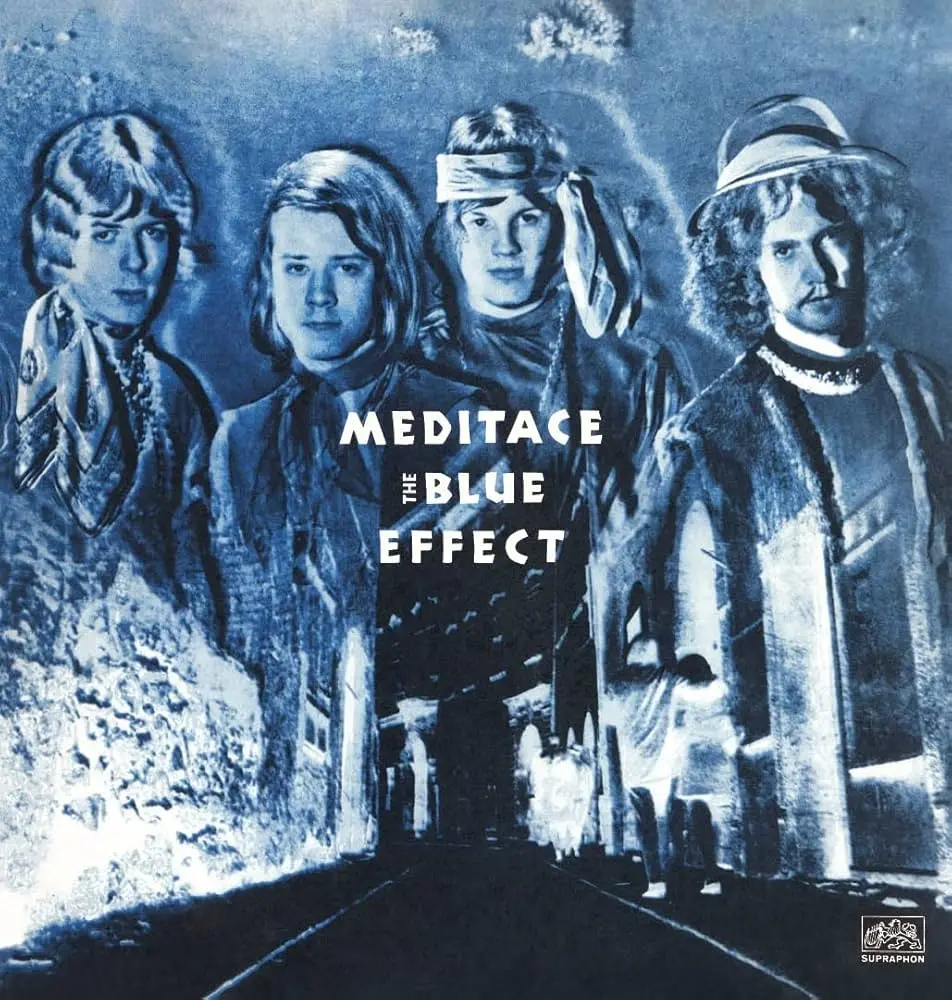 The Blue Effect released their debut album, Meditace, in September 1970 on Supraphon.
The material captures their transition from late-60s beat and blues roots toward broader song forms with acoustic passages, expanded arrangements, and early hints of their coming jazz-rock ambitions. Despite the quartet pictured on the sleeve, the recordings date from a year earlier when second guitarist Miloš Svoboda remained in the lineup.
Guitarist Radim Hladík centers the album with clean, incisive leads and occasional sitar lines. Singer–flutist Vladimír Mišík carries most tracks with full-throated delivery and brief flute accents. Svoboda appears on the earliest session, adding rhythm support on “Paměť Lásky.” Bassist Jiří Kozel supplies firm low-end motion and co-writes two numbers, while drummer Vlado Čech underpins the set with crisp, forward pacing. The absence of keyboards gives the arrangements open space for guitar interplay and vocal focus.
Mišík wrote or co-wrote half the album, including “Blue Effect Street,” “Sluneční Hrob,” and the English-language “Little Girl.” Hladík composed “Paměť Lásky,” “Fénix,” and “Stroj Na Nic,” and partnered with Kozel on two side-two titles. Lyricists Jiří Smetana, Karel Kozel, and Zdeněk Rytíř contribute the album’s recurring themes of memory, isolation, and self-reflection. “Where Is My Star” credits Mišík for the music on release despite an earlier uncredited Hladík authorship.
Meditace ranges from brisk, guitar-forward rockers to slower, atmospheric pieces. “Paměť Lásky” moves between quiet verses and tightened peaks with sudden vocal surges. “Blue Effect Street” alternates clipped rhythmic figures with extended guitar runs that rise in sharp, ascending bursts. “Fénix” follows a steady mid-tempo cycle with contour shifts between its brass-shaped vocal refrain and open-chord bridges. “Deserted Alley” opens with near-hushed acoustic phrasing before widening into amplified lines and abrupt dynamic lifts. On “Blues About Stone,” the long-form structure builds gradually, using slow, tessellated guitar phrases over a patient rhythm pulse. “Where Is My Star” tightens into a compact, rising sequence that frames one of the album’s most focused instrumental breaks.
A1. “Paměť Lásky” [Memory of Love] (4:35) — Hladík/Rytíř
A2. “Blue Effect Street” (4:10) — Mišík/Rytíř
A3. “Fénix” [Phoenix] (4:35) — Hladík/Rytíř
A4. “Stroj Na Nic” [Useless Machine] (2:30) — Hladík/Rytíř
A5. “Sluneční Hrob” [Sunny Grave] (1:55) — Mišík
B1. “Little Girl (Děvčátko)” (3:55) — Mišík
B2. “Deserted Alley (Osamělá Ulice)” (3:15) — Mišík/K. Kozel
B3. “Blues About Stone (Kamenné Blues)” (8:10) — Kozel/Hladík/Mišík/Čech
B4. “Rainy Day (Deštivý Den)” (4:00) — Kozel/Hladík
B5. “Where Is My Star (Kde Je Má Hvězda)” (3:30) — Mišík/Smetana
Sessions occurred between June and August 1969 at Supraphon Studio Dejvice in Prague with producer Michael Prostějovský and engineer Petr Čada. “Paměť Lásky” originated at Mozarteum on April 19, 1969. Technical support was provided by Petr Kocfelda and Václav Heblík.
Meditace features cover photography by Alan Pajer, who depicts the band standing in a grainy monochrome portrait used on both mono and stereo editions.
In 1971, Supraphon repackaged Meditace as Kingdom of Life with the vocals re-recorded in English. The 1996 CD adds period non-album tracks, including “Sluneční Blues,” “Sen Není Věčný,” “I Like the World,” and selections from the Snakes maxi-single.
Coniunctio (w/ Jazz Q Praha)
 Blue Effect collaborated with Jazz Q Praha on Coniunctio, recorded in March 1970 at Studio Dejvice in Prague and released months later on Supraphon as a limited Gramofonový klub edition.
The project marks a sharp break from their debut, placing the band inside open-form improvisation with Jazz Q’s early free-jazz vocabulary. The album’s four long pieces frame aggressive ensemble passages, sudden dropouts, and sparse piano or flute interludes, reflecting two groups testing shared ground at an early stage in both careers.
Hladík anchors the louder sections with clipped, abrasive guitar figures and bursts of metallic resonance, while Kozel and Čech drive the Blue Effect portions with firm, amplified motion. Jazz Q adds Kratochvíl’s piano and organ surges, Pellant’s wandering double-bass lines, and Stivín’s wide palette of flute, piccolo, alto sax, and noise effects. Milan Vitoch doubles the drum chair on the Jazz Q segments, thickening the percussive language and giving the larger ensemble room to alternate density with sudden, near-silent spaces.
Stivín and Kratochvíl co-wrote the two “Coniunctio” pieces that bookend the album. Hladík composed the Blue Effect–based “Návštěva U Tety Markéty, Vypití Šálku Čaje,” which features Stivín as soloist. Stivín alone contributes “Asi Půjdem Se Psem Ven,” the album’s most abstract piece. The writing favors open frameworks that cue extended group improvisation rather than fixed harmonic progressions, relying on shifting instrumental pairings and irregular entries.
The nineteen-minute “Coniunctio I” sequences jagged ensemble eruptions, long stretches of fractured piano or bass motion, and brief consolidations where guitar or flute rise from the texture before the group splinters again. “Návštěva U Tety Markéty” sets a steady rhythmic footing for guitar and flute exchanges, using abrupt accelerations and quick decelerations to pivot its central phrases. “Asi Půjdem Se Psem Ven” unfolds in a loose, fragmented arc where high-register reeds, clattering percussion, and scattered piano lines collide in short, irregular bursts. “Coniunctio II” tightens the structure with a firmer pulse, letting guitar and flute trade ascending lines over a rhythm section that alternates between tight cycles and unruly crescendos.
A. “Coniunctio I (In Memoriam Lubomíra Přistofa)” (19:15) — Stivín/Kratochvíl
B1. “Návštěva U Tety Markéty, Vypití Šálku Čaje” [A Visit to Aunt Margaret, Drinking a Cup of Tea] (6:00) — Hladík
B2. “Asi Půjdem Se Psem Ven” [We’ll Probably Take the Dog Out] (7:15) — Stivín
B3. “Coniunctio II” (7:15) — Stivín/Hladík
Sessions occurred in March 1970 at Supraphon Studio Dejvice with producer Tony-Line, recording supervisor Mojmír Balling, and engineer Jan Chalupský. Instrumentation includes Hladík on guitar and mechanical noise effects, Kozel on bass and bells, Čech and Vitoch on drums and horse bells, Pellant on double bass, Kratochvíl on piano, organ, and trumpet-bassoon, and Stivín on flutes, piccolo, alto sax, woodblocks, and assorted sound devices.
Coniunctio uses cover art reproduced from Mikuláš Medek’s painting Sensitivní signál IV (1967), with design by Stanislav Dvorský and photography by Alexandr Janovský. The album appeared exclusively through the Gramofonový klub subscription series before the band reverted to the Czech spelling of their name on later releases.
Nová Syntéza
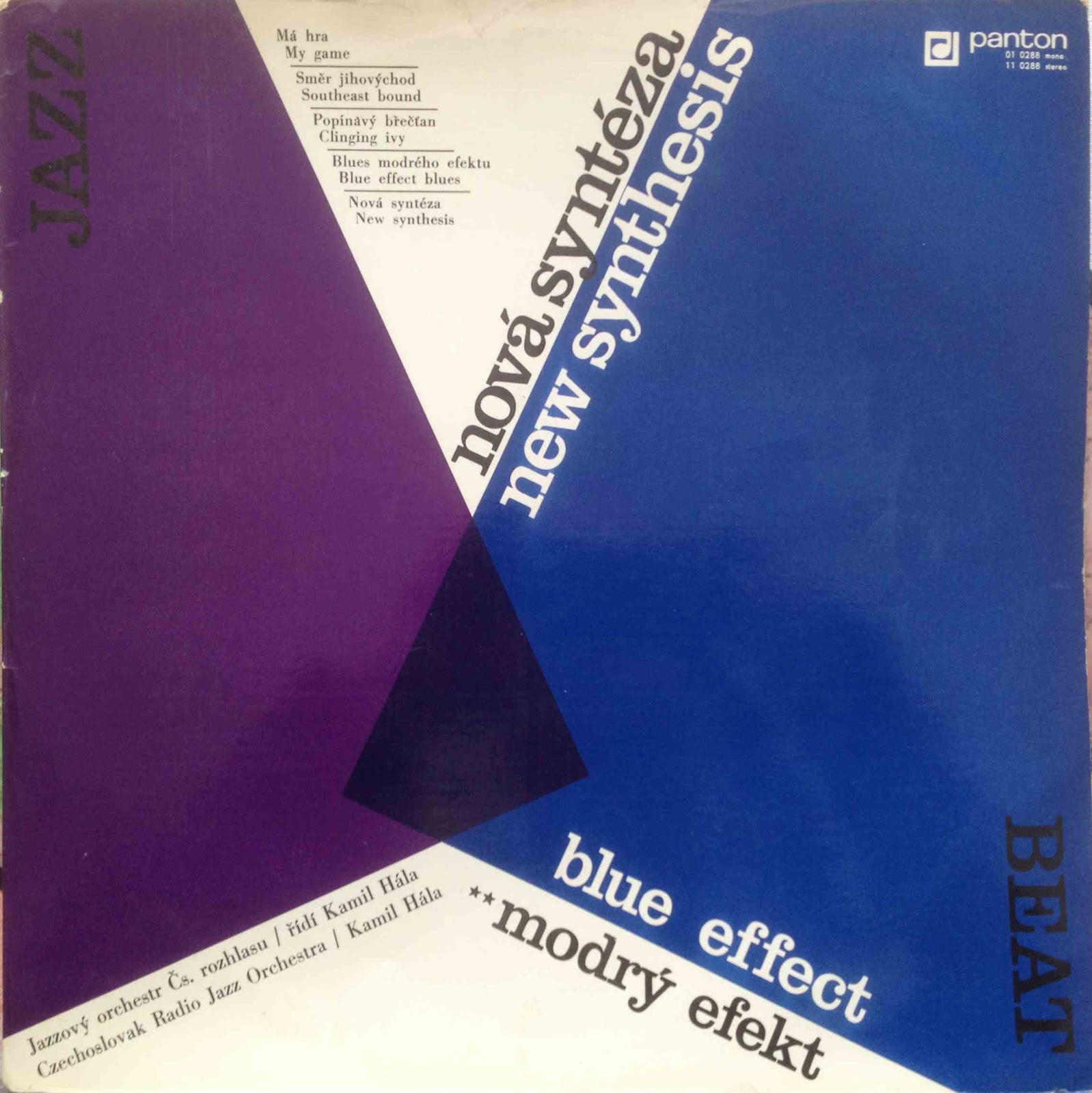 Modrý Efekt released their third album, Nová Syntéza, in November 1971 on Panton, which co-billed the title to the Jazzový Orchestr Československého Rozhlasu (the Czechoslovak Radio Jazz Orchestra).
The album marks a decisive move from the free-form experiments of Coniunctio toward fully scored brass–rock structures, with written themes, cue-based transitions, and long-form pieces shaped around the orchestra’s broad voicings. The material balances amplified guitar passages with sectional brass writing, creating a hybrid sound that sits between symphonic jazz, hard-rock phrasing, and extended blues motifs.
Hladík threads much of the album with bright, cutting lines that pivot between heavy unison figures and wide-interval solos. Semelka adds electric piano and occasional organ shading while contributing one of the album’s core compositions. Kozel drives the ensemble passages with firm, rounded bass motion, often doubling or countering the brass riffs. Čech keeps the rhythmic center taut, matching the orchestra’s accents without losing the band’s rock pulse. Conductor–arranger Kamil Hála shapes the big-band framework with tightly voiced trumpet and trombone lines, giving the album its signature blend of full-orchestra swells and stripped-down trio or quartet breaks.
Hladík composed “Má Hra” and “Popínavý Břečťan,” both structured around recurring motifs that open into extended instrumental sections. Semelka supplied “Směr Jihovýchod,” which shifts between atmospheric voicings and denser ensemble writing. Hála and Vlastimil Hála co-wrote “Blues Modrého Efektu” and the nineteen-minute title piece, each built around orchestral frameworks that cue the band through alternating sections of blues-based figures, jazz-oriented exchanges, and long-cycle development.
“Má Hra” opens with tightly stacked brass statements that give way to a heavier midsection where guitar and bass move in crisp parallel motion before widening into faster, hard-edged runs. “Směr Jihovýchod” leans on a slower, suspended theme that thickens as brass and guitar merge into a rising mid-tempo climb. “Popínavý Břečťan” alternates its main line with sudden rhythmic shifts, including a central break where bass and drums push the momentum into a brief swing-like turn before the guitar returns in sharper, more pointed phrasing.
“Blues Modrého Efektu” stretches a relaxed, steady pulse into long blues expansions framed by the orchestra’s softened back-line voicings. “Nová Syntéza” closes the album with multiple contrasting sections: a riff-driven opening, a passage of clustered brass punctuations, a percussive stretch that invites guitar and bass commentary, a quieter mid-album interlude shaped by piano lines, and a final ascent that reunites band and orchestra for the concluding statement.
A1. “Má Hra” [My Game] (9:00) — Hladík
A2. “Směr Jihovýchod” [Southeast Bound] (5:50) — Semelka
A3. “Popínavý Břečťan” [Clinging Ivy] (5:55) — Hladík
B1. “Blues Modrého Efektu” [Blue Effect Blues] (8:00) — Kamil Hála/Vlastimil Hála
B2. “Nová Syntéza” [New Synthesis] (14:25) — Kamil Hála/Vlastimil Hála
Sessions occurred in 1971 at Supraphon Studio Dejvice with producer Oskar Jelínek, recording supervisor Vlastimil Hála, and engineer Milan Papírník. Instrumentation includes Hladík on guitar; Semelka on piano and organ; Kozel on bass; Čech on drums; and the Czechoslovak Radio Jazz Orchestra under Kamil Hála, featuring trumpet and trombone sections with expanded brass voicings.
Nová Syntéza features a cover design by Stanislav Dvorský with photography by Alexandr Janovský.
Nová Syntéza 2
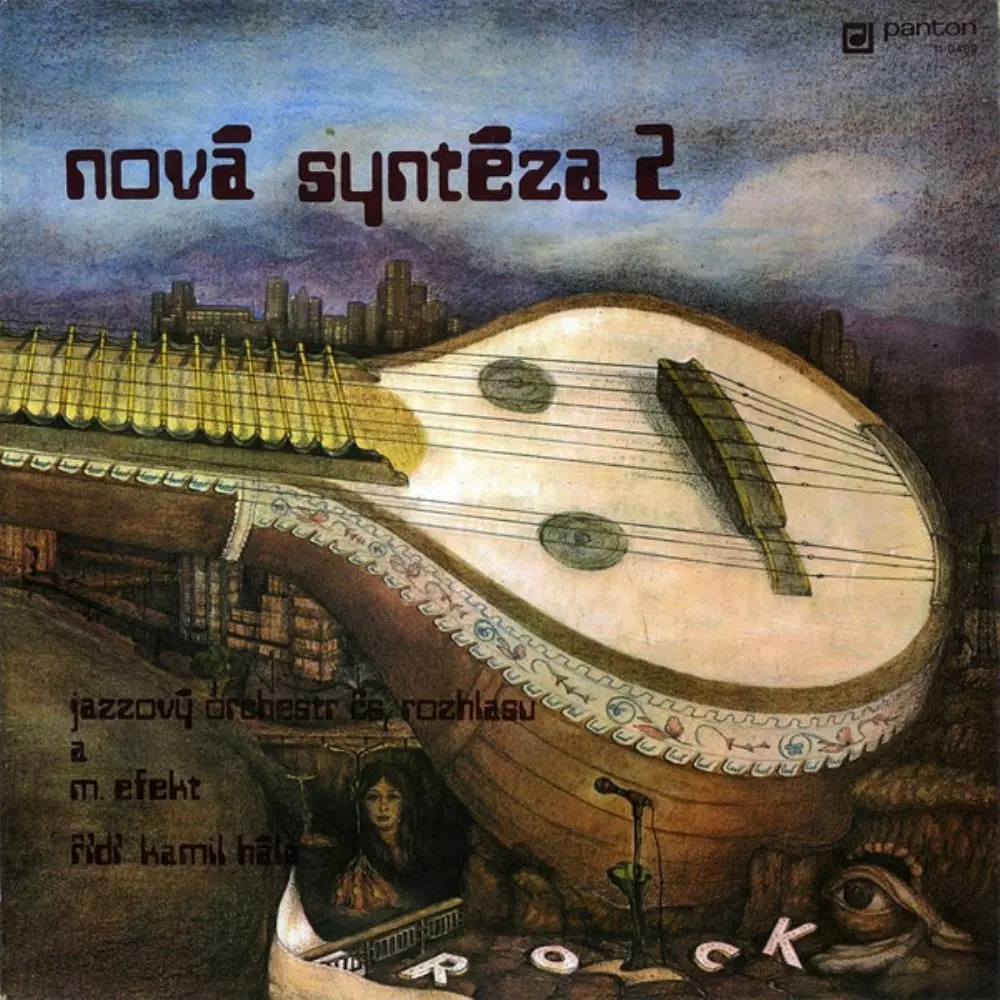 Modrý Efekt released their fourth album, Nová Syntéza 2, in October 1974 on Panton, which abbreviated their name as M. Efekt and again partnered them with the Jazzový Orchestr Československého Rozhlasu.
Modrý Efekt & Radim Hladík
 Modrý Efekt released their fifth album, Modrý Efekt & Radim Hladík, in December 1975 on Supraphon.
Though issued mid-decade, the material comes from sessions held between March 18 and June 6, 1973, at Supraphon’s Dejvice studio in Prague and marks the band’s move from large-ensemble orchestral projects to an electric, small-group format built around extended instrumental pieces.
Guitarist Radim Hladík leads the lineup with electric, acoustic, and steel guitar and ring-modulated effects, supported by bassist–violinist Josef Kůstka, keyboardist–vocalist Lešek Semelka, and drummer Vlado Čech. Guest spots by pianist Martin Kratochvíl (electric piano) and multi-reedist Jiří Stivín (flute, alto saxophone) extend the textures, adding reeds and Rhodes voicings to the core guitar group. The arrangements pivot between sparse acoustic openings, tightly locked rhythm parts, and dense ensemble climaxes where guitar, flute, saxophone, and electric piano trade lines.
Hladík composed and arranged all five tracks, shaping the album as a sequence of long-form pieces with recurring themes and mid-track mood shifts. “Boty” revisits material first aired in earlier orchestral form, now recast for quartet and guests, while “Hypertenze” foregrounds ensemble solo space with individual features for Kratochvíl, Stivín, and Kůstka. Vocals appear only in brief choral and wordless passages; the main focus stays on instrumental interplay and development.
“Boty” opens with a short keyboard flare, then settles into a steady mid-tempo pattern where Hladík’s guitar threads through shifting sections, tightening into sharp unison figures with bass before dropping to a low-lit middle stretch of sustained chords, flute lines, and rising organ phrases, then surging back into faster runs and accent-heavy cadences. “Čajovna” holds a slower, even pace, built on a simple pulse with layered guitar voices that bend and sustain over a restrained rhythm section. “Skládanka” moves quicker with a more restless undercurrent, alternating agile flute phrases and compact guitar figures over a busy drum and bass foundation, broken by a central passage of wordless vocal fragments and rapid guitar statements.
“Ztráty a nálezy” begins on close-miked acoustic guitar with light percussion and electric violin entering as the band slides into a slow, spacious song form, organ filling the gaps while guitar and violin share the lead, then returning to the opening acoustic figure. “Hypertenze” starts with a forceful riff and dense drum pattern, then opens into a long sequence of exchanges between guitar, electric piano, alto saxophone, and bass, thinning at mid-length into a quieter stretch where Kůstka’s bass steps forward, before a final build that restores the opening weight with repeating figures, background vocal lines, and an insistent saxophone lead.
A1. “Boty” [Shoes] (10:05)
A2. “Čajovna” [Tea-Room] (4:05)
A3. “Skládanka” [Jigsaw Puzzle] (5:55)
B1. “Ztráty a nálezy” [Lost and Found] (5:20)
B2. “Hypertenze” [Hypertension] (12:35)
Sessions occurred from March 18 to June 6, 1973, at the Supraphon studio in Dejvice, Prague, with Hynek Žalčík producing, compiling, and supervising the recordings. František Řebíček and Jiří Rohan handled sound engineering, with additional recording supervision by Jan Spálený and Květoslav Rohleder. The album appeared through Supraphon in association with Mladý Svět and the Svazarm Hi-Fi Club, pressed by Gramofonové Závody and printed by Severografia Červený Kostelec.
Modrý Efekt & Radim Hladík features cover design and layout by Karel Machálek with supplementary graphic work by Vladimír Nagaj and photography by Jan Hlína and Vladimír Merta, issued as a dedicated Hi-Fi Club and Diskotéka Mladého světa edition.
CD reissues append two non-album tracks from 1973, “Armageddon” (6:22) and “Clara” (4:13), vocal pieces originally cut for the German compilation Hallo Nr. 10 that did not appear on the original LP.
Svitanie
 Modrý Efekt (billed henceforth as M. Efekt) released their sixth album, Svitanie, in October 1977 on Opus.
The album marks their turn from the hard fusion of Modrý Efekt & Radim Hladík toward expansive, symphonic forms, with an emphasis on shifting time signatures, dynamic contrasts, and compositional breadth. With bassist Fedor Frešo (ex-Collegium Musicum) and keyboardist Oldřich Veselý (ex-Synkopy 61), M. Efekt became a pan-Czechoslovak supergroup, streamlining into a quartet rooted in high-register vocals, thick textures, and extended instrumental arcs.
Hladík leads with modulated sustain lines and staccato runs that blur the boundary between phrasing and atmospherics. Veselý alternates organ, electric piano, ARP strings, and Mellotron-like voicings, framing each piece with dense chordal layers or light chromatic cascades. Frešo drives the material with counterpoint basslines and harmonic outlines that foreground his role in the compositions. Čech operates across tightly cued snare rolls, staggered ride cymbal figures, and sharp accent shifts, adjusting tempo and emphasis with minimal strain.
Frešo, Veselý, and Hladík co-composed the three instrumental pieces and the side-long title suite, “Svitanie.” All four adapted the folk-based “Ej, Padá, Padá Rosenka,” credited to the Slovak traditional canon, with Frešo handling the lead vocal. Veselý sings backing and harmony parts throughout.
“Vysoká Stolička, Dlhý Popol” moves through a layered organ overture, suspended guitar–bass interchanges, and sudden tempo breaks that stage rhythmic handoffs between dueling motifs. “Ej, Padá, Padá Rosenka” rises from a slow, church-like intro to a crisp ensemble passage punctuated by Hladík’s volume-controlled flares. “V Sobotu Popoludní” threads doubled riffs over fluctuating meters, including an accelerated midsection with responsive synth and guitar phrasing. “Svitanie” opens with ambient organ and sustained guitar tones, then expands across multiple episodes—stretched blues sections, modal breaks, acoustic overlays, and swelling returns—each shaped by tonal change and structural reprisal.
A1. “Vysoká Stolička, Dlhý Popol” [High Chair, Long Ashes] (10:12) — Frešo/Veselý/Hladík
A2. “Ej, Padá, Padá Rosenka” [Dew Is Falling, Falling] (6:36) — Slovak trad.; arr. Frešo/Veselý/Hladík/Čech
A3. “V Sobotu Popoludní” [On Saturday Afternoon] (4:15) — Frešo/Veselý/Hladík
B. “Svitanie” [Dawning] (19:35) — Frešo/Veselý/Hladík; lyrics by Jaroslav Hutka
Sessions occurred in 1977 at Opus Studio in Pezinok with recording supervisor Ján Lauko and engineer Juraj Filo. M. Efekt arranged the material as a four-piece: Hladík (electric and acoustic guitars), Veselý (organ, piano, electric piano, ARP string synth, vocals), Frešo (bass guitar, mandolin bass, percussion, vocals), and Čech (drums, percussion).
Svitanie features cover art by Igor Imro with photography by Jindro Zlesák. Liner notes by Ondřej Konrád appear on the back sleeve.
Svět Hledačů
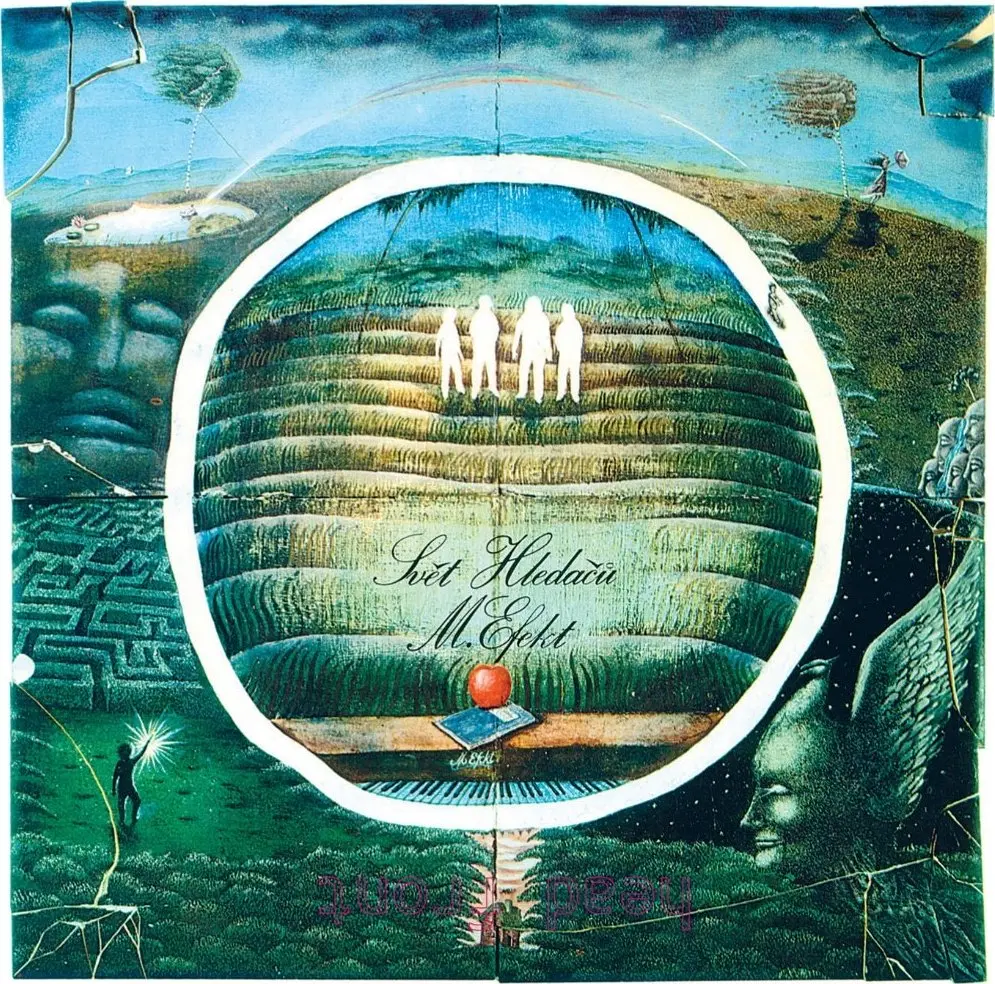 M. Efekt released their seventh album, Svět Hledačů, in December 1979 on Panton.
The album departs from the ambient fusion and symphonic interplay of Svitanie in favor of a dense, fully keyboard-laden sound with alternating vocal sections and layered harmonic frameworks. It features the return of Lešek Semelka, who joins Oldřich Veselý as co-lead vocalist and second keyboardist. The absence of a bassist yields a low-end shift to clavinet, celesta, and Moog textures, framing a sound that aligns more with space–symphonic traditions than the jazz–rock core of prior releases.
Radim Hladík anchors the arrangements with sharp flanger patterns, brittle chord voicings, and long scalar breaks that evoke both Steve Howe and Frippian angularity. Veselý and Semelka divide keyboard and vocal roles: the former deploys Omni and Micromoog textures in sustained pads or pointillistic interjections; the latter adds clavinet runs, celesta shading, and soaring vocal passages. Čech supports with active fills and tight rhythmic changes, shifting pace without offsetting the thickened arrangements.
Hladík composed the opening “Za Krokem Žen” and the mid-side piece “Rajky,” both voiced by lyricist Daniel Macík and poet Pavel Vrba, respectively. Veselý wrote and sang “Hledám Své Vlastní Já,” while Semelka supplied the material for “Zmoudření Babím Létem” and the album-closer “Zázrak Jedné Noci.” The lyrical content explores themes of transformation, spiritual searching, and metaphysical resolve.
“Za Krokem Žen” opens with ambient organ and suspended chords, then cycles through tight groove figures, phased guitar runs, and staggered vocal entrances. “Hledám Své Vlastní Já” remains subdued with piano-led harmonies and minor cadences shaped around multi-voice lines. “Rajky” alternates a syncopated main riff with delayed entries and a fugue-styled build involving interlocked keyboard and guitar phrases.
“Zmoudření Babím Létem” layers a thick organ overture over clustered vocal phrasing and shifting rhythmic pulses before dropping into synth interplay and rapid guitar breaks. “Zázrak Jedné Noci” spans nearly twelve minutes with alternating calm and agitation, cycling from a solemn melodic base into spatial breakdowns, pulse-based expansions, and final harmonic convergence.
A1. “Za Krokem Žen” [Step by Step with Women] (11:43) — Hladík; lyrics by Daniel Macík
A2. “Hledám Své Vlastní Já” [I Seek My Own Self] (4:12) — Veselý; lyrics by Pavel Vrba
A3. “Rajky” [Birds of Paradise] (7:14) — Hladík; lyrics by Pavel Vrba
B1. “Zmoudření Babím Létem” [Wisdom of the Indian Summer] (8:45) — Semelka; lyrics by Pavel Vrba
B2. “Zázrak Jedné Noci” [Miracle of One Night] (11:48) — Semelka; lyrics by Pavel Vrba
Sessions occurred in 1979 with Svatoslav Rychlý (recording supervisor) and Jan Štěpánek (engineer). The quartet features Hladík (guitar), Čech (drums, percussion), Veselý (ARP Omni, Micromoog, piano, clavinet, vocals), and Semelka (Micromoog, piano, celesta, clavinet, vocals).
Svět Hledačů features a front and back cover designed by Petr Sís with photography by Alan Pajer. Liner notes by Petr Dorůžka appear on the back sleeve.
33
 M. Efekt released their eighth album, 33, in September 1981 on Supraphon.
The album continues their symphonic trajectory but with a more compact trio structure and a heightened emotional tone. Following the departure of Oldřich Veselý, Lešek Semelka remained as sole keyboardist and vocalist, joining Radim Hladík and drummer Vlado Čech for what became the band’s swan song. The absence of a bassist once again shifted harmonic grounding to synths and guitar, with extended passages that blend lyrical phrasing and intricate interplay across all four long-form tracks.
Hladík deploys a mix of clean phrasing, flanged distortion, and ARP Avatar guitar synth textures, balancing rhythmic punctuation with melodic lead work. Semelka integrates Multi Moog, Micro Moog, and Korg Polyphonic Ensemble voicings into layered chords, counterlines, and supportive bass patterns. Čech keeps the trio’s pacing taut with restless fills, precise metric shifts, and detailed dynamic control.
Hladík composed the first two tracks, “Třiatřicet” and “Avignonské Slečny Z Prahy,” both with lyrics by regular contributor Pavel Vrba. Semelka wrote the back-half material, “Občasná Pánská Jízda” and “Kohoutek Kamarádství Dokapává,” with Vrba again supplying the texts. The vocals—entirely handled by Semelka—alternate between urgent declamations and soft melodic cadences, complementing the music’s changing tone.
“Třiatřicet” opens with jagged guitar cycles and brief vocals before settling into extended instrumental sections that juxtapose soft interludes and reprise-driven builds. “Avignonské Slečny Z Prahy” contrasts sustained synth pads and lyrical lines with brief vocal refrains and slow, expressive guitar phrasing. “Občasná Pánská Jízda” moves from thick organ voicings and delay-treated guitar motifs into atmospheric breaks and layered Moog improvisations. “Kohoutek Kamarádství Dokapává” opens with a dramatic guitar statement and alternates between restrained, vocal-centered passages and angular instrumental breaks, ending with a reprise of the core harmonic theme.
A1. “Třiatřicet” [Thirty-Three] (14:23) — Hladík; lyrics by Pavel Vrba
A2. “Avignonské Slečny Z Prahy” [Avignon Ladies from Prague] (6:58) — Hladík; lyrics by Pavel Vrba
B1. “Občasná Pánská Jízda” [Occasional Boys’ Outing] (11:19) — Semelka; lyrics by Pavel Vrba
B2. “Kohoutek Kamarádství Dokapává” [The Tap of Friendship Is Dripping Out] (8:49) — Semelka; lyrics by Pavel Vrba
Sessions occurred in 1981 at the Mozarteum with recording supervisors Jan Spálený, Květoslav Rohleder, Pavel Kühn, and Pavel Větrovec, and engineer Karel Hodr. The trio consisted of Hladík (guitar, ARP Avatar guitar synthesizer), Semelka (vocals, Micro Moog, Multi Moog, Korg Polyphonic Ensemble), and Čech (drums, bells, mlýnek).
33 features cover art by Petr Sís with photography by Jiří Chocholáč and typography by Josef Vincík. Booklet editing by Jana Řehořová.
Discography:
- Coniunctio (1970 • Blue Effect & Jazz Q Praha)
- Meditace (1970)
- Kingdom of Life (1971)
- Nová syntéza (1971 • Modrý Efekt)
- Nová syntéza 2 (1974 • M. Efekt)
- Modrý Efekt & Radim Hladík (1975 • Modrý Efekt & Radim Hladík)
- Svitanie (1977 • M Efekt)
- Svět hledačů (1979 • M. Efekt)
- 33 (1981 • M. Efekt)
Sources:
- Discogs: Modrý Efekt
- 45worlds: Modrý Efekt
- ProgArchives: Modrý Efekt
- RYM: Modrý Efekt
- MusicBrainz: Modrý Efekt
Artist/Album Pages:
Visitor 2035 was an English symphonic/jazz-rock band that released the 1976 musical double-album ...
Korni Grupa was a Yugoslav symphonic-rock band that released fourteen singles and the 1972–74 albu...
Puzzle was an American jazz-funk/soul band from Chicago that released two albums in 1973/74 on Mo...
Mosaic was a French jazz-rock band that released the 1978 album Ultimatum on self-press Ekimoz. ...
Chris Rea is an English singer, guitarist, and songwriter who released nine albums between 1978 an...
Gipsy Love was an Austrian soul-rock band that was active for two years during the early 1970s. Th...
Chain Reaction was a Jamaican-Brit soul trio that released the album Indebted to You in 1977 on Gull...
A Foot in Coldwater (AFIC) was a Canadian hard-rock band from Toronto that released three Daffodi...
Eumir Deodato is a Brazilian pianist, composer, arranger, and producer who emerged from the Rio de...
Ray Russell (born April 4, 1947) is an English jazz-rock guitarist who emerged as a quartet leader...
Head, Heart & Hands were a German jazz-rock band that debuted with the 1976 Vertigo release Li...
Esther Williams is an American soul singer who released three albums between 1976 and 1981, setti...