
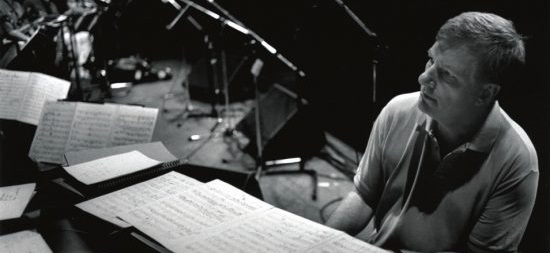
Mike Westbrook (born March 21, 1936) is an English jazz pianist, composer, and bandleader who directed the namesake Mike Westbrook Concert Band through five albums between 1967 and 1970 on Deram. He then assembled the Mike Westbrook Orchestra with a veritable array of new-jazz nameplayers on saxophone (Alan Skidmore, Ray Warleigh), trumpet (Harry Beckett, Kenny Wheeler), guitar (Gary Boyle), bass (Harry Miller), and drums (John Marshall). The orchestra cut the 1971 RCA/Neon release Metropolis with vocalist Norma Winstone. In 1975, a paired-down lineup released Citadel / Room 315 with saxist John Surman as the featured soloist.
Between the two orchestra albums, Westbrook cut two discs with the blues-rock/jazz combo Solid Gold Cadillac. In 1976, he assembled the Mike Westbrook Brass Band for a three-album run, culminating with a live double-LP in 1981 on Polydor.
Background
Mike Westbrook was born Michael John David Westbrook on March 21, 1936, in High Wycombe, Buckinghamshire; the son of piano teacher Vera Butler and amateur percussionist Philip Westbrook. He grew up in Torquay and Plymouth and attended Kelly College in Tavistock. Westbrook collected 78 rpm records by Louis Armstrong, Jelly Roll Morton, Fats Waller, and Duke Ellington as a teenager. He taught himself trumpet and piano and learned to read music without formal composition training.
Westbrook trained briefly in accountancy after school, then completed two years of National Service. He served partly in Germany and saw Lionel Hampton’s band in 1956 at Bournemouth Winter Gardens. Westbrook studied painting at Plymouth Art College after his discharge. He formed his first jazz group at Plymouth Arts Centre in 1958 with fellow art students. Early lineups included guitarist Keith Rowe and saxophonists Lou Gare and John Surman, whose arrival gave Westbrook a four-horn lineup for original material.
Westbrook moved to London in the early 1960s and taught art at West Drayton Grammar School, where future saxophonist Alan Wakeman studied under him. He continued his art studies at Hornsey School of Art. Westbrook led a mid-1960s sextet with Surman, bassist Harry Miller, drummer Alan Jackson, trombonist Malcolm Griffiths, and saxophonist Mike Osborne. His groups played regularly from 1965 through 1967 at Ronnie Scott’s Old Place on Gerrard Street and appeared at Little Theatre Club in Covent Garden. Westbrook recorded a prospective sextet session with engineer Eddie Kramer and a 1966 BBC Jazz Scene session.
Westbrook expanded the sextet into Mike Westbrook Concert Band for Celebration, a 15-part suite premiered in March 1967 at Liverpool University. The Concert Band presented Celebration at Old Place in May 1967 and secured a contract with Decca subsidiary Deram. Westbrook condensed the suite to eight selections for a Deram session with producer Peter Eden.
Discography:
- Celebration (1967 • The Mike Westbrook Concert Band)
- Release (1968 • Mike Westbrook Concert Band)
- Marching Song Vol. 1 (1969 • The Mike Westbrook Concert Band)
- Marching Song Vol. 2 (1969)
- Love Songs (1970 • The Mike Westbrook Concert Band)
- Metropolis (1971)
- Tyger: A Celebration of William Blake [cast recording] (1971)
- Citadel / Room 315 (1975 • Mike Westbrook Orchestra)
- Love/Dream and Variations (1976 • Mike Westbrook Orchestra)
- Plays “For the Record” (1976 • Mike Westbrook Brass Band)
- Goose Sauce (1978)
- Piano (1978)
- Mama Chicago (1979)
- Bright as Fire [The Westbrook Blake] (1980)
- The Paris Album (1981 • Mike Westbrook Brass Band)
- The Cortège (1982 • Mike Westbrook Orchestra)
- A Little Westbrook Music (1983)
- Pier Rides (1986)
- Westbrook-Rossini (1987)
- London Bridge Is Broken Down (1988)
- Off Abbey Road (1989 • Mike Westbrook Band)
Artist/Album Pages:
Mixture was a Swedish jazz-rock band that made a 1980 self-titled album on Coop Records. Profi...
Keith Green (Oct. 21, 1953 — July 28, 1982) was an American singer/songwriter from Brooklyn. He fi...
Oriental Wind was a multinational avant/ethno-jazz ensemble named after the 1977 solo album by Tur...
Tamiko Jones — aka Barbara Tamiko Ferguson (born 1945) — is an American soul singer from Kyle, W.V.,...
Scandal was an Australian art-rock band from Adelaide behind a 1978 self-titled album on Mushroom ...
Natdamperen were a Danish jazz-rock band that released two albums on self-press Abel Records in 1...
Saïno was a French jazz-rock band that self-released two albums between 1982 and 1984 on namesake ...
The Muffins were an American jazz-rock band that released two proper albums: the Canterbury-style ...
Vita Nova was a Munich-based symphonic/psych trio comprised of German multi-instrumentalist Eddy M...
UPP was an English jazz-funk band that released two albums on Epic during 1975 and 1976, the first...
Galapagos Duck was an Australian jazz-funk band from Sydney that released a string of albums on Ph...
Man was a Welsh jam-rock band that released twelve albums between 1969 and 1977. On Pye, they made...