

Mike Batt (Feb. 6, 1949) is an English composer and arranger from Southampton who conducted a string of instrumental/interpretive recordings with his namesake orchestra for DJM Silverline between 1970 and 1972. In 1973, he masterminded the first of six releases by the costumed studio act The Wombles, a musical vehicle for the namesake children’s television series.
In 1977, Batt conducted the all-star symphonic-rock recording Schizophonia, featuring the London Symphony Orchestra and released on Epic. The subsequent Tarot Suite, credited to Mike Batt and Friends, features appearances by Rory Gallagher, Roger Chapman, and Colin Blunstone. Three further orchestrated works appeared on Epic between 1980 and 1982, including the popular 1981 release Six Days in Berlin, featuring guitarists B.J. Cole and Ray Russell. Batt’s 1986 Adventure Records release The Hunting of the Snark features vocal performances by Art Garfunkel, Cliff Richard, Captain Sensible, Deniece Williams, Julian Lennon, and Roger Daltery.
Batt’s songs have been recorded by numerous performers, including David Essex, Barbara Dickson, Cliff Richard (“Please Don’t Fall In Love“), Elaine Paige, and The Hollies.
Background
Michael Philip Batt was born on February 6, 1949, in Southampton and attended Peter Symonds School in Winchester. At eighteen, he answered a New Musical Express advertisement placed by Liberty Records executive Ray Williams. Liberty signed him as a songwriter and recording artist, then appointed him head of A&R at nineteen.
Batt signed the Groundhogs and produced their 1968 debut, Scratching the Surface, for Liberty. He next co-wrote, produced, and played piano on Hapshash and the Coloured Coat’s Western Flier. His 1969 version of “Your Mother Should Know” followed under his own name, while Family used his uncredited brass and string arrangements on Music in a Doll’s House. Batt established the Mike Batt Orchestra as a vehicle for arranged studio projects at the start of the next decade.
The Mike Batt Orchestra and Portrait Albums
Penny Farthing released the 1970 set Batt Tracks as the first Mike Batt Orchestra album. Batt arranged, conducted, and produced orchestral versions of current songs, including “Come and Get It,” “Leaving on a Jet Plane,” “Something,” “Venus,” and “Bridge Over Troubled Water.”
DJM Silverline then issued a sequence of interpretive LPs built around individual songwriters and groups. DJM’s 1971 program comprised Portrait of Bob Dylan, Portrait of Elton John, Portrait of the Rolling Stones, and Portrait of Simon and Garfunkel. The sequence concluded the next year with Portrait of Cat Stevens and Portrait of George Harrison. Batt arranged and conducted each set, then produced the corresponding sessions. DJM later condensed the series on the 1974 sampler Portrait of Mike Batt.
The same period produced the Synthesonic Sounds albums Moog at the Movies and Ye Olde Moog, plus the instructional release Yoga for Health. These assignments extended Batt’s orchestral and studio work into the opening phase of the Wombles project.
The Wombles and Mid-Seventies Work
Television producers asked Batt to write music for the BBC children’s series The Wombles. He accepted character-based recording rights in place of a flat fee and wrote, arranged, produced, and sang the records. The project yielded Wombling Songs, Remember You’re a Womble, Keep On Wombling, and Superwombling between 1973 and 1975, with four gold albums and eight hit singles. Guitarist Chris Spedding, percussionist Ray Cooper, drummer Clem Cattini, and bassist Les Hurdle formed the recurring studio rhythm section.
Batt also scored Simon in the Land of Chalk Drawings and returned to the Wombles for the 1978 film soundtrack Wombling Free. Outside the character project, he produced Steeleye Span’s All Around My Hat and Rocket Cottage, then produced the Kursaal Flyers single “Little Does She Know.” The BBC seaside series Seaside Special used “Summertime City,” credited to Mike Batt with the New Edition, as a theme; the 1975 single reached No. 4 on the UK chart.
Schizophonia
 Mike Batt released his debut solo album, Schizophonia, in July 1977 on Epic.
The first side forms an Arabic-themed sequence, while the second combines Batt songs, a Bach adaptation, and “Don’t Let Me Be Misunderstood.” The London Symphony Orchestra joins a rhythm group drawn from his Wombles sessions, with guitarists Chris Spedding and Alan Parker, percussionist Ray Cooper, drummer Clem Cattini, and bassist Les Hurdle among the principal players. Batt wrote all tracks except where noted.
“The Ride to Agadir” surges from an unaccompanied opening into oboe, tablas, electric lead, and broad orchestral statements. “Insh’Allah” pivots through sharply separated sections, with Middle Eastern-inflected figures crossing dense ensemble passages. “The Fires of Rabat” sweeps through band riffs and symphonic passages.
“It Seemed Like a Good Idea at the Time” saunters through orchestra-led swing figures and dry, ironic phrasing. “Railway Hotel” lingers over a restrained 4/4 tread, acoustic guitar, cor anglais, and melancholic strings. “Bourrée” resolves into a chamber-scaled dance after a brief ensemble-sung entrance.
A1. “The Ride to Agadir” (6:40)
A2. “Berber’s Prayer” (2:03)
A3. “The Walls of the World” (3:19)
A4. “Insh’Allah” (4:58)
A5. “The Fires of Rabat” (2:56)
B1. “It Seemed Like a Good Idea at the Time” (2:53)
B2. “Bourrée” (1:35) – Johann Sebastian Bach
B3. “Railway Hotel” (3:21)
B4. “Voices in the Dark” (4:04)
B5. “Don’t Let Me Be Misunderstood” (4:09) – Bennie Benjamin, Sol Marcus, Gloria Caldwell
Sessions extended across 1976, chiefly at Wessex Studios in London, with additional work at Lansdowne, Olympic, and CTS. Batt produced the album with principal engineers Tim Friese-Greene and Mike Thompson, who remained in the production team for Tarot Suite.
Visual artist Michael Hasted supplied the cover paintings after designing the Groundhogs debut Scratching the Surface, which Batt produced. Portrait photographer Peter Lavery handled the back-cover image; his 1977 sleeve work also included Gallagher and Lyle’s Showdown. Maurice Wilson set the typography.
Epic lifted “Railway Hotel” as a March 1978 single (b/w “The Ride to Agadir”). Both songs entered national charts in continental Europe, where Batt’s solo records circulated without the Wombles association. Dramatico paired Schizophonia with Tarot Suite on a 2009 compact-disc reissue.
Caravans
 CBS issued Mike Batt’s soundtrack album Caravans in 1978 alongside the James Fargo film.
Batt divided the score between Persian-location material and a broad principal theme for the film’s western narrative. The London Philharmonic Orchestra performs the orchestral passages, while regional reeds and percussion distinguish the travel and palace cues. Barbara Dickson sings “Caravan Song,” the album’s sole vocal selection.
A1. “Caravan on the Move” (4:00)
A2. “Main Title” (2:45)
A3. “Russian Dance” (1:43)
A4. “Inside Sardar Khan’s Palace” (1:35)
A5. “Journey to Badek” (1:45)
A6. “The Camp at Qualir” (3:02)
A7. “The Desolate Valley” (1:22)
A8. “Caravan Song” (2:04)
B1. “Qualir at Night” (1:45)
B2. “Storm in the Desert” (6:35)
B3. “Becky’s Waltz” (1:03)
B4. “Kochi Dancer” (1:13)
B5. “The Aftermath” (3:48)
B6. “Theme from Caravans” (3:38)
Batt produced and conducted the London Philharmonic Orchestra sessions with engineer John Richards and assistant Howard Somers. Richards also engineered the Carpenters album Christmas Portrait within the same release cycle.
Dickson recorded an extended version of “Caravan Song” for a December 1979 single, backed by Batt and the London Philharmonic Orchestra. The release reached No. 41 on the UK chart. Dramatico’s 2009 compact disc paired the score with Batt’s Watership Down Orchestral Suite.
Tarot Suite
 Mike Batt released his second solo album, Tarot Suite, in September 1979 on Epic.
The ten tracks draw on figures and episodes from the Major Arcana. Roger Chapman sings “Imbecile” and “Run Like the Wind,” Colin Blunstone takes “Losing Your Way in the Rain,” and Batt sings “Lady of the Dawn.” Six instrumental pieces complete the sequence. The London Symphony Orchestra joins guitarists Rory Gallagher, Jim Cregan, and Chris Spedding, pedal-steel player B.J. Cole, and saxophonist Mel Collins.
“Introduction (The Journey of a Fool)” tolls through dark bells and heartbeat thuds before strings surge beneath Gallagher’s lead. “Imbecile” charges on chugging guitars and Chapman’s rough declamation before massed orchestral hits close final passage. “Plainsong” flickers through rapid keyboard figures, chopped syllables, and sparse percussion.
“Tarota” gallops between horn peaks, contrasting solos, and layered syllables. “The Night of the Dead” stomps through cymbal crashes and abrupt turns. “Run Like the Wind” drives Chapman’s grainy lead through a wild saxophone break.
A1. “Introduction (The Journey of a Fool)” (4:26)
A2. “Imbecile” (5:05) – Roger Chapman (vocals)
A3. “Plainsong” (1:58)
A4. “Lady of the Dawn” (4:00) – Mike Batt (vocals)
A5. “The Valley of Swords” (5:30)
B1. “Losing Your Way in the Rain” (3:33) – Colin Blunstone (vocals)
B2. “Tarota” (6:13)
B3. “The Night of the Dead” (3:30)
B4. “The Dead of the Night” (1:58)
B5. “Run Like the Wind” (4:27) – Roger Chapman (vocals)
Batt produced the 1978–79 sessions with principal engineer Mike Thompson, then arranged and conducted the London Symphony Orchestra. Robert Butterworth and Gary Langan handled additional recording; Langan’s recent engineering credits included Queen’s News of the World.
Batt and CBS art-department designer Simon Cantwell built the package around illustrator Jack Richards’s card imagery and returning photographer Peter Lavery. Richard Field set the typography; Cantwell also worked on CBS sleeves for Sailor and Lone Star within the same decade.
Epic released “Lady of the Dawn” as a single (b/w “The Night of the Dead”). The song reached No. 3 in Switzerland, No. 16 in West Germany, No. 17 in the Netherlands, and No. 24 in Belgium. Tarot Suite also entered album charts in West Germany, the Netherlands, New Zealand, and Sweden before the 2009 Dramatico pairing with Schizophonia.
Waves
 Mike Batt released his third solo album, Waves, in August 1980 on Epic.
Batt built the album around sea and radio imagery, with “The Winds of Change” as the principal song and a run of compact instrumental pieces across the second side. Bassist Frank McDonald, drummer Trevor Morais, and guitarists Jim Cregan, Nigel Jenkins, and Ray Russell form the rhythm group. The Amsterdam Chamber Orchestra, led by Gijs Beths and drawn from Concertgebouw players, supplies the orchestral ensemble.
“Portishead Radio” jitters through mechanized accents and an agitated beat. “Conga Reel” clatters through conga figures and blunt horn interjections. “Fishing for the Moon” charges through hard-edged guitar figures before a brief orchestral interlude. “Waiting for a Wave” glides with a lilting, subdued sway.
A1. “The Winds of Change” (3:56)
A2. “Waves” (6:00)
A3. “Portishead Radio” (4:08)
A4. “Mona” (6:57)
B1. “Conga Reel” (2:56)
B2. “Buenos Dias, Capitan” (2:40)
B3. “Lobsterissimus Bumbicissimus” (1:05)
B4. “Fishing for the Moon” (3:16)
B5. “Echo Foxtrot” (3:09)
B6. “Sierra Tango” (2:50)
B7. “Waiting for a Wave” (2:00)
Batt produced the 1980 sessions at Wisseloord Studios in Hilversum with engineer Pieter Boer and conducted the Amsterdam Chamber Orchestra. The same engineer also worked on the Undertones album Hypnotised within the release cycle, linking the session to Wisseloord’s contemporary rock production.
CBS art director Rosław Szaybo directed the package, Graphyk completed the sleeve artwork, and Jaap de Jong supplied photography. The front reproduces an Ida Rentoul Outhwaite fantasy painting. For a concurrent CBS project, Szaybo designed the 1980 Judas Priest sleeve British Steel.
Epic issued “The Winds of Change” as a single, and the song entered several continental European charts. Dramatico coupled Waves with Six Days in Berlin for a 2009 compact-disc release.
Six Days in Berlin
 Mike Batt released his fourth solo album, Six Days in Berlin, in September 1981 on Epic.
One extended composition spans six numbered parts and uses a midpoint passage assembled from a reversed orchestral score. The Berlin Opera Orchestra joins drummer Curt Cress, bassist Frank McDonald, guitarists Mats Björklund and Ray Russell, pedal-steel player B.J. Cole, and saxophonist Mel Collins.
“Part One” unfurls a Parisian accordion figure through broad orchestral passages and Middle Eastern-inflected motifs. “Part Two” swells through a stirring orchestra-led interlude.
A1. “Part One” (8:51)
A2. “Part Two” (3:45)
A3. “Part Three” (5:34)
B1. “Part Four” (7:22)
B2. “Part Five” (4:28)
B3. “Part Six” (11:08)
Batt produced the 1981 basic sessions at Hansa Studio Two in Berlin with chief engineer Tom Müller. Mike Stavrou recorded the later voices and mixed the album at AIR Studios in Montserrat, while Müller oversaw the Hansa orchestral recording.
Berlin photographer Henrike Schutz photographed Batt for the front sleeve, which places him in checked tailoring beneath a comic speech caption. Guitarist Ray Russell supplied the informal back-cover images, extending his session role into the package.
Dramatico’s 2009 compact disc paired Six Days in Berlin with Waves.
Zero Zero
 Mike Batt released his fifth solo album, Zero Zero, in December 1982 on Epic.
The album accompanies a television fantasy commissioned for the Australian Broadcasting Corporation’s fiftieth anniversary. Batt plays Number 17, a worker in a future society that treats emotion as a disorder, and the Sydney Symphony Orchestra supports the score.
“Love Makes You Crazy” jitters through programmed beats and brittle synthesizer accents. “Whispering Fools” lingers as a plaintive, mechanized anthem. “Love Makes You Crazy (Instrumental Reprise)” pivots from electronic figures into a full orchestral return.
A1. “Introduction (The Birth of Number 17)” (5:22)
A2. “System 605” (2:17)
A3. “Love Makes You Crazy” (3:38)
A4. “Delirium” (8:45)
B1. “Whispering Fools” (4:30)
B2. “Zero Zero” (7:17)
B3. “The Dance of the Neurosurgeons” (3:52)
B4. “No Lights in My Eyes” (3:09)
B5. “Love Makes You Crazy (Instrumental Reprise)” (3:02)
Batt produced the 1982 Sydney sessions with principal engineer John Bee and conducted the Sydney Symphony Orchestra. Additional engineers Glen Phinister and Richard Lush supported Bee, while David Harvey coordinated the sound. Bee moved from this project to early-Eighties sessions with the Church, including Seance and Remote Luxury.
Batt designed the gatefold package around Barry Gaunt and Bob Clark’s still photography from the television production. The booklet follows Number 17 through the treatment centre and uses a checked inner-sleeve pattern tied to the program’s visual scheme.
Epic lifted “Love Makes You Crazy” as a January 1983 single (b/w “The Dance of the Neurosurgeons”). “Whispering Fools” followed in March (b/w “System 605”) as the second single. Dramatico reissued Zero Zero in 2009 with a DVD of the television production.
The Hunting of the Snark
 Mike Batt released the concept album The Hunting of the Snark in 1986 through Adventure Records.
Batt adapted Lewis Carroll’s poem for songs, narration, and the London Symphony Orchestra. John Gielgud and John Hurt narrate between character performances by Roger Daltrey, Art Garfunkel, Julian Lennon, Cliff Richard, Captain Sensible, and Deniece Williams. Maggie Reilly joins Lennon and Batt on “The Vanishing.” George Harrison contributes guitar, and Stéphane Grappelli plays violin. Carroll’s text supplies the spoken passages, while Batt wrote the music and lyrics.
“Children of the Sky” surges through amplified ensemble figures, a blues-tinged guitar break, and a symphonic turn before playful narration. “The Bellman’s Speech” declaims over ceremonial orchestra with Victorian stage diction. “The Escapade” unfurls from strings through soprano aria and triumphant brass before spoken recitation.
“The Pig Must Die” charges through Daltrey’s dramatic lead and amplified orchestral passages before a narrated close. “A Delicate Combination” braids Garfunkel and Williams through close duet harmonies. “The Vanishing” pivots from symphonic opening into ensemble passages, saxophone solo, and alternating sung and narrated sections.
A1. “Introduction” (2:06) – John Gielgud (narration)
A2. “Children of the Sky” (5:25) – Mike Batt (vocals); John Gielgud and John Hurt (narration)
A3. “The Bellman’s Speech” (3:14) – Cliff Richard (vocals)
A4. “The Escapade” (9:21) – Art Garfunkel, Julian Lennon, Cliff Richard, and Deniece Williams (vocals); John Gielgud and John Hurt (narration)
A5. “Midnight Smoke” (5:58) – Julian Lennon (vocals); John Gielgud and John Hurt (narration)
A6. “The Snooker Song” (3:15) – Captain Sensible (vocals); John Hurt (narration)
B1. “The Pig Must Die” (5:13) – Roger Daltrey (vocals); John Gielgud (narration)
B2. “The Beaver’s Lesson” (3:16) – Art Garfunkel and Deniece Williams (vocals); John Hurt (narration)
B3. “A Delicate Combination” (1:50) – Art Garfunkel and Deniece Williams (vocals)
B4. “As Long As the Moon Can Shine” (5:01) – Art Garfunkel (vocals); John Hurt (narration)
B5. “Dancing Towards Disaster” (3:01) – Deniece Williams (vocals)
B6. “The Vanishing” (8:00) – Julian Lennon, Maggie Reilly, and Mike Batt (vocals); John Gielgud and John Hurt (narration)
Batt recorded the album in 1984 across London and Los Angeles facilities, including CTS, Wessex, Abbey Road, and Kendun, then arranged and conducted the London Symphony Orchestra. Nick Patrick and Robert Butterworth served as principal engineers; Butterworth returned from Tarot Suite, while Patrick completed the final mix.
Fantasy artist Patrick Woodroffe painted the fold-out package after his 1983 sleeve program for Pallas’s The Sentinel. His scenes place the expedition and Carroll figures within an illustrated landscape, while the libretto identifies the cast and narrative sequence.
“Midnight Smoke” appeared as a November 1986 single. Adventure followed with “Children of the Sky” (b/w an excerpt from “The Beaver’s Lesson”), while Captain Sensible issued “The Snooker Song” with “Midnight Smoke” as a 1988 single. Batt staged a Royal Albert Hall concert in 1987 and later expanded the work for a 1991 West End production. Dramatico combined the original album with the Royal Albert Hall film on a 2010 compact disc and DVD edition.
Songs of Love and War
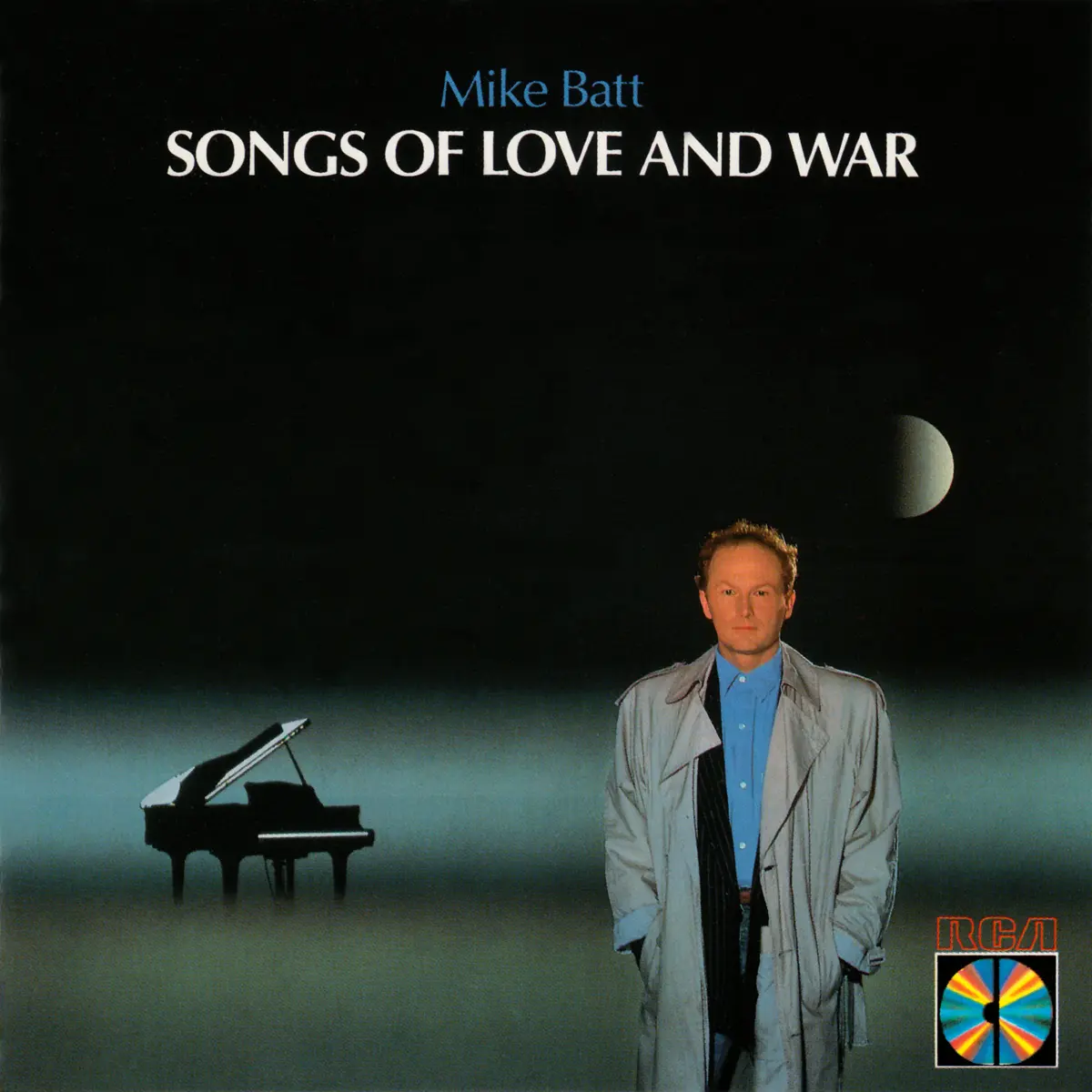 Mike Batt released his sixth solo album, Songs of Love and War, in 1988 on RCA.
The record combines five new pieces with revised versions of “Railway Hotel,” “Soldier’s Song,” and “Caravan Song.” The London Philharmonic Orchestra supports Batt’s keyboards, accordion, and lead voice, with guitarist Jim Cregan, bassist Andy Pask, and orchestra leader David Nolan among the principal musicians.
A1. “Warsaw” (6:45)
A2. “Railway Hotel” (3:12)
A3. “Sailing Ships from Heaven” (7:05)
A4. “Scorpio Prelude” (4:15)
A5. “Ring of Scorpio” (7:14)
B1. “Can’t Lie No More” (4:39)
B2. “Soldier’s Song” (4:23)
B3. “Caravan Song” (3:41)
B4. “The Lion of Kandahar” (8:14)
Co-producer and engineer Gavin Greenaway worked beside Batt on the 1988 sessions, with Batt arranging and conducting the London Philharmonic Orchestra. Their partnership continued through the associated single campaign.
The RCA sleeve places Batt before a grand piano on a dark stage. Original packaging identifies no separate photographer or designer, leaving the visual production unassigned.
RCA released “Warsaw” as a November 1988 single. The label followed with a 1989 revision of “Caravan Song.” Dramatico’s 2009 compact disc paired Songs of Love and War with Arabesque.
Classic Blue
 Justin Hayward released Classic Blue, arranged and produced by Mike Batt, in October 1989 on Trax Music.
Hayward sings and plays guitar across orchestral versions of songs by Smokey Robinson, Jimmy Webb, the Beatles, Don McLean, the Beach Boys, Procol Harum, Fleetwood Mac, Jeff Wayne, and Led Zeppelin. Three Batt compositions—“Bright Eyes,” “Railway Hotel,” and “As Long As the Moon Can Shine”—connect the project to his earlier catalogue. The London Philharmonic Orchestra performs the arrangements under Batt’s direction.
1. “The Tracks of My Tears” (3:20) – Smokey Robinson, Marvin Tarplin, Warren Moore
2. “MacArthur Park” (7:12) – Jimmy Webb
3. “Blackbird” (2:28) – John Lennon, Paul McCartney
4. “Vincent” (4:49) – Don McLean
5. “God Only Knows” (3:30) – Brian Wilson, Tony Asher
6. “Bright Eyes” (3:50) – Batt
7. “A Whiter Shade of Pale” (4:24) – Gary Brooker, Keith Reid
8. “Scarborough Fair” (4:15) – traditional; arranged by Paul Simon and Art Garfunkel
9. “Railway Hotel” (3:19) – Batt
10. “Man of the World” (3:25) – Peter Green
11. “Forever Autumn” (5:12) – Jeff Wayne, Gary Osborne, Paul Vigrass
12. “As Long As the Moon Can Shine” (4:17) – Batt
13. “Stairway to Heaven” (7:42) – Jimmy Page, Robert Plant
Batt produced the 1988–89 digital sessions at Abbey Road Studios with engineer Haydn Bendall and assistant Garth Cousins, then arranged and conducted the London Philharmonic Orchestra. Bendall also contributed recording work to Kate Bush’s The Sensual World in the same year, while Abbey Road provided the orchestral room for the London Philharmonic sessions.
David Thorpe created the cover, and Acrobat Design assembled the package around a blue-toned Hayward portrait. Thorpe’s image separates the collaboration from Batt’s own illustrated concept sleeves.
Trax issued “The Tracks of My Tears” as a 1989 single (b/w “Railway Hotel”). Classic Blue reached No. 47 on the UK album chart, No. 74 in the Netherlands, and No. 97 in Australia. Castle’s 1994 compact disc restored the album to catalogue.
Later Activity
Batt served as joint musical director of the 1990 Melbourne Summer Music Festival and mounted expanded Australian performances of The Hunting of the Snark. He designed and directed the October 1991 West End production at the Prince Edward Theatre. The animated series The Dreamstone supplied another large orchestral project, with Batt composing the score and recording character songs for performers including Billy Connolly, Ozzy Osbourne, Bonnie Tyler, and Joe Brown.
Sony Germany released the 1995 solo album Arabesque. Batt also composed the Channel Tunnel inauguration anthem “When Flags Fly Together” and produced Vanessa-Mae’s The Violin Player. Later projects included the film score Keep the Aspidistra Flying, the Royal Philharmonic guest-vocal album Philharmania, and music for the television adaptation of Watership Down.
Batt founded Dramatico in 2002 and signed Katie Melua, whose first six albums appeared through the company. He produced and arranged her early recordings, including Call Off the Search, Piece by Piece, and Pictures, while the label also issued work by Carla Bruni, Marianne Faithfull, Gurrumul, and Caro Emerald. His own releases included A Songwriter’s Tale, A Classical Tale, and the 2020 anthology The Penultimate Collection.
Later commissions returned him to orchestral rock and concert music. Two 2018 projects paired Batt with Hawkwind on Road to Utopia and the Royal Philharmonic Orchestra on Holst’s The Planets. The multimedia project Songs from Croix-Noire preceded his 2024 autobiography, The Closest Thing to Crazy. Batt produced and arranged Justin Hayward’s 2025 recording of “Life in a Northern Town,” then conducted the London Symphony Orchestra in a 2026 recording of Symphony No. 1, Ukraine.
Discography:
- Batt Tracks (1970 • The Mike Batt Orchestra)
- Portrait of Bob Dylan (1971 • The Mike Batt Orchestra)
- Portrait of Elton John (1971 • The Mike Batt Orchestra)
- Portrait of The Rolling Stones (1971 • The Mike Batt Orchestra)
- Portrait of George Harrison (1971 • The Mike Batt Orchestra)
- Portrait of Cat Stevens (1971 • The Mike Batt Orchestra)
- Portrait of Simon and Garfunkel (1971 • The Mike Batt Orchestra)
- Schizophonia (1977)
- Caravans (OST, 1979)
- Tarot Suite (1979)
- Waves (1980)
- Six Days in Berlin (1981)
- Zero Zero (1982)
- The Hunting of the Snark (1986)
- Songs of Love and War (1988)
- Classic Blue (1989 • Justin Hayward With Mike Batt & The London Philharmonic Orchestra)
- The Dreamstone – Music and Songs from (1990)
- Arabesque (1995)
- Keep the Aspidistra Flying (OST, 1998)
- Philharmania (1998)
- Watership Down (OST, 2000)
- Bright Eyes at the Railway Hotel (2004)
- A Songwriter’s Tale (2008)
- A Classical Tale (2015)
Sources:
Artist/Album Pages:
Crack of Dawn was a soul-funk band from Kingston, Jamaica, that settled in Toronto, Ontario, durin...
The Durutti Column was an English ambient project from Manchester that made nine albums and assort...
Robin Trower (born March 9, 1945) is an English rock/blues guitarist with a musical career that date...
Mother Goose was a New Zealander art-rock band that released two albums on Mushroom Records betwee...
Pentangle was an English folk-rock band from London that released six albums between 1968 and 1972...
Bill Watrous (June 8, 1939 — July 2, 2018) was an American jazz trombonist from Middletown, Conn. ...
Terpandre was a French symphonic-rock band that recorded an album in 1978 that was ultimately rele...
Blue Motion was a Swiss avant-classical keyboard trio that sprung from the ashes of Circus. They sn...
Dick Heckstall-Smith — aka Richard Malden (Sept. 26, 1934 — Dec. 17, 2004) — was an English jazz-r...
Daryl Hall and John Oates — commonly known as Hall & Oates — were an American musical duo, activ...
Fermáta are a Slovak jazz-rock band that released seven albums between 1975 and 1984 on Opus Recor...
X is an American rock band from Los Angeles, formed in 1977 during the Southwest punk explosion. The...