

Loleatta Holloway (1946–2011) was an American soul singer from Chicago who made the 1973–75 albums Loleatta and Cry to Me on the Atlanta-based Aware Records. She made four subsequent albums (1976–80) on Gold Mind/Salsoul and scored R&B/dance hits with “Hit and Run,” “Love Sensation,” “I May Not Be There When You Want Me (But I’m Right on Time),” and the Bunny Sigler duet “Only You.”
Background
Loleatta Holloway was born on November 5, 1946, in Chicago, where she started singing with her mother in the Holloway Community Singers. Between 1967 and 1971, she sang behind gospel icon Albertina Walker in the Caravans, appearing on their 1969 release Think About It. Afterwards, she was cast in the 1971 musical review Don’t Bother Me, I Can’t Cope. Around this time, she met producer Floyd Smith, who became her manager and husband.
Her first single, “Rainbow ’71” (b/w “For Sentimental Reasons”), was issued on Harvey, Ill., soul-press Apache. The a-side is a Curtis Mayfield composition, recorded in 1965 by Gene Chandler. Holloway renders the song in half-soliloquy with elongated vowels and caterwauled stress words over a slow, intense arrangement. Later that year, “Rainbow” was issued nationally on Galaxy as the b-side to “Bring It On Up,” a Stax-style soul-funk shouter that makes early use of a drum machine.
Her efforts led to a contract with the Atlanta-based Aware label, a division of the General Recording Corporation (GRC).
Loleatta (1973)
 Loleatta Holloway released her debut album, Loleatta, in July 1973 on Aware.
The album presents Holloway’s early approach to soul, blending heartfelt balladry with R&B-inflected up-tempo numbers. Her voice dominates each track with a commanding presence, articulating sharp turns and elongated vowels across the arrangements.
Floyd Smith wrote “Part Time Lover, Full Time Fool” and co-wrote “Only a Fool” with Billy Durham. Loleatta also tackles songs by Sam Dees (“So Can I,” “Mother of Shame”), Chuck Jackson (“Our Love”), Ashford & Simpson (“Love Woke Me Up”), Tyrone Davis (“Can I Change My Mind”), and Aretha Franklin (“Remember Me”).
The material divides into heartfelt ballads such as “Our Love” and “Love Woke Me Up,” mid-tempo soul numbers like “So Can I” and “Only a Fool,” and reinterpretations of standards exemplified by “The Man I Love.”
A1. “The Man I Love” (2:25)
A2. “We Did It” (2:19)
A3. “Our Love” (3:09)
A4. “Can I Change My Mind” (2:40) originated as a June 1968 b-side by Tyrone Davis, written by Barry Despenza with Carl Wolfolk.
A5. “Part Time Lover, Full Time Fool” (4:03)
B1. “So Can I” (3:20)
B2. “Only a Fool” (2:25)
B3. “Love Woke Me Up” (2:45)
B4. “Mother of Shame” (2:41)
B5. “Remember Me” (2:04)
Sessions occurred at Sound Pit Studios in Atlanta with producer Floyd Smith and engineer Ken Laxton, with remixing handled by Glenn Meadows, Milan Bogdan, and Wayne Neuendorf.
Loleatta features album design and photography by David “Worm” Holmes and J. Flournoy Holmes for Wonder Graphics.
Aware lifted “Mother of Shame” as a single (b/w “Our Love”). In 1977, Natalie Cole took “Our Love” to No. 1 in the Billboard R&B chart.
Cry to Me
 Loleatta Holloway released her second album, Cry to Me, in January 1975 on Aware.
The album expands on Holloway’s early soul approach with deeper R&B textures and more pronounced rhythmic shifts. Her voice dominates each track with sharp turns and sustained climaxes, bridging ballads and mid-tempo arrangements with controlled intensity.
Floyd Smith wrote and produced the sessions, with Sam Dees contributing multiple tracks (“Cry to Me,” “I Know Where You’re Coming From,” “The Show Must Go On,” “H.E.L.P. M.E. M.Y. L.O.R.D.”). Holloway wrote one track (“I’ll Be Gone”) and covers songs by Curtis Mayfield (“Just Be True to Me”), Frederick Knight (“The World Don’t Owe You Nothing”), Ronnie Walker (“Something About the Way I Feel”), and Josephine Armstead (“Casanova”).
The material divides into emotive ballads such as “Cry to Me” and “I’ll Be Gone,” rhythm-driven numbers like “The Show Must Go On” and “The World Don’t Owe You Nothing,” and covers including “Casanova,” which recalls the original 1967 Ruby Andrews single.
A1. “Cry to Me” (5:45)
A2. “I Know Where You’re Coming From” (3:19)
A3. “The Show Must Go On” (3:50)
A4. “The World Don’t Owe You Nothing” (3:10)
A5. “Just Be True to Me” (3:16)
B1. “Something About the Way I Feel” (3:23)
B2. “I’ll Be Gone” (4:08)
B3. “I Can’t Help Myself” (3:48)
B4. “Casanova” (3:42)
B5. “H.E.L.P. M.E. M.Y. L.O.R.D.” (2:48)
Sessions occurred at The Sound Pit in Atlanta with producer Floyd Smith and engineer Milan Bogdan, who also mastered the album.
Cry to Me features album design by Ruby Mazur and photography by Nick Rietz.
Aware issued “H.E.L.P. M.E. M.Y. L.O.R.D.” (b/w “The World Don’t Owe You Nothing”) in May 1974 as an advance single. It reached No. 10 on the Billboard R&B Singles chart. Between January and September 1975, Aware lifted three further singles: “Cry to Me” (b/w “So Can I”), “I Know Where You’re Coming From” (b/w “The Show Must Go On”), and “Casanova” (b/w “Only a Fool”).
Loleatta (1976)
 Loleatta Holloway released her third album (and second titled Loleatta) in October 1976 on Gold Mind.
The album blends Philly soul and disco elements with Holloway’s commanding voice driving each track. It features dynamic dance numbers and emotive ballads, marking her first release for Norman Harris’ Gold Mind label while maintaining production input from her husband Floyd Smith.
Norman Harris, Allan Felder, and Ron Tyson wrote and produced most of the material, including the title tracks “Hit and Run,” “We’re Getting Stronger (The Longer We Stay Together),” “Dreamin’,” and “Ripped Off.” Floyd Smith contributed “Is It Just a Man’s Way,” while Curtis Mayfield penned “What Now.” Sam Dees co-wrote “Worn Out Broken Heart” with Sandra Drayton, and Ben Raleigh with B. Halley wrote “That’s How Heartaches Are Made.”
The album alternates between high-energy disco numbers such as “Hit and Run,” “Dreamin’,” and “We’re Getting Stronger,” and slower, passion-driven ballads including “Is It Just a Man’s Way,” “Worn Out Broken Heart,” and “What Now.” By contrast, “Ripped Off” and “Dreamin'” feature extended rhythmic breaks, while Holloway’s sharp turns and sustained climaxes propel both the dance tracks and the heartfelt ballads.
A1. “Hit and Run” (5:52)
A2. “Is It Just a Man’s Way?” (3:38)
A3. “We’re Getting Stronger (The Longer We Stay Together)” (4:34)
A4. “Dreamin'” (6:17)
B1. “Ripped Off” (4:49)
B2. “Worn Out Broken Heart” (5:23)
B3. “That’s How Heartaches Are Made” (3:00)
B4. “What Now” (6:11)
Sessions occurred at Sigma Sound Studios in Philadelphia and Paragon Recording Studios in Chicago with producers Floyd Smith and Norman Harris, assisted by Ron Kearsey. Engineers included Arthur Stoppe, Bill Bradley, Carl Parulo, and others, with Al Brown mastering the final album.
Loleatta features art direction by Paula Bisacca and photography by Hank Dunning.
The singles included “Worn Out Broken Heart” / “Dreamin'” (No. 25 R&B), “Hit and Run” / “Is It Just a Man’s Way,” “We’re Getting Stronger (The Longer We Stay Together)” / “That’s How Heartaches Are Made,” and “Run Away” / “Run Away (Album Version)” credited to The Salsoul Orchestra featuring Holloway.
Queen of the Night
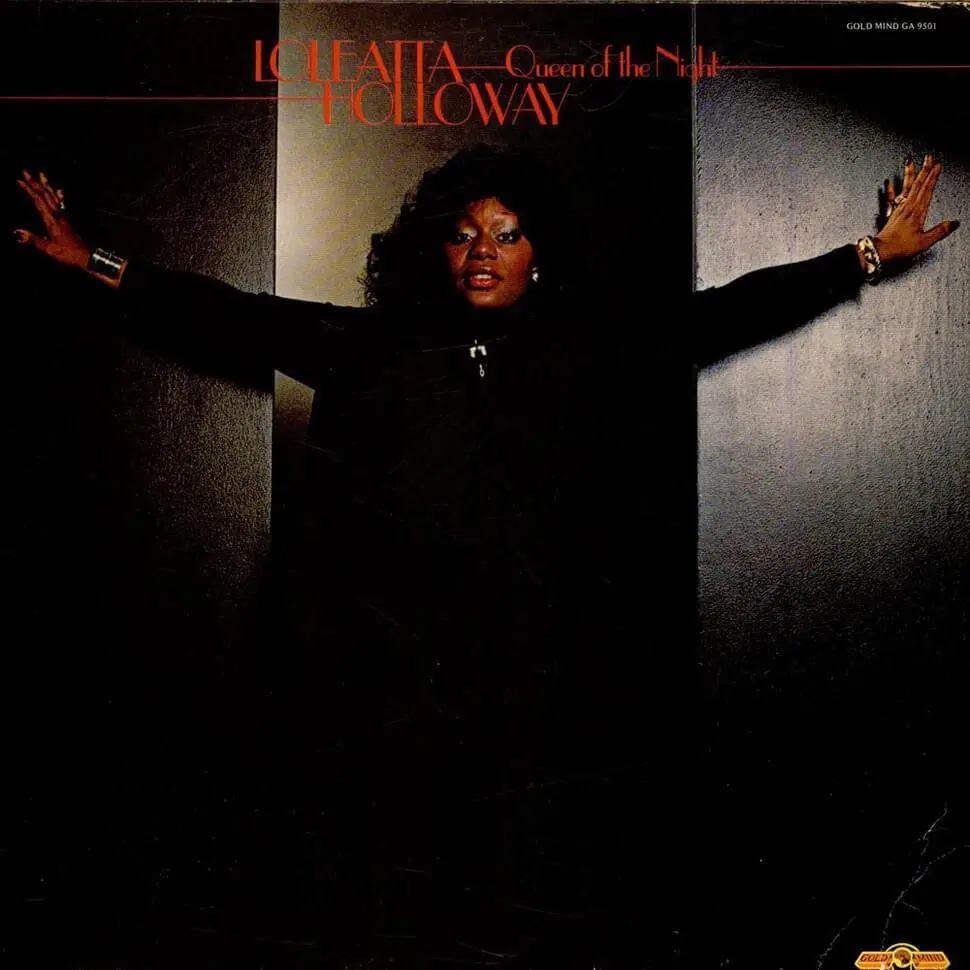 Loleatta Holloway released her fourth album, Queen of the Night, in August 1978 on Gold Mind.
The album extends Holloway’s transition from Southern soul to disco, pairing her commanding vocals with Norman Harris’ elaborate arrangements and steady, driving rhythms. It continues her collaboration with Harris while incorporating mixed production contributions from Bunny Sigler, Ron Tyson, and Floyd Smith.
Norman Harris and Ron Tyson wrote the majority of the material, including “Catch Me on the Rebound” and “Good, Good Feeling.” Bunny Sigler wrote and produced “Only You” and “I May Not Be There When You Want Me (But I’m Right on Time).” Floyd Smith and Gordon Edwards co-produced “I’m in Love,” a Bobby Womack cover. Other contributors include Edward Moore (co-writer of “Two Sides to Every Story”), Frank Austin Jr., Mikki Farrow, and Robert Strother (“Mama Don’t, Papa Won’t”), and Joe Brooks (“You Light Up My Life”).
The album alternates between uptempo disco tracks such as “Catch Me on the Rebound,” “Mama Don’t, Papa Won’t,” and “I May Not Be There When You Want Me (But I’m Right on Time),” and soulful ballads including “Only You,” “You Light Up My Life,” “Two Sides to Every Story,” and the Womack cover “I’m in Love.” Holloway navigates angular vocal turns and sustained climaxes across both rhythmic and contemplative numbers, while horn and string arrangements accentuate the pacing of the dance tracks.
A1. “Catch Me on the Rebound” (6:10)
A2. “Only You” (6:14)
A3. “Good, Good Feeling” (4:15)
A4. “Mama Don’t, Papa Won’t” (5:00)
B1. “I May Not Be There When You Want Me (But I’m Right on Time)” (7:35)
B2. “You Light Up My Life” (4:05)
B3. “Two Sides to Every Story” (4:30)
B4. “I’m in Love” (4:15) was a 1967 Wilson Pickett single, covered soon after by writer Bobby Womack.
Sessions occurred at Sigma Sound Studios in Philadelphia and New York City, with Norman Harris, Bunny Sigler, Ron Tyson, Floyd Smith, and Gordon Edwards producing. Arthur Stoppe, Carl Paruolo, and Jay Mark handled recording engineering, assisted by Dirk Devlin, Jeffrey Stewart, and Rocky Schnaars. José Rodriguez mastered the album at Sterling Sound, Inc.
Art direction came from Stan Hochstadt, design by Lori L. Lambert, and photography by Don Hunstein.
Singles included “Only You” / “Good, Good Feeling” (No. 11 R&B) and “Catch Me on the Rebound” / “Mama Don’t, Papa Won’t.”
Loleatta Holloway (1979)
 Loleatta Holloway released her self-titled fifth album in July 1979 on Gold Mind.
The album blends disco and soul, showcasing Holloway’s commanding vocals across richly arranged tracks. It combines productions from Floyd Smith, Bunny Sigler, and Bobby Womack, with strings, horns, and percussion accenting both dance-oriented numbers and ballads.
Floyd Smith produced and arranged the majority of the album, while Bobby Womack and Patrick Moten produced “There Must Be a Reason” and “Baby It’s You.” Bunny Sigler produced “That’s What You Said,” co-written with Rick Wigginton. Songwriting contributors also include Clarence McDonald, Lorell Simon, Helen Robinson, and Barney Williams.
The album opens with the dramatic “The Greatest Performance of My Life,” followed by mid-tempo tracks like “All About the Paper” and “That’s What You Said.” Northern Soul influences surface on “Baby It’s You,” while gospel-style uplift shapes “There’ll Come a Time.” Holloway closes with the contemplative “Sweet Mother of Mine,” balancing her disco and soul repertoire with nuanced phrasing and sustained climaxes.
A1. “The Greatest Performance of My Life” (7:00) originated as “Así,” a 1968 by Argentine singer Sando; first Anglicized in 1971 by Nancy Wilson.
A2. “All About the Paper” (6:10)
A3. “There Must Be a Reason” (6:20)
B1. “That’s What You Said” (6:55)
B2. “Baby It’s You” (3:59) was a 1961 hit for The Shirelles, written by Burt Bacharach, Luther Dixon, and Mack David.
B3. “There’ll Come a Time” (3:21) originated as a 1968 single by Betty Everett, co-written by Smith and Eugene Record.
B4. “Sweet Mother of Mine” (4:37)
Sessions occurred at Sigma Sound Studios, Muscle Shoals Sound Studios, Universal Recording Corp., and PS Recording Studios. Floyd Smith, Bunny Sigler, and Bobby Womack produced, with engineers Carl Paruolo, Steve Melton, Paul Sarano, Bob Blank, and Bob Stone. José Rodriguez mastered the album. Album cover art was by Richard Bernstein.
Gold Mind lifted “That’s What You Said” (b/w “There’ll Come a Time”).
Holloway sings the refrain “strong enough to walk on through the night” on “Relight My Fire,” the 1979 hit by Dan Hartman.
Love Sensation
 Loleatta Holloway released her sixth album, Love Sensation, in June 1980 on Gold Mind.
The album spotlights Holloway’s powerhouse vocals across disco, R&B, and soul-oriented arrangements. It combines the intensity of Dan Hartman’s production on the title track with smoother, more traditional disco and ballad treatments from Norman Harris, Bobby Womack, Patrick Moten, and Floyd Smith.
Dan Hartman wrote and produced the title track. Norman Harris co-wrote “I’ll Be Standing There” with Ron Tyson and produced and arranged several tracks, including “Long Hard Climb to Love” and “Two Became a Crowd.” Bobby and Cecil Womack wrote and produced “Short End of the Stick,” “Dance What ‘Cha Wanna,” and “My Way,” while Floyd Smith produced “I’ve Been Loving You Too Long,” written by Jerry Butler and Otis Redding. Other contributors include Michael and Richard Berardi, Gary Knight, Gene Allan, and Noel Resnick.
The album opens with the high-intensity title track, “Love Sensation,” a dramatic showcase of Holloway’s upper register. “Short End of the Stick” and “Dance What ‘Cha Wanna” emphasize smooth, uptempo disco with measured pace, while “Two Became a Crowd” delivers unexpected chordal shifts in the chorus. Ballads vary in texture: “My Way” leans on soft harmonies, and “I’ve Been Loving You Too Long” slows the tempo to a waltz-like cadence, allowing Holloway’s vocals to carry the emotional weight.
A1. “Love Sensation” (6:15)
A2. “Long Hard Climb to Love” (4:37)
A3. “Short End of the Stick” (3:12)
A4. “I’ve Been Loving You Too Long” (4:35) was a 1965 hit for Otis Redding.
B1. “Two Became a Crowd” (5:23)
B2. “Dance What ‘Cha Wanna” (5:10)
B3. “My Way” (5:30)
B4. “I’ll Be Standing There” (4:50)
Sessions occurred at Sigma Sound Studios, the Schoolhouse, Blank Tape Studios, Muscle Shoals Sound Studios, and Universal Recording Corp., with mixing at Sigma Sound Studios and Blank Tape Studios. Dan Hartman, Norman Harris, Bobby Womack, Patrick Moten, and Floyd Smith produced, with engineers Bob Blank, Carl Paruolo, Steve Melton, and Arthur Stoppe. José Rodriguez mastered the album.
Album artwork was by Richard Bernstein.
The lead single, “Love Sensation” / “Short End of the Stick,” reached the top of the Billboard dance charts. The title track later became a seminal sample source.
Discography:
- “Rainbow ’71” / “For Sentimental Reasons” (1971)
- Loleatta (1973)
- Cry to Me (1975)
- Loleatta (1976)
- Queen of the Night (1978)
- Loleatta (1979)
- Love Sensation (1980)
Sources:
- Discogs: Loleatta Holloway
- 45worlds: Loleatta Holloway
- 45cat: Loleatta Holloway
- MusicBrainz: Loleatta Holloway
Artist/Album Pages:
Deutsch Amerikanische Freundschaft (German American Friendship, DAF) was the German NDW duo of singe...
Shape of the Rain was an English rustic-rock band that released the 1971 album Riley, Riley, Wood ...
Spaceark were an American jazz-rock/soul-funk band from Los Angeles that released two albums on s...
Van der Graaf Generator are an English rock band, formed at Manchester University in 1967 by singer–...
Laboratorium was a Polish jazz-rock band behind six studio albums and three live discs through 198...
Vesta Williams (Dec. 1, 1957 — Sept. 22, 2011) was an American soul singer who debuted in 1986 and...
Opo were a Dutch folk-rock band that released two albums on specialty label Stoof between 1975 and...
The Landress / Hart Group were an American jazz-rock band from Van Nuys, Calif., that released th...
Northwind was a Scottish folk-rock band from Glasgow that released the album Sister, Brother, Love...
David Friesen (born May 6, 1942) is an American jazz bassist from Washington State who made nine ...
Wooden Horse was an English-Australian folk-rock band that released two eponymous albums in 1972/7...
Green was an American psychedelic rock band that released two albums between 1969 and 1971 on ATCO. ...