

Korni Grupa was a Yugoslav symphonic-rock band that released fourteen singles and the 1972–74 albums Korni Grupa and Not an Ordinary Life.
Members: Kornelije Kovač (keyboards, 1968-74), Seka Kojadinović (vocals, 1968), Borko Kacl (guitar, 1968-69), Bojan Hreljac (bass, 1968-74), Vladimir Furduj Furda (drums, 1968-74), Dušan Prelević (vocals, 1969), Dalibor Brun (vocals, 1969), Dado Topić (vocals, 1969-71), Josip Boček (guitar, 1969-74), Zdravko Čolić (vocals, 1971-72), Zlatko Pejaković (vocals, 1972-74)
Background
Korni Grupa formed in September 1968 in Beograd on the initiative of keyboardist and composer Kornelije “Bata” Kovač, a graduate of the Sarajevo Music Academy and former member of the pop-rock band Indexi. Upon relocating to Belgrade, Kovač teamed with bassist Bojan Hreljac and drummer Vladimir “Furda” Furduj, both formerly of Elipse, and guitarist Velibor “Borko” Kacl, recently of Zlatni Dečaci. They were soon joined by vocalist Miroslava “Seka” Kojadinović, completing a high-profile lineup widely regarded as Yugoslavia’s first supergroup.
Their earliest material—written in rehearsals held in Hreljac’s garage—was unveiled at their debut performance at Belgrade’s Dom Sindikata. The set included original songs and an experimental cover of “If You Go Away,” incorporating taped sea sounds. This debut attracted significant media attention and led to further live appearances, including a multimedia show at Dom Omladine featuring painters, dancers, and theatrical sketches. However, internal tensions emerged when Kojadinović objected to performing the pop-leaning “Marijan” on national television, prompting her departure. They replaced her with Dušan “Prele” Prelević, a well-known Belgrade vocalist.
Korni Grupa entered the 1968 Jugovizija festival with “Cigu-ligu,” but Prelević’s inebriated performance led to a split shortly after. These early upheavals prefaced a period of stylistic transition and lineup changes as Kovač began steering the group toward more progressive material.
1969–71 Singles
Korni Grupa debuted in 1969 with “Cigu-ligu” backed with “Čovek i pas,” featuring Dušan “Prele” Prelević on vocals. Shortly after, Prelević departed and was replaced by Rijeka vocalist Dalibor Brun, with whom the band recorded three singles: “Magična ruka,” “Sonata,” and “Dzum-ram.” These established their dual trajectory—pursuing both commercial festival pop and progressive rock. With Brun, they also released “Pastir i cvet” backed with “Ako jednom budeš sama,” incorporating Balkan folk instruments (šargija, tarabuka, frula) and winning the Golden Pier at the 1969 Singing Europe festival in Scheveningen.
Brun left soon after, and in late 1969 Korni Grupa recruited Dado Topić, formerly of Dinamiti. His debut single with the band was “Devojčice mala,” issued as a split with 4M’s “Priča se.” The group’s first full-length concert followed in November 1969 at Dom Omladine. Following guitarist Borko Kacl’s exit, Topić’s former bandmate Josip Boček joined on guitar. This lineup produced several progressive recordings, including “Jedna žena” and “Prvo svetlo u kući broj 4,” as well as the classically inspired “Etida” and “Žena je luka a čovek brod.” “Jedna žena” won audience and jury awards at the 1970 Zagreb Music Festival.
The band also recorded songs for film and variety shows. “Bube,” theme to Bube u glavi, was released with “Neko spava pored mene,” both noted for their frank lyrical themes. Other singles included the charting “Trla baba lan,” later adapted by Dalida as “Ram Dam Dam,” backed with “Slika,” co-written with Ljuba Ninković. In 1971, Korni Grupa composed the rock suite “1941.” with guest vocalist Josipa Lisac, for a televised anniversary tribute to the Yugoslav uprising.
Korni Grupa’s final singles of this phase, “Pusti da te diram” and “Groš,” followed a short stint with new singer Zdravko Čolić, who joined after Topić’s departure in mid-1971. Despite TV appearances and recordings, Čolić’s pop-oriented style proved incompatible with the band’s progressive direction, leading to his exit after six months.
Korni Grupa
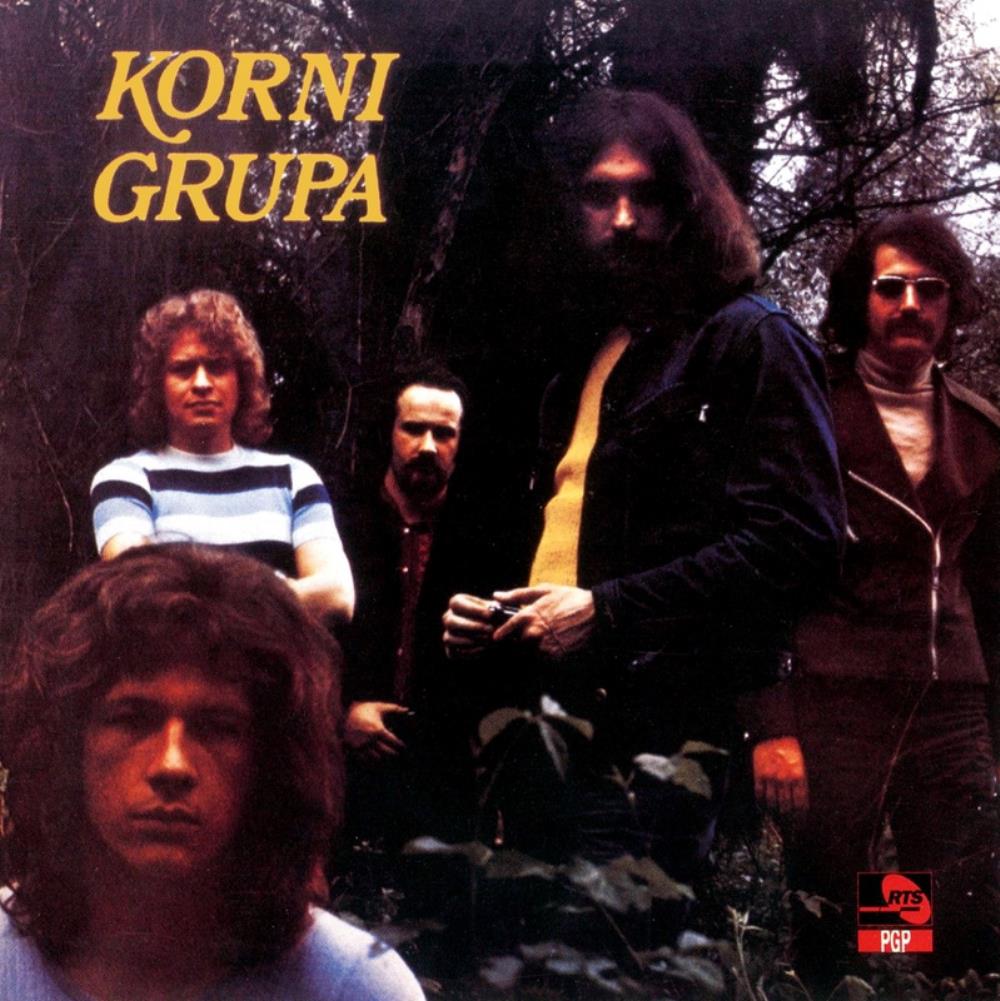 Korni Grupa released their self-titled debut album in 1972 on RTB.
At the time of release, full-length rock albums were still uncommon in Yugoslavia, with most bands issuing 7-inch singles. Kornelije Kovač wrote or co-wrote all compositions, drawing on extended forms and shifting arrangements that reflected the group’s growing emphasis on long-form rock composition.
The lineup featured new vocalist Zlatko Pejaković, a former member of Lavine, Zlatni Akordi, and Had. Josip Boček played electric and acoustic guitar and sang backing vocals. Composer Kornelije Kovač handled organ, piano, electric piano, harpsichord, vibraphone, and backing vocals. Bojan Hreljac played bass and percussion, and Vladimir Furduj contributed drums, congas, and tambourine.
Korni Grupa opens with “Glas sa obale boje,” which alternates between subdued acoustic verses and expansive electric sections shaped by sustained guitar chords and wide-voiced piano accompaniment. “Put na istok,” a 14-minute suite in four parts, transitions from strident vocal blues-rock to funk-accented organ passages, shifting midway into a restrained baroque-styled keyboard segment that yields to an extended instrumental finale colored by asymmetric percussion and Balkan modality.
“Moj bol” blends rhythmically flexible jazz phrasing with dramatic tempo fluctuations and a late guitar solo that cuts across tightly spaced piano chords and low tom rolls. “Bezglave Ja-Ha Horde” pivots to a dense, fast-paced form with electric piano flurries, aggressive electric guitar, and rapid vocal inflections, held together by relentless kick-snare propulsion. “Tata Ko i mama Spo” closes in a slow, bittersweet tone, with layered guitar figures underpinning plaintive vocals and midrange piano voicings that fade into a clipped final cadence. Throughout, the band structures its pieces with clear sectional contrast, building tension through repetition, timbral layering, and abrupt dynamic shifts rather than linear harmonic development.
A1. “Glas sa obale boja” [A Voice from the Coast of Colors] (4:25)
A2. “Put za istok” [A Trip to the East] (14:13)
—a. “Prvi dan” [First Day]
—b. “Drugi dan” [Second Day]
—c. “Dilema” [Dilemma]
—d. “Zemlja” [Land]
B1. “Moj bol” [My Pain] (10:20) — music: Ljubiša Brandiolica; lyrics: Kovač
B2. “Bezglave ja-ha horde” [The Headless Ya-Ha Hordes] (6:42)
B3. “Tata Ko. i mama Spo.” [Daddy Ko. and Mommy Spo.] (4:09)
Sessions for tracks A1, A2, B2, and B3 occurred in February 1972 at Studio VI of Radio Beograd, engineered by Toša Andrin. Track B1 was recorded earlier, on December 4, 1971, at Studio RTV Ljubljana, engineered by Sergej Dolenc. Mića Marković produced the album for RTB. Photography and design were by Velisav Tomović.
Following the release, Korni Grupa performed at the 1972 Zagreb Music Festival with “Kosovka devojka,” taking second place, and appeared at the Montreux Jazz Festival on June 22, where they were joined by Mića Marković (saxophone) and Petar Ugrin (violin, trumpet) under the billing “Korni Group and Two Good Ones.” The band also filmed Put za istok, the first Yugoslav television program shot in color.
1972–73 Singles
Between 1972 and 1973, Korni Grupa issued a series of thematically diverse and lyrically ambitious singles that reinforced their dual commitment to progressive composition and literary engagement. One of their most notable releases was “Ivo Lola,” a dramatic setting of the farewell letter written by World War II partisan Ivo Lola Ribar to his fiancée Sloboda Trajković. The B-side, “Znam za kime zvono zvoni” [I Know for Whom the Bell Tolls], featured guest vocals by Ditka Haberl.
During the same period, the band released a revised studio version of “Etida,” first premiered live in 1970. Due to a misprint, initial pressings mistakenly labeled the track “Edita.” The B-side featured a shortened and retitled version of an earlier composition, issued as “Jednoj ženi” [To a Woman].
Korni Grupa continued this literary focus with “Zbogom ostaj o, detinjstvo” [Farewell, Oh, Childhood], based on a poem by Milovan Vitezović, and “Miris” [Scent], which set to music Charles Baudelaire’s sonnet Parfum exotique. Another release, “Praštanje” [Forgiveness], used lyrics by poet Brana Crnčević, then viewed as a political dissident.
In parallel, they released additional singles such as “Pokloni svoj mi foto” backed with “Bez veze,” the Opatija Festival entry “Etida (Opatija ’73)” backed with “Jedna žena,” and the double-sided folkloric single “Oj, dodole” / “Život.” They also issued “Tri palme” with “Tri čoveka u kafani” on the reverse. These singles document the band’s continued activity and stylistic breadth in the period between their debut LP and Eurovision-era material.
Not an Ordinary Life
 Korni Grupa released their second RTB album, Not an Ordinary Life, in June 1974 under the name Kornelyans.
Korni Grupa released their second album, Not an Ordinary Life, in June 1974 under the anglicized name The Kornelyans, issued by the Italian label Ricordi and licensed for distribution in Yugoslavia, Japan, Israel, and parts of South America. The group recorded the album in late 1973 as a symphonic rock project aimed at the international market, with lyrics in English and expanded compositions produced by Italian arranger and impresario Carlo Alberto Rossi. The album was issued domestically by PGP RTB, where the band’s name appeared in transliterated form.
The lineup consisted of Zlatko Pejaković on lead vocals, Josip Boček on electric and acoustic guitars and backing vocals, Kornelije Kovač on keyboards and backing vocals, Bojan Hreljac on bass, and Vladimir Furduj on drums. Kovač composed all six tracks.
Not an Ordinary Life pivots toward extended, multi-section forms built on dense keyboard layering and sharply articulated rhythmic shifts. “Rising” acts as a brief overture, setting a restrained pulse through interlocking piano and synthesizer figures before dissolving into silence. The title track expands gradually, moving from spoken-sung passages into contrasting blocks of forceful ensemble playing, with abrupt bass-led turns, clustered keyboard runs, and a central instrumental stretch where drums and guitar push intensity through repeated accelerations and pullbacks.
“Generation 1942” alternates reflective vocal sections with brighter instrumental passages, marked by acoustic guitar textures giving way to electric piano and organ interplay. “Fall of the Land of Women” tightens the attack, driven by low-end propulsion and compressed vocal delivery, while keyboards and guitar trade short, cutting phrases. “Temporary Parting” pares the sound back to piano-led motifs that accumulate momentum through syncopated bass and drums, and “Man with a White Flag” closes the album by cycling through successive themes—heavy, sparse, then expansive—before tapering off on sustained organ tones and a gradual fade.
A1. “Rising” (2:15)
A2. “Not an Ordinary Life” (10:20)
A3. “Generation 1942” (6:17)
B1. “Fall of the Land of Woman” (5:17)
B2. “Temporary Parting” (4:00)
B3. “Man With a White Flag” (11:53)
Sessions occurred in Italy under the supervision of recording engineer Ria Gaetano. Rossi produced the album for Ricordi. Milenko Miletić served as art director; Miodrag “Bata” Knežević designed the sleeve; and Jež, Beograd printed the packaging. The RTB edition was lacquer cut and pressed in-house, with editorial oversight by Svetolik Jakovljević.
In May 1974, Kornelyans released “Generation 1942” backed with “One Woman” as a single, drawn from the album. Despite limited promotion, the LP sold 10,000 copies internationally and marked the band’s final studio release before disbanding later that year.
1974–75 Singles
In spring 1974, Korni Grupa won first place at the Opatija Festival with “Moja generacija” [My Generation], which qualified them to represent Yugoslavia at the Eurovision Song Contest in Brighton. The performance took place alongside ABBA’s winning entry, with whom the band shared backstage facilities. The English-language version of “Moja generacija” was issued on single in Italy, backed with a shortened version of “Jednoj ženi” [To a Woman].
The band continued releasing singles through 1974 and into early 1975, including “Miris” [Scent], which featured lyrics adapted from Baudelaire’s Parfum exotique, paired with “Praštanje” [Forgiveness], written by dissident poet Brana Crnčević. Another single, “Kuda ideš svete moj” [Where Are You Going, My World], appeared with “Divlje jagode” [Wild Strawberries] as the B-side.
“Moja generacija,” backed with “Zbogom ostaj, djetinjstvo” [Farewell, Oh, Childhood], also circulated in domestic editions. Despite their momentum and high profile, dissatisfaction with their 12th-place Eurovision result led Kornelije Kovač to formally disband Korni Grupa later in 1974.
Mrtvo More
In 1975, PGP-RTB released Mrtvo more (The Dead Sea), a posthumous double-LP by Korni Grupa issued after their disbandment.
It was the first double album in Yugoslav rock history and served as both a retrospective and a document of the band’s stylistic duality. The group had officially dissolved on December 1, 1974, shortly after performing two farewell concerts at Studio M in Novi Sad on November 24. Selected material from those concerts comprised one disc of the set, highlighting the band’s symphonic rock repertoire.
The live disc featured extended renditions of “Put na istok” [A Trip to the East], “Čovek sa belom zastavom” [Man With a White Flag], and “Blues,” performed in full-length progressive arrangements:
A1. “Čovek sa belom zastavom (Instrumentalni deo)” [Man With a White Flag – Instrumental Section] (6:27)
A2. “Blues (Live)” (10:04)
B. “Put na istok (Live)” [A Trip to the East] (19:56)
The second LP compiled single tracks from the band’s earlier studio output, focusing on their more commercial material. Together, the two records presented a comprehensive overview of Korni Grupa’s dual identity as both a progressive rock unit and a successful pop ensemble in the Yugoslav scene.
1941
 In 1979, PGP-RTB issued 1941., a posthumous Korni Grupa album comprising the soundtrack to the namesake television episode recorded in 1971 as part of the historical music series Jedan čovek – jedna pesma (One Man – One Song), directed by Jovan Ristić. The recording remained unreleased during the band’s active years and appeared eight years later in LP format.
The 26-minute composition sets wartime poetry by Branko Ćopić to symphonic rock arrangements by Kornelije Kovač, who also played keyboards and directed the session. Lead vocals were shared by Dado Topić and guest singer Josipa Lisac. The instrumental lineup featured Josip Boček on guitar, Bojan Hreljac on bass, and Vladimir Furduj on drums. Toša Andrin engineered the recording. Milivoje Marković produced the session at Studio VI of Radio Beograd.
A. “I deo” [Part I] (14:44)
B. “II deo” [Part II] (11:58)
1941. was the final release of original Korni Grupa material issued under their name. Though the band disbanded in 1974, this release offered a rare document of their large-form conceptual work in the early 1970s and served as a companion to their symphonic rock ambitions as heard on Not an Ordinary Life.
Postlude
Following the dissolution of Korni Grupa in late 1974, its members pursued divergent musical paths. Kornelije Kovač embarked on a prolific career as a composer, arranger, and producer across Yugoslavia and abroad. Vocalist Zlatko Pejaković shifted toward a mainstream pop career. Guitarist Josip Boček and bassist Bojan Hreljac became active as studio musicians, while drummer Vladimir Furduj moved into jazz performance.
In 1977, two previously unreleased recordings from the band’s November 1974 farewell concerts in Novi Sad—“Jedna žena” and “I ne tako običan život” [Not an Ordinary Life at All]—appeared on the Randevu s muzikom various artists live compilation. That same year, Kovač attempted to launch a supergroup under the name K2 (distinct from the later pop duo of his daughters), which was to include Boček, Dado Topić, Sloba Marković, Čarli Novak, and Ratko Divljak. The project was abandoned due to Topić’s indecision.
In 1979, RTB released 1941., a studio album based on a 1971 recording made for Yugoslav television. The band’s original guitarist Velibor “Borko” Kacl died in a car accident on May 17, 1984.
Korni Grupa reunited in May 1987 for the Legende YU Rocka (Legends of YU Rock) concerts, with Kovač, Boček, Hreljac, Furduj, and Topić reprising their early 1970s lineup. The event, organized by Radio 101, took place at Zagreb’s Dom Sportova, followed by additional performances in June at Belgrade’s Sava Centar and in December at Sarajevo’s Zetra Hall.
Discography:
- Korni Grupa (1972)
- Not an Ordinary Life (1974 • Kornelyans)
- Mrtvo More (1975)
- 1941 [tv soundtrack] (1979, recorded 1971)
Sources:
- Discogs: Korni Grupa
- MusicBrainz: Korni Grupa
- RYM: Korni Grupa
- 45cat: Korni Grupa
- ProgArchives: Korni Grupa
Artist/Album Pages:
Mighty Baby was an English post-psych band that released the 1969–71 albums Mighty Baby and A Jug ...
Les McCann (September 23, 1935 – December 29, 2023) was an American jazz pianist and singer. He e...
Space Farm was a New Zealander psych-rock quartet behind the 1972 Zodiac album Going Home to Etern...
Junco Partners were an English rock band from Newcastle, formed as an R&B/beat sextet in 1964....
Gryphon was an English Elizabethan symphonic folk and rock band that released four albums on Trans...
The Gods were an English psych-rock band that released the 1968–69 Columbia albums Genesis and To ...
Skin Alley was an English jazz-rock/jam band that released the 1970 CBS albums Skin Alley and To P...
Goliath was an English jazz-rock/soul band from Manchester that released a self-titled album on CBS ...
Michael Chapman (1941–2021) was an English singer-songwriter and guitarist from Leeds who released t...
Francesco De Gregori (born April 4, 1951) is an Italian singer/songwriter who emerged in 1972 as o...
Stanley Turrentine (April 5, 1934 — September 12, 2000) was an American post-bop/jazz-funk tenor ...
Strawberry Path was a Japanese hard-rock/psych duo that released the 1971 Philips album When the R...