
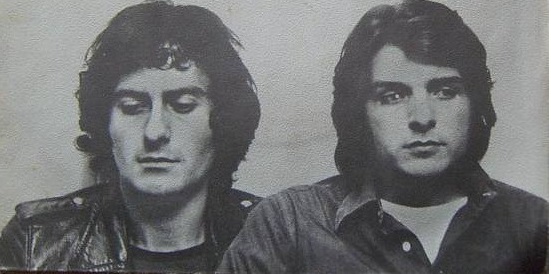
Ilous & Decuyper were a French folk-pop duo that released two singles and a self-titled album on Flamophone circa 1971/72.
Members: Bernard Ilous (vocals, guitars, piano, keyboards, organ, percussion), Patrice Decuyper (vocals, guitars, percussion)
Backgroud
Ilous and Decuyper were the duo of singing multi-instrumentalists Bernard Ilous and Patrice Decuyper.
Ilous (b. May 7, 1947; Algiers) cut two 1967 singles on Maxi Records as part of Les Rovers, a chanson quartet with veteran singer Jean-Yves Gran. He also did a pre-album stint in Le Système Crapoutchik. His songs appeared on 1968–70 albums by Éric Charden, Johnny Hallyday, and Françoise Hardy.
Ilous & Decuyper (1971)
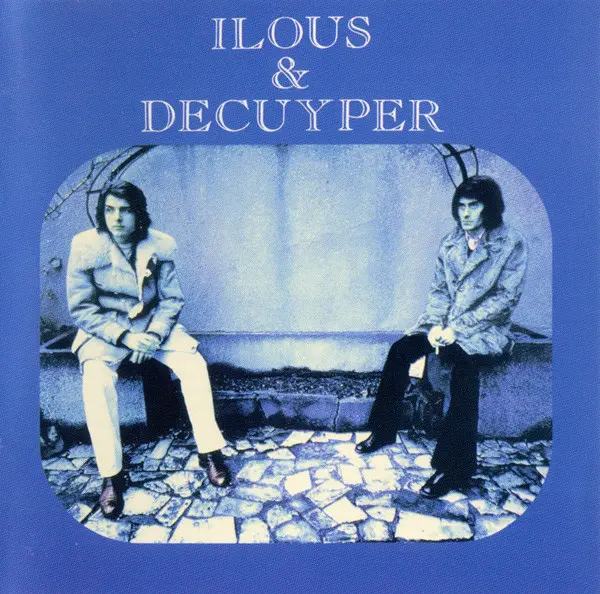 Ilous & Decuyper released their self-titled album in 1971 on Flamophone.
The album presents a subdued, introspective strain of French progressive folk with acoustic textures, delicate harmonies, and philosophical overtones. Its androgynous vocals and soft instrumental layering evoke autumnal calm and emotional restraint, offset at times by ethereal or surreal touches. The arrangements balance pastoral acoustics and sparse electric flourishes with subtle percussion, French horn, and keyboard colorations.
Singer–guitarists Bertrand Ilous and Paul Decuyper wrote the material, mostly in collaboration, with Ilous handling keyboards (piano, electric piano, organ) and Decuyper providing additional guitars and percussion. They were joined by bassist Christian Padovan, drummer André Sitbon, and horn player Jean-Jacques Justafré. Guitarist Jean-Pierre Alarcen appears on the album’s single cover version.
A1. “Indifférents” [Indifferent] (1:22)
A2. “Vous Mourrez Demain” [You Will Die Tomorrow] (4:03)
A3. “Cor Bucolique” [Bucolic Horn] (2:56)
A4. “Eleanor Rigby” (4:39) — originated as a 1966 Parlophone single by The Beatles, written by John Lennon and Paul McCartney. Ilous & Decuyper reinterpret the song in a slower, dreamlike setting with layered guitars and horn accompaniment.
A5. “Non” [No] (3:42)
A6. “Nuit de Glace” [Night of Ice] (1:10)
B1. “L’Élu” [The Chosen One] (2:44)
B2. “Cyclothymie” [Cyclothymia] (4:03)
B3. “Mélancolie” [Melancholy] (3:46)
B4. “Hawaï” (0:54)
B5. “Berceuse” [Lullaby] (2:35)
B6. “Beurk!!” [Yuck!!] (3:42)
B7. “Indifférents” [Indifferent] (1:22)
Sessions took place in Paris with recording engineer Régis Lecorre and mixer Jean-Pierre Janiaud.
Ilous & Decuyper features photography by Bernard Plossu and artwork printed by Imprimerie de Saint-Michel.
The duo followed the album with the 1972 standalone single “Aime-Toi Toi-Même” [Love Yourself] (b/w “L’Espoir” [Hope]).
Postlude
Bernard Ilous released the 1971 Flamophone solo singles “Bienheureux Les Innocents” (b/w “Comme Les Autres”) and “(Je Ne Sais) D’où Vient le Vent” (b/w “Fille De Lune”) and the 1974 album Ilous. He appeared as a vocalist on late-Seventies albums by Sumeria, Gilles Dreu, and Saint-Preux. His younger cousin, Terry Ilous, surfaced in the late-Eighties LA glam-metal band XYZ.
Decuyper wrote the 1980 Rockets track “Synthetic Man.”
Discography:
- Ilous & Decuyper (1971)
Sources:
- Discogs: Ilous & Decuyper
- RYM: Ilous & Decuyper
- 45cat: Ilous & Decuyper
- ProgArchives: Ilous & Decuyper
Artist/Album Pages:
Eden Rose was a French organ-rock band that released the album On the Way to Eden on Katema in 197...
Aphélandra was a French symphonic-rock band that recorded an album in 1976, released a quarter-cen...
Clearlight was a French space-rock ensemble that released the 1975 Virgin albums Clearlight Sympho...
Vortex was a French Zeuhl band that released a self-titled album on JBP in 1975, followed by the p...
Zao was a French Zeuhl ensemble, active during the 1970s and later sporadic intervals. Between 197...
Falstaff was a French jazz-rock band that self-released the 1981 album Prononcez g. Members: Jér...
Oniris was the French symphonic-rock band behind the 1979 Barclay album L'Homme-Voilier. Members...
Phileas Fogg was a French avant-jazz/rock band behind the 1986 Sonart album Coma Depasse. Back...
Martin Circus was a French post-psych rock band that debuted with a 1969 live disc, followed by ni...
Fernand Péna et Puzzle were a French folk/psych band behind a 1977 album on the self-operated Cent...
Cossi Anatz were a French contemporary jazz ensemble that released the half-live/half-studio albu...
Sandrose was a French symphonic/psych band that released a self-titled album on Polydor in 1972. ...