

Green was an American psychedelic rock band that released two albums between 1969 and 1971 on ATCO.
Members: Wilson Fisher (vocals, guitar, bass), James Neel (drums, backing vocals), John Martin (vocals, guitar, keyboards), Gary Casebeer (vocals, drums), Richard Gardzina (flute, accordion, clarinet, tenor saxophone, trumpet, piano), Jay Pruitt (trumpet, piano) (1971), Bobby “Richard” Blood (horns, keyboards)
Background
Green formed in 1968 at North Texas State University, where Denton natives Wilson Fisher, James Neel, John Martin, and Gary Casebeer teamed with Richard Gardzina, who came from Manchester, New Hampshire. Reedists Neel and Gardzina doubled on brass and keyboards along with Casebeer, who also played percussion. Harpist Fisher and keyboardist Martin, the two main songwriters, both played strings. All five members sang.
Green cut an acetate with four songs: two by Martin (“Where Have I Been?,” “At the Time”), Fisher’s “Sunrise # 7,” and the Martin–Gardzina “Have You Ever?” They signed to ATCO and linked with producer Fred Darian.
Green
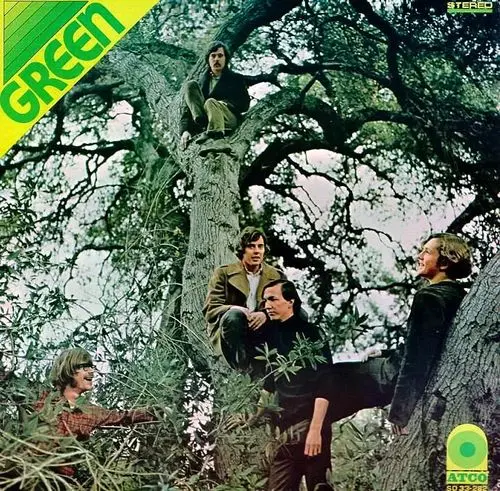 Green released their self-titled debut in March 1969 on ATCO.
By this time, the Denton, Texas–based sextet had solidified around a multi-instrumental lineup: Wilson Fisher (vocals, harmonica, guitar, bass), James Neel (vocals, drums, reeds, keys), John Martin (vocals, guitar, keyboards), Gary Casebeer (vocals, drums, brass, keys), and Richard Gardzina (vocals, flute, clarinet, reeds, brass, piano). Session player Bobby “Richard” Blood contributed horns and keys. Fisher and Martin handled the majority of songwriting, with additional input from other members.
Martin opens side A with “To Be,” a woozy psych rocker laced with rough guitar, pounding drums, flute accents, and ragged vocal interplay. He continues with “Where Have I Been,” which blends SoCal folk-rock and UK pop–psych in a manner akin to Buffalo Springfield jamming with The Hollies. Fisher contributes the dreamy “Sunrise #7,” a mellow number driven by acoustic strumming, flute, and a buoyant bassline. Martin’s remaining cuts on side A include the harmony-rich “Just Try” and the Baroque-styled “Sparkle,” a sunshine-pop standout with tight vocal layers and a tightly coiled melodic core.
Side B opens with the cacophonous “Green,” co-credited to all five band members and Blood. Its feedback guitar, frantic drumming, and brass outbursts evoke a more chaotic take on the horn-rock style emerging contemporaneously in Chicago and Blood, Sweat & Tears. Martin’s “Footprints In the Snow” explores gentle folk-pop terrain with harpsichord textures, while his “At the Time” pairs compact guitar rock with subtle studio effects. Fisher’s second contribution, “RCMPB,” offers an uptempo garage-psych groove tinged with Baroque horn flourishes. Martin’s folk-rocker “Don’t” follows, and the Martin–Gardzina closer “Have You Ever” shifts mid-song from pastoral balladry to twangy country-rock.
A1. “To Be” (2:52)
A2. “Where Have I Been” (3:02)
A3. “Sunrise #7” (3:34)
A4. “Just Try” (2:11)
A5. “Sparkle” (2:17)
B1. “Green” (3:21)
B2. “Footprints In the Snow” (2:25)
B3. “At the Time” (2:12)
B4. “RCMPB” (3:04)
B5. “Don’t” (2:18)
B6. “Have You Ever” (3:02)
Green was produced by Fred Darian with co-production by Irv Weinhaus. Sessions took place at Gold Star Studios and were engineered by Stan Ross. The album was mastered at Longwear Plating and lacquered at Atlantic Studios, with pressing handled by Monarch (Δ13084). Design was by Haig Adishian with photography by Fred Seligo (front) and Don Cropper (back). Tracks were published by Cotillion and Kling Street Music under Atlantic Recording Corporation.
Green later earned cult praise for its unique fusion of West Coast folk-rock, UK psychedelia, and orchestral pop. Reviews highlight its inventive arrangements, heavy group harmonies, and unorthodox integration of brass and woodwinds.
To Help Somebody
 Green released their second album, To Help Somebody, in 1971 on ATCO.
The lineup featured Wilson Fisher (vocals, 12-string guitar, 8-string bass), John Martin (vocals, guitar, piano, clavinet), Gary Casebeer (vocals, drums), and Richard Gardzina (tenor saxophone, flute, clarinet, trumpet, piano, accordion). Jay Pruitt played piano and trumpet, while cellist Kathy Kelsey Pruitt appeared on two tracks. Trombonist Chuck Mandernach contributed to one number.
To Help Somebody emphasized a more acoustic, country-tinged direction with brass and woodwinds still woven into the arrangements. Martin wrote ten of the album’s thirteen songs, including the title track and “All My Bells.” Fisher supplied two cuts, “Can You See Me?” and “Big Dipper,” while Casebeer and Pruitt each contributed one song: “Teenage Women” and “High Time,” respectively. The group handled production duties themselves.
A1. “All My Bells” (3:14)
A2. “To Help Somebody” (1:51)
A3. “She Don’t Love Me” (2:53)
A4. “Mary Magdalena” (1:58)
A5. “Can You See Me?” (2:48)
A6. “Teenage Women” (2:33)
A7. “Lady, Oh Lady” (1:44)
B1. “Big Dipper” (3:55)
B2. “High Time” (2:58)
B3. “Suzy” (2:45)
B4. “Funny Faces” (3:06)
B5. “San Fernando Valley Girls” (2:57)
B6. “Forest Lawn” (1:32)
To Help Somebody was engineered by Bob Pickering. Design was by Loring Eutemey with photography by Chuck Mandernach (color) and Chris Nichols (group photo).
Discography:
- Green (1969)
- To Help Somebody (1971)
Sources:
Artist/Album Pages:
Michael de Albuquerque (born June 24, 1947) is an English musician, singer, and songwriter who cut...
Broth was a Cuban-American psych-rock/funk band from New Jersey that made a 1970 self-titled album...
New Birth was an American soul-psych ensemble that released twelve albums between 1970 and 1982 an...
Jimmy McGriff (April 3, 1936 — May 24, 2008) was an American soul-jazz/funk organist who helped d...
Leroy Hutson (born June 4, 1945) is an American R&B singer, songwriter, and producer from Newa...
The Smoke was an American pop-psych band from Los Angeles that released a 1968 self-titled album ...
Argent was an English art-rock band that released six studio albums and a live double-LP on Epic bet...
The term "glam," while seemingly evocative, has become a musically incoherent concept that has don...
Brinsley Schwarz was an English rustic-rock band that released six albums between 1970 and 1974 on U...
Yvonne Fair (Oct. 21, 1942 — March 6, 1994) was an American soul singer who emerged in the James ...
Jackson Heights was an English band that issued the folk-rock album King Progress on Charisma in 1...
Night Sun was a German hard-rock band that released the 1972 album Mournin' on Zebra Records. Me...