

Graffiti was an American psychedelic rock band that released a 1968 self-titled album and the standalone single “He’s Got the Knack” on ABC Records.
Members: Tony Taylor (vocals), George Strunz (guitar), John St. John (guitar), Steve Benderoth (bass, keyboards), Richie Blakin (drums, percussion)
Background
Graffiti had its roots in The Hangmen, a Washington DC garage band that moved to New York City and became The Collection, a psychedelic baroque-rock act with guitarist George Strunz and singer Tony Taylor.
Strunz (born Jorge Strunz in Costa Rica) moved as a child between Colombia, Mexico, Spain, England, and Canada before his family settled in the US. He studied classical and flamenco guitar from age 6 and spent his teens backing Spanish dancers before branching into rock.
The Collection cut the 1968 RCA Victor single “Paper Crown of Gold,” a windy number (in A minor) with staccato guitar, fluid bass, locomotive snare, and skating Farfisa; twice broken by a slow, dark bridge. The b-side is a harpsichord-laden take on “Aquarius” from the musical Hair, arranged with Association-style harmonies.
Months after that single, Collection singer Tony Taylor and guitarist George Strunz formed Graffiti with guitarist John St. John, bassist–keyboardist Steve Benderoth, and drummer Richie Blakin.
“He’s Got the Knack”
In August 1968, Graffiti debuted with the standalone single “He’s Got the Knack” (2:44, b/w “Love In Spite”) on ABC Records. The A-side — a non-album cut — is a brisk, fuzz-driven instrumental written by one Robert Leeman. Set to rapidfire drums and frosty Vox Continental organ, it intercuts a jagged E-minor riff with brief, jazzy slow passages. A series of echoed title chants enter at the 1:25 mark.
The flip, “Love In Spite,” penned by Strunz and Benderoth, appears on their subsequent album. Bob Thiele produced the single, which appeared in a white-label promo edition marked “Play Side” on the A.
Graffiti
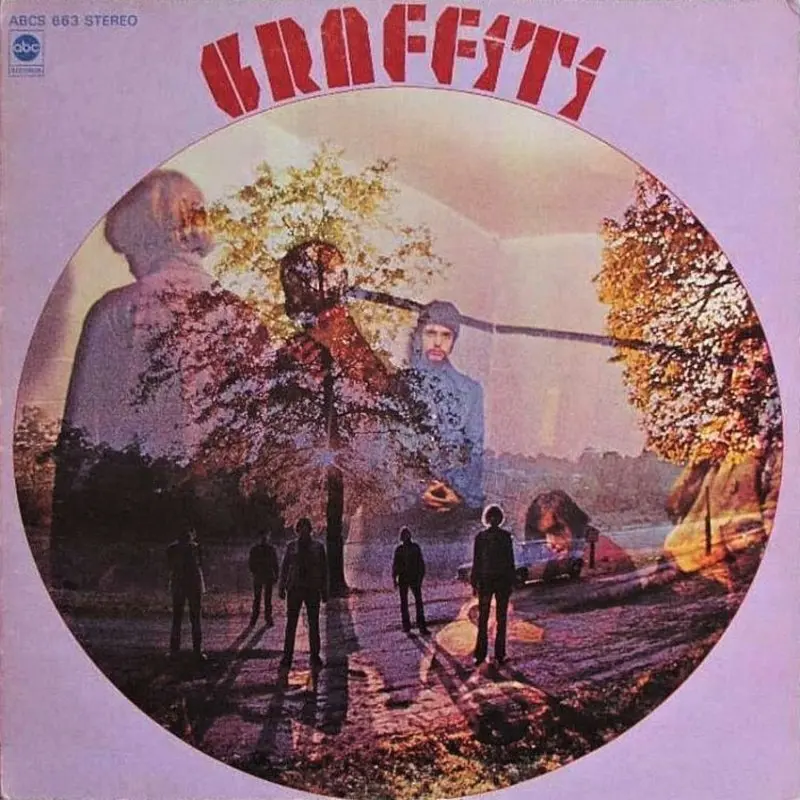 Graffiti released their self-titled album in November 1968 on ABC Records. It features eleven tracks, including three instrumental interludes, written primarily by bassist Steve Benderoth with contributions from George Strunz, Jon St. John, and Tony Taylor.
The album explores an eclectic range of late-60s rock, blending psychedelic textures with vocal pop harmonies, progressive structures, jazzy chord changes, and frequent shifts in rhythm and style. Tracks flow together in suites, foreshadowing the multipart arrangements of early prog. Fuzz guitar, offbeat transitions, and unexpected stereo panning reflect the band’s ambition to stretch the bounds of conventional psych-pop.
A1. “Father Protector” (4:11) – Opens with a flamenco-tinged acoustic figure before morphing into a fuzz-drenched minor-key rocker; features husky vocals and abrupt changes in tone and melody.
A2a. “The Capture of Me” (9:34) – A multi-part epic with Association-style harmonies, jazzy rhythmic underpinnings, two soaring Strunz solos, and dynamic interplay between vocals and bass.
A2b. “Lifeblood” – Joins seamlessly with the prior track; builds from subdued jazz-rock textures into a fuzz jam that fades too quickly.
A3a. “Interlude #1” – A Stax-style soul instrumental reminiscent of Booker T. & the MG’s.
A3b. “Jingle Jangle Woman” (4:06) – The album’s most commercial cut, mixing fuzz leads with close vocal harmonies and stereo channel-splitting effects.
B1a. “New Life” (2:48) – Juxtaposes bubbly psych-pop with tripped-out tonalities; rich in vocal layers and textural turns.
B1b. “Girl On Fire” (2:24) – Uses phasing effects and compact melodic lines for a radio-friendly highlight.
B1c. “Interlude #2” (1:16) – A brief harmony-laden vignette with strong melodic appeal.
B1d. “Coldwater” (4:35) – Combines sci-fi sound effects, bluesy organ riffs, and major/minor mood swings.
B1e. “Interlude #3” (0:28) – A percussive experimental fragment, likened to sandpaper on wood.
B1f. “Love In Spite” (3:17) – A harmonic psych-pop number with hazy vocals and sustained fuzz lines.
B2. “Ugly Mascara” (5:10) – A gritty, low-slung blues-rock closer with standout vocals and molten leads from Strunz.
Graffiti was produced by Bob Thiele and Jay Senter with engineer Ed Kramer, who tracked the album at New York’s Record Plant during the final sessions for Jimi Hendrix’s Electric Ladyland.
The album was plated at Longwear and issued in a gatefold sleeve with translucent lavender treeside imagery (front), a lakeside band photo (back), and interior portraits and lyrics. Cover visuals were designed by Byron Goto and Henry Epstein with photography by Bob Boris (cover) and Bob Ritter (inner).
“Girl On Fire” was the slated b-side to “Do You Feel Sorry,” a non-album rarity intended for release in February 1969 (ABC No. 45-11182).
After Graffiti
George reverted to his birth name Jorge Strunz and formed Caldera, a Latin jazz-rock band that released the 1976–79 Capitol albums Caldera, Sky Islands, Time and Chance, and Dreamer. Upon their breakup, he teamed with Iranian guitarist Ardeshir Farah in the duo Strunz & Farah, which made twenty albums between 1982 and 2023 and backed Sting on his 1995 soundtrack to the IMAX nautical documentary The Living Sea.
Steve Benderoth drums on the 1972 Ovation Records release Comin’ Apart by singer Laura Yager. In 1978, he surfaced as a backing vocalist on Song of Wholeness, a spiritual album by Lamb’s Ministries singer–songwriter Judi Cochran. He plays a dual role as producer (under his own name) and bassist–singer (under the stagename Dwight Knight) on the 1979 Casablanca release by Lenny & The Squigtones, the fictional fifties rock band of characters Lenny (Michael McKean) and Squiggy (David Lander), the greaser pair on the 1976–83 ABC sitcom Laverne & Shirley.
Both sides of the Collection single appear on Voyages Into…The Bottomless Pit (Vol. 3), a 27-track compilation of psychedelic rarities by archivists Voyages Records.
Discography:
- “He’s Got the Knack” / “Love In Spite” (1968)
- Graffiti (1968)
Sources:
Artist/Album Pages:
David Newman (Feb. 24, 1933 — Jan. 20, 2009) was an American jazz-funk saxophonist and flutist. He...
Johnny "Guitar" Watson (Feb. 3, 1935 — May 17, 1996) was an American R&B guitarist, active as ...
Vashti Bunyan is an English singer–songwriter who released two mid-'60s singles and the 1970 Phili...
Jacques Thollot (October 9, 1946 — Oct. 2, 2014) was a French keyboardist, percussionist, and comp...
The Pink Fairies were an English psychedelic hard-rock band from London that released three albums...
The Advancement was an American jazz-psych band from Hollywood that released a self-titled album ...
Teruo Nakamura — 中村照夫 (born March 3, 1942) — is a Japanese jazz bassist behind the 1973 Three Blin...
Frank Lowe (June 24, 1943 — Sept. 19, 2003) was an American free-jazz saxophonist and composer fro...
Splash was a Swedish brass-rock/jazz-rock band that released the 1972 Polydor album Ut på Vischan!...
Siloah was a German ethno-folk/psych band that self-issued a 1971 eponymous album, followed by the...
Pappo's Blues was an Argentine blues-rock/hard-rock band that released seven numerically-titled st...
Colin Blunstone is an English singer who fronted The Zombies, which charted with the British Invas...