

Flame Dream is the Swiss symphonic-rock band behind the 1978/79 Philips albums Calatea and Elements and the 1981/82 Vertigo titles Out in the Dark and Supervision.
Members: Urs Waldispühl (guitar, vocals), Peter Wolf (woodwinds, vocals), Peter Furrer (drums, percussion), Urs Hochuli (bass, vocals), Roland Ruckstuhl (keyboards, sequencer, vocoder), Dale Hauskins (guitar)
Inception
Flame Dream formed in 1977 in Luzern, a municipality in central Switzerland, located in the nation’s German-speaking Alemanic region.
Calatea
 Flame Dream released their debut album, Calatea, in January 1979 on Philips.
The album unfolds as a continuous suite anchored by tightly meshed instrumental sections. Keyboardist Roland Ruckstuhl alternates between rapid thematic shifts and layered chord voicings, trading prominence with guitarist Urs Waldispühl, who threads sustained lines through dynamic breaks and transitional interludes. Woodwind player Peter Wolf interjects with spiraling motifs and blended phrasings, at times doubling vocal refrains. Bassist Urs Hochuli and drummer Peter Furrer form a reactive fulcrum, shifting between insistent forward motion and suspended passages to shape the narrative flow.
Calatea runs on constant motion—quick meter shifts, stop/start breaks, and tightly interlocked ensemble writing—with keyboard-led themes that recombine in short, contoured phrases. “Gate to Calatea” sets the tone with a tango-leaning rhythmic pulse and bright, airy transitions, then “Survey From the Summit” opens in a more classically framed way before folding into multi-part instrumental blocks. “Volcano” stretches the format into a long arc built around prominent piano figures, mellotron color, and an extended flute line that lengthens the track’s central plateau, while the drumming pushes hard through the sectional turns.
“Pyramids” leans furthest into fusion-like motion, using piano/synth interplay and prominent sax phrasing to sharpen the attack. “Apocalypse of Sounds” shifts atmosphere toward an “Eastern” tint with mixed instrumental colors, then “Gate Out of Calatea” reprises the tango-inflected framing before closing with a darker, heavier final push; across the album, mellotron appears in the opener, “Volcano,” and the closer, while flute and sax repeatedly cut across the keyboard architecture as lead voices.
A1. “Gate to Calatea” (5:52) – Ruckstuhl
A2. “Survey From the Summit” (5:18) – Waldispühl
A3. “Volcano” (11:18) – Ruckstuhl
B1. “Pyramids” (5:03) – Ruckstuhl
B2. “Apocalypse of Sounds” (6:34) – Ruckstuhl
B3. “Gate Out of Calatea” (8:30) – Ruckstuhl
Flame Dream recorded and remixed the album at Aquarius Studios in Geneva with engineer Jean Ristori, a onetime member of Mainhorse. They self-produced the album and developed the underlying story concept as a collective. Urs Hochuli designed the cover, issued by Phonogram AG as part of the Philips label catalog.
After this album, Urs Waldispühl departed and Flame Dream recorded their second album as a guitar-free quartet.
Elements
 Flame Dream released their second album, Elements, in January 1980 on Philips.
Elements stretches Flame Dream’s approach into four long-form pieces built on keyboards and woodwinds, with the absent guitar role absorbed into layered arrangements and heightened bass prominence. Roland Ruckstuhl drives structural transitions with synth swells, organ shading, and piano passages that shift in tandem with Peter Wolf’s woodwinds, which alternate between doubling ensemble figures and cutting forward in lead phrases.
“Sun Fire” opens in a haze of distant textures, then gains focus as mellotron and keys build around the rhythm section before settling into a vocal-led mid-tempo passage. “Sea Monsters” opens with atmospheric layering and sparse chords, then locks into a steady engine where organ blocks and synth patterns rise in intensity before thickening into late-section surges.
“Earth Song” begins with voice alone, then kicks into motion as drums and bass snap in, allowing the saxophone to trace angular lines over a pulsing keyboard foundation. “A Poem of Dancing” unfolds from a sparse sax intro into a sustained ensemble build, with interwoven piano lines, layered keys, and prominent bass movement driving the midsection into a steadily advancing resolution.
A1. “Sun Fire” (9:53) – Ruckstuhl
A2. “Sea Monsters” (13:31) – Ruckstuhl
B1. “Earth Song” (6:53) – Wolf
B2. “A Poem of Dancing” (13:10) – Ruckstuhl
B3. “Savate? Nose” (1:26) – Flame Dream
Flame Dream recorded and remixed Elements at Aquarius Studios with engineer Jean Ristori, who worked in sequence on titles by Welcome and former bandmate Patrick Moraz. They self-produced the album and issued it through Philips, distributed in Italy by Polygram Dischi. Urs Hochuli designed and executed the album’s cover art.
“Nowhere To Go!” / “Sun Fire”
In 1980, Frame Dream released a standalone single: “Nowhere to Go,” a co-write by Peter Wolf and Roland Ruckstuhl composition backed with “Sun Fire,” written by Ruckstuhl.
A. “Nowhere to Go” (4:20)
B. “Sun Fire” (3:55)
Out in the Dark
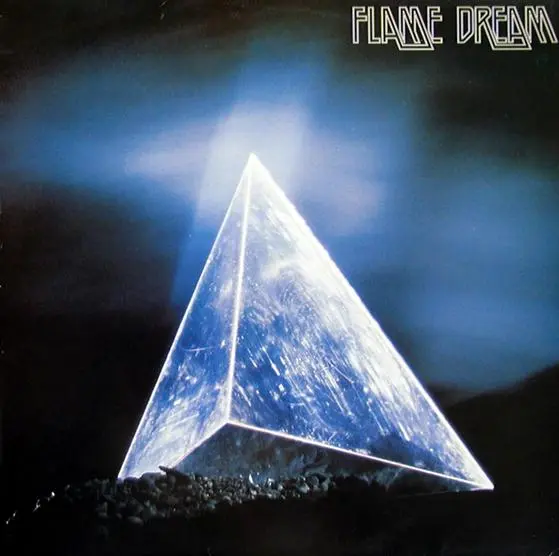 Flame Dream released their third album, Out in the Dark, in February 1981 on Vertigo.
The album emphasizes compositional continuity through linked vocal passages and tone-shifting instrumental sections. Roland Ruckstuhl directs the sequencing with layered synth voicings and vocoder accents, often engaging in mirrored phrases and sharp breaks with guest guitarist Dale Hauskins, whose phrasing contrasts sustained tones with punctuated motifs. Peter Wolf overlays wind instruments and voices with lyrical pacing drawn from external texts. Bassist Urs Hochuli underpins each section with pedal resonance and pivot tones while drummer Peter Furrer adjusts the backbeat architecture with shifting tempo frames and ambient tape overlays.
“Full Moon” opens on clipped, syncopated interplay between bass, keyboard, and drums, with sax and voice layered sparsely into the buildup. “Nocturnal Flight” begins with subdued mellotron and keyboards, then breaks into a more forceful section after 2:30, where guitar and drums take a more dominant role before peaking in a sustained solo. The title track begins at a slower, darker register, centered on voice and sparse flute passages, then shifts tempo five minutes in, driving forward with spry piano phrasing, light-touch drums, and fluttering flute lines.
“Wintertime Nights” follows a more upbeat contour, but the middle section slows for a fluid, mid-register synth solo anchored by steady rhythmic push. The three-part “Strange Meeting” suite dominates the second side: Part One builds gradually from quiet chords into a brisk, tightly structured passage driven by synth lines and coordinated rhythm shifts. “Caleidoscope” immediately follows, pairing menacing mellotron backdrops with high-register sax and percussion interplay, cycling through brief dissonances and reentries before folding into Part Two, where the main themes reappear under a more expansive, upward-driving close led by layered mellotron and sustained bass figures.
Sun Side
A1. “Full Moon” (5:22) – Ruckstuhl / Robert Graves
A2. “Nocturnal Flight” (5:32) – Ruckstuhl / Wolf
A3. “Out in the Dark” (9:29) – Ruckstuhl / Wolf
Dark Side
B1. “Wintertime Nights” (4:02) – Ruckstuhl / Wolf
B2. “Strange Meeting (Part One)” (9:07) – Ruckstuhl / Wilfred Owen
B3. “Caleidoscope” (5:37) – Ruckstuhl / Wolf
B4. “Strange Meeting (Part Two)” (1:50) – Ruckstuhl / Wilfred Owen
Flame Dream recorded and mixed the album at Aquarius Studios with co-producer and engineer John Acock, a soundman on 1980/81 albums by Berlin Blondes, Renaissance, and Steve Hackett. Urs Hochuli created the album’s cover design and photography, released by Phonogram AG under the Vertigo imprint.
Dale Hauskins also played the solo on “Voyage to the Blue Sun” from the self-titled album by the American electronic band Starforce 1.
Supervision
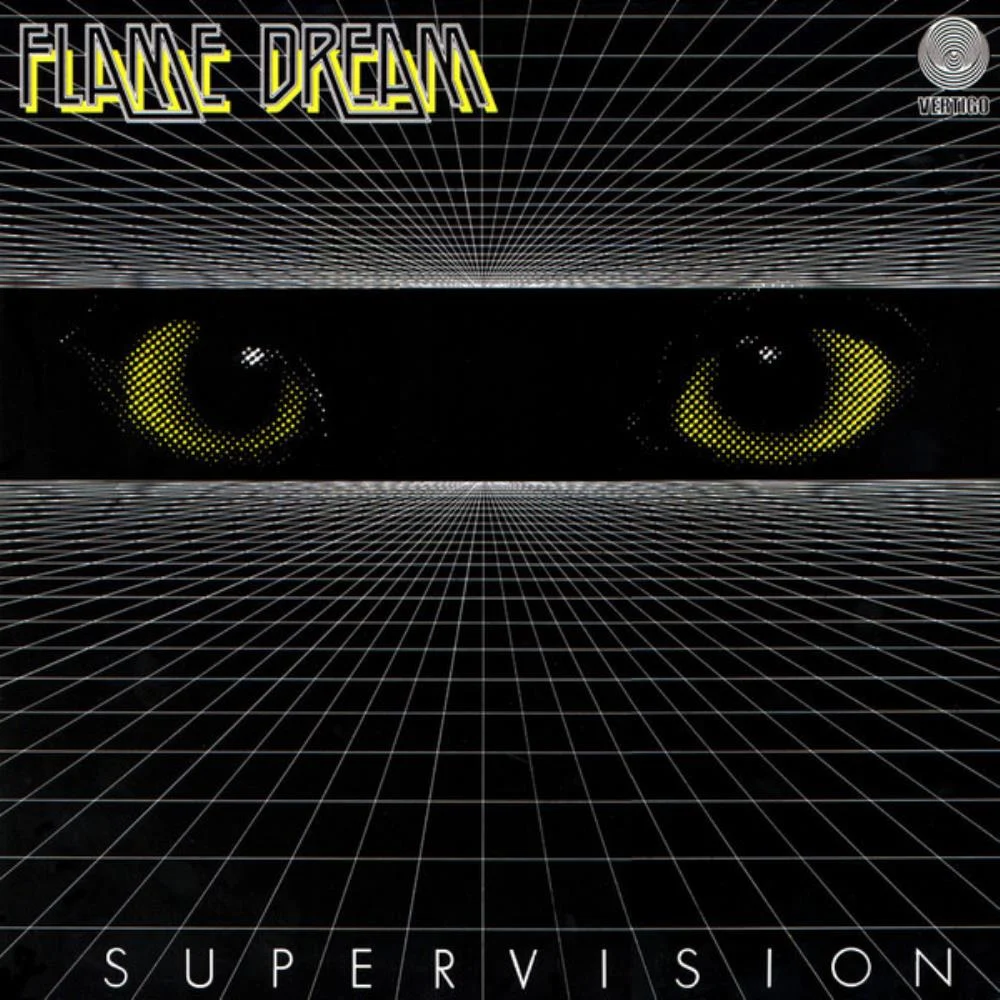 Flame Dream released their fourth album, Supervision, in January 1982 on Vertigo.
The album sharpens their approach into compact vocal tracks and multipart suites built on keyboard-reed interplay. Ruckstuhl’s sequenced runs and textures trade space with Wolf’s wind lines, while Hochuli and Furrer shape momentum through tonal contrast and rhythmic pivots.
“Blackmail” opens with clipped bass patterns and brisk synth lines under offset vocal phrasing, followed by “Dancing Into Daylight,” a brief interlude with light acoustic textures and flute over a restrained rhythmic pulse. The title track stands out with a skewed central motif shaped by winding sax lines, off-kilter synth phrases, and an unusually atmospheric intro. The three-part “Paradise Lost” suite carries the album’s most elaborate construction: “Arrival” sets a sparse and brooding tone; “The Attack” builds momentum with darting synth lines and a rhythm section that presses forward beneath layered voices; “Finale” slows to a spacious close, drawn out over swelling chords and descending phrases.
A1. “Blackmail” (4:38)
A2. “Dancing Into Daylight” (2:12)
A3. “Supervision” (5:18)
A4. “Signs of Solitude” (4:05)
A5. “Tragedy” (5:09)
B1. “Time for a Change” (5:36)
B2. “Woman’s Art?” (3:02)
B3. “Paradise Lost” (0:00
— a. “The Arrival” (1:34)
— b. “The Attack” (6:15)
— c. “Finale” (4:27)
Flame Dream recorded and co-produced Supervision with John Acock, returning to Aquarius Studios in Geneva for the sessions. Phonogram GmbH issued the album on Vertigo with production credits split between the band and Acock. Peter Wolf supplied all lyrics, and Ruckstuhl composed all titles.
Travaganza
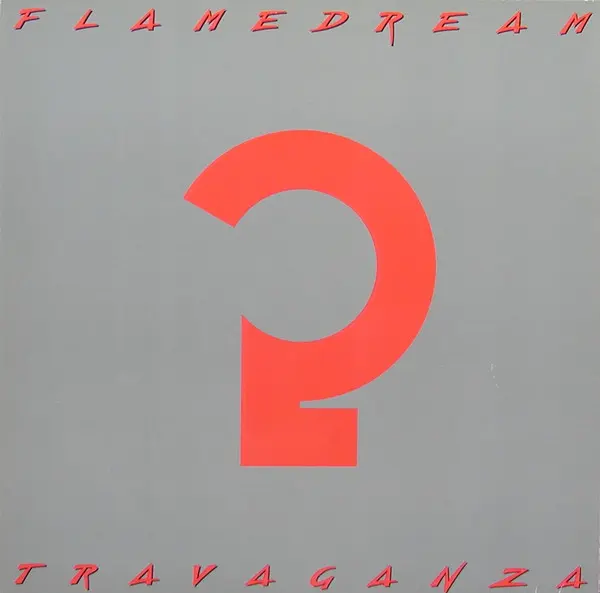 Flame Dream released their fifth album, Travaganza, in 1983 on Vertigo.
The album shifts toward concise song structures shaped by ensemble layering and electronic sequencing. Keyboardist Roland Ruckstuhl integrates Fairlight textures with acoustic and electric keys, locking into mirrored exchanges with Peter Wolf’s woodwind overlays and vocal inflections.
Guitarist-bassist Urs Hochuli rotates between pulsed rhythm figures and sustain-based phrasing that bridge vocal breaks and instrumental interludes. Drummer Peter Furrer reinforces the structure with forward-shifting backbeats and accent patterns that serve as the rhythmic anchor throughout.
A1. “Race My Car” (3:50) – Ruckstuhl
A2. “Stay With Me” (4:20) – Ruckstuhl
A3. “Turn Around” (4:32) – Ruckstuhl
A4. “Double-Quick-Action” (3:31) – Ruckstuhl / Furrer / Hochuli / Wolf
A5. “In From the Cold” (5:40) – Ruckstuhl
B1. “Invader” (4:06) – Ruckstuhl
B2. “On My Way” (4:10) – Ruckstuhl
B3. “Lifetime” (3:47) – Ruckstuhl / Furrer / Hochuli / Wolf
B4. “Side By Side” (3:40) – Ruckstuhl / Furrer / Hochuli / Wolf
B5. “Suspicion” (5:03) – Ruckstuhl / Furrer / Hochuli / Wolf
Flame Dream recorded Travaganza with engineer and co-producer John Acock. Sessions took place in 1983 with mastering by Kevin Metcalfe. The band produced the album in partnership with Acock and handled visual presentation in-house, with cover artwork and photography by Urs Hochuli and Walter Jossen. Ruckstuhl composed the music, with shared lyric duties across the final six tracks by Wolf, Furrer, Hochuli, and Ruckstuhl.
Discography:
- Calatea (1978)
- Elements (1979)
- “Nowhere To Go!” / “Sun Fire” (1980)
- Out in the Dark (1981)
- Supervision (1982)
- Travaganza (1983)
- 8 on 6 (1986)
Sources:
Artist/Album Pages:
Triumph was a Canadian hard-rock band that released six albums on Attic Records between 1976 and ...
New York City Band was an American soul-funk studio ensemble that released a self-titled album on ...
Kliche was a Danish post-punk band that made the 1980–82 albums Supertanker and Okay Okay Boys on...
The Shirts were an American new wave band from New York that emerged on the mid-Seventies Bowery s...
Ratata was a Swedish synthpop band from Stockholm that released seven studio albums, starting with...
Pierre Moerlen's Gong was a French jazz-rock band that functioned as a continuation of Gong follow...
Nada (born Nov. 17, 1953) is an Italian singer, songwriter, and actress who reached national promi...
Tomo Akikawabaya — aka Tomoyasu Hayakawa (とも あきかわばや) — is a Japanese coldwave producer who issued ...
Grand Prix was an English hard-rock band that made the 1980–82 RCA albums Grand Prix and There for...
Falco (Feb. 19, 1957 — Feb. 6, 1998) was an Austrian new wave singer and songwriter who landed a n...
Nichts was a German NDW band that released four singles and the 1981–83 albums Made in Eile, Tango...
Charly Antolini is a Swiss drummer and bandleader who emerged with the Tremble Kids in the late 19...
Correction: “Flame Dream *IS* Swiss symphonic-rock band from Luzern” , not “was”. They are back with a new album “Silent Transition”. See http://www.flamedreammusic.com