

The Faces were an English hard-rock/soul band that released four studio albums between 1970 and 1973 on Warner Bros.
They assembled in 1969 when singer Rod Stewart and guitarist Ron Wood, both recently of the Jeff Beck Group, stepped into the Small Faces to fill the guitar–vocal talents of Steve Marriott, who moved on to Humble Pie. The band dropped “Small” from the name since the two new members exceeded the short heights of band elders Ronnie Lane, Kenney Jones, and Ian McLagen.
The Faces’ five-year run overlapped with Stewart’s rise to international superstar status.
Members: Rod Stewart (lead vocals, 1969-75), Ron Wood (guitar, vocals), Ronnie Lane (bass, vocals, 1969-73), Kenney Jones (drums), Ian McLagan (keyboards), Tetsu Yamauchi (bass, 1973-75), Glen Matlock (bass, 2010-present), Mick Hucknall (lead vocals, 2010-present)
Background
The Faces resulted from a gap left by Steve Marriott, the guitarist and vocal belter of pop-rockers the Small Faces. After his January 1969 departure to Humble Pie, the remaining band — bassist–singer Ronnie Lane, drummer Kenney Jones, and keyboardist Ian McLagen — needed to fill his double-roll.
That May, the three Small Faces partook in Quiet Melon, a blues-rock-soul project headed by former Artwoods singer Art Wood and bassist Kim Gardner of Ashton Gardner & Dyke. Also present was Wood’s younger brother, guitarist Ron Wood, a former bandmate of Gardner’s in The Birds and The Creation; plus Ron’s current bandmate in the Jeff Beck Group, singer Rod Stewart.
Stewart emerged earlier that decade as a blue-eyed-soul singer on London’s nascent R&B–beat scene. In 1964, he cut a single under his own name and one with Long John Baldry and the Hoochie Coochie Men. The following year, he and Baldry formed the unrecorded blues-rock septet Steampacket with future members of Trinity. In 1966, he cut two singles with the similar Shotgun Express, featuring the nucleus of the soon-to-be Fleetwood Mac.
In February 1967, Stewart joined the Jeff Beck Group, which the guitarist formed after his dismissal from the Yardbirds. The group also featured guitarist Ron Wood, who played bass on the 1968–69 albums Truth and Beck-Ola.
Tension mounted between the Beck and Stewart–Wood camps just as the pair partook in Quiet Melon, which generated three songs: “Diamond Joe,” “Engine 4444,” and “Instrumental” (unreleased until 1995).
Weeks later, Stewart and Wood left Beck to jointly fill Marriott’s vacated role in the Small Faces. Before they commenced with band activities, Stewart recorded his first solo album during June–August 1969 at Lansdowne and Olympic Studios, London, with help from Wood, McLagen, Keith Emerson, and members of Steamhammer.
Since Stewart (5’10”) and Wood (5’9″) exceeded the maximum height (5’6″) of the preexisting band, they dropped “Small” from the name. As Faces, they sought to distinguish their newfound blues-rock-soul approach from the beat-mod-psych style and image of the prior band.
First Step
 Faces released their first album, First Step, on March 27, 1970, on Warner Bros.
Guitarist Ron Wood composed the instrumental “Pineapple and the Monkey” and co-wrote “Around the Plynth” with singer Rod Stewart, who duets with bassist Ronnie Lane on “Shake, Shudder, Shiver” and “Nobody Knows,” both Lane–Wood compositions. The three joint wrote “Flying.”
Lane submitted “Stone” and “Devotion” (another Stewart duet) while keyboardist Ian McLagan (Hammond, Wurlitzer) co-wrote the final two songs with drummer Kenney Jones (“Looking Out the Window”) and Stewart (“Three Button Hand Me Down”). Side One opens with the Bob Dylan cover “Wicked Messenger.”
“Flying” unites Stewart, Lane, and Wood on an airy, reflective piece built on acoustic layers and vocal harmonies. “Around the Plynth” rides Wood’s slide phrasing and Stewart’s rasping delivery, contrasting with Lane’s gentler turns on “Stone” and “Devotion.” “Shake, Shudder, Shiver” and “Nobody Knows” blend pub-rock directness with loose ensemble interplay, while “Three Button Hand Me Down” closes the album with a spirited tempo and swaggering vocal trade-offs.
A1. “Wicked Messenger” (4:00) — written by Bob Dylan, first recorded on his 1967 album John Wesley Harding
A2. “Devotion” (4:48)
A3. “Shake, Shudder, Shiver” (3:09)
A4. “Stone” (5:33)
A5. “Around the Plynth” (5:45)
B1. “Flying” (4:10)
B2. “Pineapple and the Monkey” (4:23)
B3. “Nobody Knows” (4:04)
B4. “Looking Out the Window” (5:00) features Stewart on banjo
B5. “Three Button Hand Me Down” (5:30) features Wood on second bass
Sessions occurred between December 1969 and January 1970 at De Lane Lea Studios in London with the Faces self-producing and Martin Birch engineering.
The cover features Ron Wood holding Geoffrey Sisley’s instructional book First Step: How to Play the Guitar Plectrum Style, photographed by Martin Cook at artist Mike McInnerney’s Willoughby House. The gatefold image shows the band posing informally in McInnerney’s garden.
Warner Bros. promoted First Step in the UK and US during the spring of 1970. Though its singles failed to chart, the album introduced the group’s raw, communal approach, setting the tone for their more cohesive later work.
First Step established Faces as a new entity distinct from both the Small Faces and the Jeff Beck Group, emphasizing ensemble spirit over precision and marking the starting point for Stewart and Wood’s parallel ascent in the early 1970s.
Long Player
 Faces released their second album, Long Player, in February 1971 on Warner Bros.
The album blends studio and live performances, mixing ragged rockers, folk-tinged ballads, and extended blues jams. Side A features two songs (“Tell Everyone,” “Richmond”) by bassist–singer Ronnie Lane, who co-wrote “On the Beach” with guitarist Ron Wood. Singer Rod Stewart collaborated with the pair on two songs (“Sweet Lady Mary,” “Had Me a Real Good Time”) and co-wrote “Bad ‘n’ Ruin” with keyboardist Ian McLagen.
Long Player contains live renditions of songs by Paul McCartney (“Maybe I’m Amazed”) and American bluesman Big Bill Broonzy (“I Feel So Good”).
The album opens with rollicking rocker “Bad ‘n’ Ruin,” propelled by Wood’s guitars and Stewart’s lead vocals, followed by Lane’s reflective, folk-tinged “Tell Everyone.” Ballads such as “Sweet Lady Mary” and “Richmond” highlight acoustic-electric interplay and McLagan’s organ textures. Live covers of “Maybe I’m Amazed” and “I Feel So Good” stretch the performances, with audience participation and extended solos. The closing “Jerusalem,” 1916 hymn by Sir Hubert Parry, serves as a brief instrumental coda.
A1. “Bad ‘n’ Ruin” (5:30) — Stewart and McLagan co-wrote this ragged rocker; Wood supplies angular guitar riffs and a driving rhythm.
A2. “Tell Everyone” (4:22) — written by Lane; a homesick, folk-blues ballad supported by McLagan’s Hammond organ.
A3. “Sweet Lady Mary” (5:40) — Wood, Stewart, and Lane; combines acoustic and electric guitars with swirling organ under Stewart’s tender lead.
A4. “Richmond” (3:05) — Lane; Americana-inflected folk-rock with pedal steel flourishes.
A5. “Maybe I’m Amazed” (5:35) — Paul McCartney; live rendition with shared lead vocals between Lane and Stewart.
B1. “Had Me a Real Good Time” (5:50) — Wood, Stewart, Lane; loose, boozy rock with saxophone by Bobby Keys and trumpet by Harry Beckett.
B2. “On the Beach” (4:15) — Wood and Lane; acoustic slide guitar and raw folk-rock textures.
B3. “I Feel So Good” (8:50) — Big Bill Broonzy; extended live blues jam with audience interaction.
B4. “Jerusalem” (1:55) — Sir Hubert Parry; instrumental take highlighting Wood’s dobro work.
Sessions occurred September 1970–January 1971 at Morgan Sound Studios, London, with live tracks recorded 10 November 1970 at Fillmore East, NY. The Faces self-produced the album with engineering from Morgan Sound and The Rolling Stones Mobile Recording Unit.
A unique early mix of “Had Me a Real Good Time” appeared as a single in November 1970, backed with the non-album instrumental “Rear Wheel Skid.” “Maybe I’m Amazed” also appeared as a pre-album single in the US, with the B-side “Oh Lord, I’m Browned Off.”
Long Player captures the Faces in full swing, alternating between ramshackle rock, tender ballads, and expansive blues jams, reflecting both their cohesion as a band and their playful, raw energy.
A Nod Is as Good as a Wink… to a Blind Horse
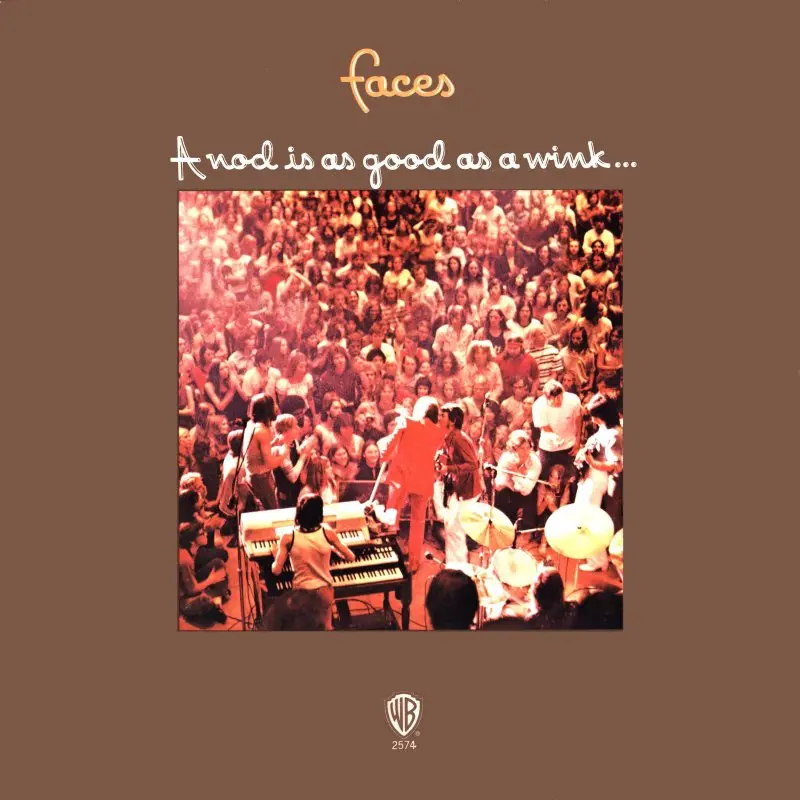 Faces released their third album, A Nod Is as Good as a Wink… to a Blind Horse, on November 17, 1971, on Warner Bros.
The album captures Faces at their most focused, combining raucous blues-rock with honky tonk piano, rollicking riffs, and a loose, party-driven energy. It balances hard-rocking numbers with ballads and features the interplay between Rod Stewart’s raspy vocals and Ronnie Wood’s idiosyncratic guitar work, alongside Ronnie Lane’s bass and songwriting contributions. The record includes the group’s biggest hit, “Stay With Me,” and demonstrates a sharper, more concise approach than their earlier releases.
Rod Stewart wrote or co-wrote the majority of the songs on the album. Ronnie Lane contributes three tracks, one co-written with Ian McLagan. The Faces also cover Chuck Berry’s “Memphis, Tennessee.”
Musically, the album alternates between boisterous rockers like “Miss Judy’s Farm” and “Too Bad,” tongue-in-cheek numbers such as Lane’s “You’re So Rude,” heartfelt ballads exemplified by “Debris,” and celebratory closing tracks like “That’s All You Need.” Stewart’s singing anchors the high-energy cuts, while Lane’s vocals provide introspective and humorous counterpoints. Wood’s slide and electric guitar work punctuate the album with sharp turns and blues-inflected textures, and McLagan’s piano and organ fill out the arrangements.
A1. “Miss Judy’s Farm” (3:38) — Stewart opens with a rallying vocal over Wood’s propulsive guitar riff.
A2. “You’re So Rude” (3:41) — Lane narrates a comical tale of a misguided encounter, co-written with McLagan.
A3. “Love Lives Here” (3:04) — Stewart delivers a soul-tinged ballad with gentle piano accompaniment.
A4. “Last Orders Please” (2:33) — Lane leads a pub-ready rocker with McLagan’s piano prominent.
A5. “Stay With Me” (4:37) — Stewart and Wood co-wrote this driving, blues-laden rock track that became the band’s signature single.
B1. “Debris” (4:36) — Lane’s reflective ballad with Stewart on harmony, examining personal loss.
B2. “Memphis” (5:29) — cover of Chuck Berry; the Faces’ loose adaptation adds extended guitar and piano interludes.
B3. “Too Bad” (3:12) — Stewart fronts a spontaneous, ragged rocker with backing from Lane, McLagan, and Wood.
B4. “That’s All You Need” (5:06) — closes the album with Wood’s slide guitar and steel drum textures from Harry Fowler.
Sessions occurred at Olympic Studios in London with the Faces and Glyn Johns producing and engineering.
Original pressings of A Nod Is as Good as a Wink… to a Blind Horse included a poster featuring lyrics, polaroids of the band on tour, and images of pills, which was withdrawn shortly after release.
Warner Bros. promoted the album with “Stay With Me” (b/w Lane’s “Debris”), which reached No. 17 on the US Billboard Hot 100 and No. 6 in the UK.
Later artists covering Faces tracks include Rose Tattoo performing “Stay With Me” and the Quireboys on their version of “Debris.”
Ooh La La
 Faces released their fourth album, Ooh La La, in March 1973 on Warner Bros.
The album captures the band mid-transition, with a more introspective second side reflecting Ronnie Lane’s expanded role as composer and vocalist. The first side delivers rollicking, Stones-like rockers featuring Ronnie Wood’s electric and slide guitars, Kenney Jones’ propulsive drumming, and Ian McLagan’s boogie-inflected keys, while the second side leans on Lane’s folk-tinged ballads and narrative sketches, including the only studio lead vocal by Wood.
Rod Stewart wrote or co-wrote six tracks, mostly with Wood and McLagan, while Lane contributed to five songs and co-wrote the title track with Wood. The instrumental “Fly in the Ointment” was a group composition, marking the only band-wide studio cut on a Faces LP.
Musically, the first side emphasizes driving, blues-infused rockers such as “Silicone Grown” and “Borstal Boys,” while “Cindy Incidentally” offers a lighter, folk-rock feel. Lane’s contributions on side two—”Flags and Banners,” “Glad and Sorry,” “Just Another Honky,” and the raucous yet bittersweet “Ooh La La”—mix soft, narrative-driven ballads with humorous or reflective lyrical content. The instrumental “Fly in the Ointment” adds a tense, riff-based interlude amid the folk-leaning second side.
A1. “Silicone Grown” (3:05)
A2. “Cindy Incidentally” (2:37)
A3. “Flags and Banners” (2:00) — lead singer Ronnie Lane, Stewart on banjo/secondary guitar
A4. “My Fault” (3:05) — co-lead vocals Rod Stewart and Ronnie Wood
A5. “Borstal Boys” (2:52)
B1. “Fly in the Ointment” (3:49) — instrumental
B2. “If I’m on the Late Side” (2:36) — co-written Lane/Stewart
B3. “Glad and Sorry” (3:04) — lead vocals Ronnie Lane, Wood, McLagan
B4. “Just Another Honky” (3:32) — lead singer Ronnie Lane
B5. “Ooh La La” (3:30) — lead singer Ronnie Wood, co-written Lane/Wood
Sessions occurred at Olympic Studios, London, from September 1972 to January 1973 with Glyn Johns producing and engineering, assisted by Ron Nevison on track-specific effects.
Ooh La La features artwork by Jim Ladwig, centering on Gastone, a 1920s stage character; the die-cut sleeve animates Gastone’s eyes and jaw when pressed, complemented by an inner photomontage of the band in a can-can scene.
Warner Bros. promoted the album with “Cindy Incidentally” (b/w “Skewiff [Mend the Fuse]”) in February 1973, followed by “Ooh La La” (b/w “Just Another Honky”) in March. “Ooh La La” later gained recognition through film soundtracks including Rushmore (1998) and Without a Paddle (2004), while “Glad and Sorry” appeared in Blow (2001) and I’m Your Woman (2020).
The album reached No. 1 on the UK Albums Chart and entered the US Billboard 200 at No. 21, marking Faces’ only chart-topping LP in the UK. Several tracks, including “Ooh La La,” have been covered by artists in the late 1970s and beyond, cementing its status as a touchstone of pub rock and early 1970s British bar-band songwriting.
2015 reissue bonus tracks include BBC sessions, rehearsal takes, and a live version of John Lennon’s “Jealous Guy” with Tetsu Yamauchi on bass.
Discography:
- First Step (1970)
- Long Player (1971)
- A Nod Is as Good as a Wink… to a Blind Horse (1971)
- Ooh La La (1973)
Sources:
Artist/Album Pages:
Ford Theatre was an American psychedelic rock band behind the 1968/69 albums Trilogy for the Masse...
Cliff Richard (born Oct. 14, 1940) is an English pop vocalist with a career that has spanned more th...
Badger was an English symphonic hard-rock band that released a live album on Atco/Atlantic in 1973...
Christopher was an American psych-rock powertrio from Houston that released a 1970 self-titled al...
Petrus Castrus was a Portuguese symphonic-rock band that included musician/composer Júlio Pereira....
The Stooges were an American hard-rock/punk band fronted by singer Iggy Pop. They released two al...
Flaming Youth was an English psych-rock band that released the album Ark 2 on Fontana in 1969. Drumm...
Lalo Schifrin (June 21, 1932–June 26, 2025) was an Argentinian pianist, composer, and arranger who...
The National Head Band was an English blues-psych band that released the album Albert 1 on Warner...
Killing Joke are an English rock band that released eight albums between 1980 and 1990. They emerg...
Sparks is the musical partnership of American keyboardist–songwriter Ron Mael and his vocalist bro...
Galliard was an English brass-rock band from Birmingham that released the 1969/70 Deram albums Str...