

Don Cherry (November 18, 1936 — October 19, 1995) was an American avant-garde jazz trumpeter.
He emerged in 1958 as a sideman for Ornette Coleman on the trumpeter’s early Contemporary/Atlantic run. During the 1960s, Cherry moved through frontline roles with Sonny Rollins, John Coltrane, Albert Ayler, George Russell, and the New York Contemporary Five, often in small-group settings built for open forms and extended improvisation.
As a bandleader, Cherry debuted with the 1966 Blue Note title Complete Communion, then expanded the suite-based approach on Symphony for Improvisers. He pushed free-jazz structure toward modular themes and collective circulation on the 1968–69 sets for Eternal Rhythm and Mu (Parts 1–2). In the mid-1970s, he redirected that approach into multi-cultural “world fusion” work on Organic Music Society, Relativity Suite, and Brown Rice.
Background
Don Cherry grew up in Oklahoma City in a musical household: his mother and grandmother played piano while his trumpeter father ran the Cherry Blossom Club. He heard jazz firsthand as the club hosted Charlie Christian and Fletcher Henderson. In 1940, Cherry moved with his family to the Watts neighborhood of Los Angeles, where his father tended bar at the Plantation Club on Central Avenue.
Cherry started on piano as a schoolboy, skipping classes at Fremont High School to play in the Jefferson High swing band. School discipline sent him to Jacob Riis High School, where he met drummer Billy Higgins. By the early 1950s, Cherry worked the Los Angeles scene and took jobs with working bands, including occasional piano work with Art Farmer.
He met Clifford Brown during the trumpeter’s LA stay with Max Roach. Cherry also played informal sets, including one at the house of Eric Dolphy. He toured with saxophonist James Clay, then landed an ongoing gig in the backing band of Ornette Coleman.
Early Credits
Between 1958 and 1962, Cherry backed Coleman on the trumpeter’s Contemporary debut Something Else!!!!, followed by The Shape of Jazz to Come, Tomorrow Is the Question!, and Change of the Century. He followed on Atlantic with the 1960–62 titles This Is Our Music, Free Jazz, Ornette!, and Ornette on Tenor.
Cherry also appeared on 1962–65 albums by Steve Lacy (Evidence), Sonny Rollins (Our Man In Jazz), Gary Burton (3 In Jazz), George Russell Sextet (At Beethoven Hall), Sonny Murray (Sonny’s Time Now), and the Albert Ayler Quartet (Ghosts).
In 1963, Cherry played on the Swedish Bird Notes release Psycology, co-billed with Bengt “Frippe” Nordström and Bosse Skoglund. That May, he cut a session at Zounds Studios, NYC, with Prince Lasha, Sonny Simmons, Clifford Jordan; released in a numbered edition as It Is Revealed.
By 1966, Cherry gained co-billed status with John Coltrane on The Avant-Garde, an Atlantic Records archival release of a 1960 session.
Togetherness
 In early 1966, Don Cherry released Togetherness, a live album on Durium Records, later co-billed to Gato Barbieri.
The live set documents a Paris quintet built around Cherry’s five-movement composition “Togetherness.” Cherry leads on cornet while Gato Barbieri answers on tenor saxophone, pushing the frontline in extended, movement-to-movement development. Vibraphonist Karl Berger adds harmonic color while bassist Jean-François Jenny-Clark and drummer Aldo Romano anchor the set.
Across the five movements, the set runs on a familiar pattern—brief thematic cues, then extended blowing—but the first three stretches land loose and low on incident, with long passages that feel under-shaped and prone to drift. Around the mid-point, the cornet line breaks into abrupt splats and short bursts that read more as texture than direction, while the drumming stays light and tinny, with timekeeping that wobbles instead of locking the ensemble to a clear pulse. The tenor sax enters with a big, forceful tone but often presses against the cornet phrasing in a way that muddies the center, so the two voices collide more than they braid. The last two movements tighten the frame: the transitions feel cleaner, the band commits to a steadier pace, and the cornet–sax exchanges start to trade phrases with sharper turns and more decisive handoffs, giving the close the only sustained sense of collective focus.
A1. “Togetherness One – First Movement” (5:08)
A2. “Togetherness One – Second Movement” (5:26)
A3. “Togetherness One – Third Movement” (9:41)
B1. “Togetherness Two – Fourth Movement” (12:07)
B2. “Togetherness Two – Fifth Movement” (9:41)
Cherry recorded the album live in Paris, France, during the spring and summer of 1965 with Barbieri, Berger, Jenny-Clark, and Romano.
Inner City Records reissued the album in 1976 as Gato Barbieri & Don Cherry, shifting the billing to reflect Barbieri’s co-headliner association with the release.
Complete Communion
 Don Cherry released his debut bandleader studio album, Complete Communion, in May 1966 on Blue Note.
Communion presents two side-long suites built from multiple themes, with each side unfolding as a continuous sequence of linked sections. Cherry leads on cornet with Gato Barbieri on tenor saxophone, setting the thematic cues and moving the band through transitions between the named suite parts. Henry Grimes (bass) and Edward Blackwell (drums) anchor the quartet as the material cycles between unison figures, open space, and shifting ensemble passages across each continuous performance.
The opening suite moves through brisk, swing-leaning momentum and quick, jingle-like motifs that return in slightly altered form; the band treats each return as a cue to pivot, so drum and bass accents from one segment surface later as echoes against a different horn line. Don Cherry phrases in compact, contoured bursts—clean intervals, sudden skips, clipped repeats—then leaves space for the rhythm section to tilt the feel with snap-to-the-grid hits or looser, more elastic push. Gato Barbieri answers with a harder edge, climbing into high-register flurries and dense barrages that press the center until the group snaps back to the next thematic block. Across both suites, Henry Grimes and Ed Blackwell carry much of the motion: they can hold a steady pulse, then fracture it into restless chatter, or stretch the pace into a more languid sprawl without losing the thread. The second suite (Elephantasy) keeps the same stitched form and tight cohesion, but it leans more on extended roaming between signposts, so the structural “grabs” feel less frequent even as the interplay stays alert and conversational.
A1. “Complete Communion: Complete Communion/And Now/Golden Heart/Remembrance” (20:38)
B1. “Elephantasy: Elephantasy/Our Feelings/Bishmallah/Wind, Sand And Stars” (19:36)
Cherry recorded the album on December 24, 1965 at Van Gelder Studio in Englewood Cliffs, New Jersey. Alfred Lion produced the session with recording by Rudy Van Gelder.
Blue Note later compiled the album’s tracks on The Complete Blue Note Recordings of Don Cherry.
Symphony for Improvisers
 Don Cherry released his second studio album, Symphony for Improvisers, in August 1967 on Blue Note.
The album expands the suite-based approach into a larger ensemble built around two side-long performances with multiple titled sections. Cherry leads on cornet with Gato Barbieri and Pharoah Sanders alternating tenor saxophone roles, with Sanders also adding piccolo color inside the ensemble texture. Karl Berger shifts between vibes and piano, and the rhythm section widens to two bassists—Henry Grimes and Jean-François Jenny-Clark—supported by Ed Blackwell on drums as the band moves through themed passages and open improvising blocks inside each continuous side.
On Symphony for Improvisers, two side-long suites keep the music in near-constant motion, with short thematic signposts that snap the ensemble into new angles before the horns peel off again. The title piece opens at a fast clip—Blackwell pushes a sharp, quick pulse while Cherry’s pocket-cornet phrases land in light, jagged cells—and the added voices widen the texture without turning it dense: Berger’s vibraphone hangs bright, sustained tones that soften the edges, while Sanders threads in on piccolo like a thin, needling line that keeps poking holes in the surface. The band cycles through brisk, conversational passages and more suspended, dreamlike stretches led by vibraphone resonance, then kicks back into fidgety, celebratory chatter as the horns jab and overlap.
“Manhattan Cry” shifts the temperature down at the start, with spare piano chords and a slower, heavier tread that makes the later surges feel steeper; the saxophones lean into a single-minded, ear-level intensity, pushing long, forceful streams against Cherry’s more clipped, directional statements. Throughout both suites, the writing favors abrupt pivots over smooth joins, and the tension between a relaxed, sunlit rhythmic feel and the sax-driven pressure becomes the main engine; even with two bassists on the date, the low end stays lean and mobile, so the drumming and vibraphone carry much of the momentum and color.
A1. “Symphony for Improvisers: Symphony for Improvisers/Nu Creative Love/What’s Not Serious?/Infant Happiness” (19:43)
B1. “Manhattan Cry: Manhattan Cry/Lunatic/Sparkle Plenty/Om Nu” (19:17)
Cherry recorded the album on September 19, 1966 at Van Gelder Studio with producer Alfred Lion.
In 2021, Ezz-thetics reissued Symphony for Improvisers alongside Complete Communion as Complete Communion & Symphony For Improvisers Revisited.
Where Is Brooklyn?
 Don Cherry released his third studio album, Where Is Brooklyn?, in June 1969 on Blue Note.
The album returns to a quartet format with Cherry on cornet leading Pharoah Sanders on tenor saxophone and piccolo. Henry Grimes (bass) and Ed Blackwell (drums) anchor the group through five Cherry compositions, including a long closing performance that stretches across much of side B.
Where Is Brooklyn? hits harder and faster than the prior suites, with compact heads that snap the band into motion and leave long stretches for direct, four-way push. “Awake Nu” opens on an Ornette-leaning theme, but the lift comes from the rhythm section: Blackwell and Grimes play close to the beat without sitting squarely on it, so the pulse feels buoyant and slightly off-center as Cherry rises into a high, biting solo and Sanders adds short shrieks from the edge. “Taste Maker” keeps the forward pace and turns the front line into a tight, abrasive weave—Sanders shakes a wild vibrato around Cherry’s line, then rockets upward while Cherry keeps circling through him, with Grimes and Blackwell shifting accents under the exchanges.
“The Thing” rides a slinkier head and gives the bass more room; Grimes moves from walking motion to more strummed, percussive figures, then steps forward for a featured statement while the drums keep the surface restless. “This Is the Bomb” reads as the most restrained of the shorter pieces, holding its material closer to the theme and saving the sharpest bursts for brief flashes. Side two’s “Unite” stretches into a long, continuous surge: Sanders can hit full intensity early and stay there, with occasional piccolo color, while Cherry answers in clipped, angular phrases and the rhythm section keeps the whole span tight, fast, and constantly prodded by Blackwell’s shifting patterns and Grimes’ mobile foundation.
A1. “Awake Nu” (6:55)
A2. “Taste Maker” (6:48)
A3. “The Thing” (5:50)
A4. “There Is the Bomb” (4:51)
B1. “Unite” (17:48)
Cherry recorded the album on November 11, 1966 at Van Gelder Studio in Englewood Cliffs, New Jersey. Alfred Lion produced the session.
In 2022, Ezz-thetics reissued the album alongside Eternal Rhythm as Where Is Brooklyn? & Eternal Rhythm, Revisited.
“mu” First Part
 On August 22, 1969, Don Cherry held a Paris session that produced seventy minutes of music, released two on separate albums: “mu” First Part and Second Part, both on BYG.
The music documents a duo setting with Cherry leading on trumpet while also adding piano, flute, voice, bells, and percussion, matched by Ed Blackwell on drums, percussion, and bells. They frame each piece as percussion-led ritual space, with Cherry shifting instruments to change the light on the same stripped pulse.
“Brilliant Action” and “Total Vibration” push the album’s sharpest pressure: Blackwell snaps into march-like breaks and abrupt accents while Cherry answers in short, fractured bursts, so the tension comes from stops, starts, and sudden forward jolts. “Amajelo” sits at the opposite pole, with flute lines circling over a smooth, repeating percussive cycle that reads as a steady dance figure; “Sun of the East” holds a similar ceremonial focus, with flute and drums setting an image of chant and procession through its modal turns.
“Terrestrial Beings” starts as a quiet piano–percussion dialogue, then opens into a longer arc that turns darker and more chaotic as the pulse thickens and the attacks grow harsher. “Bamboo Night” places a calm bamboo-flute tone against a more impulsive undercurrent, so the piece flickers between stillness and quick bursts of energy. “Teo-Teo-Can” leans on voice as texture—extended calls that mimic nocturnal birds—while “Smiling Faces Going Places” and “Psycho-Drama” return to trumpet statements backed by drums, with bells and small percussion details punctuating the spaces between phrases.
MU – First Part (BYG, 1969)
A1. “Brilliant Action” (8:50)
A2. “Omejelo” (7:25)
A3. “Total Vibration (Part 1)” (3:00)
A4. “Total Vibration (Part 2)” (6:00)
B1. “Sun of the East” (7:30)
B2. “Terrestrial Beings” (4:42)
MU – Second Part (BYG, 1970)
A1. “The Mysticism of My Sound” (4:00)
A2. “Medley: Dollar Brand / Spontaneous Composing / Exert, Man on the Moon” (3:15)
A3. “Bamboo Night” (6:07)
A4. “Teo-Teo-Can” (6:30)
B1. “Smiling Faces Going Places” (5:00)
B2. “Psycho-Drama” (2:45)
B3. “Medley: Theme Albert Heath / Theme Dollar Brand / Baby Rest, Time For…” (3:55)
Jean Georgakarakos and Jean Luc Young produced the session for BYG, which split the roughly seventy minutes across two releases in its Actuel series, issuing Mu First Part in 1969 and Mu Second Part in 1970, with both later paired as a single box set in 1971.
In December 1977, Cherry and Blackwell presented a New York University concert titled “Mu, Part Three.”
Eternal Rhythm
 In September 1969, MPS released Eternal Rhythm, a document of the November 1968 Don Cherry set at the Berlin Jazz Festival.
Eternal Rhythm centers on a two-part performance that unfolds as a continuous suite with titled subsections inside each part. Cherry leads the ensemble while also adding multiple instruments and voice, joined by two trombonists—Albert Mangelsdorff and Eje Thelin—alongside Bernt Rosengren on tenor saxophone plus reeds and flutes. Sonny Sharrock brings electric guitar to the front line, with Karl Berger and Joachim Kühn alternating keyboard and percussion colors on vibraphone, piano, prepared piano, and gendèr. Arild Andersen (bass) and Jacques Thollot (drums and percussion) anchor the set, with Thollot also contributing saron, gong, bells, and voice.
The two-part suite plays like a field recording of a large ensemble that keeps re-forming in real time: Part I opens in raw clatter—gongs, small bells, and gamelan-like metal strikes stack into a harsh shimmer while horns flare in short, overlapping yelps—and Cherry’s flutes steer long passages where the band thins out to let a single line hover over restless percussion. A few minutes in, the texture hardens as Sonny Sharrock arrives with jagged, high-volume slashes, then the music drops into a darker, noir-leaning pocket where his guitar holds drones under bent brass and vibraphone tones that ring like distant chimes.
Part II starts mean again—voices wail, drums surge in polyrhythmic bursts, trombones smear notes, and a prepared piano clatters in irregular clusters—yet the mass never stays at full boil for long; it keeps breaking apart into smaller combinations, then slamming back together on new accents. The center stretch can suddenly tilt into a dirge-like shuffle with a clearer, song-shaped pulse, and the final span opens into the suite’s most focused, sustained passage: the ensemble locks into a calmer, more luminous flow where the noise recedes, the percussion turns to glints and soft booms, and the horns ride longer, steadier arcs before the piece dissolves.
A1. “Eternal Rhythm Part I” (17:49) (Cherry)
a. “Baby’s Breath”
b. “Sonny Sharrock”
c. “Turkish Prayer”
d. “Crystal Clear (Exposition)”
e. “Endless Beginnings”
f. “Baby’s Breath (Unaccompanied)”
B1. “Eternal Rhythm Part II” (23:40) (Cherry)
a. “Autumn Melody”
b. “Lanoo”
c. “Crystal Clear (Development)”
d. “Screaming J”
e. “Always Beginnings”
Cherry recorded the album live at the Berlin Jazz Festival on November 11–12, 1968. Joachim E. Berendt produced the release for MPS.
Heinz Bähr handled cover and layout. In 2022, Ezz-thetics reissued the album alongside Where Is Brooklyn? as Where Is Brooklyn? & Eternal Rhythm Revisited, in a shortened form.
Organic Music Society
 Don Cherry released his sixth studio album, Organic Music Society, in 1972 on the Swedish Caprice label.
The album uses a large ensemble built around Cherry’s trumpet, keyboards, and vocals, with added brass, flutes, strings, and percussion shaping the arrangements across a long, multi-piece program. Cherry alternates between trumpet and piano or harmonium while the surrounding players expand the palette: Tommy Goldman and Tommy Koverhult share flute roles, Maffy Falay and H’suan add trumpet lines, and Hans Isgren contributes sarangi. Naná Vasconcelos brings berimbau and percussion, with Helen Eggert and Moki Cherry adding tambura and vocals. Chris Bothen plays doussn’gouni, Tage Siven anchors on bass, and the drum parts split across Okay Temiz and Bengt Berger, with Berger also adding percussion.
“North Brazilian Ceremonial Hymn” sets the template: a short, wordless chant repeats in a fixed cycle while bells, shakers, and hand percussion stack into a slow, patient tower that shifts by small additions and withdrawals. “Elixir” opens in a hazy, suspended space, then turns into a faster, African-leaning pulse where Cherry cuts through with high, piercing trumpet phrases and sharp squeals that ride above the drum lattice. Across the longer spans, the music favors trance structure—complex but constant rhythmic loops, short refrains, and extended vocal lines that keep a shamanic monotone—while a roaming arsenal of flutes, harmonium, tambura, piano, and “exotic” timbres changes the color more than the underlying pace. At points Cherry uses that settled bed as a launch pad, dropping an improvised figure that forces the ensemble to pivot and develop his line against the modal refrains; elsewhere, the album jumps between field-recorded looseness and more organized, ensemble-forward Stockholm performances, which read as cleaner, more tune-shaped stretches inside the wider collage.
A1. “North Brazilian Ceremonial Hymn” (12:25) – Naná Vasconcelos
A2. “Elixir” (6:08) – Cherry
A3. “Manusha Raga Kamboji” (2:19) – Hans Isgren
A4. “Relativity Suite” (18:52) – Cherry
B1. “Terry’s Tune” (Version One) (1:56) – Terry Riley
B2. “Hope” (10:08) – Cherry
B3. “The Creator Has a Master Plan” (6:28) – Pharoah Sanders, Leon Thomas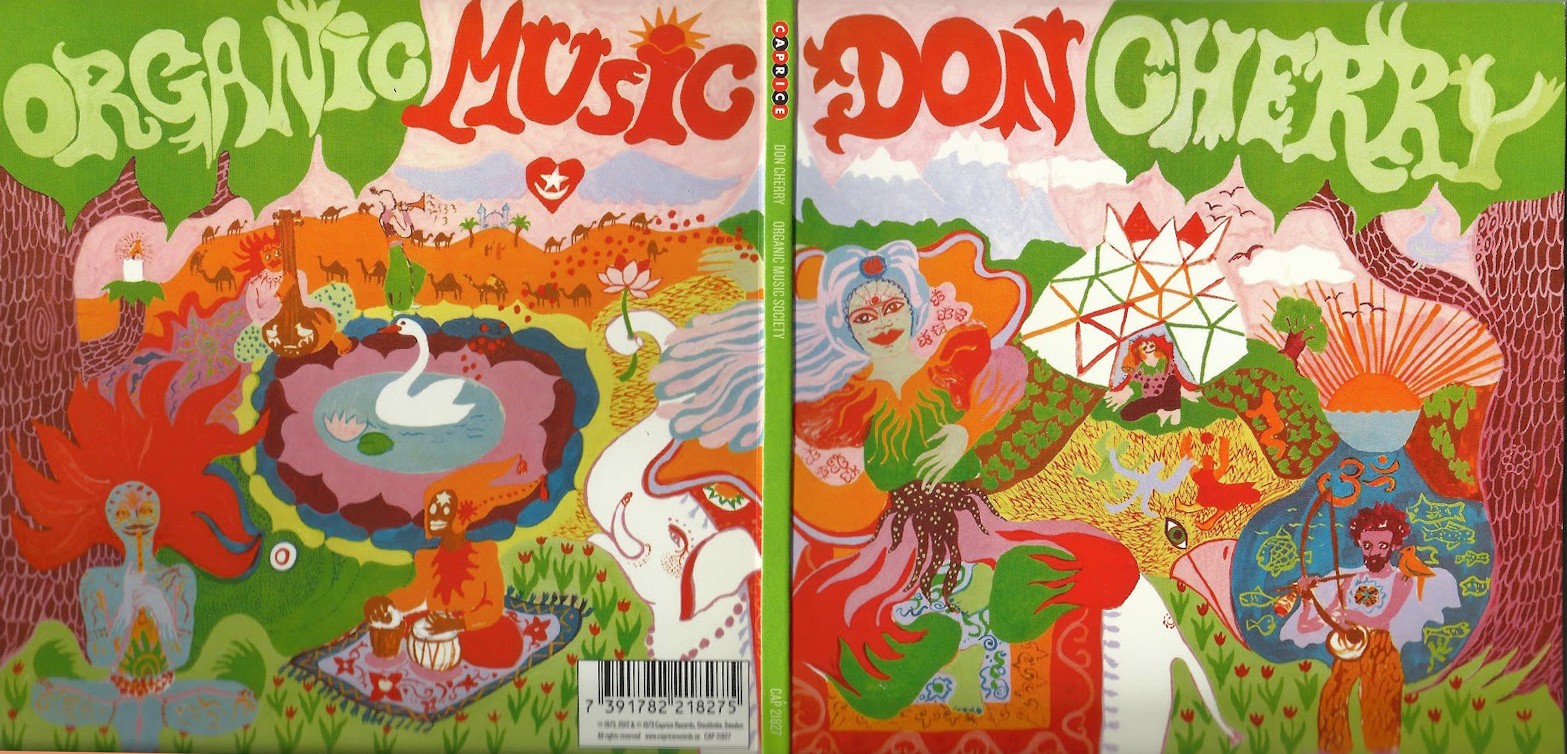 B4. “Sidhartha” (1:59) – Cherry
B5. “Utopia & Visions” (6:33) – Cherry
B6. “Bra Joe from Kilimanjaro” (2:33) – Dollar Brand
B7. “Terry’s Tune” (Version Two) (5:10) – Terry Riley
B8. “Resa” (5:41) – Cherry
Cherry recorded the album on August 14, 1972. Jan Bruér, Keith Knox, and Rita Knox produced the sessions for Caprice.
Eternal Now
 Don Cherry released his seventh studio album, Eternal Now, in 1974 on Sonet.
The album sets Cherry’s trumpet alongside keyboards, voice, and percussion, with additional players adding bells, drones, and sustained color across a five-track program. Cherry shifts between trumpet, piano, and harmonium while also contributing vocals and instruments including h’suan, daster, and gong. Bengt Berger and Christer Bothén expand the texture through piano plus Tibetan bells and other percussion instruments, with Berger also using Tibetan bells, African finger piano, mridangam, and cymbal. Bernt Rosengren appears on tárogató, and Agneta Ernström adds Tibetan bells and dousso kynia.
A1. “Gamla Stan – The Old Town by Night” (8:27)
A2. “Love Train” (7:50)
A3. “Bass Figure for Ballatune” (3:44) – Chris Bothen
A4. “Moving Pictures for the Ear” (9:40) – Bothen, Cherry
B1. “Tibet” (7:59)
Cherry recorded the album at Studio Decibel in Stockholm on April 30, 1973 (tracks 2–4) and May 1, 1973 (tracks 1 and 5). Keith Knox produced the sessions for Sonet.
Sonet reissued the album on CD in 1996 paired with Live Ankara as The Sonet Recordings.
Relativity Suite
 Don Cherry released his eighth studio album, Relativity Suite, in 1973 • Don Cherry & The Jazz Composer’s Orchestra on JCOA.
Relativity Suite runs as a compact, multi-part orchestral chain where Cherry moves the ensemble through quick scene changes and layered colors. The reed front line stacks soprano/alto and two tenors into tight clusters that can sound like a small brass band at full cry, then peel back to let French horn and tuba round the edges while strings smear long tones across the middle. “Desireless” lands as a brief, hushed vignette—barely there, but fully shaped—before the suite pivots again. “March of the Hobbits” snaps the set into a marching cadence that feels deliberately out of place inside the surrounding ritual space, with the oddness heightened by the orchestra’s bright, almost cartoonish lift. Elsewhere the suite leans on non-Western timbres as structural pillars: guzheng figures and tambura drone sit under the horns, and Cherry alternates trumpet statements with voice and conch-like blasts that cue new entries. The rhythm section stays flexible—Blackwell and Motian can push a firm, forward beat, then dissolve it into scattered percussion—so the orchestra can slide from dense, churning tutti to thinner, string-led passages without losing momentum.
The front line layers reeds—Charles Brackeen (soprano/alto saxophone), Carlos Ward (alto saxophone), Frank Lowe (tenor saxophone), and Dewey Redman (tenor saxophone)—with Sharon Freeman on French horn, Brian Trentham on trombone, and Jack Jeffers on tuba. Strings broaden the ensemble through Leroy Jenkins (violin), Joan Kalisch and Nan Newton (viola), and Pat Dixon and Jane Robertson (cello). Charlie Haden anchors on bass with Carla Bley on piano, while Ed Blackwell and Paul Motian split drums and percussion. Moki Cherry adds tambura on “Trans-Love Airways,” and Selene Fung contributes guzheng.
A1. “Tantra” (8:00)
A2. “Mali Doussn’gouni” (5:40)
A3. “Desireless” (1:22)
A4. “The Queen of Tung-T’ing Lake” (4:30)
B1. “Trans-Love Airways” (6:50)
B2. “Infinite Gentleness” (3:22)
B3. “March of the Hobbits” (3:38)
Cherry recorded the album on February 14, 1973 at Blue Rock Studio in New York. Cherry and the Jazz Composer’s Orchestra produced the session with engineering by Eddie Korvin, and the release credits Eternal River Music (BMI) as publisher.
Moki Cherry designed and handmade the cover quilt, photographed by Gregory Reeve. Jonathan Sa’ada shot the back cover photographs of Don and Eagle Eye Cherry.
Brown Rice
 Don Cherry released his ninth studio album, Brown Rice, in 1975 on EMI Italy. In 1977, the album appeared as a self-titled release on Horizon.
The album frames Cherry’s trumpet, keyboards, and vocals inside a four-track program recorded across two New York studios, with additional players added on a track-by-track basis. Saxist Frank Lowe and pianist Ricky Cherry appear along with bassist Charlie Haden, who yields “Chenrezig” to Hakim Jamil, paced throughout by drummer Billy Higgins. The title track adds singer Verna Gillis and conguero Bunchie Fox, while Moki Cherry plays tambura on “Malkauns.”
On Brown Rice, each side-long track locks onto a repeating bass figure and lets the surface fill with voice, hand percussion, and short horn flares that keep changing the temperature. “Brown Rice” rides a low, churning electric bass with a small, chiming loop above it, while a ghostly female choir and Cherry’s close-miked whispers turn the jam into something calm but uneasy; trumpet lines dart in quick, contoured phrases, then smear into reverb as the percussion keeps a brisk, skittering undercurrent. “Malkauns” opens on tambura drone and a wandering Haden bass chorus, then tightens as the drums begin to shift patterns under Cherry’s warmer, longer trumpet arcs; midway, the pulse loosens and the horn starts breaking the line into freer bursts before the piece circles back toward the opening drone.
“Chenrezig” begins with throat-sung chant over low, rumbling bass, then pivots into a fuller ensemble passage where piano comps in clipped, slightly dissonant accents and the horns lift into a brighter, service-like surge; the closing minutes push harder, with the chanting returning as the band thickens into a more ferocious churn. “Degi-Degi” closes on the album’s most forward, dance-leaning cycle: electric piano lays down repetitive chords over a firm bass line and busy drums, while Cherry’s distorted trumpet can read like a fuzzed guitar at first glance, and Frank Lowe’s tenor cuts through in energetic, up-tempo runs as Cherry resumes his murmured vocal thread over the top.
A1. “Brown Rice” (5:15)
A2. “Malkauns” (14:02) – Bengt Berger, Cherry
 B1. “Chenrezig” (12:51)
B2. “Degi-Degi” (7:06)
Cherry recorded tracks 1, 2, and 4 at the Basement Recording Studios in New York and recorded “Chenrezig” at Grog Kill in Woodstock. Corrado Bacchelli produced the album with associate production by Beppe Muccioli, and Stanley Crouch provided liner notes.
The 1975 release artwork features tapestries sewn by Moki Cherry. In 1988, John Snyder and Rudy Van Gelder prepared a digital master at Van Gelder Studio, and A&M issued the album on CD in 1989. The album returned to vinyl in 2019.
Hear & Now
 Don Cherry released his tenth studio album, Hear & Now, in May 1977 on Atlantic.
On Hear & Now, the surface shifts between hand percussion cycles and electric band punch, with Cherry often acting as colorist more than constant lead voice. “Mahakali” opens in long form, as drums and bass set a firm, forward pulse under a guitar that breaks into a wide, wailing solo, then drops back into layered vamp and short horn replies. “Universal Mother” keeps Cherry mostly off trumpet; congas and additional percussion stack interlocking patterns while the bass holds a steady, grounded line. “Karmapa Chenno” spotlights stretched, calling trumpet notes over chant-like vocal phrases, with bright lead guitar flashing around the edges.
“California” snaps into a roadhouse backbeat and ends before the idea fully develops, while “Buddha’s Blues” turns jumpy: flute carries the front, trumpet answers, and the rhythm section keeps quick accents that lurch and reset. “Eagle Eye” strips down to a tight trio—flute over conga and percussion—then cuts out fast. The larger “Surrender Rose” tries for scale via thick backing voices, yet the arrangement stays flat as it piles texture. The closing run—“Journey of Milarepa,” “Shanti,” and “The Ending Movement Liberation”—lands as the most focused stretch, with the band moving through connected sections that keep tension in the transitions and let the extended finale feel like the record’s one true deep dive.
The album features saxophonist Michael Brecker, sitarist Collin Walcott, tamboura player Moki Cherry, guitarists Ronald Dean Miller and Stan Samole, harpist Lois Colin, keyboardist Cliff Carter, vocalists Cheryl Alexander and Patty Scialfa, pianist/timpanist/tom-tom player Narada Michael Walden, bassists Marcus Miller and Neil Jason, drummers Tony Williams, Lenny White, and Steve Jordan, conguero Sammy Figueroa, and percussionist Raphael Cruz.
A1. “Mahakali” (9:50)
A2. “Universal Mother” (6:46) – Sherab-Barry Bryant, Cherry
A3. “Karmapa Chenno” (7:14)
A4. “California” (2:51)
B1. “Buddha’s Blues” (3:40)
B2. “Eagle Eye” (0:55)
B3. “Surrender Rose” (3:32) – Narada Michael Walden
B4. “Journey of Milarepa/Shanti/The Ending Movement–Liberation [from Welkin of Infinity]” (10:12) – Cherry/Cherry/Stan Samole
Cherry recorded the album at Electric Lady Studios in New York in December 1976. Narada Michael Walden produced the sessions for Atlantic.
Discography:
- Psychology (1963 • Bengt “Frippe” Nordström / Bosse Skoglund / Don Cherry)
- It Is Revealed (1963 • Prince Lasha, Sonny Simmons, Clifford Jordan & Don Cherry)
- New York Eye and Ear Control (OST, 1966 • Albert Ayler, Don Cherry, John Tchicai, Roswell Rudd, Gary Peacock, Sonny Murray)
- The Avant-Garde (1966 • John Coltrane & Don Cherry)
- Complete Communion (1966)
- Symphony for Improvisers (1967)
- “mu” First Part (1969)
- Where Is Brooklyn? (1969)
- Eternal Rhythm (1969)
- “mu” Second Part (1970)
- Human Music (1970 • Jon Appleton & Don Cherry)
- Organic Music Society (1972)
- Eternal Now (1973)
- Relativity Suite (1973 • Don Cherry & The Jazz Composer’s Orchestra)
- Don Cherry (1977)
- Hear & Now (1977)
- Don Cherry & Latif Khan (1981 • Don Cherry & Latif Khan)
- El Corazón (1982 • Don Cherry & Ed Blackwell)
- Home Boy (1985)
- Art Deco (1989)
- Multikulti (1990)
- Dona Nostra (1994 • Don Cherry, Lennart Åberg & Bobo Stenson)
- Brotherhood Suite (archival, 1997)
- Modern Art (archival, 2014)
- Terry Riley Don Cherry Duo (archival, 2017 • Terry Riley • Terry Riley Don Cherry Duo)
Sources:
Artist/Album Pages:
Loggins and Messina were an American country rock duo that released six studio albums and a live do...
Wildmarken was a Swedish hard-rock band behind the 1976/77 EMI albums Wildmarken and Och nu på Sju...
Flash was an English symphonic/hard-rock band on Capitol's Sovereign imprint that released three alb...
Sweet Talks were a Ghanaian highlife ensemble that gained international listeners with their 1976 ...
Eleanore Mills is an American soul singer who released the 1974 Astroscope album This Is Eleanore...
Gulliver was an American rock quartet formed in Philadelphia by singer-keyboardist Daryl Hall, si...
F.G. Experimental Laboratory was the electronic-music project of Swiss multi-instrumentalist Frédy...
MacKenzie Theory was an Australian jazz-rock band that released the 1973 album Out of the Blue on ...
Gypsy was an English folk-rock band that released the 1971–72 albums Gypsy and Brenda & the Ra...
Johnny Heartsman (Feb. 9, 1936 — Dec. 27, 1996) was an American jazz-funk/blues multi-instrumenta...
Univers Zéro is a Belgian chamber-rock/Zeuhl ensemble that debuted with a 1977 self-titled Atem rele...
Euclid was an American hard-rock/psych band from Maine that released the 1970 album Heavy Equipme...