

Brian Auger & The Trinity was an English jazz-rock/soul band that released three albums between 1967 and 1969 on Marmalade — two with singer Julie Driscoll — followed by a 1970 fourth on RCA Victor. They scored a 1968 UK Top 5 hit with the Bob Dylan cover “This Wheel’s On Fire.” Auger, a specialist on Hammond organ, subsequently led Oblivion Express through a string of 1970s albums.
Members: Julie Driscoll (vocals, guitar), Brian Auger (keyboards, piano, vocals), Gary Boyle (guitar), Dave Ambrose (guitar, bass, vocals), Clive Thacker (drums, percussion)
Background
Auger (born Brian Albert Gordon Auger; July 18, 1939) spent his early childhood in London with a player piano in the family household. By age three, he took a interest in the notes, holes, and patterns generated by the instrument. A 1944 German air raid destroyed the Auger home but left the family unscathed.
Young Brian spent two years in a temp-living arrangement with another family in Leeds, where Auger gained proficiency on their proper piano. After the Augers reunited, he gave neighborhood concerts from the bay window in their new family home. With absolute pitch, Auger self-taught himself the latest pop radio hits.
Meanwhile, Auger’s older brother collected records by Big Band jazz leaders (Count Basie, Duke Ellington), whose music influenced the young keyboardist. Auger grew fascinated with the texture and harmony of modal pianists like Bill Evans and the visceral feel of post-pop players like McCoy Tyner and Herbie Hancock. Auger sought a middle ground between jazz technique and R&B grit.
By age sixteen, Auger played in local combos with setlists comprised of Jazz Messengers material. As his reputation grew, Auger secured backing-band slots on English tours by American jazz figures, including Billie Holliday. Inspired by soul-jazz organist Jimmy Smith, he gained proficiency on the Hammond B3 organ, a little-played instrument on the London jazz and R&B scenes (due to the instrument’s bulkiness).
Trinity (Mk 1)
In July 1963, Auger formed the first edition of Trinity with drummer Phil Kinorra and Irish bassist Rick Laird.
Auger won the 1964 Melody Maker jazz poll. He earned his first major rock credit with the harpsichord riff on “For Your Love,” the March 1965 third single and inaugural hit by London R&B lightning rods the Yardbirds.
Brian Auger’s Trinity released their first single, “Fool Killer” (b/w “Let’s Do It Tonight”) in May 1965 on Columbia. Their second single, “Green Onions ’65” (b/w “Kiko”), followed in October.
A. “Fool Killer”
B. “Let’s Do It Tonight”
A. “Green Onions ’65”
B. “Kiko”
Yardbirds manager (and Crawdaddy Club owner) Giorgio Gomelsky produced both singles and introduced Auger to his seventeen-year-old secretary Julie Driscoll.
Steampacket
In August 1965, Auger formed Steampacket with guitarist Vic Briggs (The Echoes), bassist Rick Fenson (Screaming Lord Sutch & The Savages), drummer Micky Waller (The Flee-Rekkers), and three vocalists: newcomer Julie Driscoll and Hoochie Coochie Men singers Rod Stewart and Long John Baldry. Due to conflicting contracts, Steampacket never released any material but did record nine songs that later surfaced on a 1970 archival album on the French BYG label.
In early 1966, Stewart departed Steampacket for Shotgun Express, an R&B band with singer Beryl Marsden and the nucleus of beatsters The Cheynes: keyboardist Peter Bardens and drummer Mick Fleetwood.
1967
Early Singles
 Brian Auger & the Trinity debuted on March 31, 1967, with “Tiger” backed with “Oh Baby, Won’t You Come Back Home to Croydon, Where Everybody Beadle’s and Bo’s,” both co-writes by Auger and bassist Roger David Sutton.
A. “Tiger” (2:29) is a mid-tempo R&B organ-rocker (in A flat) with sly, suggestive male vocals, soaring Hammond glissandos, and punctual horn charts.
B. “Oh Baby, Won’t You Come Back Home to Croydon, Where Everybody Beadle’s and Bo’s” (2:18)
Trinity stabilized as a quartet with Auger, Boyle, bassist David Ambrose (b. December 11, 1945, Highgate) and drummer Clive Thacker (b. February 13, 1940, Enfield).
On May 8, 1967, Auger and Trinity held an impromptu jam with rising star Jimi Hendrix at London’s Speakeasy club. On July 29, Trinity partook in the Love-In Festival, a psychedelic underground event at Alexandra Palace in North London with sets by the Blossom Toes, Crazy World of Arthur Brown, The Creation, Sam Gopal Dream, Tomorrow, and headliners Pink Floyd and Eric Burdon & The Animals.
 Their second single appeared on October 27 with split takes of “Red Beans and Rice,” a 1965 song by Booker T. & the M.G.’s.
A. “Red Beans and Rice, Part 1″ (2:09) is an uptempo 12-bar organ raveup (in A flat) with punctual trumpet notes and jive vocals, intercut with brassy vocable refrains and a spinning-top Hammond mid-section.
B. “Red Beans and Rice, Part 2” (2:40)
“Red Beans” coincided with Auger and Trinity’s appearance at the University of Leeds Rag Ball for a 10/26 multi-act event with The Kinks, The Monty Sunshine Jazz Band, and The Clockwork Oranges.
On November 10, Trinity joined Julie Driscoll on the split-sided Aretha Franklin cover “Save Me,” issued under the credit Julie Driscoll and Brian Auger with the Trinity.
 “Save Me” first appeared on Franklin’s 1967 Atlantic debut I Never Loved a Man the Way I Love You, her tenth album. Aretha co-wrote the song with her sister, Carolyn Franklin, and saxophonist Curtis Ousley (aka King Curtis).
A. “Save Me (Pt. 1)” (2:30) Trinity’s rendition is a medium-uptempo organ-soul number (in F) with source-faithful vocal exclamations by Julie.
B. “Save Me (Pt. 2)” (1:43) This captures the brassy, largely instrumental final third of the full version (4:03), where Julie returns for soaring utterances of the chorus.
“Save Me” was subsequently covered by jazz singer Nina Simone (1969) and Aussie punks The Saints (1978).
Open
 Brian Auger & the Trinity released their debut album, Open, in November 1967 on Marmalade. Auger plays organ and piano throughout with the classic Trinity core: guitarist Gary Boyle, bassist David Ambrose, and drummer Clive Thacker. This is their first of two non-consecutive albums with Julie Driscoll, who features across Side Two.
Side One highlights Auger with three originals framed by a Wes Montgomery opener and a closer with full band interplay. Side Two showcases Driscoll on three covers and two Auger collaborations. “Tramp” and “Why (Am I Treated So Bad)” extend her range, while Donovan’s “Season of the Witch” becomes a dramatic centerpiece.
 Auger wrote four songs and co-wrote one each with Driscoll (“A Kind of Love In”) and earlier bassist Trevor Sutton (“Break It Up”). Outside material came from Montgomery (“In and Out”) and the Staple Singers (“Why (Am I Treated So Bad)”).
Brian Auger ‘Auge’
A1. “In and Out” (2:56) originated on Montgomery’s 1965 Verve Records release Movin’ Wes.
A2. “Isola Natale” (5:10)
A3. “Black Cat” (3:20) appears with an arching horn riff that frames a hyperactive churn (in E) with exuberant Auger vocals and plunging chorus refrains; engulfed by a whirlwind finale.
A4. “Lament for Miss Baker” (2:32) is a slow, sparse piano etude performed by Auger alone.
A5. “Goodbye Jungle Telegraph” (6:02)
Julie Driscoll ‘Jools’  B1. “Tramp” (4:07) originated as a December 1966 single by Oklahoma blues guitarist Lowell Fulsom; co-written by Jimmy McCracklin and covered first as a duet by Otis Redding and Carla Thomas. The narrator rejects stereotypes with the line “I don’t wear continental clothes and stetson hats,” asserting individuality against the perceived straitjackets of cosmopolitan and cowboy culture.
B2. “Why (Am I Treated So Bad)” (3:30) originated as a 1965 Staples Singers b-side; written by Roebuck “Pops” Staples and covered since by The Sweet Inspirations and Cannonball Adderley.
B3. “A Kind of Love In” (2:27) opens to a brassy fanfare (in A flat) with a piercing octave guitar semiquaver. Julie dominates the unison vocal lines, intercut with trumpet/sax bursts.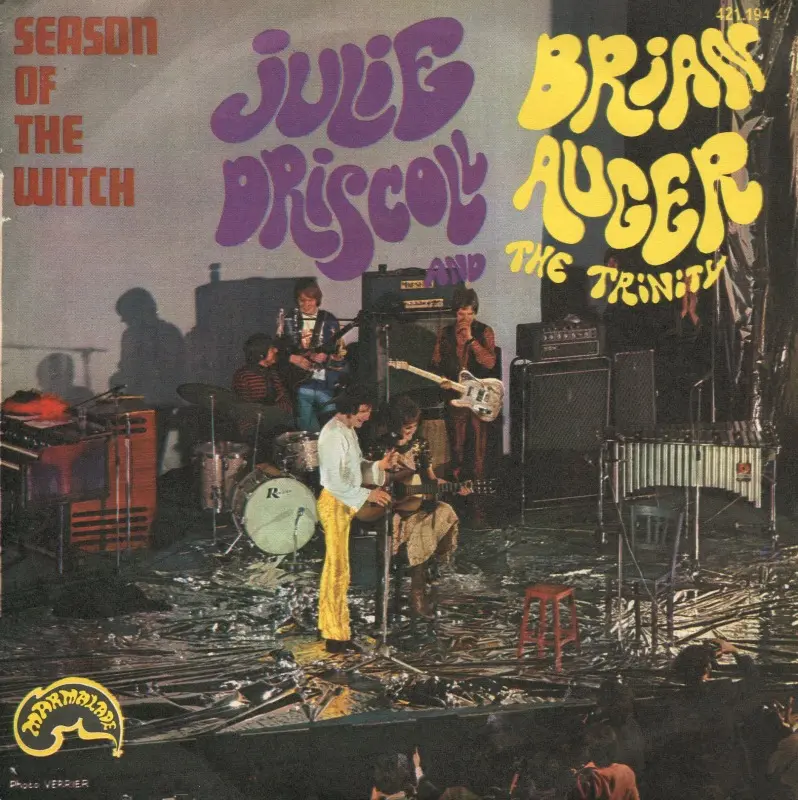 B4. “Break It Up” (2:52) is a mid-tempo 12-bar R&B tune (in D flat) with dive piano and rapid root-note bass against a shuffling backbeat and call-and-response vocals between Julie and the band.
B5. “Season of the Witch” (7:44) originated on Sunshine Superman, the 1966 third album by Scottish folkster Donovan; covered early by The Lamp of Childhood and The Pandamonium. Trinity render this as a slow, unfolding jam (in B flat) that grows from bare rhythmic foundations, overlaid with Julie’s emotive vocals as Auger selects on/off, gradual entry points.
Trinity’s “Season of the Witch” presaged a 1968/69 round of covers by Vanilla Fudge, Marble Phrogg, Terry Reid, Lou Rawls, Dianne Brooks, Pesky Gee, and Sam Gopal.
 Sessions occurred at Chappell Studios in London with producer Giorgio Gomelsky and engineer John Timperly. Gomelsky produced Open and its surrounding singles in sequence with We Are Ever So Clean, the debut album by Marmalade labelmates the Blossom Toes.
Marmalade copies appeared in a single sleeve with a magenta photo of Driscoll (front) and a spiral-blurred orange pic of Auger (back). Select pressings reverse these images.
 In French, Marmalade issued the album in an alternate monochrome sleeve that shows the couple looking down under bold pink letters. In Italy, Open appeared on Ricordi International in another alternate that shows Auger and Driscoll (full color) looking straight at the camera in hippie attire. This cover (similar to the Italian “Save Me” sleeve) features curled psychedelic letters.
Open peaked at No. 12 on the UK Albums Chart during a thirteen-week chart run. Boyle stepped aside for the next two albums. In France, Marmalade lifted “Tramp” as a late-1967 single (b/w “Break It Up”), followed in 1968 by “Season of the Witch,” spread across both sides.
“Black Cat” inspired covers by Spanish beatsters Los Dixies and American brass-rockers Rastus.
1968
“I Am a Lonesome Hobo”
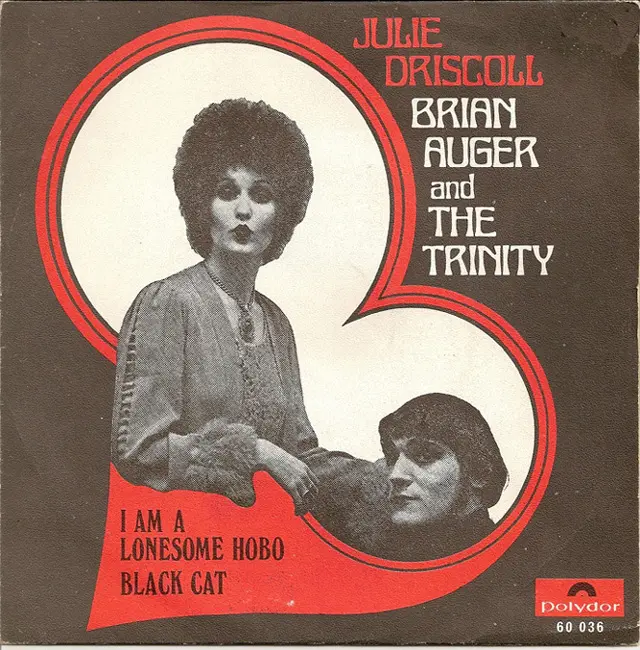 In early 1968, “A Kind of Love In” and “Black Cat (El Gato Negro)” appeared as respective b-sides on French (Marmalade) and Spanish (Polydor) copies of the exclusive a-side “I Am a Lonesome Hobo,” their first Bob Dylan cover. In Turkey, “Hobo” appeared as the b-side of “Save Me.”
A. “I Am a Lonesome Hobo” (4:05) originated on Dylan’s December 1967 release John Wesley Harding, his eighth studio album. Trinity render this as a mid-tempo shuffle tied to a single key (E flat) with high-end organ runs, which intercut Julie’s high-registered delivery.
Despite a 1971 acetate by Heron, “I Am a Lonesome Hobo” remained a less-covered Dylan song until a 1983 version by The Triffids.
“This Wheel’s On Fire”
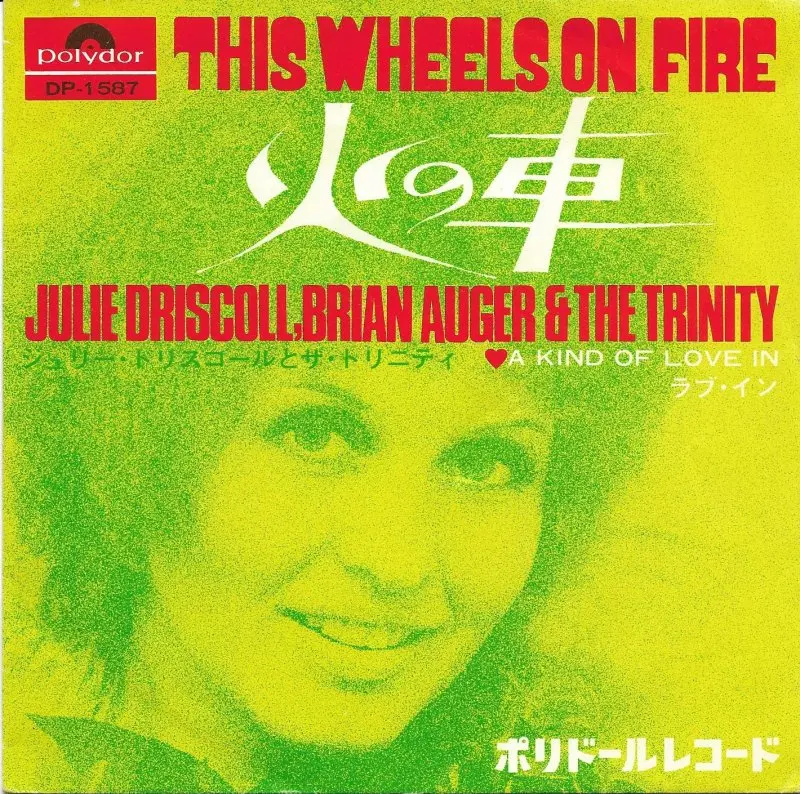 “This Wheel’s on Fire,” On April 5, 1968, Julie Driscoll, Brian Auger and Trinity released their second global standalone collaborative single: “This Wheel’s on Fire,” another Dylan cover backed with “A Kind of Love In.”
“This Wheel’s on Fire” originated as a June 1967 demo by Bob Dylan and The Band, recorded after the icon’s recovery from his 1966 motorcycle accident (referenced by the title). Driscoll and Trinity cut the first properly released version of the bootlegged song, which Dylan co-wrote with Band bassist Rick Danko. Trinity’s version appeared three month before The Band’s re-recording of “This Wheel’s on Fire” for their debut album, Music from Big Pink. (The Dylan/Band original remained unreleased until The Basement Tapes, a 1975 archival collection of their 1967 recordings.)
 A. “This Wheel’s On Fire” (3:12) Trinity render this as a misty ballad with airy vocals and medium strum (in A minor) that intensifies amid the phased swoop of the chorus. Julie portrays a woman on her way to meet someone again, believing it’s a fated reunion. She recalls a past where the other person called on her for a favor, which ultimately failed. She acknowledges the chaotic, potentially destructive journey about to unfold.
- If your memory serves you well,
I was goin’ to confiscate your lace,
and wrap it up in a sailor’s knot,
and hide it in your case
This line implies a playful, intimate act of taking something personal from the other person. The act of “confiscating” their lace—a delicate, private item—and hiding it suggests a deep familiarity and a slightly mischievous, yet loving, gesture. The “sailor’s knot” adds to this, hinting at something intricate, secure, and lasting, almost as if they were creating a memento of their bond.
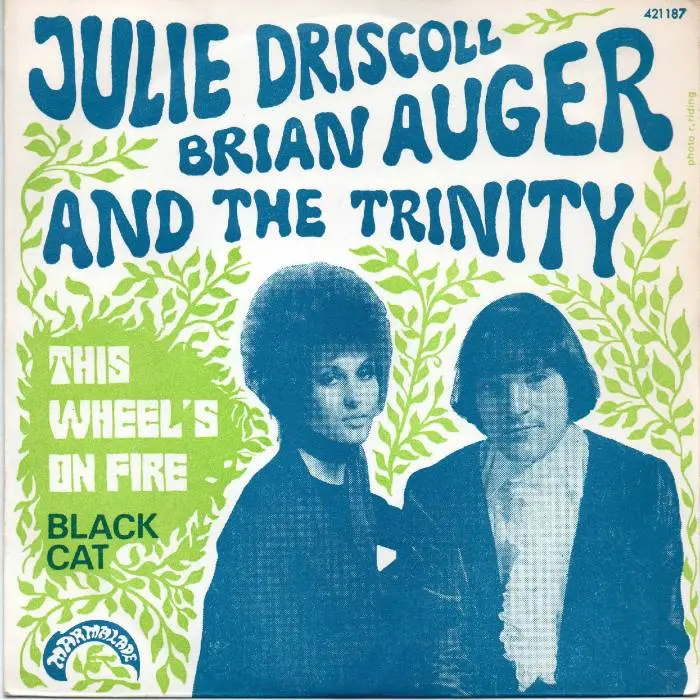 “This Wheel’s On Fire” reached No. 5 on the UK Singles Chart and No. 13 in Canada. This remained Trinity’s only UK-charting single.
Driscoll, Auger and Trinity mimed the song on Top of the Pops for the BBC music program’s May 28, 1968, broadcast. In Germany they performed the song for the April 6 broadcast of the Radio Bremen music program Beat-Club, which also featured the act on the June 22 broadcast amid numbers by The Association, Bee Gees, The Equals, The Herd, Manfred Mann, The Move, Procol Harum, and Small Faces.
In light of Trinity’s popularization of the song, covers of “This Wheel’s On Fire” followed by acts in the UK (The Hollies, Paul Jones) and Canada (Ian & Sylvia). In the US, where Trinity’s version peaked at No. 106, Dylan’s bootlegged version spawned covers by The Byrds and ex-Vagrants singer Leslie West, whose version appeared on his 1969 album Mountain, the prototype for his namesake band.
 In 1987, Siouxsie & The Banshees revived “This Wheel’s On Fire” as the lead single from their all-covers album Through the Looking Glass. The Banshees, unaware of the song’s Dylan origins, based their theatrical chamber-goth version on the psychedelic arrangement of the Driscoll/Trinity version. The Banshees version reached No. 14 on the UK Singles Chart and gave the song newfound stateside popularity via US college radio and MTV’s 120 Minutes program.
In 1992, Driscoll sung a rough acoustic/vocal version for the BBC sitcom Absolutely Fabulous, recorded with comedian Adrian Edmondson, the husband of the show’s co-star, Jennifer Saunders.
Montreax | “Road to Cairo”
 On Friday, June 14, 1968, Julie Driscoll, Brian Auger and Trinity performed at the second annual Montreux Jazz Festival, a four-day event at the Montreax Casino in Switzerland with sets by Jan Gabarek, Phillip Catherine, Nina Simone, Manfred Schoof, Bill Evans, Mike Westbrook, and Young-Holt Unlimited.
Trinity’s twelve-song Montreux set featured two Open numbers (“Season of the Witch,” “Goodbye Jungle Telegraph”), two perennial staples (“Save Me,” “Red Beans and Rice”), four future studio covers (“Take Me to the Water,” “If You Live,” “Bumpin’ On Sunset,” “A Day In the Life”), and otherwise unrecorded songs by Johnny Griffin (“Soft and Furry”), Richie Havens (“Inside of Him”), Rudy Stevenson (“I’m Going Back Home”), and the Auger exclusive “Along Came Zizi.”
 Trinity’s entire set appears on Live at Montreux 1968, a 2024 archival disc by Repertoire Records. They were the first rock act to perform at the Montreux Festival, which expand its subsequent program with purveyors of brassy jazz-rock (Colosseum) and improvisational blues-rock (Ten Years After).
On September 27, 1968, Trinity followed their recent hit with “Road to Cairo,” a David Ackles cover backed with “Shadows of You,” a the Driscoll–Auger original.
“Road to Cairo” first appeared on the 1968 Elektra release David Ackles, the American singer/songwriter’s debut album.
 A. “Road to Cairo” (5:22) Trinity render this as a slow, organ-laden blues, built on a chordal descent (from B minor) with brassy refrains and emotive vocals from Julie, who maintains the writer’s male perspective but mutes the last word in the sixth line: “I got to see my little bride.” She moans with soaring vowels as Trinity climax with uptempo jazzy runs.
The narrator’s plight is that of a traveling wanderer returning home after a long absence. Although he desperately wants to see his family—his “children” and “little b****”—he’s filled with fear and dread. He admits to having been a “bum” and never having a dime to his name. The shame and guilt of his failed life become too much to bear. In the end, he chooses not to go the last twenty-two miles to Cairo, believing his family is “better thinking I’m dead” than seeing him as a poor, disappointing figure. His journey home, which began with hope, ends in a devastating choice to stay away forever.
 B. “Shadows of You” (3:39) is a brisk, fluid soul-jazz number (in F) with unison vocals lines inter-cut with organ breaks, fueled by rapid-fire drum rolls. Auger cuts to a high-speed Hammond break against Ambrose and Thacker’s rhythmic bombardment. The lyrics allude to a romantic impasse.
On Tuesday, October 29, Julie Driscoll headlined the Marquee Club with support from Brian Auger’s Trinity (billed as two separate acts).
1969
Definitely What!…
 Brian Auger & the Trinity released their second album, Definitely What!…, in March 1969 on Marmalade. The album presents Trinity as a trio comprised of Auger, David Ambrose, and Clive Thacker.
Definitely What!… balances jazz-rock instrumentals with covers that frame Auger’s Hammond sound against Ambrose’s bass and Thacker’s drums. The group-credited title track stretches into improvisational interplay.
Auger wrote two numbers and recreated “John Brown’s Body” with arranger Richard Hill. Covers include works by The Beatles, Wes Montgomery (“Bumpin’ On Sunset”), Mose Allison (“If You Live”), and Booker T. & the MG’s.
A1. “Day In the Life” (5:04) is a Lennon–McCartney composition from the 1967 Beatles album Sgt. Pepper’s Lonely Hearts Club Band. Trinity released one of the earliest instrumental versions of this pioneering symphonic-rock numer.
A2. “George Bruno Money” (4:06)
A3. “Far Horizon” (5:10)
A4. “John Brown’s Body” (3:00) is an Auger-arranged traditional of unknown authorship, performed as early as 1901 by Welsh-American singer J. W. Myers. In 1950, American big-band cornetist Red Nichols adopted the tune as “Battle Hymn,” a Jump Records 78rpm with His Five Pennies.
B1. “Red Beans and Rice” (5:40)
B2. “Bumpin’ On Sunset” (4:55)
B3. “If You Live” (3:48) originated on Allison’s 1959 album Creek Bay; covered since by Lisa Kindred, The Peddlers, and Swedish beatsters The Shanes.
B4. “Definitely What!” (7:55)
Sessions occurred at Advision Studios with producer Giorgio Gomelsky and engineer Eddie Offord (misspelled Offard). Gomelsky produced Definitely What!… in sequence with the second Blossom Toes album and 1969 Marmalade titles by Gary Farr, Gordon Jackson, and John McLaughlin. Offord also earned early credits on titles by Andromeda, Amalgam, Cartoone, and Poet and the One Man Band.
Jim Earp painted the sleeve, which shows three heads peaking from a crate amid desolate fog. US copies have a blue-scale photo of the trio.
“What You Gonna Do?”
 Julie Driscoll, Brian Auger and Trinity embarked on a brief spring 1969 tour of the US West Coast, where they opened for Led Zeppelin on multi-nighters in San Francisco at the Fillmore West (April 24 and 27), the Winterland Ballroom (April 25–26), and in Pasedena at the Rose Palace (May 2–3).
On May 2, 1969, Brian Auger and the Trinity released the standalone single “What You Gonna Do?,” an Auger original backed with an edit of their pre-released Wes Montgomery cover “Bumpin’ On Sunset” (3:50).
 A. “What You Gonna Do?” (3:21) is a mid-tempo R&B organ number (D flat) with stern baritone vocals and revved-up refrains about a romantic standoff.
On Tuesday, July 9, Brian Auger and Trinity performed a headline set at London’s Marquee club, supported by Circus, a psychedelic one-off with singer/songwriter Phillip Goodhand-Tait and serial reedist Mel Collins. On August 24, Trinity played the Paradiso in Amsterdam as part of a multi-act event with Deep Purple, Bonzo Dog Band, Eire Apparent, Humble Pie, and Steamhammer.
Streetnoise
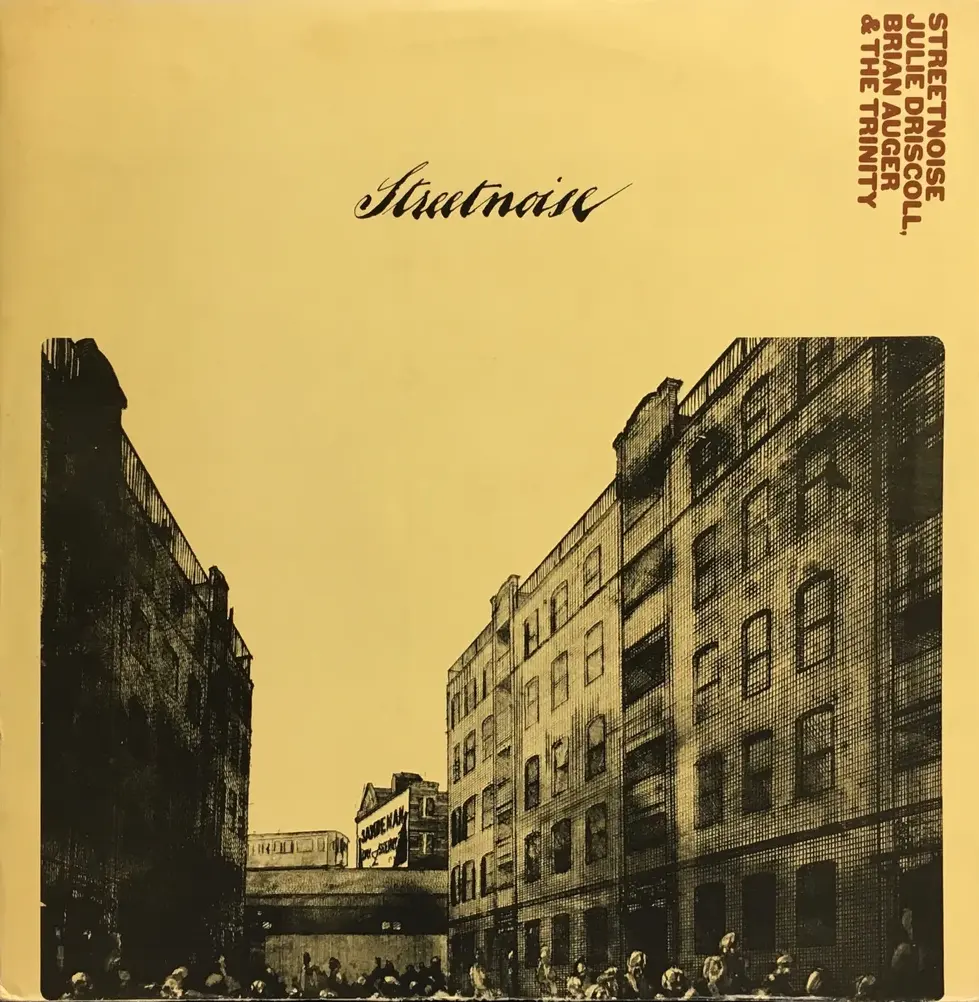 Brian Auger & the Trinity released their second album, the two-record Streetnoise, in July 1969 on Marmalade. This is the second Trinity album with featured singer Julie Driscoll affixed to the nameplate.
The two-record set divides into thematic sides: Auger’s originals, Driscoll’s arrangements, and their shared repertoire of covers. Numbers by Nina Simone, Richie Havens, Laura Nyro, The Doors, and Miles Davis frame the sequence. Driscoll’s voice carries both standards and new material, set against Auger’s Hammond and Ambrose’s elastic bass.
Auger wrote four songs (“Tropic of Capricorn,” Side C), Driscoll three (“Czechoslovakia,” “A Word About Colour,” “Vauxhall to Lambeth Bridge”), and Ambrose one (“In Search of the Sun”). The remaining selections cover Havens, Nyro, Davis, and Hair composers Galt MacDermot, James Rado, and Gerome Ragni.
How Good It Would Be To Feel Free….
A1. “Tropic of Capricorn” (5:30)
A2. “Czechoslovakia” (6:45) is a medium-uptempo organ vamp with a circular chord pattern (rooted in B flat) and lyrics concerning the recent Soviet invasion of Prague and the influx of Czech refugees in the UK. Julie soars during the naked acoustic mid-section that chronicles the event with stark imagery (“fighters in close formation, ready for the invasion”). After she sings “I remember going to a country where people warned… people were ready for changes…,” a sonic recreation of the invasion ensues with tank blasts fired through a rhythmic stampede.
A3. “Take Me to the Water” (4:00) is a song by Nina Simone from her 1967 album High Priestess of Soul. Trinity render this in gospel form with a slow, harmonized piano verse followed by a brisk, hopping Julie-led run with repetitions of “going back home.”
A4. “A Word About Colour” (1:35) is a classical guitar etude with faint right-channel vocals by Julie.
Kiss Him Quick, He Has To Part….  B1. “Light My Fire” (4:30) was the inaugural 1967 hit by The Doors; covered singe by Boz Burrell, Clarence Carter, Julie London, Nancy Sinatra, Spanky Wilson, and beat groups in Japan (The Mops) and Philippines (D’Swooners). Trinity’s rendition predated a flood of soul covers by Stevie Wonder, Erma Franklin, Four Tops, and Friends of Distinction.
B2. “Indian Rope Man” (3:00) is a song by Richie Havens from his 1968 double-album Richard P. Havens, 1983. The song underwent subsequent organ-psych interpretations by Frumpy, Noir, and McPhee.
B3. “When I Was A Young Girl Arranged” (8:00) is Driscoll-arranged traditional.
B4. “Flesh Failures (Let The Sunshine In)” (3:00) is an anthem from the counter-culture musical Hair, first performed in April 1968 by the Broadway cast that included Melba Moore. The Spencer Davis Group recorded the first rock version as “Let the Sunshine In.” In 1969, the 5th Dimension scored a global hit with the song in medley form with another hair number, “The Age of Aquarius.”
Looking In The Eye Of The World….  C1. “Ellis Island” (4:10)
C2. “In Search of the Sun” (4:25)
C3. “Finally Found You Out” (4:35)
C4. “Looking In the Eye of the World” (5:05)
Save The Country….
D1. “Vauxhall to Lambeth Bridge” (6:20)
D2. “All Blues” (5:40) is a Miles Davis composition from his landmark 1959 album Kind of Blue. Singer Oscar Brown added lyrics to his 1963 version, covered since by Annie Ross and Karin Krog.
D3. “I’ve Got Life” (4:30) is another Hair number, popularized by Nina Simone as a medley with another song from the musical, “Ain’t Got No.”
D4. “Save the Country” (4:00) originated as a 1968 single by Laura Nyro, who re-recorded it for her 1969 third album New York Tendaberry, released two months after Streetnoise, which also pre-dated versions by Thelma Houston and the 5th Dimension, whose 1970 cover peaked at No. 10 on the US Billboard adult contemporary chart. Nyro’s lyrics concern the 1968 assassination of Robert Kennedy.
 Sessions occurred at Advision Studios, London, with producer Giorgio Gomelsky and engineer Eddie Offord assisted by Phillip Dunn and Roger Wilkinson.
Streetnoise features cover art by Ralph Steadman, sleeve design by Paragon Publicity, and photography by Barry Wentzel. The credits present Trinity with nicknames: Brian ‘Auge’ Auger, Julie ‘Jools’ Driscoll, David ‘Lobs’ Ambrose, and Clive ‘Toli’ Thacker.
The album appeared in a beige vertical gatefold with a tenement illustration by Welsh artist Ralph Steadman, known for his later splash caricatures and collaborations with author Hunter S. Thompson.
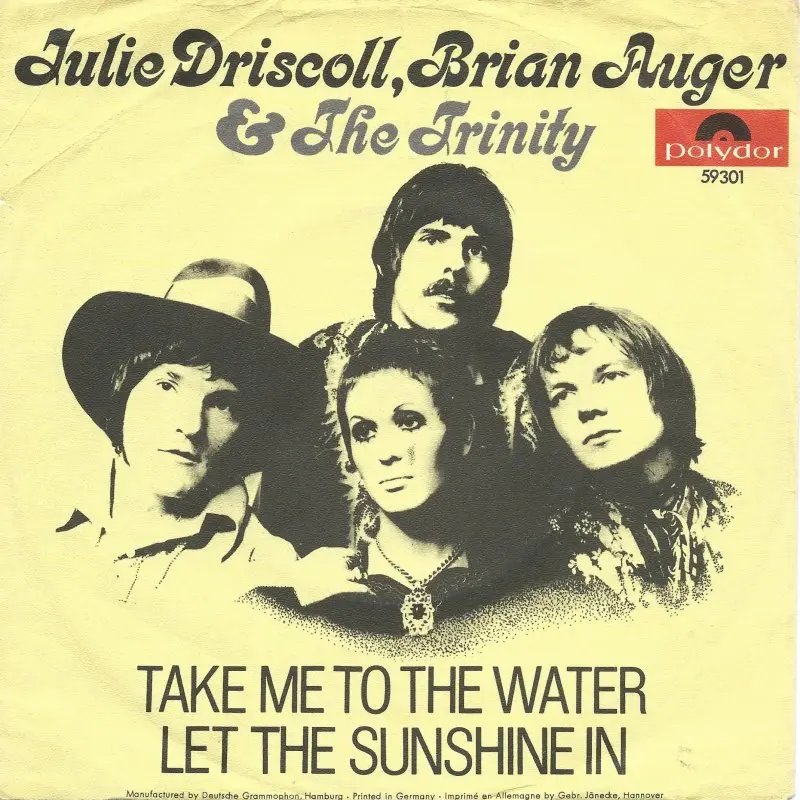
Marmalade lifted “Take Me To The Water” as a September 1969 single backed with “Indian Rope Man.” In France, the two Hair songs appeared together on 7″ with the a-side title reversed — “Let The Sunshine In (Flesh Failures)” — to emphasize the chorus line.
On Tuesday, October 14, Brian Auger and Trinity headlined the Marquee, supported by Mancunian brass-psychsters Samson.
Julie Driscoll parted ways with Trinity and took up with jazz pianist Keith Tippett. She partook in his 1971 experimental big-band project Centipede and cut an album with BB Blunder, a reconfigured Blossom Toes. Her debut solo album, 1969, appeared in 1971 on Polydor.
1970
Befour
 Brian Auger & the Trinity released their fourth album, Befour, in July 1970 on RCA Victor. The album welcomes back Gary Boyle to the lineup, a four-piece with David Ambrose and Clive Thacker.
The album balances soul covers with Auger’s Hammond-driven jazz-rock frameworks. Standards by Herbie Hancock (“Maiden Voyage”), Eddie Harris (“Listen Here”), Traffic (“No Time to Live”), and Sly Stone (“I Wanna Take You Higher”) sit beside a Faure adaptation and one Ambrose composition, the closing “As She Knows.”
A1. “I Wanna Take You Higher” (5:00) originated on Sly & The Family Stone‘s April 1969 album Stand! Ike & Turner Turner released their cover two months before Trinity, whose version preceded live renditions by the 5th Dimension, Jackson 5, and Kool & The Gang. A2. “Pavane” (3:43) is an adaptation of an 1887 classical piece by French modernist composer Gabriel Faure.
A3. “No Time to Live” (5:25) originated on the 1968 self-titled second album by Traffic; written by Jim Capaldi and Steve Winwood.
A4. “Maiden Voyage” (4:58) originated on Hancock’s 1965 namesake Blue Note album; covered since by Bobby Hutcherson, Karin Krog, and Ramsey Lewis.
B1. “Listen Here” (9:24) originated as a Harris instrumental from his 1966 album Mean Greens. Auger recorded this cover during an earlier session with Ferris Wheel drummer Barry Reeves, Dantalian’s Chariot drummer Colin Allen, Steampacket alumnus Mickey Waller, and earlier Trinity bassist Roger Sutton. B2. “Just You Just Me” (3:27) is the album’s only Auger original.
B3. “As She Knows” (6:26)
Auger self-produced Befour, which Eddie Offord engineered amid 1970 titles by Taste, Stone the Crows, Jackson Heights, and his two soon-to-be star clients, Yes and Emerson Lake & Palmer. Sessions occurred at Advision Studios.
RCA lifted “Listen Here” as a single with “I Wanna Take You Higher.”
Soon after Befour, Auger disbanded Trinity and assembled the first lineup of Oblivion Express. Gary Boyle resurfaced in Isotope.
Discography:
- Open (1967 • Julie Driscoll, Brian Auger & the Trinity)
- Definitely What!… (1968)
- Streetnoise (1969 • Julie Driscoll, Brian Auger & the Trinity)
- Befour (1970)
Sources:
- Discogs: Brian Auger & The Trinity
- RYM: Brian Auger & The Trinity
- 45worlds: Brian Auger & The Trinity
- 45cat: Brian Auger & The Trinity
- BrianAuger.com: Brian Auger Bio
- Nostalgia Central: Brian Auger & The Trinity
- SecondHandSongs; Brian Auger & Trinity
Artist/Album Pages:
Storyteller was an English folk-rock band that released the 1970–71 albums Storyteller and More Pa...
Snow was an American pop-psych band from Cleveland that released a 1968 self-titled album on Epic...
Airto Moreira (born Aug. 5, 1941) is a Brazilian vocalist and percussionist, married to vocalist F...
Mogul Thrash was an English brass-rock band from London that released a self-titled album on RCA V...
Les Champignons were a Québécois psych-rock band that released the 1972 album Première Capsule on ...
Belouis Some — aka Neville Keighley (b. December 12, 1959) — is an English singer and songwriter w...
The Beacon Street Union was an American psychedelic rock band that released the 1968 albums Eyes of ...
Blackfeather was an Australian post-psychedelic hard-rock band that released the 1971 Infinity alb...
Jenghiz Khan was a Belgian hard-rock/psych band that released the album Well Cut in 1970 on Barclay....
The Running Man was an English rock trio that released a 1972 album on RCA. Guitarist Ray Russell...
Ashton, Gardner & Dyke were an English organ-rock trio that released a 1969 self-titled album on...
Andwellas Dream was an Irish psychedelic pop trio that released the 1969 CBS album Love and Poetry...