

Arthur Brown (born June 24, 1942) is an English singer, performer, and bandleader from Whitby, Yorkshire, who shot to fame as the frontman of The Crazy World of Arthur Brown, which issued a self-titled album on Track Record in 1968. Between 1971 and 1973, he recorded three albums with space rockers Kingdom Come.
Brown debuted as a solo artist with the 1975 Gull release Dance, followed in 1977 by Chisholm in My Bosom. With producer Patrick Campbell-Lyons (Nirvana), he made the 1976 single “Ooh, It Takes Two to Tango” (b/w “Rocking the Boat”) as Arthur and Aliki. He also sings “Universal Zoo” on the 1977 sci-fi concept album Intergalactic Tour Band, recorded with an all-star musical cast assembled by Passport Records.
In 1980, he collaborated with former Crazy World bandmate Vincent Crane on the album Faster Than the Speed of Light. The pair also appeared on the album Time Actor by Richard Wahnfried (aka Klaus Schulze.) In 1982, Brown released back-to-back solo albums on Republic Records.
Dance
 Arthur Brown released his debut solo album, Dance, in 1975 on Gull. The album embraces a theatrical and eclectic mix of styles shaped by layered arrangements, spiritual themes, and an emphasis on ensemble interaction.
Brown co-wrote seven songs. Former Kingdom Come guitarist Andy Dalby plays throughout and co-wrote “Helen With the Sun” and “Quietly With Tact.” Lee Robinson serves as principal bassist while future Blockheads drummer Charlie Charles plays on all but “Soul Garden,” which features Charley Dunbar (ex-Hawkwind). Ken Elliott (Second Hand, Seventh Wave) plays clavinet and Moog on three tracks, while Pete Solley (Procol Harum, Paladin) contributes organ and Moog to three others.
Avant-jazz pianist Keith Tippett appears on “Helen With the Sun” and “Hearts and Minds.” George Khan plays saxophone on “Take a Chance,” “Crazy,” and “Soul Garden.” Stuart Gordon (The Korgis, Peter Hammill) adds violin to “Soul Garden,” which also features Skin Flesh & Bones as the credited rhythm section. Backing vocals include Thunderthighs (Mott the Hoople, Lou Reed) on two tracks, the Gospelayres on “The Lord Will Find a Way,” and others across the mid-album sequence.
A1. “We’ve Got to Get Out of This Place” (3:29)
A2. “Helen With the Sun” (7:33)
A3. “Take a Chance” (5:03)
A4. “Crazy” (2:16)
A5. “Hearts and Minds” (3:13)
B1. “Dance” (5:33)
B2. “Out of Time” (3:37)
B3. “Quietly With Tact” (4:29)
B4. “Soul Garden” (4:43)
B5. “The Lord Will Find a Way” (4:17)
B6. “Is There Nothing Beyond God” (2:26)
Sessions took place at Morgan Studios with Rodger Bain producing and Vic Smith engineering. Andy Dalby arranged all album tracks, with Don Gould handling string arrangements on “We’ve Got to Get Out of This Place” and “Out of Time.” Front and back cover photos come from Serge Krouglikoff and Mick Rock, respectively. John Pasche designed the sleeve.
“We’ve Got to Get Out of This Place” and “Out of Time” both appeared as singles.
Between albums, Brown sang “The Tell-Tale Heart” on Tales of Mystery and Imagination, the debut album by the Alan Parsons Project.
Chisholm in My Bosom
 Arthur Brown released his second solo album, Chisholm in My Bosom, in 1977 on Gull.
Brown sings lead vocals across the album and self-produces. Andy Dalby returns as a principal contributor, joined by guitarists Eugene Dilibero, John McBurnie, and Rick Kulack. Strawbs bassist Chas Cronk rotates with ex-TGSOE Norman Watt‑Roy, backed by fellow Blockhead Charlie Charles, who alternates the drum slot with future members of Wings (Steve Holley) and Manfred Mann’s Earth Band (John Lingwood).
Chisholm reunites Brown with Vincent Crane, who splits keyboard tracks with Mike Storey, Goodge Harris, and Robert Kirby. Brand X percussionist Morris Pert appears alongside Tony Uter and Robin James. Robert John “Mutt” Lange adds backing vocals.
A1. “Need to Know” (3:36)
A2. “Monkey Walk” (4:32)
A3. “Let a Little Sunshine (Into Your Life)” (3:30)
A4. “I Put a Spell on You” (4:11)
A5. “She’s On My Mind” (3:26)
A6. “The Lord Is My Saviour” (3:26)
B1. “Chisholm in My Bosom” (23:00)
Sessions took place at Morgan Studios in London, with engineering on “I Put a Spell on You” by George Nicholson. Peter Harenberg cut the lacquer. John Pasche designed the sleeve, and Mick Rock and Annette Green supplied the photography. Gull issued the album in Germany in a fully laminated sleeve with a polylined inner marked “250 / 8.77 O.”
Faster Than the Speed of Light
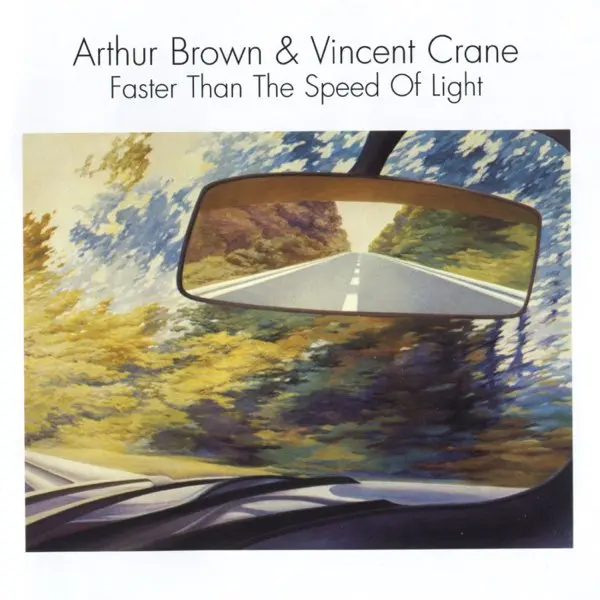 Arthur Brown and Vincent Crane released a collaborative album, Faster Than the Speed of Light, on December 28, 1979, produced by Klaus Schulze for his Innovative Communication label.
Faster combines dramatic vocal arrangements with symphonic elements, electronic textures, and piano-led structures. Crane’s arsenal includes Steinway, Hammond organ, clavinet, and Minimoog synthesizer. Percussionist Clifford Venner and vocal arranger Derek Damon also take part with the Frankfurt Symphony Orchestra.
A1. “Storm Clouds” (1:04)
A2. “Nothing We Can Do” (5:16)
A3. “No” (2:32)
A4. “Bright Getaway” (1:24)
A5. “Timeship” (6:15)
A6. “Come and Join the Fun” (5:43)
B1. “Stormwind” (0:32)
B2. “Storm” (5:39)
B3. “This Is It” (3:19)
B4. “Tightrope” (3:54)
B5. “Balance” (1:31)
B6. “Faster Than the Speed of Light” (8:01)
Sessions took place at Panne-Paulsen Studios in Frankfurt. Eberhard Panne served as recording and mixing engineer. Schulze oversaw the project as executive producer, sharing that role with Michael Haentjes.
Requiem
 Arthur Brown released his third solo album, Requiem, in 1982 on Remote (UK) and Republic (US).
The album explores dense, synthetic textures and post-industrial soundscapes shaped through electronic instrumentation and studio treatments. Brown recorded Requiem with keyboardist Sterling Smith and percussionist D. Aldridge. Smith plays synthesizer, Mellotron, and ring-modulated piano. Scott Morgan programed the Serge and Oberheim synthesizers, Fairlight CMI, and rhythm sequences on all tracks except “Gabriel.”
Sparks co-founder Earl Mankey co-produced and engineered Requiem, contributing signal-based effects such as snare-paint and electrochop. Additional vocalists include Count Peter Butcher, Ali, Earle, Salima, Scott, and Sterling, with chant vocals credited on “Busha Busha.” Will Alexander and Arthur Barrow supply supplemental Fairlight and Jupiter 8 programming.
A1. “Requiem” (6:12)
A2. “Mechanical Masseur” (3:45)
A3. “Busha-Busha” (3:53)
A4. “2024” (3:57)
B1. “Chant/Shades” (4:31)
B2. “Animal People” (5:59)
B3. “Spirits” (4:33)
B4. “Gabriel” (5:33)
Sessions took place at CTS Studios with mastering by Boppin’ Bob Jones, who also handled UK remastering. Darrel Johansen contributes Sym 1 pulse programming on “Spirits.” Will Alexander and Arthur Barrow supply auxiliary programming for the Fairlight CMI and Jupiter 8 systems. The album was produced by Brown and Mankey for FIG Productions. Packaging features a cover design by Barry Martin and Stefan Suchomski, based on a concept by Andy Merrim.
Requiem emerged from Brown’s early 1980s collaboration with Mankey and Morgan and expanded on the synth-based concepts first explored on the earlier Speaknotech project.
Speaknotech
 In 1982, Republic (US) issued Speaknotech as a second back-to-back Arthur Brown solo release. The album reappeared in 1984 as The Complete Tapes of Atoya on the Dutch Plexus label, co-credited to Brown and Craig Leon.
The album adopts a sparse, machine-driven format centered on programmed rhythms, synthetic backdrops, and Brown’s declamatory vocals. Leon arranged synthesizer and drum machine arrangements, and plays additional guitar on select numbers. Mankey plays guitar and bass drum on “King of England.” Scott Morgan plays all instruments and handles core programming. Ross McLeod adds keyboard moans on “Not Fade Away.”
A1. “King of England” (4:22)
A2. “Conversation” (4:30)
A3. “Strange Romance” (2:55)
A4. “Not Fade Away” (3:31)
A5. “The Morning Was Cold” (4:39)
B1. “Speaknotech” (5:16)
B2. “Names Are Names” (4:03)
B3. “Love Lady” (3:26)
B4. “Big Guns Don’t Die” (4:54)
B5. “Take a Picture” (2:43)
Sessions took place in 1981 at Riverside Studios and Lone Star Studios, with additional recording and remix work at Earles Studio. Scott Morgan and Craig Leon share recording credits on the original tracks. Mankey co-handled final recording and remix duties. The album was issued under license in both its original and expanded forms, with the later Plexus edition credited jointly to Arthur Brown and Craig Leon.
Speaknotech marked Brown’s first collaboration with Leon, pairing vocal abstraction with minimal synthesizer architecture and launching a transitional period of low-fidelity electronic experimentation in Brown’s post-Requiem trajectory.
Discography:
- Dance (1975)
- Chisholm in My Bosom (1977)
- Faster Than the Speed of Light (1980 • Arthur Brown & Vincent Crane)
- Requiem (1982)
- Speaknotech (1982)
- The Complete Tapes of Atoya (1984 • Arthur Brown and Craig Leon)
Sources:
Artist/Album Pages:
Missing Persons were an American new wave band, best known for the hits "Mental Hopscotch," "Desti...
Orchestral Manoeuvres in the Dark — also known by the acronym OMD — are an English electronic band t...
Fotomaker was an American hard-rock/pop band from NYC that made the 1978/79 Atlantic albums Fotom...
Aubrey Small was an English pop-rock band that released a self-titled album in 1971 on Polydor. ...
Ultravox was an English new wave band, first fronted by John Foxx on the 1977–78 Island releases Ult...
The Main Ingredient was an American soul-funk/psych group from Manhattan that first recorded as Th...
Juicy was an American synth-funk band from that released a 1982 self-titled album on Arista, follo...
Pablo Cruise was an American harmony-pop/rock band from San Francisco that released seven albums f...
Shot in the Dark was an English-American melodic-rock band that made a 1981 self-titled album on ...
Nancy Wilson (Feb. 20, 1937 — Dec. 13, 2018) was an American soul and jazz singer who released thi...
Bettye Lavette is an American soul singer who emerged with the 1962 Atlantic R&B hit “My Man —...
The Boomtown Rats are an Irish rock band that released six albums between 1977 and 1984 on Ensign an...