 Alice Cooper released their seventh album, Muscle of Love, on November 20, 1973, on Warner Bros.
Muscle of Love leans on rawer surfaces, with streetwise openers, piano-led detours, and several songs that hinge on Alice’s vocal theater more than dense arrangement. “Big Apple Dreamin’ (Hippo)” opens on a slow swagger and a lumbering low-end push, then adds a rising string line that thickens the city-tale pulse. “Never Been Sold Before” keeps the pressure on through a hard riff, brassy jabs, and a tighter vocal sneer. “Hard Hearted Alice” starts in a hushed acoustic-and-organ haze, then widens into a fuller chorus and a more forceful guitar exchange.
“Crazy Little Child” shifts to a piano-led sway with a noir gait and staged vocal phrasing, while “Working Up a Sweat” snaps back with slide-guitar grease and a rowdy barroom shove. The title track rides a brisk adolescent stomp, “The Man with the Golden Gun” threads spy-score brass and sharp guitar lines through a dramatic vocal arc, “Teenage Lament ’74” eases into an acoustic lope with stacked backing voices, and “Woman Machine” closes on a meaner charge with dark humor and a heavier riff.
A1. “Big Apple Dreamin’ (Hippo)” (5:10) — Cooper, Buxton, Bruce, Dunaway, Smith
A2. “Never Been Sold Before” (4:28) — Cooper, Buxton, Bruce, Dunaway, Smith
A3. “Hard Hearted Alice” (4:53) — Cooper, Bruce
A4. “Crazy Little Child” (5:03) — Cooper, Bruce
B1. “Working Up a Sweat” (3:32) — Cooper, Bruce
B2. “Muscle of Love” (3:45) — Cooper, Bruce
B3. “Man with the Golden Gun” (4:12) — Cooper, Buxton, Bruce, Dunaway, Smith
B4. “Teenage Lament ’74” (3:54) — Cooper, Smith
B5. “Woman Machine” (4:31) — Cooper, Buxton, Bruce, Dunaway, Smith
Alice Cooper recorded Muscle of Love at Sunset Sound in Hollywood, Record Plant in New York, and the Cooper Mansion in Greenwich, Connecticut, in 1973 with producers Jack Richardson and Jack Douglas.
Warner Bros. packaged the original LP in a shallow corrugated cardboard carton with a printed stain along the lower edge. The inner sleeve placed the band in sailor uniforms across paired before-and-after photo scenes, and the first pressing also included a fold-out paper book cover.
Warner Bros. issued “Teenage Lament ’74” (b/w “Working Up a Sweat”) as a 7-inch on November 28, 1973. The single reached No. 48 on the Billboard Hot 100 and No. 12 in the UK.
On January 25, 1974, “Muscle of Love” became the second 7-inch from the album with “Crazy Little Child” on the flip side. The single reached No. 107 on the Record World singles chart, and the album reached No. 10 on the Billboard 200.
Welcome to My Nightmare
 Alice Cooper released Welcome to My Nightmare on March 11, 1975, on Atlantic.
The album marks a Broadway turn with piano passages, horn charts, children’s voices, and hard-riff stretches give the record a stage-built shape, while short segues and spoken passages steer the sequence toward darker climaxes and quieter lulls. Guitarists Dick Wagner and Steve Hunter carve the sharpest lines, keyboardist Bob Ezrin and keyboardist Jozef Chirowski add piano, clavinet, synthesizer, and choral color, and bassist Prakash John with drummer Pentti Glan hold the songs to a firm backbeat.
Welcome to My Nightmare opens with a creeping pulse, a near-whisper, and a later brass surge that turns hush into spectacle. “Devil’s Food” sets a spoken menace that spills straight into “The Black Widow,” where a diseased stomp, grinding attack, and snarling vocal line lock the threat in place. “Some Folks” cuts sideways with finger-snap swing, piano bounce, and a sudden late shift in pace, while “Only Women Bleed” lowers the temperature through acoustic calm, careful phrasing, and a wounded refrain.
“Department of Youth” and “Cold Ethyl” bring back bright forward motion and sleazy bite, then “Years Ago,” “Steven,” and “The Awakening” sink into child-voice unease, chilling piano figures, and a dramatic rise that turns dread into full-stage panic. “Escape” breaks that spell with a faster release, but the album leaves its deepest mark in the uneasy stretch between gallows humor and nocturnal theater.
A1. “Welcome to My Nightmare” (5:19) — Cooper, Wagner
A2. “Devil’s Food” (3:38) — Cooper, Ezrin, Kelley Jay
A3. “The Black Widow” (3:37) — Cooper, Wagner, Ezrin
A4. “Some Folks” (4:19) — Cooper, Alan Gordon, Ezrin
A5. “Only Women Bleed” (5:49) — Cooper, Wagner
B1. “Department of Youth” (3:18) — Cooper, Wagner, Ezrin
B2. “Cold Ethyl” (2:51) — Cooper, Ezrin
B3. “Years Ago” (2:51) — Cooper, Wagner
B4. “Steven” (5:52) — Cooper, Ezrin
B5. “The Awakening” (2:25) — Cooper, Wagner, Ezrin
B6. “Escape” (3:20) — Cooper, Kim Fowley, Mark Anthony
Alice Cooper recorded Welcome to My Nightmare at Soundstage in Toronto and at Record Plant East, Electric Lady, and A&R in New York City with producer Bob Ezrin and engineers Dave Palmer, Jim Frank, Corky Stasiak, Ed Sprigg, Rod O’Brien, and Phil Ramone.
Drew Struzan created the cover art, and Atlantic housed the LP in a sleeve with a printed inner sheet that carried lyrics and credits.
Atlantic issued “Only Women Bleed” (b/w “Cold Ethyl” in the US; “Devil’s Food” in Europe) as a 7-inch in March 1975 in the US and in June 1975 in Europe. The single reached No. 12 on the Billboard Hot 100 chart.
Alice Cooper lifted “Department of Youth” (b/w “Cold Ethyl” in the UK; “Some Folks” in the US) as a 7-inch in February 1975 in the UK and in August 1975 in the US. The single reached No. 67 on the Billboard Hot 100 chart.
“Welcome to My Nightmare” appeared as a 7-inch in October 1975 with “Cold Ethyl” on the flip side. The single reached No. 45 on the Billboard Hot 100 chart, and the album reached No. 5 on the Billboard 200 chart.
Alice Cooper Goes to Hell
 Alice Cooper released Alice Cooper Goes to Hell on June 25, 1976, on Warner Bros.
Goes to Hell runs on abrupt costume changes: hard-edged openers, dance-floor detours, talk-sung character turns, and a closing stretch that swells from private confession to full-stage release. “Go to Hell” lands with thick guitar weight, booming drums, and a dramatic vocal charge, while “You Gotta Dance” flips the pulse into bright keyboard bounce and a steady floorbeat. “I’m the Coolest” shrinks into a bass-heavy strut and a spoken swagger, “Didn’t We Meet” starts with delicate verses before a larger chorus, and “Guilty” keeps the attack direct and slick.
“Wish You Were Here” adds a percussive opening, an off-center rhythmic shape, and a climactic rise, while “Wake Me Gently” and “I Never Cry” lower the temperature through piano-led phrasing and softer emotional weight. “Give the Kid a Break” stages its plea as dialogue, “I’m Always Chasing Rainbows” leans toward hymnlike piano drama, and “Going Home” lifts from understatement to an orchestrated sendoff.
Dick Wagner and fellow guitarists Steve Hunter and John Tropea divide the front line. Keyboardist Bob Ezrin supplies piano, Fender Rhodes, and synthesizer. Bassist Tony Levin with drummer Allan Schwartzberg hold the album to a firm backbeat. Most tracks carry Cooper-Wagner-Ezrin credits, with “I Never Cry” credited to Cooper and Wagner and “I’m Always Chasing Rainbows” to Carroll and McCarthy.
A1. “Go to Hell” (5:15) — Cooper, Wagner, Ezrin
A2. “You Gotta Dance” (2:45) — Cooper, Wagner, Ezrin
A3. “I’m the Coolest” (3:57) — Cooper, Wagner, Ezrin
A4. “Didn’t We Meet” (4:16) — Cooper, Wagner, Ezrin
A5. “I Never Cry” (3:44) — Cooper, Wagner
B1. “Give the Kid a Break” (4:14) — Cooper, Wagner, Ezrin
B2. “Guilty” (3:22) — Cooper, Wagner, Ezrin
B3. “Wake Me Gently” (5:03) — Cooper, Wagner, Ezrin
B4. “Wish You Were Here” (4:36) — Cooper, Wagner, Ezrin
B5. “I’m Always Chasing Rainbows” (2:08) — Carroll, McCarthy
B6. “Going Home” (3:47) — Cooper, Wagner, Ezrin
Alice Cooper recorded Alice Cooper Goes to Hell at Soundstage in Toronto, Record Plant East in New York, and RCA Recording Studios in Los Angeles with producer Bob Ezrin and recording engineers Brian Christian, Corky Stasiak, Jim Frank, John Jansen, and Ringo Hrycyna.
Brian Hagiwara and Rod Dyer handled the sleeve design, and Bret Lopez shot the cover photography.
Warner Bros. issued “I Never Cry” (b/w “Go to Hell”) as a 7-inch on June 7, 1976. The single reached No. 12 on the Billboard Hot 100, and the album reached No. 27 on the Billboard 200.
Lace and Whiskey
 Alice Cooper released Lace and Whiskey on April 29, 1977, on Warner Bros.
Lace and Whiskey runs on quick costume changes, with a front half that hits in tight bursts and a back half that leans harder on stagecraft, repetition, and swell. “It’s Hot Tonight” opens on a dirty, restless push, “Lace and Whiskey” keeps the pressure tense through clipped accents and a slightly prowling vocal line, and “Road Rats” kicks harder with descending motion and a faster, rowdier pulse.
“Damned If You Do” shifts to a bouncing barroom gait. “You and Me” lowers the temperature through piano-led restraint and a broad refrain. “King of the Silver Screen” expands into trashy grandeur, then turns toward a more theatrical second section. “(No More) Love at Your Convenience” locks into dark repetition and a hard floorbeat. “I Never Wrote Those Songs” answers with heavier orchestral weight and a more wounded vocal center. “My God” closes with organ mass, desperate phrasing, and a broad final rise.
Guitarists Dick Wagner and Steve Hunter cut the front line with hard chords and short lead breaks, while keyboardist Bob Ezrin and keyboardist Jozef Chirowski add piano and synthesizer color over bassist Bob Babbitt and drummer Allan Schwartzberg’s backbeat.
A1. “It’s Hot Tonight” (3:21) — Cooper, Wagner, Ezrin
A2. “Lace and Whiskey” (3:14) — Cooper, Wagner, Ezrin
A3. “Road Rats” (4:51) — Cooper, Wagner, Ezrin
A4. “Damned If You Do” (3:14) — Cooper, Wagner, Ezrin
A5. “You and Me” (5:07) — Cooper, Wagner
B1. “King of the Silver Screen” (5:35) — Cooper, Wagner, Ezrin
B2. “Ubangi Stomp” (2:12) — Charles Underwood
B3. “(No More) Love at Your Convenience” (3:49) — Cooper, Wagner, Ezrin
B4. “I Never Wrote Those Songs” (4:34) — Cooper, Wagner, Ezrin
B5. “My God” (5:40) — Cooper, Wagner, Ezrin
Alice Cooper recorded Lace and Whiskey at Soundstage in Toronto, Cherokee Studios in Hollywood, Record Plant in New York, RCA in Los Angeles, and Producer’s Workshop in Los Angeles with producer Bob Ezrin.
The back cover pictured Cooper as his Maurice Escargot character.
Warner Bros. issued “You and Me” (b/w “It’s Hot Tonight”) as a 7-inch in April 1977. The single reached No. 9 on the Billboard Hot 100.
“(No More) Love at Your Convenience” appeared as a 7-inch in May 1977 in the UK with “It’s Hot Tonight” on the flip side. The single reached No. 44 on the UK chart, and the album reached No. 42 on the Billboard 200.
From the Inside
 Alice Cooper released From the Inside on November 17, 1978, on Warner Bros.
From the Inside stresses piano-led motion and sharply framed vocal scenes, with the title track setting an anxious pulse and clipped phrasing that turns identity panic into dance-floor tension. “Nurse Rozetta” follows with brisk attack, lewd theatricality, and a harder push. “The Quiet Room” drops into delicate verse lines, then swells into heavier chorus pressure and a confession that tightens the album’s central dread.
“Millie and Billie” softens the pace through duet phrasing and a sweet surface that hides a gruesome story. “Serious” and “For Veronica’s Sake” restore sharper momentum through quick attack, firmer motion, and a more direct vocal bite. “How You Gonna See Me Now” widens the emotional scale through careful phrasing and a rising climax, while “Inmates (We’re All Crazy)” closes with massed voices, orchestral weight, and a communal chant.
Guitarist Dick Wagner and guitarist Davey Johnstone cut the front line, keyboardist David Foster fills the arrangements with piano and synthesizer, and bassist Lee Sklar with drummer Dennis Conway anchor much of the album’s backbeat. Alice Cooper and Bernie Taupin wrote the lyrics, and Cooper with Wagner wrote the music apart from the Foster, Lukather, and Bruce Roberts exceptions in the track list.
A1. “From the Inside” (3:55) — Cooper, Taupin, Wagner, Foster
A2. “Wish I Were Born in Beverly Hills” (3:38) — Cooper, Taupin, Wagner
A3. “The Quiet Room” (3:52) — Cooper, Taupin, Wagner
A4. “Nurse Rozetta” (4:15) — Cooper, Taupin, Lukather, Foster
A5. “Millie and Billie” (4:15) — Cooper, Taupin, Bruce Roberts
B1. “Serious” (2:44) — Cooper, Taupin, Foster, Lukather
B2. “How You Gonna See Me Now” (3:57) — Cooper, Taupin, Wagner
B3. “For Veronica’s Sake” (3:37) — Cooper, Taupin, Wagner
B4. “Jackknife Johnny” (3:45) — Cooper, Taupin, Wagner
B5. “Inmates (We’re All Crazy)” (5:03) — Cooper, Taupin, Wagner
Alice Cooper recorded From the Inside at Sound City in Van Nuys, Davlen in North Hollywood, Cherokee in Hollywood, Hollywood Sound Recorders, Kendun, and Studio 55 in Los Angeles with producer David Foster and engineers Humberto Gatica, Keith Olsen, David De Vore, Tom Knox, and Howard Steele.
Warner Bros. housed the LP in a center-parting gatefold with Cooper’s face on the front and a triple-panel asylum scene inside. A flap marked “the quiet room” opened to a padded-cell image, the rear doors opened to a corridor full of inmates, and the inner sleeve carried lyrics with the hidden images.
Warner Bros. issued “How You Gonna See Me Now” (b/w “No Tricks”) as a 7-inch on October 9, 1978. The single reached No. 12 on the Billboard Hot 100, and the album reached No. 60 on the Billboard 200.
In January 1979, “From the Inside” became the second single with “Nurse Rozetta” on the flip side.
Flush the Fashion
 Alice Cooper released Flush the Fashion on April 28, 1980, on Warner Bros.
Flush the Fashion strips the songs to quick, nervous shapes, with clipped riffs, brittle synthesizer lines, and a vocal stance that flips from sneer to satire to unease. “Talk Talk” and “Nuclear Infected” hit with cheap, dirty acceleration and a raw, choppy attack. “Clones (We’re All)” locks its tension into a snaking keyboard figure and a cool, detached refrain. “Pain” slows the pace into mellow verse passages that rise toward anguished chorus surges and a sharper guitar accent.
“Model Citizen” turns sarcasm into a stiff strut with facetious backing voices, while “Dance Yourself to Death” pushes a faster pulse and “Headlines” keeps the pressure on with another terse attack. “Aspirin Damage” sounds more paranoid than playful, and “Leather Boots” breaks the sequence with an abrupt, jaunty turn.
Davey Johnstone and keyboardist-guitarist Fred Mandel cut the arrangements with tight chords, bright synthesizer stabs, and fast breaks, while bassist John Cooker Lopresti and drummer Dennis Conway pin the record to a taut backbeat.
A1. “Talk Talk” (2:09) — Sean Bonniwell
A2. “Clones (We’re All)” (3:03) — David Carron
A3. “Pain” (4:06) — Cooper, Johnstone, Mandel
A4. “Leather Boots” (1:36) — Geoff Westen
A5. “Aspirin Damage” (2:57) — Cooper, Johnstone, Mandel
B1. “Nuclear Infected” (2:14) — Cooper, Johnstone, Mandel
B2. “Grim Facts” (3:24) — Cooper, Johnstone, Mandel
B3. “Model Citizen” (2:39) — Cooper, Johnstone, Mandel
B4. “Dance Yourself to Death” (3:08) — Cooper, Frank Crandall
B5. “Headlines” (3:18) — Cooper, Johnstone, Mandel
Alice Cooper recorded Flush the Fashion at Cherokee Recording Studios in Los Angeles with producer Roy Thomas Baker and engineer Ian Taylor.
Warner Bros. packaged the LP with design by Eddy Herch, front-cover photography by Fred Valentine, back-cover and sleeve photography by Jonathan Exley, and art direction by Cooper with Peter Whorf.
Warner Bros. issued “Clones (We’re All)” (b/w “Model Citizen”) as a 7-inch in April 1980. The single reached No. 40 on the Billboard Hot 100.
“Talk Talk” appeared as a 7-inch in September 1980. The album reached No. 44 on the Billboard 200.
Special Forces
 Alice Cooper released Special Forces on September 1, 1981, on Warner Bros.
Special Forces runs on clipped attack, dry surfaces, and a tense mix of martial pulse, cheap-sounding electronics, and half-spoken theater. “Who Do You Think We Are” opens with a hard shove and a lean, street-level charge. “Seven and Seven Is” keeps the pressure high through a propulsive beat, shouted nonsense syllables, and a keyboard figure that doubles as percussion. “Don’t Talk Old to Me” starts with rough attack, then cuts to a quieter passage whose hush still holds menace.
“Skeletons in the Closet” coils around creepy keyboard lines, a crawling bass pattern, and a slithering vocal shape. “You Want It, You Got It” turns playful threat into terse forward motion, while “You Look Good in Rags” adds heavier guitar weight and breaks for an exaggerated a cappella bridge before the closing rifle-click pattern. “You’re a Movie” leans on tossed-off spoken asides and cartoon swagger, then “Vicious Rumours” shuts the album with a meaner charge and a faster pulse.
Danny Johnson and Mike Pinera carve the front line with lean riffs and quick accents, while keyboardist Duane Hitchings threads terse organ and synthesizer phrases over bassist Erik Scott and drummer Craig Krampf’s backbeat.
A1. “Who Do You Think We Are” (4:21) — Cooper, Hitchings
A2. “Seven and Seven Is” (2:41) — Arthur Lee
A3. “Prettiest Cop on the Block” (3:13) — Cooper, Johnstone, Mandel
A4. “Don’t Talk Old to Me” (2:54) — Cooper, Johnstone, Mandel
A5. “Generation Landslide ’81 (Live)” (3:50) — Cooper, Buxton, Bruce, Dunaway, Smith
B1. “Skeletons in the Closet” (3:42) — Cooper, Hitchings
B2. “You Want It, You Got It” (3:15) — Cooper, Scott, Krampf, Billy Steele, Eric Kaz
B3. “You Look Good in Rags” (3:35) — Cooper, Hitchings
B4. “You’re a Movie” (3:37) — Cooper, Hitchings
B5. “Vicious Rumours” (3:43) — Cooper, Hitchings, Scott, Pinera
Alice Cooper recorded Special Forces at American Recording Co. in Studio City with producer Richard Podolor and engineer Bill Cooper.
Warner Bros. housed the LP in a sleeve with a die-cut notch at the top. The package still listed “Look at You Over There, Ripping the Sawdust from My Teddybear,” though Cooper pulled that track before release, and the art direction credited Cooper with Richard Seireeni while Eric Blum shot the photography.
Warner Bros. issued “You Want It, You Got It” as a 7-inch in July 1981. “Who Do You Think We Are” also appeared as a single during the album campaign.
On October 1981, “Seven and Seven Is” became the third single from the album. The album reached No. 125 on the Billboard 200.
Zipper Catches Skin
 Alice Cooper released Zipper Catches Skin on August 25, 1982, on Warner Bros.
Zipper runs on manic velocity, sharp guitar attack, and a jerky stop-start pulse that keeps the songs in constant motion. “Zorro’s Ascent” opens with a gallop and later breaks for lively solo lines. “Make That Money (Scrooge’s Song)” pushes a pounding riff and heavier weight. “I Am the Future” threads foreboding synthesizer tones through a rising chorus and a more cinematic sweep. “No Baloney Homosapiens” shifts between quieter guitar passages, a faster verse, and a booming refrain.
“Adaptable (Anything for You)” prances on buoyant guitar figures, while “Tag, You’re It” tightens the pressure through a tense chug and horror-show dialogue. “I Better Be Good” snaps forward in stop-start bursts, and “I’m Alive (That Was the Day My Dead Pet Returned to Save My Life)” closes with comic menace and absurdist theater.
Dick Wagner, guitarist John Nitzinger, guitarist Mike Pinera, guitarist Billy Steele, and keyboardist Duane Hitchings cut the songs into sharp accents and quick breaks, while bassist Erik Scott with drummer-percussionist Jan Uvena pin the sequence to a taut backbeat.
A1. “Zorro’s Ascent” (3:56) — Cooper, Nitzinger, Steele, Scott
A2. “Make That Money (Scrooge’s Song)” (3:30) — Cooper, Wagner
A3. “I Am the Future” (3:29) — Gary Osborne, Lalo Schifrin
A4. “No Baloney Homosapiens (For Steve & E.T.)” (5:06) — Cooper, Wagner
B1. “Adaptable (Anything for You)” (2:56) — Cooper, Steele, Scott
B2. “I Like Girls” (2:25) — Cooper, Nitzinger, Scott
B3. “Remarkably Insincere” (2:07) — Cooper, Nitzinger, Scott
B4. “Tag, You’re It” (2:54) — Cooper, Nitzinger, Scott
B5. “I Better Be Good” (2:48) — Cooper, Wagner, Scott
B6. “I’m Alive (That Was the Day My Dead Pet Returned to Save My Life)” (3:13) — Cooper, Wagner, Scott
Alice Cooper recorded most of Zipper Catches Skin at Cherokee Recording Studios in Los Angeles and cut “I Am the Future” at Jennifudy Studios in Los Angeles with co-producer Erik Scott. Steve Tyrell produced “I Am the Future,” which plays in the closing credits of the 1982 teen dystopian film Class of 1984.
Warner Bros. issued “I Like Girls” (b/w “Zorro’s Ascent”) as a 7-inch in 1982.
“I Am the Future” appeared as a 7-inch in October 1982 in Europe and in November 1982 in the US. The US single paired the song with “Tag, You’re It,” while UK and European copies used “Zorro’s Ascent” on the flip side.
DaDa
 Alice Cooper released DaDa on September 28, 1983, on Warner Bros.
DaDa sinks into a claustrophobic mood built from cavernous booms, eerie keyboard textures, and vocal scenes that feel half overheard, half confessed. The title track opens like a disturbed prelude, with childlike voices, dripping water, and dislocated dialogue over a vast, ominous backdrop. “Enough’s Enough” lurches forward on a funhouse pulse and a brighter surface that cannot hide the tension underneath. “Former Lee Warmer” slows the pace into a softer, more theatrical lament with a tender vocal center and a queasy domestic undertow.
“Dyslexia” jolts the sequence with a twitchy rhythm and busy keyboard patterns, then “Scarlet and Sheba” expands the scale through an atmospheric opening, modal accents, slammed verse attack, and a broader refrain. “I Love America” turns blunt chant and massed responses into mocking pageantry, “Fresh Blood” drifts through synthetic brass, elastic low-end motion, and nocturnal dread, and “Pass the Gun Around” closes with a slow, mournful rise, flute-like synthesizer lines, and a final burst of fatal theater.
Wagner and keyboardist Graham Shaw shape much of that surface with hard accents, synthesizer layers, and abrupt tonal shifts, while Bob Ezrin threads Fairlight programming, keyboards, drums, and percussion through the sequence and Prakash John adds bass weight to “Fresh Blood.”
A1. “DaDa” (4:45) — Ezrin
A2. “Enough’s Enough” (4:19) — Cooper, Wagner, Shaw, Ezrin
A3. “Former Lee Warmer” (4:07) — Cooper, Wagner, Ezrin
A4. “No Man’s Land” (3:51) — Cooper, Wagner, Ezrin
A5. “Dyslexia” (4:25) — Cooper, Wagner, Shaw, Ezrin
B1. “Scarlet and Sheba” (5:18) — Cooper, Wagner, Ezrin
B2. “I Love America” (3:50) — Cooper, Wagner, Shaw, Ezrin
B3. “Fresh Blood” (5:54) — Cooper, Wagner, Ezrin
B4. “Pass the Gun Around” (5:46) — Cooper, Wagner
Alice Cooper recorded DaDa at ESP Studios in Buttonville, Ontario, with producer Bob Ezrin and associate producers Dick Wagner and Robert “Ringo” Hrycyna.
The cover drew from Salvador Dalí’s Slave Market with the Disappearing Bust of Voltaire, and the back sleeve paired a childhood photo of Cooper with a separate image of an old man.
On November 18, 1983, “I Love America” became the album’s UK 7-inch single. The album reached No. 93 on the UK chart.
Constrictor
 Alice Cooper released Constrictor on September 22, 1986, on MCA.
Constrictor runs on brisk attack, hard-edged guitar lines, cold drum impact, and camp that keeps the menace close to a grin. “Teenage Frankenstein” opens with a heavy charge and stage-monster strut. “Simple Disobedience” adds tapping figures and percussion-first pressure, while “The World Needs Guts” drives the fastest pace through a forceful riff and a shouted call to arms.
“Life and Death of the Party” darkens the center with a more haunted vocal shape and heavier emotional pull. “Trick Bag” turns slick and synthetic. “He’s Back (The Man Behind the Mask)” closes with glossy keyboard motion, a stalking refrain, and straight-to-screen slasher atmosphere.
Guitarist Kane Roberts cuts most of the front line with sharp accents and dense overdubs, keyboardist Paul Delph adds the main keyboard color, and bassist Kip Winger with drummer David Rosenberg pin the sequence to a taut backbeat. Cooper and Roberts wrote most of the album.
A1. “Teenage Frankenstein” (3:40)
A2. “Give It Up” (4:13)
A3. “Thrill My Gorilla” (2:56)
A4. “Life and Death of the Party” (3:45)
A5. “Simple Disobedience” (3:30)
B1. “The World Needs Guts” (3:59)
B2. “Trick Bag” (4:18) — Cooper, Roberts, Kelly
B3. “Crawlin’” (3:22) — Cooper, Roberts, Wagener
B4. “The Great American Success Story” (3:38) — Cooper, Roberts, Hill
B5. “He’s Back (The Man Behind the Mask)” (3:49) — Cooper, Roberts, Kelly
Alice Cooper recorded Constrictor in 1985 and 1986 with producer Beau Hill, co-producer-mixer Michael Wagener, and engineer Stephen Benben.
MCA issued “He’s Back (The Man Behind the Mask)” (b/w live “Billion Dollar Babies”) as a 7-inch on August 29, 1986. The single reached No. 61 on the UK chart.
“Teenage Frankenstein” appeared as a 7-inch in March 1987 with live “School’s Out” on the flip side. The single reached No. 80 on the UK chart, and the album reached No. 59 on the Billboard 200 and No. 41 on the UK chart.
Raise Your Fist and Yell
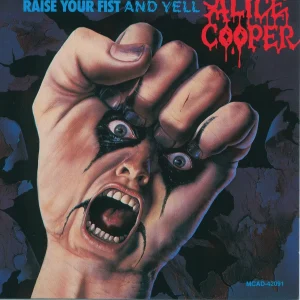 Alice Cooper released Raise Your Fist and Yell on September 5, 1987, on MCA.
Raise Your Fist and Yell hits with a harder, angrier surface, where booming drums, dense guitar weight, and reverb-heavy air turn even the mid-paced tracks into blunt-force theater. “Freedom” opens with an impactful beat and a scorched guitar charge that matches Alice’s barked defiance. “Lock Me Up” follows with a thunderous drum run, spoken intrusions, and a tighter attack. “Give the Radio Back” keeps the pressure high through searing forward motion, while “Step on You” turns meaner through a menacing stomp and a chaotic instrumental break.
“Not That Kind of Love” pushes a sleazier strut with a hard-edged surface, and “Prince of Darkness” darkens the center through somber warning and flaring lead lines. The closing run shifts into serial-killer theater: “Time to Kill” leans into cartoon evil, “Gail” drops to a creepy keyboard vignette with little warmth, and “Roses on White Lace” ends the album in a larger rush of fast six-string motion, violent momentum, and full-tilt psycho drama.
Kane Roberts drives much of that attack with dense rhythm figures and sharp lead accents, while bassist Kip Winger and drummer Ken K. Mary pin the sequence to a taut backbeat.
A1. “Freedom” (4:09) — Cooper, Roberts
A2. “Lock Me Up” (3:24) — Cooper, Roberts
A3. “Give the Radio Back” (3:34) — Cooper, Roberts
A4. “Step on You” (3:39) — Cooper, Roberts
A5. “Not That Kind of Love” (3:15) — Cooper, Roberts
B1. “Prince of Darkness” (5:10) — Cooper, Roberts
B2. “Time to Kill” (3:39) — Cooper, Roberts
B3. “Chop, Chop, Chop” (3:06) — Cooper, Roberts
B4. “Gail” (2:30) — Cooper, Roberts, Winger
B5. “Roses on White Lace” (4:27) — Cooper, Roberts
Alice Cooper recorded Raise Your Fist and Yell at Amigo Studios in North Hollywood in 1987 with producer Michael Wagener. Jim Warren painted the cover.
MCA issued “Freedom” (b/w “Time to Kill”) as a 7-inch in November 1987 in the US and in March 1988 in the UK. The single reached No. 50 on the UK chart, and the album reached No. 73 on the Billboard 200 and No. 48 on the UK album chart.
Trash
 Alice Cooper released Trash on July 25, 1989, on Epic.
“Poison” opens with foreboding synthesizer tones, a prowling riff, and a heavy drum lurch that pushes the chorus into massed voices. “Spark in the Dark” keeps the pulse brisk and the guitar attack taut. “House of Fire” rides power-chord shove and a broad refrain. “Why Trust You” cuts deeper through anger, firmer motion, and a more abrasive vocal bite.
“Only My Heart Talkin’” slows the pace with low-set acoustic picking, a wider chorus rise, and a late vocal exchange that sharpens the climax. “Bed of Nails” hits with darker drive, explosive drums, and a nastier central riff. “Trash” leans on a sleazier strut and an insistent guitar figure. “Hell Is Living Without You” rises from a tense keyboard verse to a dramatic chorus sweep, then “I’m Your Gun” shuts the album with its fastest charge and hardest snare crack.
Guitarist John McCurry cuts much of the front line, keyboardist Alan St. John adds the main keyboard layer, and bassist Hugh McDonald with drummer Bobby Chouinard lock the songs to a taut backbeat.
A1. “Poison” (4:29) — Cooper, Child, McCurry
A2. “Spark in the Dark” (3:52) — Cooper, Child
A3. “House of Fire” (3:47) — Cooper, Child, Jett
A4. “Why Trust You” (3:12) — Cooper, Child
A5. “Only My Heart Talkin’” (4:47) — Cooper, Roberts, Goldmark
B1. “Bed of Nails” (4:20) — Cooper, Child, Roberts, Warren
B2. “This Maniac’s in Love with You” (3:48) — Cooper, Child, Held, Teeley
B3. “Trash” (4:01) — Cooper, Child, Frazier, Sever
B4. “Hell Is Living Without You” (4:11) — Cooper, Child, Bon Jovi, Sambora
B5. “I’m Your Gun” (3:47) — Cooper, Child, McCurry
Alice Cooper recorded Trash in May and June 1989 at Bearsville, Power Station, Right Track, Sigma Sound, Mediasound, Grog Kill, Village Recorder, the Complex, Record Plant, Blue Jay, and Sanctuary Sound with producer Desmond Child, recording engineers Sir Arthur Payson, Obie O’Brien, Nick DiDia, George Cowan, Mark Tanzer, Lolly Grodner, Ben Fowler, John Herman, and Brian Peterofsky, mixers Steve Thompson and Michael Barbiero, and mastering engineer George Marino.
Epic issued “Poison” (b/w “Trash”) as a 7-inch on July 17, 1989. The single reached No. 7 on the Billboard Hot 100 and No. 2 on the UK chart.
“Bed of Nails” appeared as the second single on September 25, 1989. The single reached No. 38 on the UK chart and No. 13 in Australia.
In November 1989, “House of Fire” became the third single from the album with live “Poison” on the flip side. The single reached No. 56 on the Billboard Hot 100 and No. 65 on the UK chart.
On April 1990, “Only My Heart Talkin’” became the fourth single with live “Only Women Bleed” on the flip side. The single reached No. 89 on the Billboard Hot 100, and the album reached No. 20 on the Billboard 200 and No. 2 on the UK album chart.


 Alice Cooper released their debut album, Pretties for You, on June 25, 1969, on Straight.
 Alice Cooper released their second album, Easy Action, on March 27, 1970, on Straight.
 Alice Cooper released their third album, Love It to Death, on March 9, 1971, on Straight and Warner Bros.


