

ABC are an English new wave and soul-pop band that co-headed the Second British Invasion with their 1982 album The Lexicon of Love and the singles “Poison Arrow” and “The Look of Love,” both staples of MTV’s golden age.
In 1983, ABC took an edgier turn with Beauty Stab and the songs “That Was Then But This Is Now” and “Unzip.” Their third album, How to Be a … Zillionaire!, charted with the late-1985 hits “Be Near Me” and “(How to Be A) Millionaire.” They scored a final hit with the Motown-tinged “When Smokey Sings” from their 1987 album Alphabet City.
Members: Martin Fry (vocals), Mark White (guitar, keyboards, 1980-92), Stephen Singleton (alto saxophone, tenor saxophone, 1980-84), Mark Lickley (bass, 1980-81), David Robinson (drums, 1980-81), David Palmer (drums, percussion, 1981-83, 1985, 2004-?), Eden (backing vocals, 1984-85), David Yarritu (backing vocals, 1984-85)
Background
ABC evolved from Vice Versa, a Sheffield minimal-wave combo formed in 1977 by synthesizer players Stephen Singleton and Mark White. They played their first gig at the Doncaster Outlook club as the opening act for Wire. Shortly thereafter, they double-billed with local newcomers The Human League at a Sheffield University event dubbed “Wot, no Drummers,” so named because both acts used beat boxes in lieu of actual drummers.
In 1979, Vice Versa issued the EP Music 4 on self-press Neutron Records. Martin Fry, a local writer for fanzine Modern Drugs, contacted the band for an interview. Soon after, they asked him to join as a third keyboardist. With Fry on board, they played the Futurama 2 Festival in Leeds in September 1980.
On a trip to the Netherlands, Fry startled his bandmates with some improvised lyrics that revealed his vocal range. Soon after, they morphed into ABC with Fry on vocals, Singleton on sax, and White on guitar and keyboards. They envisioned new music that would fuse the urgency and inventiveness of new wave with the slickness and grit of American soul-funk. In early 1981, they hired bassist Mark Lickley and drummer David Robinson.
“Tears Are Not Enough”
 On October 16, 1981, ABC debuted with the single “Tears Are Not Enough” (b/w “Alphabet Soup”) on Vice Versa’s Neutron Records, a DIY label linked abroad with Vertigo (Germany) and Mercury (France), which issued the single as a standard 7″ (3:35) and extended 12″ (7:55). Both contains versions of “Alphabet Soup,” an exclusive b-side.
B. “Alphabet Soup” (5:25 / 8:02)
ABC recorded “Tears Are Not Enough” with veteran soundman Steve Brown, who produced earlier titles by City Boy and the Boomtown Rats. “Tears” was an early credit for engineer Owen Davies, who later worked with Pallas, The Triffids, Then Jerico, and Vitamin Z. Soon after this release, Robinson cleared for drummer David Palmer.
 ABC mimed “Tears Are Not Enough” amid blue-lit, slanted fiberglass for the November 5 and 19 broadcasts of the BBC music program Top of the Pops, which also featured in-studio numbers by Fun Boy Three (“The Lunatics (Have Taken Over the Asylum)”), Modern Romance (“Ay Ay Ay Ay Moosey”), The Pretenders (“I Go to Sleep”), and Dave Stewart & Barbara Gaskin (“It’s My Party”). “Tears Are Not Enough” reached No. 19 on the UK Singles Chart.
The band linked with Buggles mastermind Trevor Horn, a recent Yes singer. With the recent completion of the second and final Buggles album, Adventures in Modern Recording, Horn transitioned from performer to full-time producer.
The Lexicon of Love
 ABC released their debut album, The Lexicon of Love, on June 21, 1982 on Neutron Records (UK), Mercury (US, Japan), and Vertigo (Europe, Canada). They lifted the title from an ABC concert review in the New Musical Express. The album placed ABC in the vanguard of the Second British Invasion and established Trevor Horn as a major producer.
The Lexicon of Love contains ten group-written originals, including the pre-released singles “Tears Are Not Enough,” “Poison Arrow,” “The Look of Love,” and the popular deep-cuts “Show Me,” “Many Happy Returns,” and “4 Ever 2 Gether.” Amid the album’s extended fanfare, ABC lifted “All of My Heart” as a fourth single.
Mark White straddles guitar and keyboards, supplemented on the latter by Anne Dudley, a participant in Horn’s proto-Buggles project, Chromium. She arranged the album’s orchestral parts and earned a co-writing credit on “4 Ever 2 Gether.” Stephen Singleton plays tenor and alto saxophone, joined on select passages by Chromium trumpeter Louis Jardin, a recent Bim and Mezzoforte auxiliary.
Mark Lickley completed four tracks: the first three singles and “The Look of Love (Part Four),” the album’s closing postlude. ABC recorded the balance with sessionist Brad Lang, a subsequent bassist for Wham!, Toyah, and ex-Fallout Club singer Trevor Herion.
Additional guests include Sleeping Lions harpist Gaynor Sadler (a later Talk Talk contributor) and early Landscape assistant J.J. Jeczalik, who programmed the album’s Fairlight CMI tracks.
A1. “Show Me” (4:02)
A2. “Poison Arrow” (3:24)
A3. “Many Happy Returns” (3:57)
A4. “Tears Are Not Enough” (3:31)
A5. “Valentine’s Day” (3:42)
B1. “The Look of Love (Part One)” (3:29)
B2. “Date Stamp” (3:51) features backing vocals by Tessa Webb, a subsequent Morrissey Mullen singer.
B3. “All of My Heart” (5:17)
B4. “4 Ever 2 Gether” (5:33)
B5. “The Look of Love (Part Four)” (1:02)
Trevor Horn produced The Lexicon of Love between projects with Dollar and Malcolm McLaren. he album was engineered by Adventures in Modern Recording soundman Gary Langan, who engineered Seventies classics by Bijelo Dugme, Easy Street, Fox, Miguel Ríos, Nutz, and recent titles by The Invaders, The Mood, Philip Jap, and Spandau Ballet.
Sessions occurred primarly at Sarm East Studios, a complex formerly known as Basing St. Studios (aka Island Studios) that Horn purchased recently with his wife, Jill Sinclair. Additional work took place at Abbey Road Studios, Townhouse, RAK, and Tony Visconti’s Good Earth studios.
The design firm Visibe Ink created the Lexicon of Love album cover, which features liner notes by Mark White and a stylized band pics by Gered Mankowitz, a photographer of Sixties London/Decca acts (Rolling Stones, Marianne Faithfull, Giles Giles & Fripp, Traffic) with credits on recent sleeves for Cliff Richard, Duran Duran, Linx, and Steve Hackett.
“Poison Arrow”
 On February 5, 1982, ABC released “Poison Arrow” as their second single, backed with the non-album Theme From “Man-Trap,” an alternate lounge-jazz version of “Poison Arrow” used in their upcoming film.
The “Poison Arrow” video opens at the Theatre Royal Stratford, where ABC (sans Fry) are the pit band for a production in which the starlet (portrayed by Lisa Vanderpump) plays an Apollonian character who shoots an arrow through Cupid. Fry portrays three characters (goggled spectator, bellhop, lamé-suited crooner) who each attempt to woo the starlet. Crooner Martin serenades her in a tiki bar where ABC perform, only to vanish once she blows powder from her compact. As his bandmates point to her in condemnation (“you did, you did”), she traps the crooner with her wine glass. Later, spectator Martin hallucinates their embrace as she draws another bow. Filmmaker Julian Temple (The Great Rock ‘n’ Roll Swindle) directed the “Poison Arrow” video, which shares elements with ABC’s upcoming film.
ABC (with Fry in his trademark gold-lamé suit) mimed “Poison Arrow” amid metal grids for the February 18 and March 4 TotP broadcasts, which also featured in-studios by Gary Numan (“Music for Chameleons”), Imagination (“Just an Illusion”), The Jam (“Precious”), Madness (“Cardiac Arrest”), Robert Palmer (“Some Guys Have All the Luck”), UB40 (“I Won’t Close My Eyes”), and XTC (“Senses Working Overtime”). ABC also mimed “Poison Arrow” for the Dutch program TopPop, where the gold-clad Fry was flanked by his bandmates in matching off-black lamé.
“Poison Arrow” reached No. 6 on the UK Singles Chart and became their breakthrough hit abroad. In Oceania, the song reached No. 4 on Australia and No. 5 in New Zealand. The single also went Top 20 in Ireland (No. 14), the Netherlands (No. 18) and Belgium (No. 19).
“The Look of Love”
 On May 7, ABC released their third single: “The Look of Love” backed with Part Two of the song.
The “Look of Love” video occurs in a cutout theme-park where Fry MC’s a sequence of live entertainment skits that go haywire while his bandmates portray a clumsy Twenties-style slapstick troupe in striped carnival suits and hats. Assorted characters (ventriloquist, glutton, muscleman, clown, French maid, juggler, ballerina, parrot) animate the proceedings.
ABC mimed “The Look of Love” in matching gray sharkskin suits for the May 20 and June 3 TotP broadcasts, which also featured in-studios by Adam Ant (“Goody Two Shoes”), Echo & The Bunnymen (“The Back of Love”), Fun Boy Three (“The Telephone Always Rings”), and Siouxsie & the Banshees (“Fireworks”). They mimed the song again for the program’s New Year’s Eve special, which also honored 1982 songs by the Belle Stars (“The Clapping Song”), The Stranglers (“Golden Brown”), and FB3’s first Bananarama duet (“‘Tain’t What You Do (It’s the Way That You Do It)”).
“The Look of Love” reached No. 4 on the UK Singles Chart and went Top 10 in Finland (No. ), New Zealand (No. 5), Australia (No. 7), and Sweden (No. 8). The single was also a Top 20 hit in the Netherlands (No. 11), Ireland (No. 12), Spain (No. 15′), and Belgium (No. 16). “The Look of Love” became their breakthrough hit in North America, where it reached No. 1 in Canada and No. 9 on the US Cashbox Hot 100 (No. 18 Billboard).
The video received high rotation on MTV during the US cable channel’s second broadcast year, which coincided with the Second British Invasion. In January 1983, Mercury issued “Poison Arrow” as ABC’s second US single, which also charted (Billboard No. 25) amid high MTV exposure.
“All of My Heart”
 On August 27, 1982, ABC lifted “All of My Heart” as their fourth single, backed with “Overture,” and orchestral medley of Lexicon themes.
The video concerns a love triangle involving Fry, an impassioned yet jilted man whose recent lover has taken up with Mark White.
In Japan, Mercury lifted “Valentine’s Day” as a single, backed with “The Look of Love (Part 3).”
The Lexicon of Love reached No. 1 in the UK, where it became the fourth-biggest-selling album of 1982 (and the highest seller of all-original material) behind compilations by Madness, Barbra Streisand, and the Fame cast.
Abroad, The Lexicon of Love reached No. 1 in Finland and New Zealand and peaked at No. 3 in Canada and Sweden. The album peaked at No. 9 in Australia and also went Top 20 in Norway (No. 13), the Netherlands (No. 16), and Japan (No. 17). In the US, The Lexicon of Love reached No. 24 on the Billboard 200 and cemented ABC’s position at the forefront of the Second British Invasion, alongside Duran Duran, Culture Club, Eurythmics, The Fixx, Human League, and A Flock of Seagulls.
ABC toured the album with an eleven-piece orchestra across the UK, Europe, North America, and Japan, where David Palmer accepted subsequent live work with Yellow Magic Orchestra. When ABC commenced work on a followup, Palmer remained with YMO.
Mantrap
In 1983, ABC starred in Mantrap, a 52-minute musical film by director Julian Temple. The film weaves songs from The Lexicon of Love into a plot involving Martin’s ill-fated love for Samantha (Vanderpump’s “Poison Arrow” character) and his rise to fame with ABC.
The movie opens to the “Theme from Mantrap,” a piano lounge instrumental. Martin appears fatigued at a roulette gaming table, where Samantha inspires his winning hand then vanishes. After he cashes out and leaves, mobsters pummel him outside, where Palmer, Singleton, and White (accompanied by Samantha) pull him from the ground and offer him a singing gig.
Fry nails his audition to “Show Me,” which ABC perform at the Royal Stratford. He bonds with Samantha on a ferry to the next gig and conceives lyrics for a new number, “Many Happy Returns.” Their romance intensifies as ABC’s next song, “The Look of Love,” courts fanfare in high society. Samantha gifts Martin a tie pin and the two make love aboard the Eurail as opening notes cue ABC’s next number, “4 Ever 2 Gether.” The shows become workmanlike by the next number, “All of My Heart,” which intercuts an unimpassioned love scene and slow snippets of Samantha’s wickedness in the “Poison Arrow” video.
The Eurail heads East, where the couple bides time in snowy Prague as the theme replays. Once apart, Martin sees Samantha make odd transactions and trails her suspicious activity. Distraught, he self-intoxicates before ABC’s next number, “Poison Arrow,” then stumbles off mid-song and confronts Samantha, who repeats her cutting line (“I care enough to know that I can never love you,” voiced by Karen Clayton on the record). He stumbles back onstage and confronts Singleton, who follows him backstage for a slugfest, which ends with a bottle-blow to Steve’s head.
The next day, ABC cross checkpoint on somber terms. Later, bridge guards find a stage-suited Fry unconscious on a frosty jetty and awaken him with flyers to the next gig. His ensuing scream cuts to a train scene where he and Samantha again make love. The credits role to the vocal portion of “Theme from Mantrap.“
Beauty Stab
 ABC released their second album, Beauty Stab, on November 14, 1983, on Neutron, Mercury, and Vertigo. The album features Martin Fry, Mark White, and Stephen Singleton as a reconfigured trio, augmented by bassist Alan Spenner and drummer Andy Newmark, both recent Roxy Music auxiliaries.
Beauty Stab contains twelve group-credited originals, including “The Power of Persuasion,” “By Default By Design,” “Bite the Hand,” and “Unzip,” a lyrically lurid deep cut. ABC lifted two singles: “S.O.S.” and “That Was Then but This Is Now,” both with corresponding videos.
White plays guitar, piano, and synthesizer on Beauty Stab, which features string arrangements by David Bedford, a longtime Mike Oldfield collaborator. Singleton plays alto sax, complemented on tenor and baritone by Howie Casey, an earlier sessionist for Bloodstone, John Entwistle, Kevin Ayers, and Mott the Hoople. BBC Welsh Symphony Orchestra oboist David Theodore rounds out the reed section. Beauty Stab also welcomes back Lexicon percussionist Luis Jardim.
A1. “That Was Then But This Is Now” (3:33)
A2. “Love’s a Dangerous Language” (3:39)
A3. “If I Ever Thought You’d Be Lonely” (3:55)
A4. “Power of Persuasion” (3:31)
A5. “Beauty Stab” (2:06)
A6. “By Default By Design” (4:07)
B1. “Hey Citizen!” (3:55)
B2. “King Money” (4:02)
B3. “Bite the Hand” (3:06)
B4. “Unzip” (2:49)
B5. “S.O.S.” (4:48)
B6. “United Kingdom” (3:19)
ABC recorded the album with Lexicon engineer Gary Langan, who produced Beauty Stab in sequence with Horn-produced projects by McLaren, Passion Puppets, and the comeback Yes album, 90125.
Sessions occurred at Sarm Studios (East and West) with assistant engineer, Bob Kraushaar, a recent soundman for Dalek I Love You and Endgames. Further work took place at Townhouse Studios with assistant Keith Nixon, who worked on acclaimed contemporary titles by Orchestral Manoeuvres In the Dark (Dazzle Ships), Simple Minds (New Gold Dream (81-82-83-84)), UB40 (Labour of Love), and UK Players (No Way Out).
Select parts were laid at Abbey Road with veteran John Kurlander, whose early Seventies credits include titles by Badfinger, Fusion Orchestra, Masters Apprentices, and Wallace Collection.
Beauty Stab was a triple-digit credit for Newmark, who played on Seventies albums by Carly Simon, Essra Mohawk, Gary Wright, Hubert Laws, Lalo Schifrin, Patrick Moraz, and Sly & The Family Stone. On the recent Avalon tour by Roxy Music, he performed as a hired hand alongside Spenner, a prior member of Kokomo, Joe Cocker‘s Grease Band, and Spooky Tooth‘s Last Puff lineup.
Beauty Stab sports a matador image by Design KB illustrator Keith Breeden, a recent sleeve artist for the Angelic Upstarts, Blancmange, Matumbi, The Members, and Re-Flex. The inner-sleeve features a monochrome group shot by Gered Mankowitz.
“That Was Then but This Is Now” / “S.O.S.”
 ABC preceded Beauty Stab with “That Was Then but This Is Now,” an October 1983 single backed with “Vertigo,” a non-album original.
In the video, ABC perform on a soundstage laden with a global map. US and European flags flash by as the camera pans over a jump-suited Martin, who straddles the Atlantic and faces up to a hovering helicopter.
ABC mimed “That Was Then” on a sunken stage with concentric neons and multi-colored strobe lights for the November 3 TotP broadcast, which also featured in-studios by Elton John (“Kiss the Bride”), Status Quo (“A Mess of Blues”), and videos by Donna Summer (“Unconditional Love”), The Fixx (“One Thing Leads to Another”), The Police (“Synchronicity II”), and Stevie Nicks (“If Anyone Falls”). ABC also mimed “That Was Then” for the Dutch show Countdown, where Fry wore a plaid suit and white turtleneck.
 In January 1984, ABC lifted “S.O.S.” as the album’s second single (b/w “United Kingdom”).
In the “S.O.S.” video, the fashionably attired trio (Fry, White, Singleton) recline at a poolside bench as a flipdiver does practice laps. A subsequent scene aboard the Titanic cuts to a rock/paper/scissors game between Fry and White (as bespectacled suits), whose ongoing ties multiply patterns of the Doomsday Clock (four minutes to midnight). As the ship (and the band’s instruments) goes down, the swimmer persists in the cold Atlantic. In the fading scene, he surfaces with the clock in hand.
New Lineup
ABC’s drastic musical changes alienated Stephen Singleton, who left tha band after promotions wrapped on Beauty Stab. As with Palmer, he went unreplaced in the band, which was now the duo of Martin Fry and Mark White.
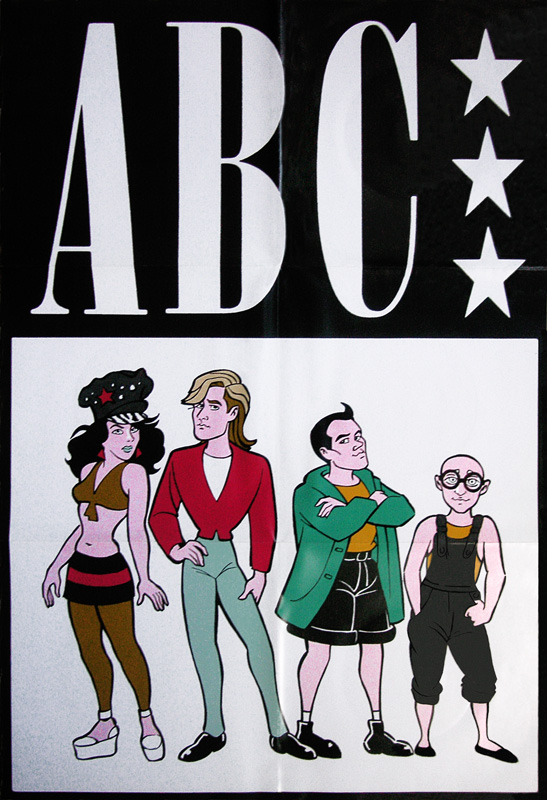 For their next project, the pair conceived a playful sound with an animated image. They hired two non-musicians, Fiona Russell Powell and David Yarritu, both on account of their unique/odd fashion sense.
Fiona (aka Eden) hailed from Sheffield, where she befriended the band in their pre-ABC days as Vice Versa. In recent years, she worked as an interview reporter for The Face, a leading UK music/fashion magazine. She cultivated a colorful, campy image on The Tube, a Channel 4 music program. Yarritu was an American photographer who amused Fry and White with his bald, bespectacled look and short stature.
“(How to Be A) Millionaire”
 On October 26, 1984, ABC released their seventh single: “(How to Be A) Millionaire.” The sleeve features cartoon versions of the new lineup by Beauty Stab illustrator Keith Breeden, whose imagery formed the basis of a corresponding video directed by Alan Best, a Canadian filmmaker with prior credits on the 1981/82 films Heavy Metal and Pink Floyd The Wall.
Neutron/Vertigo issued the single in two main formats: a standard 7″ and a (more common) 12″ with an extended version dubbed the ‘Wall St. Mix.’ In the UK, Neutron issued an alternate 12″ extended version dubbed the ‘Bond St. Mix.’
A. “How to Be a Zillionaire (Wall St. Mix)” (7:33)
B1. “How to Be a Millionaire” (3:31)
B2. “How to Be a Millionaire (Accapella)” (3:30)
A. “How to Be a Zillionaire (Bond St. Mix)” (6:05)
The animated video opens at a seaside supermarket where Fry and White load their cart with assorted products, including a guitar, a diamond ring, and a pink toy convertible, which grows into a vintage cruiser after checkout. As they zoom off, the two shrink and fall into a spinning vortex with Eden and Yarritu. They land on a gameboard, chased by dice, hands, and heels amid flying cards and flashing signs. On the final zoom-out, the ant-sized pair are dwarfed by their consumer goods.
How to Be a … Zillionaire!
 ABC released their third album, How to Be a … Zillionaire!, on October 4, 1985, on Neutron, Mercury, and Vertigo. It presents the band’s cartoon iteration with co-founders Martin Fry and Mark White, accompanied by stylists David Yarritu and Fiona ‘Eden’ Powell, both restricted to minor vocal contributions.
The album contains ten Fry/White originals, including the year-old a-side “(How to Be A) Millionaire” and two further advanced singles, “Be Near Me” and “Vanity Kills.”
White plays the E-mu Emulator II and programs the Fairlight CMI with help from Gary Moberley, a onetime John Miles sideman. Mark splits further keyboard chores with Don Snow, a recent Sinceros/Squeeze member who plays acoustic piano, Yamaha DX7, synthesizers. Snow played simultaneously in The Catch with percussionist Chris Whitten, a recent t Julian Cope and Waterboys auxiliary who plays ‘additional drums’ on “15 Storey Halo.”
Fry double-tracks his vocals and harmonizes with session backing vocalists Jackie Challenor, Lorenza Johnson, and Mae McKenna, all heard on Scritti Politti‘s 1982 album Songs to Remember.
Lexicon session bassist Brad Lang returned for Zillionaire!, which features hi-hat on the first three tracks by former ABC drummer David Palmer. Other tracks feature drums and/or beatbox by Keith LeBlanc, an early hip-hop drummer.
Additional guests include American R&B guitarists Skip McDonald (“Tower of London”) and David Williams, an Off the Wall sessionist who played on “(How to Be a) Millionaire” and recent soul-funk albums by Angela Bofill, Chaka Khan, Cheryl Lynn, and Philip Bailey.
A1. “Fear of the World” (3:50)
A2. “Be Near Me” (3:37)
A3. “Vanity Kills” (3:28) features UK jazz trumpeter Guy Barker, also heard on 85/86 titles by Blow Monkeys, Matt Bianco, The The, and Working Week.
A4. “Ocean Blue” (3:36) features backing vocals by Sixties UK R&B singer backing vocals P. P. Arnold.
A5. “15 Storey Halo” (5:36)
B1. “A to Z” (2:49) Fry sped his voice for the line “Hi, I’m Eden, and I want you to kiss my snatch.”
B2. “(How to Be A) Millionaire” (3:34)
B3. “Tower of London” (3:36)
B4. “So Hip It Hurts” (4:17)
B5. “Between You and Me” (3:16)
Sessions took place in Surrey at Jacobs Studios, where Fry and White co-produced the album with engineer Martyn Webster, a prior soundman for Anne Clark, Aviator, and Barbara Thompson’s Paraphernalia.
The inner-sleeve features block lyrical texts in multiple directions and a monochrome member photo grid by British fashion photographer Nick Knight, whose imagery also graces 1984/85 sleeves for Europeans, King, Shriekback, Silent Running, and Thomas Leer.
“Be Near Me”
 ABC preceded the album by six months with “Be Near Me,” released in April as their eighth single (b/w “A to Z”). The 12″ features an extended version (Munich Disco Mix) and a dub version (“What’s Your Destination?”). Breeden’s sleeve art continues the cartoon theme, including a leaopard-lapel red jacket that Mark White wears in the video.
A. “Be Near Me (Munich Disco Mix)” (5:29)
B2. “What’s Your Destination?” (3:36)
The video opens with a monochrome profile view of Fly and cuts to the main sequence where the band play colorful toy instruments against a white backdrop, clad in distinct garments with recurrent leaopard patterns.
In the US, “Be Near Me” accompanied the album’s autumn 1985 release and entered heavy MTV rotation. The song became ABC’s first major hit in three years on Billboard, where “Be Near Me” reached No. 9 on the Hot 100 and No. 1 on the Hot Dance Club Play chart.
With this elevated profile, Mercury issued “(How to Be A) Millionaire” as the followup US single in Janurary 1986, fourteen months after its original UK release. With high rotation on MTV, the song reached No. 4 on the Dance Club Play chart and No. 20 on the Billboard Hot 100.
“Vanity Kills” and “Ocean Blue”
 In June 1985, ABC lifted “Vanity Kills” as the third UK Zillionaire single, backed with the non-album “Judy’s Jewels.”
B. “Judy’s Jewels” (2:03)
In the “Vanity Kills” video, Fly and White portray armed sleuths who roll up at a pier and survey a nearby resort where a gala takes place while an aging diva quarrels with her lover in the penthouse suite. The plot goes unresolved. Despite the single’s picture sleeve, Eden and Yarritu are absent from the video, which doesn’t refer to the Zillionaire cartoon concept.
 In January 1986, ABC released “Ocean Blue” as the fourth UK Zillionaire single (b/w “Tower of London”). As an example of the album’s serious side, its release marked Fry and White’s abandonment of the recent cartoon presentation (with ironic timing, as “Ocean Blue” coincided with the stateside popularity of “(How to Be A) Millionaire”).
Palmer appears in the monochrome video, where Fly sings with plaintive expressions amid the crumbled interior of a once-lavish manor, where a six-piece violin section mimes the symphonic break.
Alphabet City
 ABC released their fourth album, Alphabet City, on October 12, 1987, on Neutron, Mercury, and Phonogram.
Alphabet City features nine proper songs co-written by Martin Fry and Mark White, including “One Day,” “King Without a Crown,” “Rage and Then Regret,” and the singles “When Smokey Sings” and “The Night You Murdered Love.”
Chic co-founder Bernard Edwards produced both singles, which feature strings by Richard Niles, a recent arranger for Clannad and Swing Out Sister. Anne Dudley arranged two songs (“One Day” “Bad Blood”) and co-wrote the “Avenue A/Z” bookends with White.
Mark resumes his guitarist role on Alphabet City and splits keyboard tasks with David Clayton, a recent member of David Palmer’s Person to Person.
Brad Lang returns again as electric bassist. His rhythmic partner, serial drummer Graham Broad, played on recent titles by Boys Don’t Cry, Charlie, The Fountainhead, Go West, and Modern English. Alphabet City also features double-bassist Danny Thompson, a veteran of the post-psychedelic jazz-folk scene in Pentangle and Magna Carta. Additional guets include Dizrhythmia percussionist/tablist Pandit Dinesh, Scouse harmonica player Judd Lander (Communards, The The), Beauty Stab saxophonist Howie Casey, and recurrent ABC percussionist Luís Jardim.
Richard’s wife, Lexicon guest Tessa Niles (née Webb), sing backing with Fry, who also harmonizes with session vocalists Linda Taylor (Gonzalez, Frankie Miller), Miriam Stockley (Thomas Dolby, Nik Kershaw, Robbie Nevil), and Dolette McDonald (Sting, Colourfield, The System, Yukihiro Takahashi).
A1. “Avenue A” (0:56) Mark White Anne Dudley
A2. “When Smokey Sings” (4:22)
A3. “The Night You Murdered Love” (4:53)
A4. “Think Again” (3:41)
A5. “Rage and Then Regret” (3:34)
A6. “Ark-Angel” (4:54)
B1. “King Without a Crown” (4:41)
B2. “Bad Blood” (3:56)
B3. “Jealous Lover” (3:36)
B4. “One Day” (5:35)
B5. “Avenue Z” (0:42) White Dudley
Fry and White co-produced the album at Marcus Recording Studios with Zillionaire engineer Martyn Webster. Breeden illustrated the Alphabet City sleeve, which features pics of the pair by Andy Earl, a photographer for Bow Wow Wow and Loose Ends.
Jardim, Lander, and Tessa Niles also appeared (along with David Palmer) on Infected, the 1986 second The The album.
“When Smokey Sings”
 ABC preceded Alphabet City by five months with “When Smokey Sings,” released as a single on May 22, 1987, with “Chicago (Part 1),” a non-album b-side. Neurtron issued multiple 12″ versions with different extended mixes of both songs.
B. “Chicago (parts one and two)” (6:38)
In the video, Fry croons in a pinstripe three-piece suit as the band sways on a multi-level stage under blue and lavendar lights. Meanwhile, the second-person subject prays to a framed paining of Smokey Robinson and soon lands the affection of a hair-shorn female, first encountered at the hood of his car on a London cruise during the “Avenue A” prelude of the full video (5:15).
The sharp-suited band mimed on a sunken stage amid chrome panels and zolo neon lights for the June 11, 18, and July 2 TotP broadcasts, which also featured in-studios by a-ha (“The Living Daylights”), Billy Idol (“Sweet Sixteen”), Black (“Sweetest Smile”), Chris Rea (“Let’s Dance”), Pet Shop Boys (“It’s a Sin”), and Whitesnake (“Is This Love?”). For TopPop, ABC mimed “Smokey” in neo-Forties sophisti-pop suits, backed by a cardboard cityscape.
“The Night You Murdered Love”
 On August 24, 1987, ABC lifted “The Night You Murdered Love” as the second advanced Alphabet City single, backed with the non-album “Minneapolis.” The 12″ contains three alternate mixes of the a-side, including ‘The Whole Story’ (8:14) and ‘The Reply’ (4:50), both with raps by Contessa Lady V.
B. “Minneapolis” (2:57)
White plays a dobro guitar in the video, which intercuts a rehearsal-stage performance with walkabout scenes in Paris, where a beehive-haired model fires slingshots at assorted tagets around the Eiffel Tower and Palais Garnier.
 In November, ABC followed the album’s release with a third single, “King Without a Crown,” backed with a live version of “The Look of Love.”
Alphabet City reached No. 4 in Iceland and No. 7 on the UK Albums Chart. It also grazed the Dutch and German Top 20.
Up
ABC released their fifth album, Up, on October 16, 1989, on Neutron, Mercury, and Phonogram.
“One Better World”
Released: 15 May 1989
“The Real Thing”
Released: 11 September 1989
Discography:
- The Lexicon of Love (1982)
- Beauty Stab (1983)
- How to Be a … Zillionaire! (1985)
- Alphabet City (1987)
- Up (1989)
- Abracadabra (1991)
Sources:
Artist/Album Pages:
Warhorse was an English hard-rock band that made the 1970–72 Vertigo albums Warhorse and Red Sea. ...
Stern Meissen was a German symphonic-rock band that released seven albums between 1977 and 1987 on...
Marshall Crenshaw is an American songwriter and guitarist from Detroit. He released six studio album...
Xmal Deutschland was a German goth-rock band fronted by songwriter Anja Huwe. They cut two 1981/82...
Cyklus was a German jazz-rock band that released the 1979 album Planet of Two Suns on Erlkönig Sch...
Tomorrow was an English psych-rock band that released two singles on Parlophone in 1967, belatedly f...
Avenger was an English Tyneside metal band behind the 1983 single "Too Wild to Tame" and the 1984/...
Jacques Tom Rivest is a Québécois guitarist and songwriter who recorded an album with Pollen in 19...
The Plastic People of the Universe were a Czech rock group formed in Prague in 1968, with bassist ...
In Camera was an English post-punk band on 4AD that released the 1980 short-players "Final Achieve...
Peter Sinfield (December 27, 1943 – November 14, 2024) was an English lyricist and occasional singer...
The Durutti Column was an English ambient project from Manchester that made nine albums and assort...
“Evolving out of electro-futurist Sheffield combo Vice Versa, ABC fashioned an ultra sleek, lamé-suited concoction of ’50s nightclub chic and metro-modern dance-ability in their first formation, which yielded the 1982 chef d’oeuvre The Lexicon of Love.
Garnering transatlantic accolades for their lavish, theatrical songs and cinematic videos, the band were an iconic cornerstone of MTV’s golden age thanks to clips for the carnival-eque “The Look of Love” and the melodramatic “Poison Arrow.” (Spring, 2018)