
Cliff Richard (born Oct. 14, 1940) is an English pop vocalist with a career that has spanned more than 60 years, starting in the late 1950s amid the U.K.’s initial wave of home-grown rock performers. Between 1958 and 1963, he enjoyed teen-idol fame and a series of hits with his backing band The Shadows.
In 1976, he entered the second phase of his career with the transatlantic breakthrough I’m Nearly Famous. Over the following seven-year period, he released eight albums in a contemporary rock vein with songs provided by Terry Britten, Alan Tarney, and Chris Eaton, among others.
Background
Richard was born Harry Rodger Webb on October 14, 1940, one of four children borne to English parents in Lucknow, India. His father was a catering contractor for Indian Railways in the then-British colony. When Harry was seven, the Webb family moved to England, where they settled in Cheshunt, Hertfordshire, in 1949. At secondary school, he excelled in English literature.
An enthusiast of skiffle, his father bought him a guitar when he was sixteen. In 1957, Webb did brief stints in The Quintones (a doo-wop combo) and the Dick Teague Skiffle Group. The following year, he started singing for The Drifters, a rock n’ roll band with guitarist/songwriter Ian Samwell, guitarist Norman Mitham, and drummer Terry Smart. At his manager’s suggestion, Webb adopted the stagename Cliff as a synonym for “rock.” The surname Richard was added as an ode to his idol, Little Richard.
“Move It”
 Cliff Richard made his recording debut with “Move It,” released in August 1958 on Columbia (DB 4178), backed with “Schoolboy Crush.” Written by Ian Samwell, “Move It” originated as a rehearsal piece that producer Jack Good promoted to the A-side. The track was cut at EMI’s Manchester Square studio with Richard backed by the original Drifters lineup: Hank Marvin (guitar), Bruce Welch (rhythm guitar), Jet Harris (bass), and Terry Smart (drums).
A. “Move It” (2:20)
B. “Schoolboy Crush” (2:30) — written by Aaron Schroeder and Sharon Gilbert; originated as a 1958 single by Bobby Helms.
The single reached No. 2 on the UK Singles Chart and spent 17 weeks in the listings, making Cliff Richard the first British singer widely recognized as a rock and roll performer. The release launched him into national prominence, earning press comparisons to Elvis Presley and bookings on major television programs like Oh Boy! and Six-Five Special.
“High Class Baby”
 Columbia issued “High Class Baby” in November 1958 (DB 4202), backed with “My Feet Hit the Ground,” and followed it with “Livin’ Lovin’ Doll” in January 1959 (DB 4214), backed with “Steady With You.” Both A-sides were recorded with the Drifters and reflect the early writing circle that shaped Richard’s rock and roll material.
A. “High Class Baby” (2:10)
B. “My Feet Hit the Ground” (2:00) — written by Ian Samwell; exclusive B-side.
“High Class Baby” reached No. 7 on the UK chart, solidifying Richard’s status as a consistent hitmaker and a live attraction in the British package-tour circuit.
“Livin’ Lovin’ Doll”
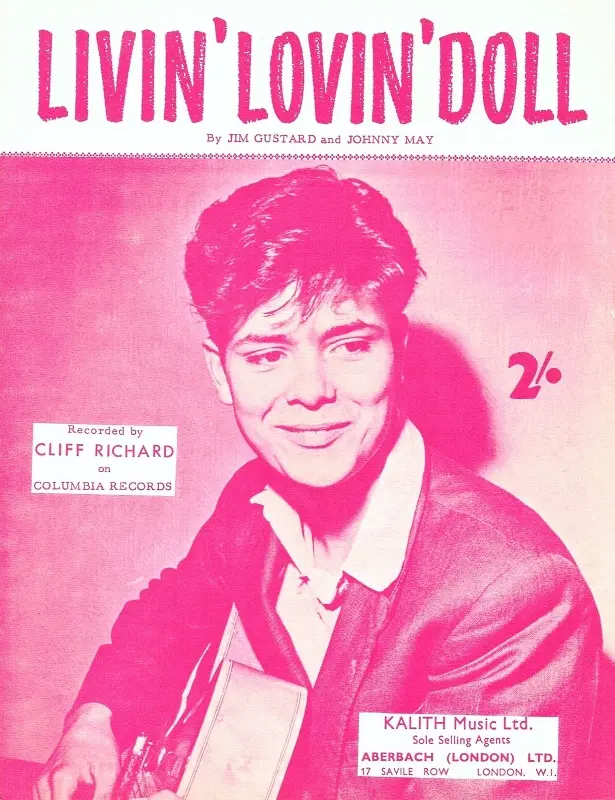 In January 1959, Richard issued “Livin’ Lovin’ Doll” (DB 4214), an upbeat rockabilly number backed with “Steady With You.”
A. “Livin’ Lovin’ Doll” (2:08) — written by Norrie Paramor and Bunny Lewis under the pseudonyms Johnny May and Jim Gustard; originated as a 1959 single.
B. “Steady With You” (2:21) — written by Ian Samwell; exclusive B-side.
“High Class Baby” reached No. 7 on the UK Singles Chart. “Livin’ Lovin’ Doll” peaked at No. 20 on the NME chart, sustaining Richard’s visibility as Britain’s leading rock and roll performer ahead of his first album release.
Cliff
 Cliff Richard released his debut album, Cliff, on April 17, 1959, on Columbia (EMI).
The album documents Richard and his band the Drifters performing a live-in-the-studio set of early rock and roll songs and instrumentals before an invited audience at Abbey Road Studios. It reached number four on the UK album chart at a time when the chart comprised only a top ten.
Hank Marvin leads on guitar with sharp, trebly phrasing. Bruce Welch supports with steady rhythm chords while Jet Harris anchors the low end on bass. Tony Meehan propels the set with crisp, uptempo drumming. The Mike Sammes Singers add vocal harmonies to “Donna” and “Danny.”
Track writing credits vary: the set includes compositions by American rock and roll, R&B, and pop writers alongside tunes credited to Drifters members.
A1. “Apron Strings” (2:40) — written by George David Weiss and Aaron Schroeder; originated as a 1958 single by Billy the Kid.
A2. “My Babe” (2:21) — written by Willie Dixon; originated as a 1955 single by Little Walter.
A3. “Down the Line” (1:59) — written by Roy Orbison; originated as a 1956 Sun single.
A4. “I Got a Feeling” (1:48) — written by Baker Knight; originated as a 1958 single by Ricky Nelson.
A5. “Jet Black” (2:13) — written by Jet Harris; Drifters instrumental.
A6. “Baby I Don’t Care” (2:08) — written by Jerry Leiber and Mike Stoller; originated as a 1957 soundtrack recording for Jailhouse Rock.
A7. “Donna” (3:06) — written by Ritchie Valens; originated as a 1958 single.
A8. “Move It” (2:09) — written by Ian Samwell; originated as a 1958 UK single by Cliff Richard.
B1. “Ready Teddy” (1:47) — written by John Marascalco and Robert Blackwell; originated as a 1956 single by Little Richard.
B2. “Too Much” (2:16) — written by Lee Rosenberg and Bernard Weinman; originated as a 1957 single by Elvis Presley.
B3. “Don’t Bug Me Baby” (2:16) — written by Leon Luallen and Johnny Bragg; originated as a late-1950s rockabilly single by Milton Allen.
B4. “Driftin’” (2:46) — written by Hank Marvin; Drifters instrumental.
B5. “That’ll Be the Day” (2:09) — written by Buddy Holly and Jerry Allison; originated as a 1957 single by the Crickets.
B6. “Be-Bop-A-Lula” (2:13) — written by Gene Vincent and Bill “Sheriff Tex” Davis; originated as a 1956 single by Gene Vincent.
B7. “Danny” (2:54) — written by Ben Weisman and Fred Wise; originated as a 1958 recording by Elvis Presley.
B8. “Whole Lotta Shakin’ Goin’ On” (2:59) — written by Dave “Curlee” Williams; originated as a 1955 single by Big Maybelle and popularized in 1957 by Jerry Lee Lewis.
Richard and the Drifters recorded the album live in Studio 2 at Abbey Road Studios, London on 9–10 February 1959 with producer Norrie Paramor and engineer Malcolm Addey.
The album was originally issued in mono only; stereo mixes of individual tracks appeared on EP releases. The full album in stereo appeared on later CD reissues.
“Mean Streak”
Cliff Richard released “Mean Streak” in May 1959 on Columbia (single DB 4236), backed with “Never Mind.” Written by Ian Samwell and Norrie Paramor under the pseudonym Joseph Seener; the A‑side originated as a 1959 single.
A. “Mean Streak” (2:00) — written by Ian Samwell and Norrie Paramor under the pseudonym Joseph Seener; originated as a 1959 single.
B. “Never Mind” (2:01) — exclusive B‑side.
“Mean Streak” reached No. 10 on the New Musical Express Top 30 and charted in the upper regions on other UK charts. “Never Mind,” while a B‑side, also registered, peaking at No. 21 on the NME Top 30. The release sustained Richard’s commercial momentum after his early 1958–59 singles and kept him a fixture in UK charts between his debut LP and Cliff Sings.
“Living Doll”
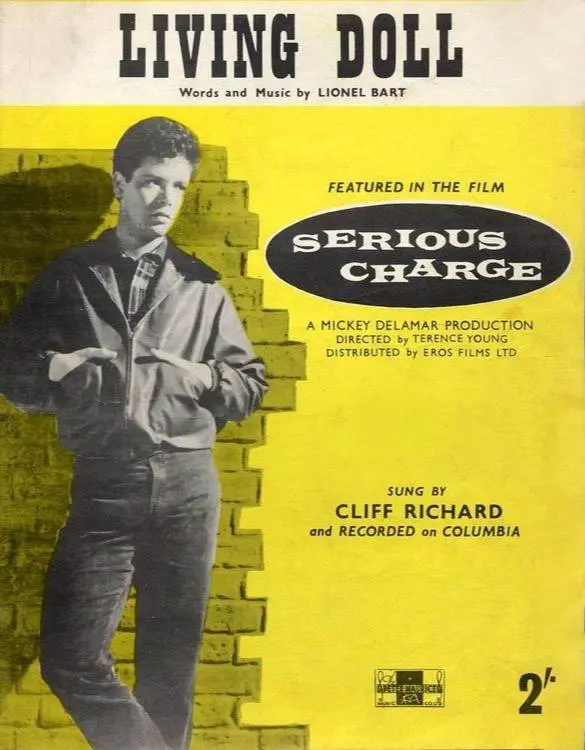 Cliff Richard released “Living Doll” in July 1959 on Columbia (DB 4306), backed with “Apron Strings.” Written by Lionel Bart; the A‑side originated as a 1959 single recorded by Richard and the Drifters.
Richard recorded “Living Doll” in April 1959 for the soundtrack of the film Serious Charge, where it appears as an up‑tempo light rock and roll number before being released as a single. Bart wrote the song in minutes after seeing a newspaper advertisement for a child’s doll that could “kneel, walk, sit and sing”; it was contractual that Richard’s film appearance include a single release.
A. “Living Doll” (2:35) — written by Lionel Bart; originated as a 1959 single.
B. “Apron Strings” (2:40) — written by George David Weiss and Aaron Schroeder; previously recorded on Cliff as a cover R&B number.
 “Living Doll” reached No. 1 on the UK Singles Chart for six weeks and was the top‑selling UK single of 1959 with over 770,000 sales. It became Richard’s first million‑selling record and earned an internally awarded Gold Disc at a televised show in January 1960.
The song also became Richard’s first hit in the United States, peaking at No. 30 on the Billboard Hot 100, and topped charts in Ireland, Norway, and Sweden while reaching the top ten in numerous other territories, broadening his international profile and signaling a move toward a softer pop style that would shape his subsequent hits. Bart, as the writer, won an Ivor Novello Award for best song for “Living Doll.”
“Travellin’ Light”
 Cliff Richard released “Travellin’ Light” on October 2, 1959, on Columbia (DB 4351), backed with “Dynamite.” The single was the first release credited to Cliff Richard and the Shadows following the band’s name change from the Drifters.
A. “Travellin’ Light” (2:31) — written by Sid Tepper and Roy C. Bennett; originated as a 1959 single.
B. “Dynamite” (1:56) — written by Ian Samwell; exclusive B‑side.
“Travellin’ Light” reached No. 1 on the UK Singles Chart, marking Richard’s second consecutive chart‑topping single after “Living Doll,” and remained at the summit for five weeks. The B‑side “Dynamite” also charted, peaking at No. 16 on the New Musical Express chart.
The record consolidated Richard’s leadership of the British pop scene in the late 1950s and underscored the commercial potency of his collaboration with the Shadows as a fully established group. In 1980, Cliff remade “Dynamite” with his then-producer Alan Tarney.
Cliff Sings
 Cliff Richard released Cliff Sings in November 1959 on Columbia. The album marks his first full studio release and shifts between two distinct backing approaches: stripped-down rock and roll with the Drifters (soon to be renamed the Shadows), and orchestrated ballads arranged by Norrie Paramor.
Hank Marvin leads with sharp guitar phrasing. Bruce Welch provides rhythmic comping. Jet Harris anchors the low end on bass, and Tony Meehan drives the arrangements with clean, disciplined drumming. Paramor supplements select tracks with orchestral strings, alternating between band and studio ensemble textures across the two sides.
Trackwriting spans early American rock standards and mid-century pop ballads, along with one-off contemporary titles; origins are noted where documented.
A1. “Blue Suede Shoes” (1:45) — written by Carl Perkins; originated as a 1956 Sun single.
A2. “The Snake and the Bookworm” (2:10) — written by Doc Pomus and Mort Shuman; popularized through early rock covers.
A3. “I Gotta Know” (2:25) — written by Matt Williams and Paul Evans; originated as a late-1950s pop single.
A4. “Here Comes Summer” (2:15) — written by Jerry Keller; originated as a 1959 single.
A5. “I’ll String Along With You” (2:19) — written by Al Dubin and Harry Warren; originated as a 1934 popular song.
A6. “Embraceable You” (2:37) — written by George and Ira Gershwin; originated as a 1930 Broadway standard.
A7. “As Time Goes By” (2:25) — written by Herman Hupfeld; originated as a 1931 Broadway song.
A8. “The Touch of Your Lips” (2:46) — written by Ray Noble; originated as a 1936 popular ballad.
B1. “Twenty Flight Rock” (1:43) — written by Ned Fairchild and Eddie Cochran; originated as a 1957 single.
B2. “Pointed Toe Shoes” (1:50) — written by Carl Perkins; originated as a late-1950s rockabilly track.
B3. “Mean Woman Blues” (2:26) — written by Claude Demetrius; originated as a 1957 single by Elvis Presley.
B4. “I’m Walkin’” (1:49) — written by Fats Domino and Dave Bartholomew; originated as a 1957 R&B single.
B5. “I Don’t Know Why (I Just Do)” (1:56) — written by Roy Turk and Fred E. Ahlert; originated as a 1931 popular song.
B6. “Little Things Mean a Lot” (2:32) — written by Carl Stutz and Edith Lindeman; originated as a 1954 pop single.
B7. “Somewhere Along the Way” (2:37) — written by Sammy Gallop and Kurt Adams; originated as a 1951 pop standard.
B8. “That’s My Desire” (2:35) — written by Helmy Kresa and Carroll Loveday; originated as a 1931 popular song.
Sessions took place 7–9 September 1959 at Abbey Road Studios with producer Norrie Paramor and engineer Malcolm Addey.
Cliff Sings reached No. 2 on the UK Albums Chart. Columbia lifted no singles from the release, consistent with the era’s separation of album and single markets.
“A Voice in the Wilderness” b/w “Don’t Be Mad at Me”
 Cliff Richard opened 1960 with “A Voice in the Wilderness,” a ballad written by Norrie Paramor and Bunny Lewis that featured in the film Expresso Bongo and was first heard on that movie’s EP. Richard and the Shadows delivered it with gleaming pop sensibility, and although he reportedly liked the B‑side “Don’t Be Mad at Me” better, the A‑side became the focus of the single release.
A. “A Voice in the Wilderness” (2:10) (written by Paramor/Lewis)
B. “Don’t Be Mad at Me” (2:08) (exclusive B‑side)
In February 1960 “A Voice in the Wilderness” peaked at No. 2 on the UK Singles Chart behind Anthony Newley’s “Why,” holding high positions for several weeks and earning a silver certification for strong sales. It also reached No. 1 in Ireland and placed well in Sweden and India.
“Fall in Love with You” b/w “Willie and the Hand Jive”
 Issued in March 1960, “Fall in Love with You” was penned by Ian Samwell and built on a tender, melodic pop arrangement that stood alongside a spirited cover of Johnny Otis’s R&B‑inflected “Willie and the Hand Jive” on the flip.
A. “Fall in Love with You” (2:30) (written by Samwell)
B. “Willie and the Hand Jive” (2:37) (Otis cover)
“Fall in Love with You” reached No. 2 on the UK Singles Chart, again reflecting Richard’s consistent commercial pull, and garnered a silver disc. On the continental charts it saw placements in Ireland, the Netherlands, Norway and Sweden, underlining his UK and European reach in early 1960.
In November 1960, “Fall in Love with You” reappeared with his two subsequent a-sides and the earlier “Travellin’ Light” on Cliff’s Silver Discs, a Columbia EP issued in the UK, Ireland, Netherlands, Oceania, and Singapore.
“Please Don’t Tease” b/w “Where Is My Heart”
 Released in June 1960 and written by Bruce Welch and Pete Chester, “Please Don’t Tease” was a charismatic uptempo pop single that became Richard’s biggest hit of the summer.
A. “Please Don’t Tease” (2:59) (written by Welch/Chester)
B. “Where Is My Heart” (2:12) (exclusive B‑side)
“Please Don’t Tease” climbed to No. 1 on the UK Singles Chart and spent three weeks at the summit, outselling competing British and American singles that summer. It sold over 1.5 million copies worldwide, also topping charts in India, Ireland, New Zealand, Norway and Thailand, and charting strongly in Europe and Australia.
“Nine Times Out of Ten” b/w “Thinking of Our Love”
 In September 1960 Richard returned with “Nine Times Out of Ten,” co‑written by Waldense Hall and Otis Blackwell and delivered with a brisk rock‑and‑roll edge. The reflective B‑side “Thinking of Our Love” provided a softer counterpoint.
A. “Nine Times Out of Ten” (2:07) (written by Hall/Blackwell)
B. “Thinking of Our Love” (2:20) (exclusive B‑side)
“Nine Times Out of Ten” peaked at No. 3 on the UK Singles Chart, maintaining Richard’s autumn momentum, and earned a silver disc for sales. Its chart run helped keep his string of high‑charting singles intact through the end of the year.
Me and My Shadows
 Cliff Richard released his third album, Me and My Shadows, on October 7, 1960, on Columbia EMI, co-billed to The Shadows.
“I Love You” b/w “‘D’ in Love” (November 1960)
 Closing out the year, “I Love You,” written by Shadows guitarist Bruce Welch, was released in November 1960 and became one of Richard’s signature romantic pop hits of the era. Its B‑side “‘D’ in Love,” written by Sid Tepper and Roy C. Bennett, rounded out the single.
A. “I Love You” (2:02) (written by Welch)
B. “‘D’ in Love” (2:12) (Tepper/Bennett)
“I Love You” hit No. 1 on the UK Singles Chart in late December 1960, making it Richard’s second UK chart‑topper that year and placing it atop the festive chart ahead of other seasonal hits. It also reached No. 1 in New Zealand and India and achieved Top 5 positions across several European markets.
“Theme for a Dream” b/w “Mumblin’ Mosie” (February 1961)
 In February 1961, Cliff Richard released “Theme for a Dream,” a lilting pop ballad composed by Mort Garson and Earl Shuman. The single paired it with “Mumblin’ Mosie,” a cover of Johnny Otis’s 1960 R&B track, showcasing Richard’s flair for US-style rhythm and blues phrasing.
A. “Theme for a Dream” (2:06)
B. “Mumblin’ Mosie” (2:17)
“Theme for a Dream” reached No. 3 on the UK Singles Chart and earned a silver disc for surpassing 250,000 sales. The single also charted in Australia, India, Ireland, New Zealand, and several Scandinavian markets, expanding Richard’s reach across global pop markets in early 1961.
Listen to Cliff!
 Cliff Richard released his fourth album, Listen to Cliff!, on April 14, 1961, on Columbia EMI.
It marked his third studio album and the first of two full-length LPs issued that year. Though recorded at Abbey Road Studios with contributions from The Shadows and the Norrie Paramor Orchestra, the album did not spawn any UK singles. However, “Blue Moon” was issued as an export-only release. The album consists mainly of pop standards and songs drawn from musicals, with eight titles co-credited to The Shadows. It spent 26 consecutive weeks on the UK Albums Chart, peaking at No. 2, and later re-entered twice.
A1. “What’d I Say” [with The Shadows] (3:03) — first recorded by Ray Charles in 1959; created spontaneously on stage, the song became a cornerstone of his live set and helped launch the soul genre.
A2. “Blue Moon” (3:32) — composed by Richard Rodgers and Lorenz Hart in 1934; re-popularized in 1961 by the Marcels’ doo-wop version, which topped the UK and US charts.
A3. “True Love Will Come to You” [with The Shadows] (2:58)
A4. “Lover” (1:49) — debuted in the 1932 film Love Me Tonight and performed by Jeanette MacDonald; widely covered in the swing era, notably by Paul Whiteman and Guy Lombardo.
A5. “Unchained Melody” [with The Shadows] (3:30)
A6. “Idle Gossip” (2:54)
A7. “First Lesson in Love” [with The Shadows] (1:56)
A8. “Almost Like Being in Love” (2:05) — written by Frederick Loewe and Alan Jay Lerner for the 1947 musical Brigadoon; later sung by Gene Kelly in the 1954 film adaptation.
B1. “Beat out Dat Rhythm on a Drum” (1:59)
B2. “Memories Linger On” [with The Shadows] (2:40)
B3. “Temptation” (2:24) — introduced by Bing Crosby in the 1933 film Going Hollywood; became a recurring standard, revived in 1961 by the Everly Brothers who reached No. 1 in the UK.
B4. “I Live for You” [with The Shadows] (2:15)
B5. “Sentimental Journey” (2:09) — first recorded by Doris Day with Les Brown & His Band of Renown in 1945; became a postwar classic associated with homecoming and nostalgia.
B6. “I Want You to Know” [with The Shadows] (2:29) — a 1957 single by Fats Domino and Dave Bartholomew, recorded with Allen Toussaint substituting on piano during Domino’s tour absence.
B7. “We Kiss in a Shadow” (3:23) — drawn from Rodgers and Hammerstein’s The King and I (1951); sung in secret by Tuptim and Lun Tha in both the stage and 1956 film versions.
B8. “It’s You” [with The Shadows] (3:22)
Recorded at EMI Abbey Road Studios, London. Produced by Norrie Paramor. Engineered by Malcolm Addey. Cliff Richard performs vocals throughout. The Shadows perform on eight tracks, with Hank Marvin (lead guitar), Bruce Welch (rhythm guitar), Jet Harris (bass), and Tony Meehan (drums). Additional orchestral arrangements conducted by Norrie Paramor with Meehan also appearing as a session player.
Originally issued in mono and stereo LP formats, Listen to Cliff! was later reissued on reel-to-reel tape and CD, including mono/stereo hybrid editions. The album was also segmented into two mono-only EPs: Listen to Cliff! No. 1 and Listen to Cliff! No. 2. Export-only single: “Blue Moon” (1961).
“A Girl Like You” b/w “Now’s the Time to Fall in Love” (June 1961)
 Released in June 1961, “A Girl Like You” was written by Jerry Lordan, whose compositions had already yielded several hits for The Shadows. This bright, mid-tempo love song became another UK Top 3 entry for Richard, backed with the exclusive B‑side “Now’s the Time to Fall in Love.”
A. “A Girl Like You” (2:31)
B. “Now’s the Time to Fall in Love” (2:08)
“A Girl Like You” peaked at No. 3 on the UK Singles Chart and charted strongly abroad, reaching No. 1 in Hong Kong and India and entering the Top 10 in Ireland, the Netherlands, Norway, South Africa, and Sweden, reinforcing Richard’s international appeal during a year dominated by vocal solo acts and pre‑beat boom pop.
In February 1962, “A Girl Like You” reappeared with Cliff’s two prior a-sides (“I Love You,” “Theme for a Dream”) and the subsequent “When the Girl In Your Arms Is the Girl In Your Heart” on Cliff’s Hit Parade, a Columbia EP issued in the UK and antipodes.
21 Today
 Cliff Richard released his fifth album, 21 Today, on October 14, 1961, on Columbia EMI.
It marked his fourth studio album and his first recorded entirely with The Shadows as backing band. Sessions took place between September 1960 and July 1961 at Abbey Road Studios, under the direction of producer Norrie Paramor. The album became Richard’s first No. 1 on the UK Albums Chart.
The set balances contemporary pop compositions with American rock covers and pre-war standards, including two instrumental-composer collaborations with Bruce Welch and Hank Marvin. No singles were initially issued from the album in the UK, but “Outsider” was released abroad the following year, charting in South Africa, India, and Australia.
A1. “Happy Birthday to You” (1:38) — originally composed by Mildred and Patty Hill in 1893 as “Good Morning to All”; the birthday lyrics emerged in the early 20th century and became the most recognized song in the English language.
A2. “Forty Days (To Come Back Home)” (2:49) — adapted from Chuck Berry’s 1955 song “Thirty Days,” written as a blues-inflected tribute to Hank Williams.
A3. “Catch Me” (2:31) — first recorded in 1960 by American singer Jeri Lynne Fraser; released as the B-side to “Poor Begonia (Caught Pneumonia)” in August 1960.
A4. “How Wonderful to Know” (2:42) — English adaptation of “Anema e core” (“Heart and Soul”), a 1950 Neapolitan song by Salvatore D’Esposito, introduced by tenor Tito Schipa.
A5. “Tough Enough” (2:18)
A6. “Fifty Years for Every Kiss” (2:34)
A7. “The Night Is So Lonely” (2:46)
A8. “Poor Boy” (2:59)
B1. “Y’Arriva” (3:39)
B2. “Outsider” (2:45) — composed by Sid Tepper and Roy C. Bennett as one of three songs submitted for The Young Ones film but not used. Instead, it was included on 21 Today and later released as a single abroad. It reached No. 1 in South Africa, No. 2 in India, and No. 22 in Australia.
B3. “Tea for Two” (2:19) — composed by Vincent Youmans and Irving Caesar for the 1925 Broadway musical No, No, Nanette; became the biggest hit of Youmans’ career and a jazz standard.
B4. “To Prove My Love for You” (1:55)
B5. “Without You” (2:09)
B6. “A Mighty Lonely Man” (2:18)
B7. “My Blue Heaven” (2:31) — introduced in the Ziegfeld Follies of 1927 and recorded in 1927 by Gene Austin; the 1928 release spent 13 weeks at No. 1 and sold over five million copies worldwide.
B8. “Shame on You” (2:08)
Recorded between September 1960 and July 1961 at EMI Abbey Road Studios, London. Produced by Norrie Paramor. All instrumentation performed by The Shadows: Hank Marvin (lead guitar), Bruce Welch (rhythm guitar), Jet Harris (bass), and Tony Meehan (drums). Engineered by Malcolm Addey.
21 Today became Cliff Richard’s first No. 1 album in the UK, where it topped the Albums Chart in October 1961.
“Outsider” was released in January 1962 in South Africa (b/w “Y’Arriva”), peaking at No. 1. It later charted at No. 2 in India (b/w “Blue Moon”) and No. 22 in Australia.
The Young Ones
 Cliff Richard and The Shadows released their first soundtrack album, The Young Ones, on December 15, 1961, on Columbia EMI.
It was Richard’s sixth album overall and his first full-length soundtrack, recorded between January and August 1961 in support of the Associated British film of the same name. The album features songs composed by Ronald Cass and Stanley Black, with orchestral accompaniment by the Associated British Studio Orchestra and vocal support from the Mike Sammes Singers. Most tracks were recorded at EMI Studios, London, under the direction of producer Norrie Paramor.
The album topped the UK Albums Chart for six weeks and remained at No. 2 for an additional eleven, logging a 42-week chart run. It became the first British soundtrack to sell over one million copies across domestic and international markets.
A1. “Friday Night” (2:50) – A.B.S. Orchestra, Mike Sammes Singers
A2. “Got a Funny Feeling” (2:54) – Cliff Richard and The Shadows
A3. “Peace Pipe” (2:11) – The Shadows
A4. “Nothing’s Impossible” (3:27) – Cliff Richard and Grazina Frame, A.B.S. Orchestra
A5. “The Young Ones” (3:09) – Cliff Richard and The Shadows
A6. “All for One” (4:50) – Cliff Richard, Mike Sammes Singers, A.B.S. Orchestra
A7. “Lessons in Love” (2:48) – Cliff Richard and The Shadows
B1. “No One for Me But Nicky” (3:24) – Grazina Frame, A.B.S. Orchestra
B2. “What D’You Know, We’ve Got a Show & Vaudeville Routine” (7:59)
“Have a Smile for Everyone You Meet”
“Tinkle, Tinkle, Tinkle”
“Algy the Piccadilly Johnny”
“Captain Ginjah”
“Joshuah”
“Where Did You Get That Hat?”
“What D’You Know, We’ve Got a Show”
“Living Doll” – Cliff Richard, Mike Sammes Singers, A.B.S. Orchestra
B3. “When the Girl in Your Arms Is the Girl in Your Heart” (2:23) – Cliff Richard, Norrie Paramor Orchestra
B4. “Mambo” (3:00)
a) “Just Dance” – Mike Sammes Singers, A.B.S. Orchestra
b) “Mood Mambo” – A.B.S. Orchestra
B5. “The Savage” (2:22) – The Shadows
B6. “We Say Yeah” (2:10) – Cliff Richard and The Shadows
Richard sings lead vocals on most selections, with uncredited vocals by Grazina Frame. Hank Marvin plays lead guitar, Bruce Welch rhythm guitar, Jet Harris bass (replaced during sessions by Brian Locking), and Tony Meehan drums (replaced by Brian Bennett). Paramor produced the album and oversaw the orchestral segments.
 Three singles were released in conjunction with the album. “When the Girl in Your Arms Is the Girl in Your Heart” was issued on October 6, 1961 (Columbia DB 4716), backed with The Shadows’ “Got a Funny Feeling.” The song peaked at No. 3 in the UK and charted internationally in Australia, Norway, Ireland, Belgium, South Africa, and New Zealand. Despite its success, EMI failed to release it in the US, prompting frustration when Connie Francis scored a US hit with a gender-flipped version.
“The Savage,” released in November 1961 (Columbia DB 4730), served as an instrumental Shadows single tied to the film’s dance sequence and reached No. 10 in the UK.
The title track, “The Young Ones,” was released on January 5, 1962 (Columbia DB 4761), with “We Say Yeah” as the B-side. It debuted at No. 1 on the UK Singles Chart with over 500,000 advance orders and remained there for six weeks, becoming Richard’s biggest UK single and eventually selling over a million copies. “We Say Yeah” later charted in France, reaching No. 14.
 The Young Ones, released on December 13, 1961 (London premiere), and widely in the UK on January 12, 1962, was Cliff Richard’s first starring vehicle. Directed by Sidney J. Furie and retitled Wonderful to Be Young! for North America, the film casts Richard as Nicky, a teenager determined to save his local youth club from redevelopment by his businessman father, Hamilton Black (Robert Morley). With help from his friends and The Shadows, Nicky organizes a pirate radio campaign and a musical revue to rally support. Carole Gray co-stars as Jenny, with her singing voice dubbed by Grazina Frame. After a string of musical numbers and setbacks, the father joins the cause, pledging to rebuild the club. The film was shot at Elstree Studios and on location at the Finsbury Park Empire Theatre, with the vaudeville medley recorded at Abbey Road. It was the second-highest-grossing British film of 1961 and remained in UK cinemas well into 1962.
“I’m Looking Out the Window” / “Do You Want to Dance”
 In May 1962, Columbia issued “I’m Looking Out the Window,” a ballad co-written by Don Raye and John Jacob Niles and first recorded by Peggy Lee in 1959. Paired with “Do You Want to Dance,” a cover of Bobby Freeman’s 1958 R&B hit, the release functioned as a double A‑side, with each song gaining attention in different territories.
A. “I’m Looking Out the Window” (2:46)
B. “Do You Want to Dance” (2:15)
The single climbed to No. 2 on the UK Singles Chart, held back from No. 1 by Mike Sarne’s novelty hit “Come Outside.” In many regions, “Do You Want to Dance” proved the dominant side, reaching No. 1 in the Netherlands, Australia, and Flanders, and contributing to international sales exceeding 1 million. The record’s success coincided with a transitional period for the Shadows, whose backing lineup began to shift during this time.
32 Minutes and 17 Seconds with Cliff Richard
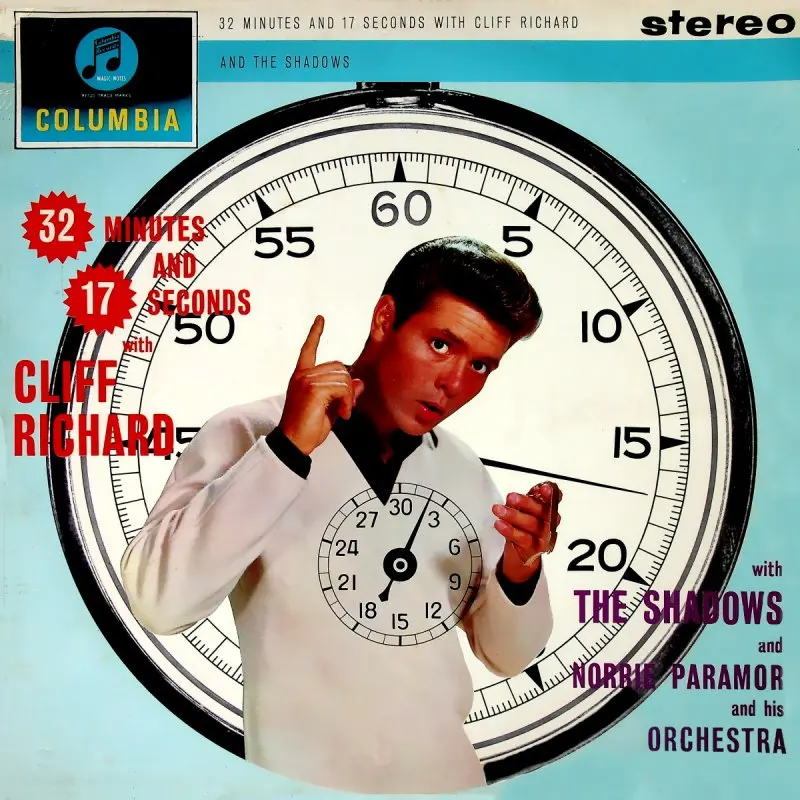 Cliff Richard released his seventh album, 32 Minutes and 17 Seconds with Cliff Richard, on September 14, 1962, on Columbia EMI.
It was his fifth studio album and the second to alternate orchestral backing by Norrie Paramor’s orchestra with group performances by The Shadows. Sessions took place between December 1961 and May 1962. Of the album’s 14 tracks, six feature The Shadows and eight were arranged by Paramor with orchestral accompaniment. The album reached No. 3 on the UK Albums Chart.
One single was issued ahead of the album: “It’ll Be Me,” a Shadows-backed cover of a 1957 Jerry Lee Lewis B-side. In Canada, the album was released in June 1963 under the title On Your Marks… Get Set… Let’s Go! where it spent six weeks at No. 1 on the CHUM Album Index and remained in the Top 5 for thirteen weeks


“Lucky Lips” (1963)
 Cliff Richard released “Lucky Lips” in May 1963 as a standalone single backed by the Shadows. The song originated as a 1956 R&B single by American singer Ruth Brown, written by Jerry Leiber and Mike Stoller. Richard’s version strips the original’s swing-era brass and reconfigures it into a brisk beat-era pop arrangement. Hank Marvin’s bright tremolo guitar leads carry the melody, while Bruce Welch and Jet Harris maintain a brisk rhythmic undercurrent. Richard delivers the vocal with clear diction and upbeat phrasing, emphasizing the song’s transformation from mid-‘50s jump-blues to early-‘60s UK pop.
A. “Lucky Lips” (2:18)
B. “I Wonder” (2:00)
“Lucky Lips” peaked at No. 4 on the UK Singles Chart and received a Silver certification. Internationally, it topped the charts in West Germany, Norway, South Africa, Sweden, and New Zealand, and reached the Top 10 in Austria, Ireland, and Belgium. The song’s broad continental success solidified Richard’s growing reputation across non-English-speaking territories, even as Beatlemania surged in the UK.
“It’s All in the Game” (1963)
 Released in August 1963, “It’s All in the Game” was Richard’s interpretation of a 1951 US No. 1 hit by Tommy Edwards. The melody originated in 1911 as “Melody in A Major” by Charles G. Dawes (later Vice President of the United States) and was adapted with lyrics by Carl Sigman in 1951. Edwards’ own re-recording in 1958 — a lush, string-laden version — served as the definitive rendition. Richard follows the 1958 arrangement closely, with Norrie Paramor conducting a sweeping orchestral backing. His vocal phrasing emphasizes clarity and restraint, fitting the track’s grand, sentimental style.
A. “It’s All in the Game” (2:58)
B. “Your Eyes Tell On You” (2:09)
The single reached No. 2 on the UK chart in September 1963, held off the top spot by The Beatles’ “She Loves You.” It achieved No. 1 in Sweden and placed in the Top 10 across several other European markets, earning UK Silver certification. Its stylized, mature tone marked a brief return to adult pop balladry amid the fast-rising beat group trend.
When in Spain

“Don’t Talk to Him” (1963)
 Richard released “Don’t Talk to Him” in October 1963, backed by the Shadows. He co-wrote the song with Bruce Welch during a period when the group briefly shifted toward moodier, introspective ballads. The track opens with a tremolo-laced guitar figure and maintains a subdued, minor-key structure underpinned by Jet Harris’s softly pulsing bass and Tony Meehan’s restrained brushwork. Lyrically, it delivers a cautionary tale of betrayal, voiced with wounded reserve.
A. “Don’t Talk to Him” (2:28)
B. “Say You’re Mine” (2:43)
The single peaked at No. 2 on the UK chart, again blocked by “She Loves You,” which dominated the autumn charts. It reached No. 1 in Ireland and South Africa, and earned Silver status in the UK. Despite strong competition from newer acts, the single confirmed Richard’s continued viability as a songwriter and interpreter of melancholic pop during a period of transition in British music.
“I’m the Lonely One” b/w “Watch What You Do with My Baby” (1964)
 In January 1964, Cliff Richard and the Shadows issued “I’m the Lonely One,” written by Gordon Mills, as a non‑album single that leaned into the beat‑influenced pop sound then sweeping the UK. The song opens with an energetic rhythmic feel, and its B‑side, “Watch What You Do with My Baby,” penned by Elvis Presley songwriters Bill Giant, Bernie Baum, and Florence Kaye, provided a complementary mid‑tempo pop groove.
A. “I’m the Lonely One” (2:16)
B. “Watch What You Do with My Baby” (2:04)
“I’m the Lonely One” climbed to No. 8 on the UK Singles Chart, reflecting Richard’s continued presence in the Top 10 amid fierce competition from emerging beat groups in 1964. The single also charted internationally, reaching the Top 5 in Denmark and strong positions across Europe and South Africa.
“Constantly (L’Edera)” b/w “True True Lovin’” (1964)
 Released in April 1964, “Constantly (L’Edera)” was Cliff Richard’s English adaptation of the Italian song L’Edera, originally performed at the 1958 Sanremo Music Festival and composed by Saverio Seracini and Vincenzo D’Acquisto. Richard’s version, with English lyrics by Michael Julien, delivered a lush romantic ballad that stood apart from the beat‑heavy singles dominating the charts. Its B‑side, “True True Lovin’,” written by Bruce Welch of the Shadows, offered a wistful uptempo love song that further showcased Richard’s versatility.
A. “Constantly (L’Edera)” (2:37)
B. “True True Lovin’” (2:25)
“Constantly” reached No. 4 on the UK Singles Chart and earned a Silver disc, standing strong despite the ongoing British Invasion. The single also charted widely overseas, including top‑10 placings in Australia, Ireland, New Zealand, Norway, and Sweden, underscoring Richard’s broad appeal in 1964.
Wonderful Life


“The Twelfth of Never” b/w “I’m Afraid to Go Home” (1964)
 In October 1964, Richard released his cover of “The Twelfth of Never,” a ballad composed by Jerry Livingston and Paul Francis Webster and made popular by Johnny Mathis in 1957. Richard’s interpretation emphasized his smooth vocal delivery over a lush pop arrangement. The single’s B‑side, “I’m Afraid to Go Home,” provided a contrasting, reflective narrative about reluctance to face heartbreak, rounding out the release with emotional depth.
A. “The Twelfth of Never” (2:44)
B. “I’m Afraid to Go Home” (2:37)
“The Twelfth of Never” peaked at No. 8 on the UK Singles Chart late in 1964. Its chart run occurred during a period when British beat groups and American imports continually reshaped the singles landscape, yet Richard maintained solid positioning across several international markets, including Australia, Ireland, and the Netherlands.
Aladdin and His Wonderful Lamp
 Cliff Richard released Aladdin and His Wonderful Lamp in December 1964 on Columbia as a cast album tied to the London stage pantomime of the same name.
The project brought together Richard, the Shadows, the Norrie Paramor Orchestra, and members of the theatrical cast for a fully original score written by the Shadows.
Aladdin marked Richard’s twelfth release and his second soundtrack-related project of the year, following Wonderful Life. It adapts the familiar Aladdin story into a sequence of songs, instrumental cues, and ensemble numbers designed to support the stage narrative rather than function as a conventional pop album. The record reached No. 13 on the UK Albums Chart and remained in the Top 20 for five weeks.
 A1. “Emperor Theme” / “Chinese Street Scene”
A2. “Me Oh My”
A3. “I Could Easily Fall (In Love with You)”
A4. “Little Princess”
A5. “This Was My Special Day”
A6. “I’m in Love With You”
A7. “There’s Gotta Be a Way”
A8. “Ballet”
B1. “Dance of the Warriors”
B2. “Friends”
B3. “Dragon Dance”
B4. “Genie with the Light Brown Lamp”
B5. “Make Ev’ry Day a Carnival Day”
B6. “Widow Twanky’s Song”
B7. “I’m Feeling Oh So Lonely”
B8. “I’ve Said Too Many Things”
B9. “Evening Comes”
B10. “Havin’ Fun”
Sessions occurred at EMI Abbey Road Studios during sessions held between 15 and 21 October 1964. Norrie Paramor produced the album and handled arrangements and conducting duties, shaping the orchestral passages that frame the songs and connect the dramatic scenes. The Shadows composed the entire score and recorded both vocal and instrumental material, with Hank Marvin on lead guitar, Bruce Welch on rhythm guitar, John Rostill on bass, and Brian Bennett on drums. Supporting vocals come from Faye Fisher, Joan Palethorpe, Audrey Bayley, and the Mike Sammes Singers, who reinforce the ensemble numbers and pantomime sequences.
The album generated two singles released within a week of each other in December 1964. The Shadows issued the instrumental “Genie with the Light Brown Lamp” first, taking it to No. 17 on the UK Singles Chart. Cliff Richard followed with “I Could Easily Fall (In Love with You),” backed by the Shadows, which climbed to No. 6 in the UK and achieved strong chart positions across Europe, Africa, Asia, and Australasia, reaching No. 1 in several territories. The B-side, “I’m in Love with You,” draws directly from the album and features orchestral backing and choral support. In 1965, Richard also recorded a German-language version of “I Could Easily Fall (In Love with You)” for continental release, extending the song’s international reach beyond the original pantomime context.
“The Minute You’re Gone” b/w “Just Another Guy” (1965)
 In March 1965, Cliff Richard released “The Minute You’re Gone,” a pop ballad written by Jimmy Gateley that he recorded in Nashville as part of a set of tracks the singer cut there under producer Billy Sherrill’s direction. The song was originally a modest US country hit for Sonny James in 1963 before Richard’s rendition transformed it into lush, orchestrated pop with backing from the Anita Kerr Singers and Nashville session musicians. Its B‑side, “Just Another Guy,” written by Neil Diamond, offered a brisk contrast with a more rhythm‑oriented feel and underscored Richard’s broader stylistic reach.
A. “The Minute You’re Gone” (2:19)
B. “Just Another Guy” (approx. 2:15)
“The Minute You’re Gone” became Richard’s eighth UK No. 1 single, topping the UK Singles Chart in April 1965 — his first chart‑topper without the Shadows as his backing band. It also charted internationally, reaching the Top 10 across multiple Commonwealth and European territories. The single earned a Silver certification in the UK for strong sales.
Cliff Richard (1965 album)

“On My Word” b/w “Just a Little Bit Too Late” (1965)
 Issued in June 1965, Cliff Richard’s “On My Word” was a cover of the 1964 single by American songwriter‑performer Chip Taylor. Richard recorded it in Nashville with Billy Sherrill producing, blending pop sensibility with gentle shuffle rhythm and brass accents. The Shadows supported him on the B‑side, “Just a Little Bit Too Late,” a Hank Marvin composition that leaned into the group’s pop‑rock strengths while complementing the A‑side’s smoother ballad tone.
A. “On My Word” (2:30)
B. “Just a Little Bit Too Late” (2:35)
“On My Word” reached No. 12 on the UK Singles Chart, showing Richard’s consistent Top 20 presence amid the evolving mid‑1960s pop landscape. The single also charted internationally, including placements in Australia, Hong Kong, and Malaysia.
“The Time in Between” b/w “Look Before You Love” (1965)
 Cliff Richard and the Shadows released “The Time in Between” in August 1965, recording it during a Portugal tour stop in Lisbon. The song was originally a French composition by Georges Aber, Micky Jones, and Thomas Brown that Richard embraced after hearing it; its arrangement showcased the Shadows’ signature tight instrumental support and Richard’s melodic pop vocal style. The B‑side, “Look Before You Love,” was written by songwriting trio Chris Arnold, David Martin, and Geoff Morrow, providing a reflective lyrical counterbalance.
A. “The Time in Between” (2:58)
B. “Look Before You Love” (2:57)
“The Time in Between” peaked at No. 22 on the UK Singles Chart as beat groups and rock acts increasingly dominated Top 20 slots, but it demonstrated Richard’s continued versatility and international appeal.
When In Rome
 Cliff Richard released When in Rome in August 1965 as his eighth studio album and fifteenth overall.
The album features Italian-language renditions of romantic ballads and mid-century pop standards, as well as localized versions of earlier Richard material. It was conceived as a companion to When in Spain (1963), but while that earlier album achieved surprise UK chart success, When in Rome failed to chart and became Richard’s first studio LP to miss the UK listings. The program includes one track in Portuguese and several adaptations of American and British songs into Italian.
Richard sings in Italian across all tracks, with phonetic coaching during the Lisbon sessions. He also performs one number in Portuguese (“Maria Ninguém”). “Non l’Ascoltar” is a localized version of his 1963 hit “Don’t Talk to Him.” The orchestral backing was arranged and conducted under the supervision of producer Norrie Paramor, who coordinated the project as an international studio effort.
A1. “Come Prima” – Mario Panzeri, Vincenzo di Paola, Sandro Taccani
A2. “Nel Blu Dipinto Di Blu (Volare)” – Domenico Modugno, Franco Migliacci
A3. “Concerto d’Autunno” [“Autumn Concerto”] – Danpa, Camillo Bargoni
A4. “O Mio Signore” [“The Questions”] – Edoardo Vianello, Mogol
A5. “Maria Ninguém” [“Maria’s Her Name”] – Carlos Lyra, Mogol
A6. “Non l’Ascoltar” [“Don’t Talk to Him”] – Cliff Richard, Bruce Welch, Cassia
A7. “Dicitencello Vuie” [“Just Say I Love Her”] – Rodolfo Falvo, Kalmanoff, Ward, Fusco, Val, Dale
B1. “Arrivederci Roma” – Pietro Garinei, Sandro Giovannini, Renato Rascel
B2. “Carina” – Alberto Testa, Poes
B3. “Legata ad un granello di sabbia” [“A Little Grain of Sand”] – Gianni Marchetti, Nico Fidenco
B4. “Casa Senza Finestre” [“House Without Windows”] – Alberto Testa, Lee Pockriss
B5. “Che Cosa Farai Di Questo Mio Amore” – Pallavicini, De Ponti
B6. “Per un Bacio d’Amor” [“Tell Me You’re Mine”] – Bertini, Ravasini
The album was recorded in Lisbon with Norrie Paramor producing and arranging the orchestral components. Sessions included phonetic coaching for Richard’s Italian and Portuguese vocal delivery.
Despite its failure to chart, When in Rome remains a distinctive entry in Cliff Richard’s discography for its multilingual repertoire and his continuing expansion into continental markets during the mid-1960s.
“Wind Me Up (Let Me Go)” b/w “The Night” (1965)
 Released in October 1965, “Wind Me Up (Let Me Go)” featured Cliff Richard recording again in Nashville under producer Billy Sherrill with session musicians and backing vocals by the Jordanaires. The energetic pop‑rock single, written by John Talley and Bob Montgomery, helped bridge Richard’s early 1960s pop sound with mid‑decade American‑influenced production styles. Its B‑side, “The Night,” was recorded back in London with the Shadows.
A. “Wind Me Up (Let Me Go)” (2:27)
B. “The Night” (3:24)
“Wind Me Up (Let Me Go)” reached No. 2 on the UK Singles Chart and earned a Silver certification, marking one of Richard’s stronger UK chart performances of 1965 and reinforcing his ability to compete with contemporary beat and rock singles.
Love Is Forever
 Cliff Richard released Love Is Forever in November 1965 on Columbia as his ninth studio album and sixteenth overall. After the commercial disappointment of When in Rome, the album returned him to the UK Albums Chart, peaking at No. 19.
The material draws heavily from classic American standards and mid-century easy listening fare, arranged in lush orchestral settings or accompanied by The Shadows. Cliff delivers a mix of sentimental ballads and subdued pop pieces, balancing nostalgic wartime-era selections with recent show tunes and romantic evergreens. Across the program, the arrangements alternate between cinematic orchestration and soft backing by his regular collaborators.
A1. “Everyone Needs Someone to Love” – Burt Bacharach, Hal David
A2. “Long Ago (And Far Away)” – Ira Gershwin, Jerome Kern
A3. “(All of a Sudden) My Heart Sings” – Rome, Jamblan, Herpin
A4. “Have I Told You Lately That I Love You” – Scotty Wiseman
A5. “Fly Me to the Moon” – Bart Howard
A6. “Theme From A Summer Place” – Mack Discant, Max Steiner
A7. “I Found a Rose” – Sid Tepper, Roy C. Bennett
B1. “My Foolish Heart” – Victor Young, Ned Washington
B2. “Through the Eye of a Needle” – Burt Bacharach, Hal David
B3. “My Colouring Book” – Fred Ebb, John Kander
B4. “I’ll Walk Alone” – Sammy Cahn, Jule Styne
B5. “Someday (You’ll Want Me to Want You)” – Hugh Starr
B6. “Paradise Lost” – Estelle Loring, Kay Rogers
B7. “Look Homeward Angel” – Wally Gold
Sessions for the album took place in multiple locations over a thirteen-month period. Most of the tracks were cut in London during May to June 1965 at EMI Abbey Road under the direction of Norrie Paramor, who arranged and conducted the bulk of the album. Three earlier recordings date from 1964: “Everyone Needs Someone to Love” and “Through the Eye of a Needle” were taped in New York during Cliff’s sessions with Epic Records, produced by Bob Morgan and arranged by Gary Sherman. “Paradise Lost” was recorded in Nashville with producer Billy Sherrill, marking a rare foray into American studio production for Cliff during this period. Ken Woodman arranged and conducted several key tracks, including “Theme From A Summer Place” and “My Foolish Heart.”
The Shadows appear on two songs: “Have I Told You Lately That I Love You” and “Someday (You’ll Want Me to Want You).” Hank Marvin plays lead guitar, Bruce Welch plays rhythm guitar, John Rostill plays bass, and Brian Bennett plays drums. The Norrie Paramor Orchestra provides the bulk of the instrumental support, with The Mike Sammes Singers reinforcing the vocal textures on several orchestral ballads. “Again” includes backing vocals by the Jordanaires.
Columbia issued no UK singles from the album, but “Everyone Needs Someone to Love” and “Through the Eye of a Needle” served as advance recordings for Cliff’s American releases on Epic. Though the album didn’t produce charting singles, its return to the UK Top 20 reaffirmed Cliff’s domestic popularity after the poor reception of his previous LP.
“Blue Turns to Grey” b/w “Somebody Loses” (1966)
 In March 1966, Cliff Richard and the Shadows released “Blue Turns to Grey,” a cover of the Mick Jagger–Keith Richards composition that had circulated in the US earlier in 1965 via versions by Dick and Dee Dee, The Mighty Avengers, and Tracey Dey before the Rolling Stones recorded it for their December’s Children (And Everybody’s) album. Richard’s take reimagines the tune with a smoother pop‑rock delivery anchored by the Shadows’ tight ensemble work. The B‑side, “Somebody Loses,” was written by longtime Presley songwriters Sid Tepper and Roy C. Bennett, offering a reflective narrative of heartbreak that complements the A‑side’s thematic mood.
A. “Blue Turns to Grey” (2:18)
B. “Somebody Loses” (2:09) (Tepper/Bennett)
“Blue Turns to Grey” reached No. 15 on the UK Singles Chart, a respectable Top 20 showing in a year dominated by beat, soul, and psychedelia. It also charted internationally, peaking at No. 20 in Australia, No. 18 in the Netherlands, and No. 11 in Sweden, and—as with several Richards‑Shadows collaborations—played to solid overseas audiences even as UK chart tastes shifted.
Kinda Latin
 Cliff Richard released Kinda Latin in May 1966 on Columbia as his tenth studio album and seventeenth overall.
Following a string of thematically focused albums, Kinda Latin marked a deliberate turn toward light bossa nova and Latin-infused pop, interpreted in English through a soft orchestral lens. The set blends Brazilian standards with American crossover hits and recent UK chart material, reshaped by subtle Latin rhythms and polished arrangements. Cliff’s phrasing adapts fluidly to the relaxed swing of the material, offering understated charm without veering into pastiche. The album entered the UK Albums Chart at No. 9 and remained in the Top 30 for twelve weeks.
A1. “Blame It on the Bossa Nova” – Cynthia Weil, Barry Mann
A2. “Blowin’ in the Wind” – Bob Dylan
A3. “Quiet Nights of Quiet Stars” – Antônio Carlos Jobim, Gene Lees
A4. “Eso Beso” – Noel Sherman, Joe Sherman
A5. “The Girl from Ipanema” – Antônio Carlos Jobim, Norman Gimbel
A6. “One Note Samba” – Antônio Carlos Jobim, Jon Hendricks
B1. “Fly Me to the Moon (In Other Words)” – Bart Howard
B2. “Our Day Will Come” – Bob Hilliard, Mort Garson
B3. “Quando, Quando, Quando” – Tony Renis, Emilio Pericoli, Alberto Testa
B4. “Come Closer to Me” – Osvaldo Farrés, Al Stewart
B5. “Meditation” – Antônio Carlos Jobim, Norman Gimbel
B6. “Concrete and Clay” – Tommy Moeller, Brian Parker
The album was recorded in October 1965 at EMI Abbey Road and produced by Norrie Paramor, who handled the arrangements and conducted the orchestral sessions. The production favors a clean, stereo-separated sound with soft percussion, brushed drums, and string embellishments that gently emphasize the rhythmic contours without overpowering the vocal focus. Paramor’s treatment of bossa nova classics like “Quiet Nights of Quiet Stars” and “Meditation” maintains their original sway while framing Cliff’s English-language delivery in airy, unobtrusive textures.
Though no singles were lifted from the album in the UK, the song selection reflects strong crossover potential, drawing from recent American and Brazilian hits already familiar to global audiences. Cliff’s interpretations of “Blame It on the Bossa Nova” and “The Girl from Ipanema” provide rhythmic clarity and vocal ease, while his take on Bob Dylan’s “Blowin’ in the Wind” leans into the album’s tonal cohesion rather than its protest origins. Kinda Latin gave Richard a stylistic refresh at a time when he balanced MOR appeal with chart visibility, setting the stage for a busier year that would include his return to soundtrack work later in 1966.
“Visions” b/w “What Would I Do (For the Love of a Girl)” (1966)
 Released in July 1966, “Visions” showcased Cliff Richard in a more introspective pop ballad mode. Written by Paul Ferris, the song features expansive orchestral backing with a dramatic melodic sweep that distinguished it from more guitar‑driven rock and beat singles of the summer. Its B‑side, “What Would I Do (For the Love of a Girl),” offers a lighter mid‑tempo pop counterpoint rooted in traditional lyrical romantic sentiment.
A. “Visions” (3:01)
B. “What Would I Do (For the Love of a Girl)” (2:29)
“Visions” spent 12 weeks on the UK chart and peaked at No. 7, reinforcing Richard’s continued commercial presence amid the rapidly evolving mid‑1960s pop landscape. It also reached No. 1 in Israel, Malaysia, and Singapore, and charted in New Zealand and Ireland, underscoring his appeal across a broad range of international markets.
Finders Keepers


Cinderella


“It’s All Over” b/w “Why Wasn’t I Born Rich” (1967)
 In March 1967, Cliff Richard released “It’s All Over,” a cover of the Everly Brothers’ 1965 pop ballad written by Don Everly. Richard’s version trades the original’s harpsichord‑tinged arrangement for a smoother, orchestral pop backcloth arranged by Bernard Ebbinghouse, emphasizing the song’s reflective sentiment about a love that has slipped away. The B‑side, “Why Wasn’t I Born Rich,” was written by the Shadows and originally featured on the Cinderella pantomime cast album; it adds a slightly cheekier, narrative contrast to the A‑side’s wistful tone.
A. “It’s All Over” (2:28)
B. “Why Wasn’t I Born Rich” (2:41)
“It’s All Over” reached No. 9 on the UK Singles Chart, maintaining Richard’s presence in the Top 10 even as the British pop scene continued its shift toward beat and psychedelic sounds. It also charted in Australia, Malaysia, and New Zealand, where audiences responded to his melodic pop style amid emerging global trends.
Don’t Stop Me Now!

“I’ll Come Runnin’” b/w “I Get the Feelin’” (1967)
 Issued in June 1967, “I’ll Come Runnin’” is Cliff Richard’s take on the Neil Diamond composition originally released by Diamond in 1966; Richard’s version was arranged with brass and rhythm accents by Mike Leander, blending pop rock energy with dramatic build and punchy chorus hooks. Its B‑side, “I Get the Feelin’,” is also penned by Diamond (originally titled “I Got the Feelin’ (Oh No No)”) and carries a similarly spirited pop rock momentum that complements the A‑side’s immediacy.
A. “I’ll Come Runnin’” (2:27)
B. “I Get the Feelin’” (2:17)
“I’ll Come Runnin’” peaked at No. 26 on the UK Singles Chart, charting as a mid‑year release that underscored Richard’s continued willingness to interpret contemporary American rock writing. It also registered internationally, reaching the Top 10 in places like New Zealand and some Southeast Asian markets, even as British beat music dominated other territories.
“The Day I Met Marie” b/w “Our Story Book” (1967)
 Released in August 1967, “The Day I Met Marie” was written by Hank Marvin of the Shadows and produced by Norrie Paramor. The song embraces baroque pop touches and pastoral lyric themes, contrasting gently with heavier rock trends yet resonating with audiences seeking melodic sophistication. Its B‑side, “Our Story Book,” offers a narrative pop focal point that complements the A‑side’s lyrical reminiscence.
A. “The Day I Met Marie” (2:16)
B. “Our Story Book” (2:31)
“The Day I Met Marie” reached No. 10 on the UK Singles Chart and was a stronger performer abroad, hitting the Top 5 in Australia and New Zealand and charting well across Western Europe. Its success further demonstrated Richard’s capacity to navigate both pop balladry and chart‑oriented singles outside the album system.
“All My Love (Solo Tu)” b/w “Sweet Little Jesus Boy” (1967)
 In November 1967, Richard released “All My Love (Solo Tu),” an English adaptation of the Italian song Solo tu (Orietta Berti) with English lyrics by Peter Callander. His version blends lush romantic phrasing with gentle orchestration under Paramor’s production. The B‑side, “Sweet Little Jesus Boy,” is a spiritual Christmas song from 1934 by Robert MacGimsey, marking one of the rare times Richard issued a traditional spiritual as a single flip.
A. “All My Love (Solo Tu)” (2:57)
B. “Sweet Little Jesus Boy” (2:42)
“All My Love (Solo Tu)” reached No. 6 on the UK Singles Chart and charted broadly overseas, including Top 10 placements in Australia, Denmark, and New Zealand, as well as strong showings in South Africa and Singapore. The single’s success rounded out a year of varied stylistic entries—from pop rock to balladry and spiritual material—demonstrating Richard’s adaptability during a transitional era in popular music.
“Congratulations” b/w “High ’n’ Dry” (1968)
In March 1968, Cliff Richard released “Congratulations,” written by Bill Martin and Phil Coulter as the UK’s entry for the Eurovision Song Contest that year. The tune, originally titled “I Think I Love You,” was reworked with upbeat lyrics celebrating new love and became one of Richard’s most enduring pop singles. It was arranged and produced by Norrie Paramor and performed with a bright, radio‑friendly pop orchestration. The B‑side, “High ’n’ Dry,” written by Greenaway and Cook, offered a more introspective lyrical counterpoint while maintaining a lush pop arrangement.
A. “Congratulations” (2:33)
B. “High ’n’ Dry” (approx. 2:20)
“Congratulations” soared to No. 1 on the UK Singles Chart, becoming one of Richard’s biggest hits. At the Eurovision final in London it finished second by a single point, but in the UK and across Europe the English single dominated, earning Gold certification for sales and placing high on multiple international charts, including Ireland, Australia, and Spain.
“Wonderful World” (Belgium & Japan only)
 “Wonderful World,” written by Guy Fletcher and Doug Flett, was recorded by Cliff Richard in 1968 as one of the songs shortlisted for the UK’s A Song for Europe selection — ultimately finishing behind “Congratulations.” It first appeared on the EP Congratulations: Cliff Sings 6 Songs for Europe and was later released as a single in Belgium and Japan. On the Belgian release the B‑side was “I’ll Love You Forever Today,” a pop ballad Richard had issued earlier that year. In Japan the flip was “Little Rag Doll,” another track from the Eurovision sessions.
A. “Wonderful World” (2:35)
B. “I’ll Love You Forever Today” (3:02) (Belgian release)
Though not issued as a single in the UK, “Wonderful World” reached No. 20 on the Belgian chart where it was released, and resonated with continental fans through its inclusion on the Eurovision EP.
“Marianne” b/w “Mr. Nice” (1968)
In September 1968, Cliff Richard released “Marianne,” an English‑language cover of the Italian song originally performed by Sergio Endrigo — adapted with English lyrics by Bill Owen following the 1968 Eurovision Song Contest where Endrigo’s original had been an entry. Richard’s version features orchestral backing by Mike Leander and a lyrical, melodic pop interpretation. The B‑side, “Mr. Nice,” was written by Terry Britten and provided a contrasting upbeat pop taste to the single pairing.
A. “Marianne” (3:19)
B. “Mr. Nice” (2:13)
“Marianne” peaked at No. 22 on the UK Singles Chart, reflecting steady chart interest amid a crowded late‑1960s pop field. It also charted in Australia and parts of continental Europe and showed Richard’s ongoing ability to interpret international material for the UK market.
“Good Times (Better Times)” b/w “Occasional Rain” (1969)
Cliff Richard opened 1969 with “Good Times (Better Times),” a reflective pop single written by Barry Mason and Les Reed, a songwriting partnership responsible for several of his mid‑to‑late‑1960s hits. The song emerged during a transitional period as Richard gradually distanced himself from beat‑oriented material in favor of adult contemporary pop. Its lyric balances nostalgia with cautious optimism, supported by a restrained orchestral arrangement rather than a guitar‑led backing. The B‑side, “Occasional Rain,” written by Don Black and Geoff Stephens, continues the introspective tone with a slower, more melancholy narrative and remained exclusive to this release for many years.
A. “Good Times (Better Times)” (3:07)
B. “Occasional Rain” (2:36)
“Good Times (Better Times)” peaked at No. 12 on the UK Singles Chart and reached No. 8 in Ireland. It also placed within the Top 20 in several European markets, including the Netherlands (No. 9), Norway (No. 12), and West Germany (No. 17). While it fell short of the UK Top 10, the single marked an important stylistic bridge toward Richard’s early‑1970s adult‑pop phase.
“Big Ship” b/w “She’s Leaving You” (1969)
Released in mid‑1969, “Big Ship” was written by Don Black and Geoff Stephens and stands as one of Cliff Richard’s most overtly metaphorical late‑1960s singles. The lyric frames emotional departure through nautical imagery, with an arrangement that builds gradually from subdued verses to a broader, sweeping chorus. The B‑side, “She’s Leaving You,” written by Tony Hazzard, is a concise breakup ballad that complements the A‑side’s theme of emotional separation and remained unavailable on UK albums at the time.
A. “Big Ship” (3:10)
B. “She’s Leaving You” (2:48)
“Big Ship” reached No. 8 on the UK Singles Chart, No. 13 in Ireland, and No. 8 in New Zealand. Its solid chart performance reinforced Richard’s continued viability as a singles artist in a year increasingly dominated by progressive rock and singer‑songwriters.
“Early in the Morning” b/w “Shout” (1969)
In July 1969, Cliff Richard released “Early in the Morning,” a recenty hit for Vanity Fair, written by Les Reed with lyrics by Don Black. Unlike many of his recent UK singles, the track was conceived with the American market in mind, featuring a brass‑driven, gospel‑inflected pop arrangement recorded in the United States. Although it did not chart in the UK, it reached No. 55 on the Billboard Hot 100, marking one of Richard’s final US chart appearances of the decade. Initially issued as a non‑album single, the song was later added to the US LP Early in the Morning and subsequently incorporated into the 1970 UK album Tracks ’n Grooves. The B‑side, “Shout,” is a cover of the Isley Brothers’ 1959 classic, which Richard had previously recorded with the Drifters in 1964; this 1969 version re‑energizes the song with a heavier brass and rhythm emphasis.
A. “Early in the Morning” (3:18)
B. “Shout” (2:48)
Though commercially modest in the UK, “Early in the Morning” occupies a notable place in Richard’s catalogue as a transitional recording that anticipated his brief early‑1970s engagement with American soul‑pop stylings.
“Throw Down a Line” b/w “Reflections” (1969)
Issued in October 1969, “Throw Down a Line” reunited Cliff Richard with Hank Marvin in a prominent co‑credit following the winding down of the Shadows’ original run. Written by Geoff Stephens and Don Black, the song adopts a gospel‑tinged pop framework built around call‑and‑response phrasing and a hopeful lyric centered on reassurance and connection. Marvin’s guitar work is restrained and textural rather than lead‑driven, underscoring the song’s communal tone. The B‑side, “Reflections,” written by Marvin and Bruce Welch, is a quieter instrumental‑leaning piece that contrasts with the A‑side’s expansive message and remained largely confined to this release.
A. “Throw Down a Line” (3:10)
B. “Reflections” (2:44)
The single reached No. 7 on the UK Singles Chart, No. 12 in Ireland, and No. 8 in New Zealand. Its success made it one of Richard’s strongest late‑1960s hits and cemented the enduring appeal of his association with Marvin even as both artists moved toward new phases in their careers.
“With the Eyes of a Child” b/w “So Long” (1969)
Closing out 1969, Cliff Richard released “With the Eyes of a Child,” written by Tony Hazzard. The song presents a gentle, almost pastoral reflection on innocence and perception, delivered with a subdued vocal and light orchestration that avoids the dramatic climaxes of his earlier singles. The B‑side, “So Long,” also written by Hazzard, continues the understated tone and was not immediately reused on contemporary albums.
A. “With the Eyes of a Child” (3:07)
B. “So Long” (2:35)
“With the Eyes of a Child” peaked at No. 20 on the UK Singles Chart and reached No. 16 in New Zealand. While not a major hit, it is often cited as an early indicator of the more introspective material Richard would pursue in the early 1970s.
“The Joy of Living”
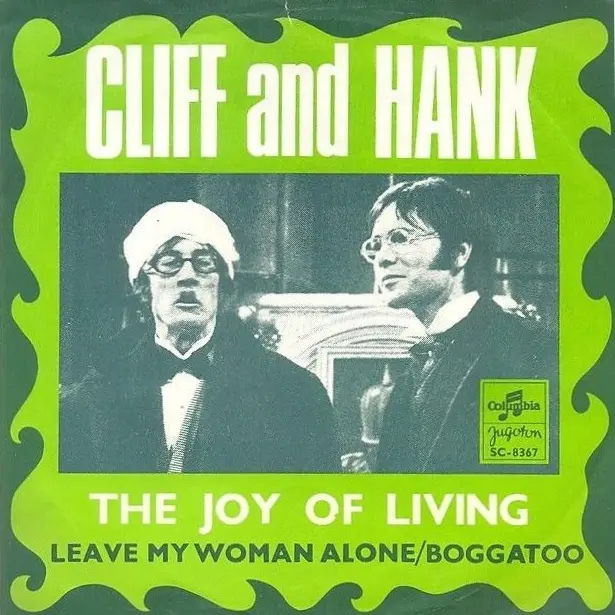 In February 1970, Cliff Richard reunited with Hank Marvin for “The Joy of Living,” a socially observant pop‑rock single co‑written by Marvin and Paul Ferris. The song’s lyric offers a wry commentary on modern life — contrasting carefree imagery with riffs that underline a subtle critique of industrial progress and thinning green spaces, an early nod to environmental unease in pop. Marvin’s influence is felt throughout, from the melodic guitar work to the shared vocal approach. Unlike a standard two‑track single, this release featured two B‑sides: “Leave My Woman Alone,” a Ray Charles composition that Richard delivers with restrained blue‑eyed soul, and “Boogitoo,” written by Marvin and Richard Anthony Hewson and sung by Marvin himself, which gives the disc added variety.
A. “The Joy of Living” (3:04)
B1. “Leave My Woman Alone” (2:57)
B2. “Boogitoo” (2:49)
Written by Hank Marvin and Paul Ferris, “The Joy of Living” peaked at No. 25 on the UK Singles Chart, marking a solid showing in a year when British pop was diversifying rapidly. Though not a major hit, it remains notable as one of the few singles credited to both Richard and Marvin outside the classic Shadows era.
“Goodbye Sam, Hello Samantha”
 Released in May 1970 as Cliff Richard’s 50th single, “Goodbye Sam, Hello Samantha” was penned by Mitch Murray, Peter Callander, and Geoff Stephens — a songwriting team behind many British pop hits of the 1960s and ’70s. The lyric narrates a lighthearted shift in focus from male camaraderie toward romantic pursuit, wrapped in brisk pop rhythms and catchy hooks. Despite Richard’s initial reluctance to record it, his manager Peter Gormley persuaded him that it would be a hit. A German language version, “Goodbye Sam (Das ist die Liebe),” was also issued in continental Europe.
A. “Goodbye Sam, Hello Samantha” (2:50)
B. “You Never Can Tell” (2:21)
Written by Mitch Murray, Peter Callander, and Geoff Stephens and produced by Norrie Paramor, the single reached No. 6 on the UK Singles Chart. It also charted internationally, including No. 1 in Malaysia and Rhodesia, No. 2 in South Africa, No. 10 in New Zealand, and Top 20 placings in Australia and Denmark. The song’s upbeat narrative and strong international performance underscored Richard’s broad appeal beyond the UK.
“I Ain’t Got Time Anymore”
 In August 1970, Cliff Richard released “I Ain’t Got Time Anymore,” a soulful pop‑rock ballad written by Mike Leander and Eddie Seago. Recorded with orchestral backing arranged by the Mike Vickers Orchestra, the track features introspective verses that build into a plaintive chorus, showcasing Richard’s expressive vocal range. The B‑side, “Monday Comes Too Soon,” was written by Shadows alumnus Hank Marvin and Jerry Lordan, and delivers a reflective pop sensibility that dovetails with the A‑side’s mood.
A. “I Ain’t Got Time Anymore” (2:32)
B. “Monday Comes Too Soon” (2:30)
Written by Mike Leander and Eddie Seago, “I Ain’t Got Time Anymore” peaked at No. 21 on the UK Singles Chart. While not a Top 10 hit, the single demonstrated Richard’s ability to interpret more reflective, contemporary pop material as 1970s musical tastes evolved. An American cover by The Glass Bottle later charted on the Billboard Hot 100, underscoring the song’s broad appeal.
“Sunny Honey Girl”
In January 1971, Cliff Richard released “Sunny Honey Girl,” a cover of a song originally recorded by the Pipkins and written by Roger Cook, Roger Greenaway, John Goodison, and Tony Hiller. Richard recorded his version in November 1970 at EMI Studios (later Abbey Road), with an arrangement featuring the orchestra of Shadows drummer Brian Bennett. The single was issued with two B‑sides: “Don’t Move Away,” a duet with Olivia Newton‑John written by Valerie Avon and Harold Spiro, and “I Was Only Fooling Myself,” written by Jimmy Campbell.
A. “Sunny Honey Girl” (2:55)
B1. “Don’t Move Away” (3:05) — duet with Olivia Newton‑John
B2. “I Was Only Fooling Myself” (3:03)
“Sunny Honey Girl” reached No. 19 on the UK Singles Chart in early 1971 and charted internationally, including Top 20 appearances in Denmark (No. 19), the Netherlands (No. 4 Single Tip), New Zealand (No. 20), and South Africa (No. 20). It also hit No. 1 in Malaysia. While not one of Richard’s biggest hits in the UK, the single’s combination of an upbeat pop A‑side and duet with Newton‑John — before her solo breakthrough — made it a noteworthy part of his early‑’70s singles output.
“Silvery Rain”
 Cliff Richard released “Silvery Rain” as a single on March 26, 1971, on Columbia. Written by Hank Marvin, the song first appeared a month earlier on the debut album by Marvin, Welch & Farrar. Cliff’s version adopts a somber, theatrical tone, addressing themes of environmental decline and chemical pollution with unusually stark imagery for a pop release.
The track stands apart from his usual fare, trading romantic sentiment for lyrical commentary on pesticide use and ecological harm. Arranged with sweeping instrumentation and minor-key undertones, it marked one of the most atypical A-sides in Richard’s catalogue to date. Derek Johnson of NME called it “one of the least commercial and uncharacteristic he has ever recorded.” Despite its departure from his usual style, the single reached No. 27 on the UK Singles Chart and went Top 20 in Denmark and the Netherlands.
A. “Silvery Rain” (Hank Marvin) – 3:46
B1. “Annabella Umbrella” (Valerie Avon, Harold Spiro) – 2:49
B2. “Time Flies” (Brian Bennett, Mike Hawker) – 2:54
Cliff recorded the A-side on 17 November 1970 at EMI Studios, London, under the direction of producer Norrie Paramor. Big Jim Sullivan plays guitar, and the Brian Bennett Orchestra handles the remaining instrumentation. “Annabella Umbrella,” one of two B-sides issued with the single, features accompaniment by the Nick Ingman Orchestra and offers a whimsical contrast to the A-side’s darker tone. The second B-side, “Time Flies,” carries a reflective mood shaped by Bennett’s orchestral backing and Mike Hawker’s lyrical introspection.
“Flying Machine”
 Cliff Richard issued “Flying Machine” as a standalone single on June 25, 1971, marking a stylistic pivot toward whimsical, story-driven pop. Written by Norwegian songwriter Georg Hultgreen—then credited under his birth name but later known as Georg Kajanus of Sailor—the song narrates an idealistic escape by air, blending fanciful imagery with a gentle, folk-inflected pop-rock arrangement. Hultgreen had previously recorded a home-cut acetate demo, which made its way to Cliff, prompting a studio version recorded that March. The single reached No. 37 on the UK Singles Chart, becoming Richard’s first release to miss the Top 30. However, it charted higher in several European territories, including Denmark and Germany, and hit No. 1 in Malaysia.
A. “Flying Machine” (3:02) – Georg Hultgreen
B. “Pigeon” (2:45) – Guy Fletcher, Doug Flett
 Cliff recorded “Flying Machine” on March 20, 1971, at EMI Studios, London, with production by Norrie Paramor, who also arranged the track. The session features Big Jim Sullivan on guitar and includes a flute part performed by Hultgreen himself. Paramor’s orchestra provides the string and rhythm backing, giving the track a sweeping but lightly textured feel that complements the airborne theme. The B-side, “Pigeon,” written by Fletcher and Flett, contrasts the A-side’s idealism with a more grounded melodic ballad, arranged by Nick Ingman and recorded with his orchestra.
Though “Flying Machine” did not match the chart strength of Richard’s recent singles, it stands out for its offbeat lyrical tone and international authorship. Hultgreen re-recorded the song in 1972 as part of the short-lived duo Kajanus Pickett. Cliff’s version remains the best-known and most widely distributed recording, and its inclusion of the writer as a featured performer makes it a unique entry in his early-1970s catalogue.
“Sing a Song of Freedom”
 Cliff Richard released “Sing a Song of Freedom” on October 29, 1971, as a standalone single on Columbia. Written by Guy Fletcher and Doug Flett, the track was conceived as a populist anthem, built around an uplifting chorus and broad-stroke lyrical appeals to unity and liberation. Orchestrated with sweeping strings and gospel-style backing vocals, the song sits firmly within the early 1970s tradition of socially charged, radio-friendly pop. Despite its vague messaging, the single found resonance in multiple markets, reaching No. 13 on the UK Singles Chart and topping the charts in Malaysia. Though reportedly banned in South Africa due to its perceived political overtones, the track achieved modest placements across Europe and Scandinavia.
A. “Sing a Song of Freedom” (3:24) – Guy Fletcher, Doug Flett
B. “A Thousand Conversations” (2:18) – Hank Marvin, Bruce Welch
Cliff recorded the A-side on August 24, 1971, at EMI Studios, London, with Norrie Paramor producing. Brian Bennett arranged the orchestral score, and Big Jim Sullivan contributed guitar. The Breakaways supplied backing vocals, reinforcing the song’s choral refrains. The B-side, “A Thousand Conversations,” originally appeared on the debut album by Marvin, Welch & Farrar earlier that year. Cliff’s version keeps the song’s introspective tone while layering it with strings and light percussion arranged under the direction of Nick Ingman.
Released between “Flying Machine” and “Jesus,” this single reinforced Cliff’s willingness to explore topical material within mainstream pop frameworks. Though it did not chart as highly as some of his earlier hits, “Sing a Song of Freedom” remains one of his more thematically pointed releases of the decade and stands out in his early 1970s catalogue for its message-driven tone and expansive production.
“Jesus”
Cliff Richard released “Jesus” as a single in February 18, 1972, marking his first explicitly Christian-themed recording since his public religious conversion. Originally written and recorded by Austrian artist Jeremy Faith (Helmut Grabher) in 1971, the song blends devotional lyrics with the production style of early 1970s orchestral pop. Cliff’s version carries a solemn, almost psychedelic quality, with phased effects and ambient textures layered over a steady mid-tempo rhythm. While the subject matter aligned with his personal convictions, the single met with resistance from parts of the UK music press and broadcasters, peaking at No. 35 on the UK Singles Chart despite success in other territories, including a No. 1 placement in Hong Kong.
A. “Jesus” (4:15) – Michel Hamburger, Pierre Darjean
B. “Mister Cloud” (3:45) – Guy Fletcher, Doug Flett
Cliff recorded “Jesus” on December 14, 1971, at EMI Studios, London, under the musical direction of Nick Ingman, who handled both arrangement and conducting. Though the record credits state “An NP production by Nick Ingman,” Norrie Paramor did not oversee the session directly. Ingman’s orchestral arrangement gives the track a shimmering, phased atmosphere, with subtle layering that complements Cliff’s restrained, reverent vocal. “Mister Cloud,” the B-side, features lyrics by Fletcher and Flett, offering a softer, introspective counterpoint to the A-side’s spiritual declaration.
Cliff later recalled holding off on recording gospel material until he found a song that felt musically and lyrically worthy. Though proud of the production, he expressed frustration over the hesitancy of UK broadcasters to support a Christian-themed single, noting that while Eastern spiritual references were widely accepted on air, his song received limited exposure due to its overt title and religious focus. Jesus remains a landmark entry in Cliff’s 1970s catalogue—more modest in commercial impact, but pivotal in signaling the integration of his faith into his recorded output.

“A Brand New Song”
 Cliff Richard released “A Brand New Song” on November 24, 1972, as his final single of the year and the first produced entirely by David Mackay, marking a full production handover from Norrie Paramor. Despite a polished arrangement and melodic optimism, the single failed to enter the UK Top 50—breaking Cliff’s unbroken run of 57 charting UK singles over a span of sixteen years. It did, however, reach No. 1 on the BRMB Breakers List, a secondary chart tracking the most popular records just outside the Top 50, indicating continued interest among fans and regional radio stations.
A. “A Brand New Song” (3:14) – Barry, Williams
B. “The Old Accordion” (3:02) – Froggatt
David Mackay produced and arranged the A-side, giving the song a clean, mid-tempo setting with warm instrumentation and layered harmonies. The track emphasizes renewal and forward momentum, fitting the transitional mood in Cliff’s 1972 output as he moved further into adult pop territory with new collaborators. The B-side, “The Old Accordion,” was written by Raymond Froggatt and produced by Norrie Paramor with arrangement by Brian Bennett. Lyrically nostalgic and musically understated, it serves as a final touchpoint with Paramor’s long association, closing out their creative partnership with a subdued, reflective tone.
Though it fell short commercially, “A Brand New Song” marked a quiet but significant shift. The single foreshadowed the stylistic recalibration Cliff would undergo over the next few years, as Mackay and, later, Alan Tarney helped reshape his recorded output for a changing pop landscape.

“Help It Along”
 “Help It Along” was released on April 27, 1973, as a four-track maxi-single on EMI (EMI 2022). It followed “Power to All Our Friends” in Cliff Richard’s Eurovision campaign and compiled four of the six finalist entries from the UK’s national selection. Written by Christopher Neil and produced by David Mackay, the title track is a briskly arranged pop tune backed by a tight session featuring Terry Britten and Kevin Peek on guitar, Alan Tarney on bass and vocals, and Trevor Spencer on drums. Barrie Guard provides percussion.
The three additional songs—“Tomorrow Rising” (by Mike Hawker and Brian Bennett), “Days of Love” (Alan Hawkshaw, Dougie Wright), and “Ashes to Ashes” (Tony Cole)—round out the maxi-single. They appear in descending order of public votes, following the two winning songs issued on the earlier “Power to All Our Friends” single. Though “Help It Along” only reached No. 29 on the UK Singles Chart, it represented Richard’s second-highest scoring entry from the Eurovision heats and was later re-recorded for his 1974 gospel album of the same name.
A1. “Help It Along” (2:52)
A2. “Tomorrow Rising” (2:44)
B1. “Days of Love” (2:57)
B2. “Ashes to Ashes” (3:02)
Sessions took place on December 28, 1972, at EMI Studios, London, with Mackay at the helm. The lineup on the single version features Richard on vocals, Britten and Peek on guitars, Tarney on bass and vocals, Spencer on drums, and Guard on percussion. For the re-recorded album version, Cliff Hall plays keyboards, Patrick Halling leads the orchestra, and backing vocals are added by Anna Peacock and Jean Hawker, with Guard also conducting.
Artist/Album Pages:
The Remains were an American garage-rock band from Boston that released a self-titled album on Ep...
Donovan (born May 10, 1946) is a Scottish folk-rock singer, guitarist, and songwriter who released...
Skeletal Family was an English goth-rock band from Keighley that debuted with singles on Luggage L...
Soft Machine was an English jazz-rock band that was active between the late 1960s and early 1980s. T...
The Lucy Show was a Canadian–English underground rock band that released the 1985–86 albums ...Und...
Blackfoot Sue was an English hard-rock/pop band led by rhythm twins Tom and David Farmer. They mad...
Brand X was an English jazz-rock unit active between 1976 and 1980, driven by the fluid interplay ...
Classix Nouveaux was an English new wave band that released three albums between 1981 and 1983 on ...
The Damned is an English punk-rock/psych band from London that released two albums on Stiff Record...
Paul Brett's Sage were an English folk-rock band that released a 1970 self-titled album on Pye, fo...
Gong was a French–Anglo musical collective that existed through numerous iterations over a four-de...
The Smoke was an English mod-rock/freakbeat band responsible for the 1967 singles "My Friend Jack," ...